
Modern Rocking Chairs as Shape Experiments
A second gallery of contemporary rockers—metal-and-walnut minimalism, crescent lounges, a white tête-à-tête, textile-wrapped color, woven cord, and bentwood blue—read as form and room dialect, not only comfort.
If the first modern rocker gallery is about sinking into comfort after a long day, this second set is about something slightly different: the rocking chair as a shape problem. How little structure can still rock? How loud can color get before the motion feels cartoonish? When does a nursery piece stop reading as “baby furniture” and start reading as living-room sculpture? The chairs below answer those questions in six very different dialects—metal-and-walnut restraint, crescent lounge drama, a white tête-à-tête for two, textile-wrapped exuberance, woven Scandinavian geometry, and a bentwood circle with sky-blue upholstery.
Early-2010s design blogs loved rockers precisely because they were both nostalgic and newly fashionable. The motion remained maternal and porch-like; the silhouettes suddenly looked gallery-ready. This roundup stays with that moment: not a shopping list of SKUs, but a reading of form, material, and room temperature.
Thin cushions, black rods, walnut runners
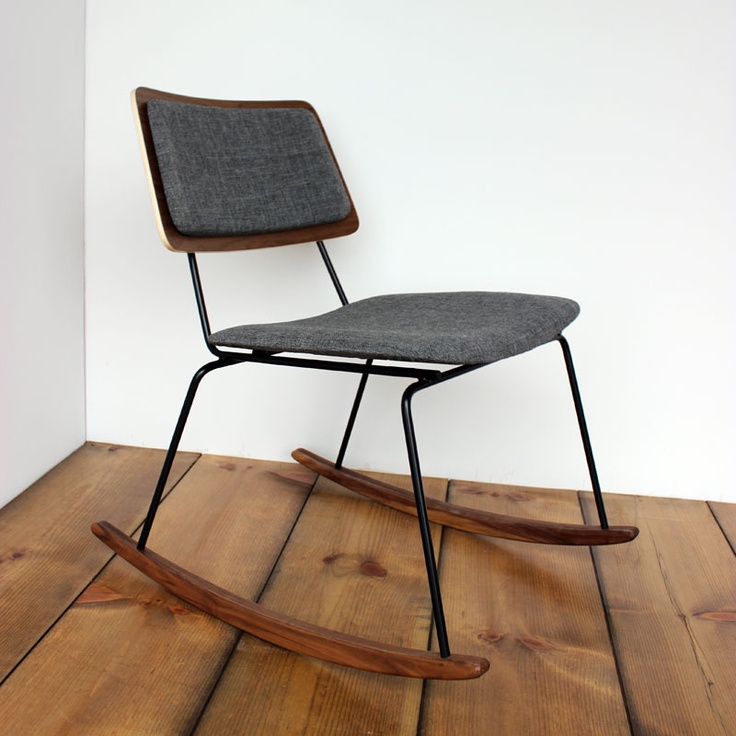
The opening chair is almost an argument against bulk. Thin charcoal cushions float on a dark plywood back panel whose edge reveals layered veneer. A skeleton of black powder-coated rods ties seat to back to rockers. The runners themselves are warm wood, so the piece never tips fully industrial. Photographed on pale plank floors against white walls, it behaves like a line drawing that happens to move.
What makes it “modern” is not a slogan; it is the refusal of padded wings and thick spindle arms. Air circulates through the frame. A lamp, a plant, or a child’s toy can sit nearby without fighting furniture mass. For a living room that already owns a soft sofa, this rocker becomes the upright counterpoint—a place to read without disappearing into upholstery. For a nursery, the same lightness matters: the chair does not dominate square footage, yet the gentle curve of the runners still delivers the classic calming motion parents expect.
Look at the material triangle: wood warmth, fabric texture, matte metal coolness. That triad is a reliable recipe for contemporary interiors that want personality without pattern overload. If your walls are quiet, the chair’s mix of temperatures does the talking.
The crescent cradle
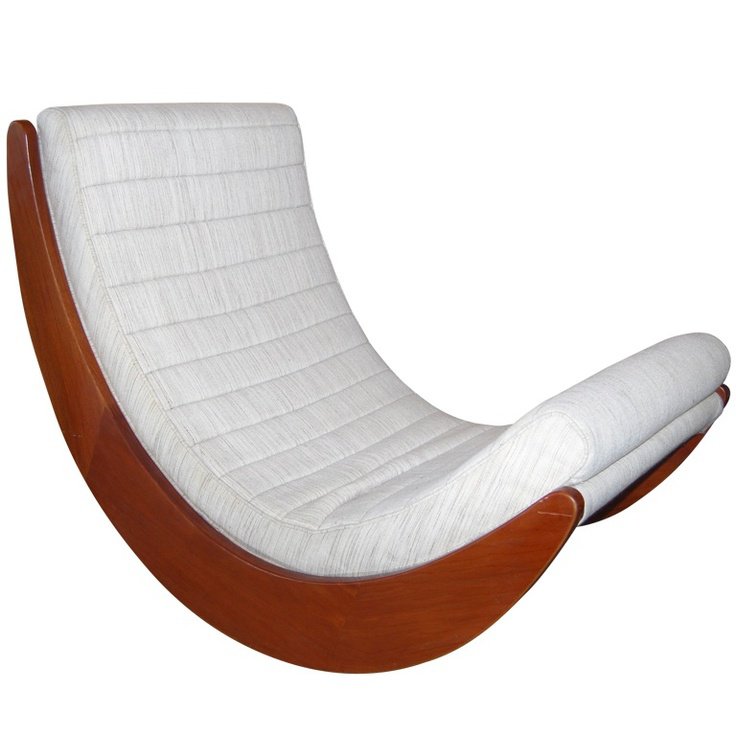
Next comes a continuous swoop: two broad wooden side panels tracing a U-shaped profile, cream channel-tufted upholstery running from high back into deep seat and up into a bolster-like foot curve. There are no separate legs to interrupt the silhouette. The whole object is one gesture—mid-century lounge logic pressed into a rocker.
This is the opposite of the thin-metal chair. Where the first piece celebrates air, the crescent celebrates enclosure. You do not perch; you settle. Horizontal ribbing in the fabric emphasizes length and invites the eye to travel the same path the body will take. In a living room, such a piece behaves like a sculptural chaise that happens to rock. In a quieter corner—guest room, reading nook—it becomes the destination furniture rather than a supporting player.
Practical note for small apartments: crescent rockers need clearance in front and behind because the continuous base claims floor ellipse. Measure the arc before you fall in love with the photo. The reward, if you have the space, is a chair that photographs as art and works as rest.
A rocker built for conversation
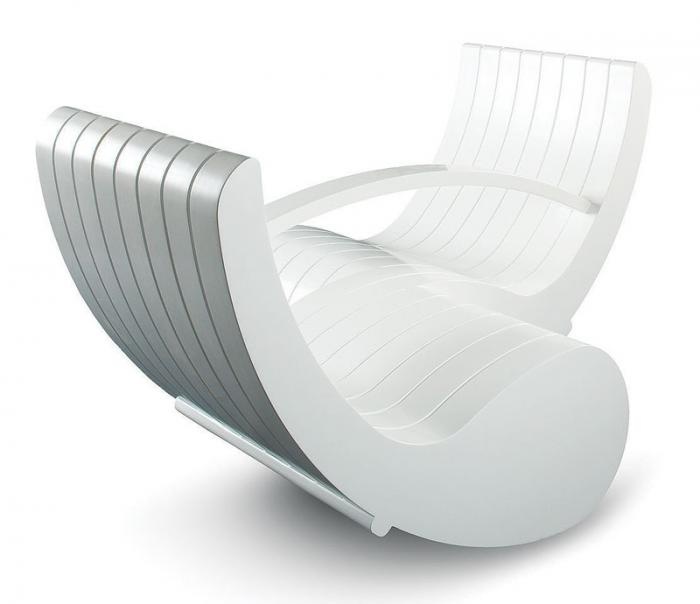
The glossy white double rocker flips the usual solo narrative. Two high-backed seats face each other across a shared undulating center, linked by a slender arched bar that reads as armrest and structural bridge. Ribbed interior surfaces catch light like molded boat hulls. Brushed metallic runners and rim accents keep the white from feeling clinical.
This is social furniture dressed as sculpture—a tête-à-tête that rocks. Couples, roommates, or a parent and older child can share motion without sitting side-by-side on a sofa. The form is unapologetically futuristic, closer to concept-show energy than porch tradition, which is exactly why it belongs in a “modern designs” gallery. It asks whether rocking must be solitary meditation. The answer here is no: rocking can be a shared pulse.
Placement tip: give it a room with enough visual quiet that the silhouette can read cleanly. Busy wallpaper or a cluttered rug will blur the symmetry that makes the piece special. A pale floor and a single strong lamp nearby usually serve it better than a gallery wall of competing frames.
When the rocker wears every scrap
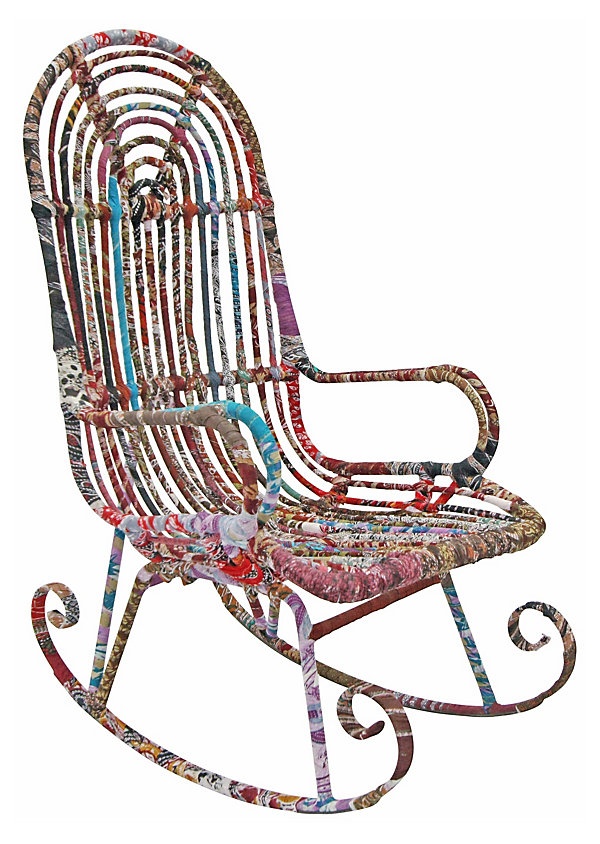
Not every modern rocker speaks in walnut and charcoal. The tall, textile-wrapped chair—metal bones bound in hundreds of multicolored fabric strips—treats the classic rocker silhouette as a canvas for craft excess. Concentric arches rise at the crest like a stylized sunrise. Florals, solids, and abstract prints collide into a dense ribbed skin. Even the scrolled rockers are wrapped.
In 2010s interiors writing, pieces like this often got filed under “bohemian” or “upcycled,” but the interesting design lesson is structural: soft materials can completely rewrite a hard form. The underlying chair remains a rocker; the surface becomes tapestry. In a nursery, that energy can feel playful rather than precious. In a living room already heavy with neutrals, it can be the one object that refuses to apologize for color.
If you live with pets or toddlers, wrapped textiles demand honesty about cleaning. Beauty here is high-maintenance by nature. Treat the chair as art you sit in occasionally, or accept that patina will arrive. Either stance is fine; pretending it is wipeable plastic is not.
Paper-cord geometry, Scandinavian calm
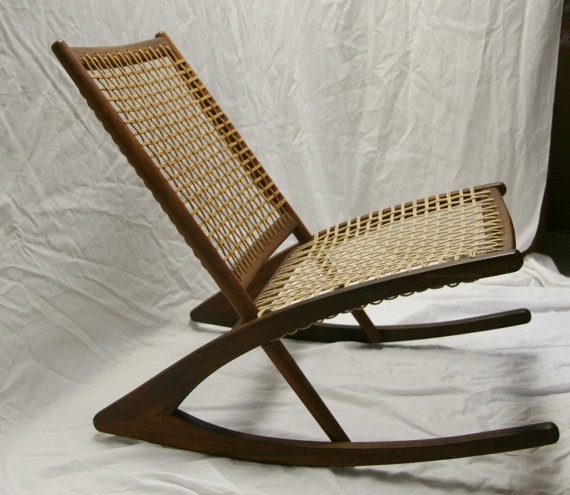
The dark-wood rocker with light woven cord returns the conversation to craft restraint. Seat and tall back are wrapped in a tight square grid—paper cord or a close cousin—around horizontal rungs. The frame draws a sharp V/Z relationship between rockers, seat, and back supports, with a slender brace underneath for honesty about physics. Against a plain backdrop, the silhouette reads Danish-modern: warm wood, cool weave, no ornament beyond joinery.
This is the chair for rooms that already own one loud statement. It will not compete with a patterned rug; it will deepen a quiet corner. Breathability matters too—woven seats stay cooler than thick foam in summer, a practical virtue often missing from lounge rockers. For a nursery that aims for calm rather than cartoon motifs, cord and wood offer adult design language that still rocks a sleepless midnight.
Care is straightforward compared with fabric-wrapped exuberance: keep the cord dry, avoid sharp toys, and accept that honest materials record use. That record is part of the aesthetic.
Circle back, sky-blue seat
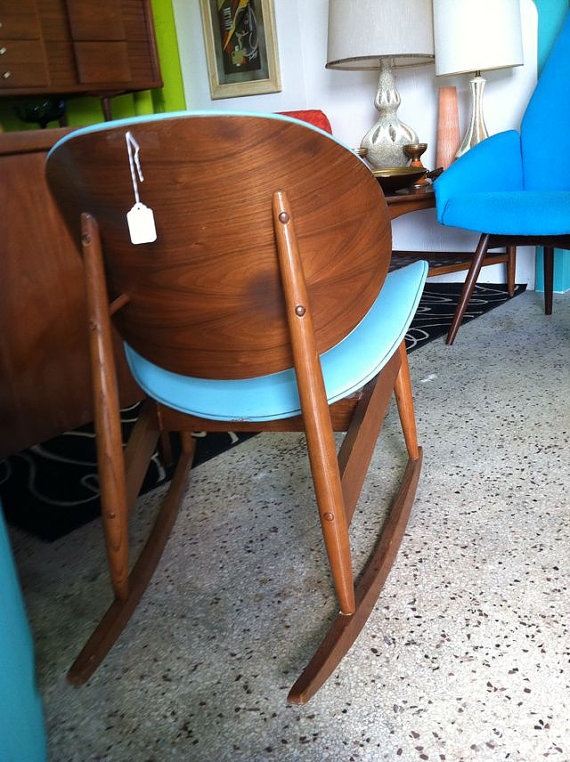
The final gallery chair shows mid-century bentwood confidence: a large circular back shell with swirling grain, sky-blue upholstery inside the bowl and on the seat, tapered rockers, and vertical struts with visible fasteners. Photographed in a lived room—lime wall, terrazzo floor, vintage lamps, a matching blue side chair nearby—it reminds you that rockers do not only exist on white seamless paper. They live among other objects and either harmonize or clash.
Here the harmony is chromatic. Blue upholstery answers the green wall without matching it. Wood grain ties the rocker to the sideboard and lamp bases. The circular back is the joke and the genius: a rocker that frames the sitter’s head like a halo or a speaker cone, depending on your mood. Organic curve meets saturated color—an early-modern move that still feels fresh in contemporary apartments hunting for character without farmhouse clichés.
How to choose among these dialects
Use the gallery as a filter, not a verdict:
- Need visual quiet? Start with the black-metal/walnut chair or the woven-cord rocker.
- Need a lounge destination? The crescent cradle owns a corner.
- Need shared motion? The white double rocker is the social outlier.
- Need color as craft? The textile-wrapped piece refuses neutrality.
- Need mid-century color punch? The circular blue bentwood brings room context with it.
Also match motion to floor. Soft rugs mute rockers; hard floors amplify them. Nurseries often prefer a rug for safety and sound; living rooms sometimes want the audible glide that makes the ritual feel real. Test the rocker’s amplitude if you can—some sculptural bases tip more dramatically than traditional long runners.
Finally, remember what this second gallery is for. It is not a sequel that repeats “buy a comfy chair.” It is a map of how designers keep reinventing the same ancient mechanism—curved runners, a seat that tips forward and back—until comfort and sculpture share one object. Pick the dialect that fits your room’s voice, measure the arc, and let the chair do the rest of the talking while you rock.

Comments
Continue reading
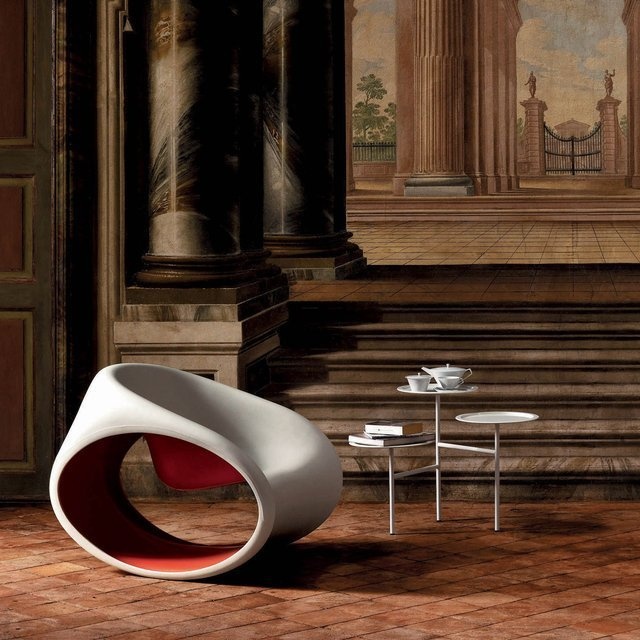
Modern Rocking Chair Designs #1: Form, Comfort, and Clear Arcs
First gallery in a two-part look at modern rocking chairs—updated silhouettes, materials, room placements, and a practical shortlist for comfort.
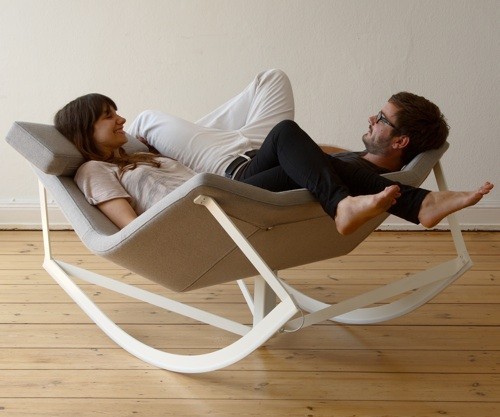
How to Choose a Rocking Chair for Home
Match the rocker to its job, check clearance and materials, and place it so the motion fits your room instead of fighting the layout.

Garden Decoration Beyond Beds: Lace, Mosaiculture, and Upcycled Yard Art
From dressed topiary and floral cyclists to license-plate dragonflies and lace between trees—garden decorations that give a yard a voice.