
Garden Decoration Beyond Beds: Lace, Mosaiculture, and Upcycled Yard Art
From dressed topiary and floral cyclists to license-plate dragonflies and lace between trees—garden decorations that give a yard a voice.
Ask most people what garden decoration means and they will answer with the obvious kit: trees, flower beds, a walkway, perhaps a pond. Those elements matter—they are structure and life. Distinction arrives when something stranger claims a place among them. A lace circle hung between trunks, cyclists grown from petunias, a dragonfly welded from license plates, a fountain stacked from children’s pools: each piece turns a yard into a story neighbors can point at from the sidewalk.
The photographs in this collection mix festival-scale horticultural sculpture with thrift-store backyard making. You do not need every idea. You need one that fits your climate, your tools, and your tolerance for whimsy—and you need to install it as carefully as you would plant a tree you intend to keep.
When plants become characters
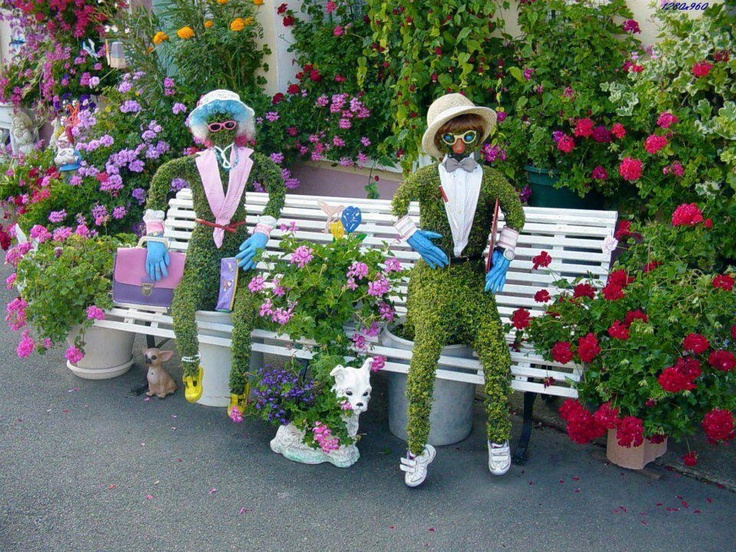
Two leafy humanoid figures sit on a white garden bench as if waiting for a bus that never comes. Short green foliage forms the bodies; real clothes and accessories finish the personalities—wide hat and pink sunglasses on one side, straw fedora and bow tie on the other, shared light-blue gloves, bright shoes, a pink bag, a red folder. Geraniums and marigolds crowd behind them; a small dog statue and a dog-shaped planter loaded with pink blooms keep the joke alive at ground level. This is topiary theatre. At home it demands a sturdy form, weather-aware costumes (or indoor storage for fabrics), and a planting backdrop busy enough that the green sitters feel hosted rather than abandoned on concrete.
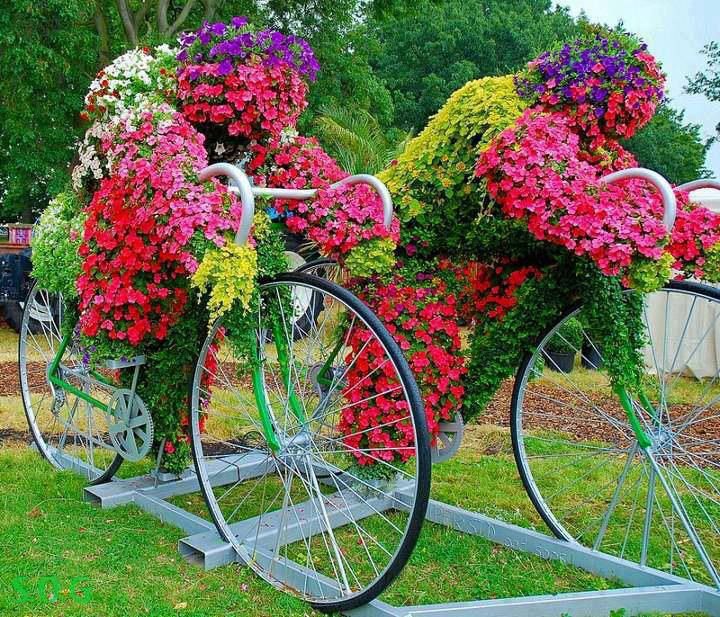
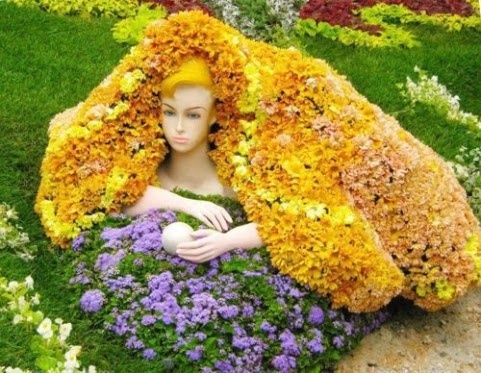
Mosaiculture pushes the same impulse to botanical-festival scale. Racing cyclists lean over real handlebars and spoked wheels while hot-pink and yellow flowers armor the torsos and green foliage wraps the limbs; a heavy metal base on the lawn carries the soil weight. A few steps of imagination away, a giant floral clam shell of yellow and orange blooms frames a mannequin figure offering a white pearl above a cushion of purple flowers. These installations need irrigation plans, frameworks, and crews—not a Saturday glue gun—but they teach home gardeners that living color can be shaped into narrative, not only lined in rows along a fence.
Vertical punctuation: poles, plates, and metal blooms
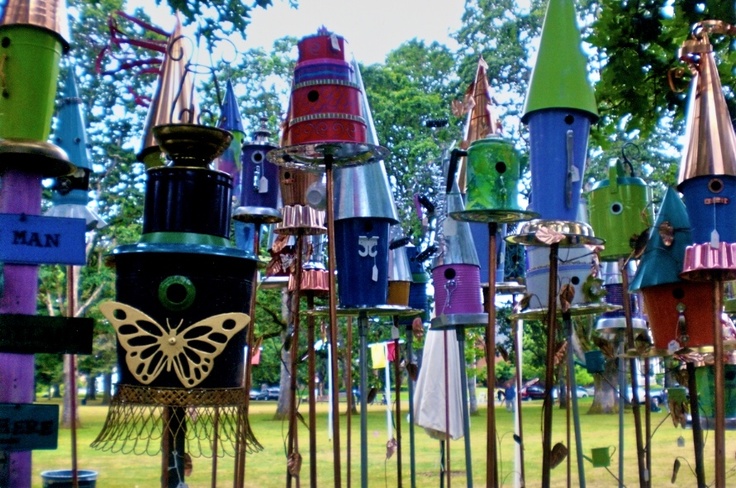
A lawn bristling with tall poles becomes a temporary forest of eccentric birdhouses—painted canisters, copper roofs, funnel cones in lime green, even a four-tier cake form in pink and red. At five to seven feet, silhouette and color travel farther than fine detail. A residential translation rarely needs a fairground crowd of poles; three or five staggered heights, each with a clear shape, will read across the yard without choking the view of actual trees.
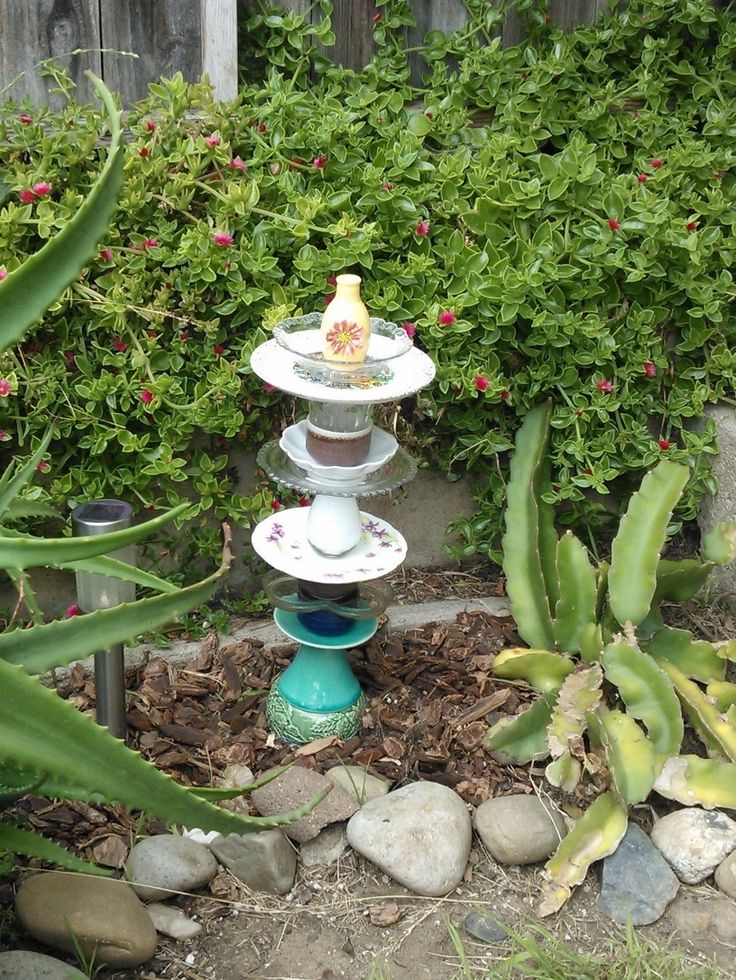
A plate-and-bowl totem offers height at bed scale. Mismatched thrift ceramics—clear glass bowls, floral dinner plates, a teal saucer, a turquoise base vase, a small bud vase on top—stack on a hidden rod among succulents, river stones, and pink groundcover. The tower catches light and eyes without the shade footprint of a dense shrub. Use moisture-rated adhesive, plates you can afford to lose to frost, and a base buried or weighted against wind.
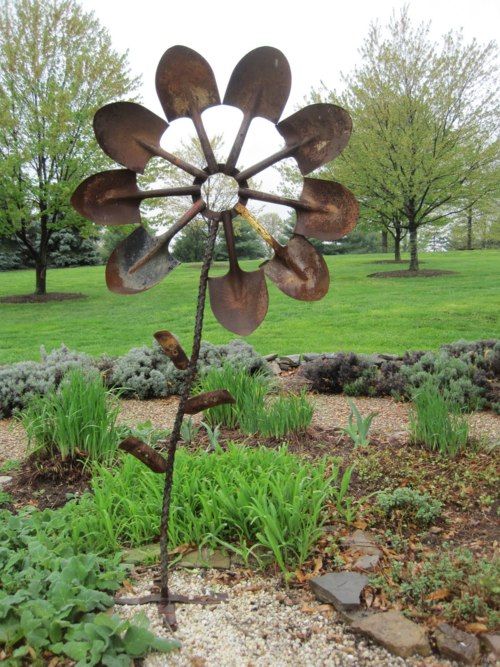
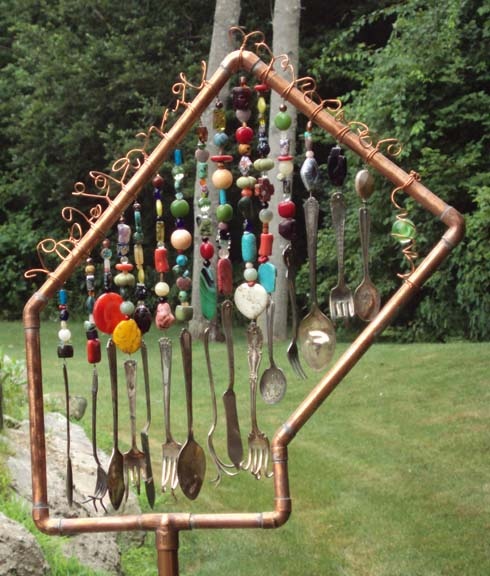
Ten rusted shovel blades radiate as petals on a twisted metal stem with leaf-like curves and an X-shaped foot in gravel. Patina is the finish; welding is the craft. Nearby, a copper pipe outline of a little house stakes into the lawn and hangs strands of beads that end in spoons and forks—garden jewelry that moves and chimes. Grind sharp edges, seal joints, and site metal where running children will not meet a shovel tip at eye level.
Walls, rocks, and underfoot pattern
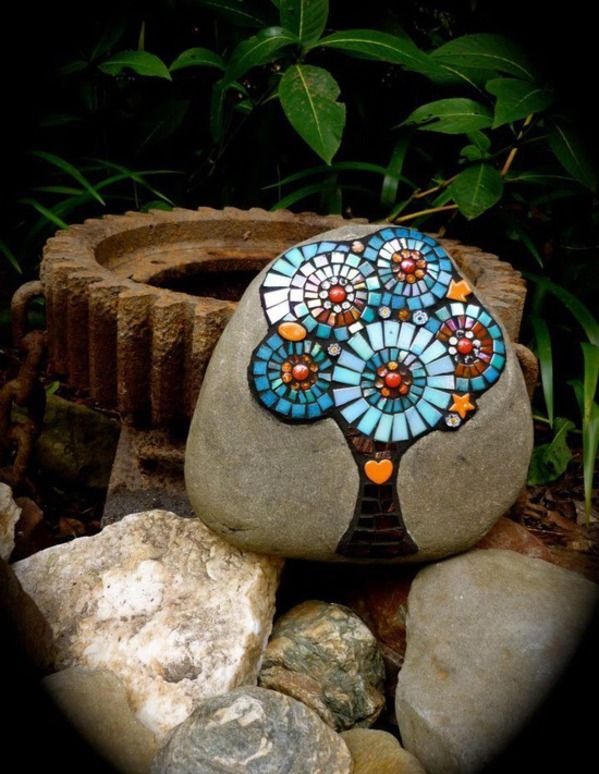
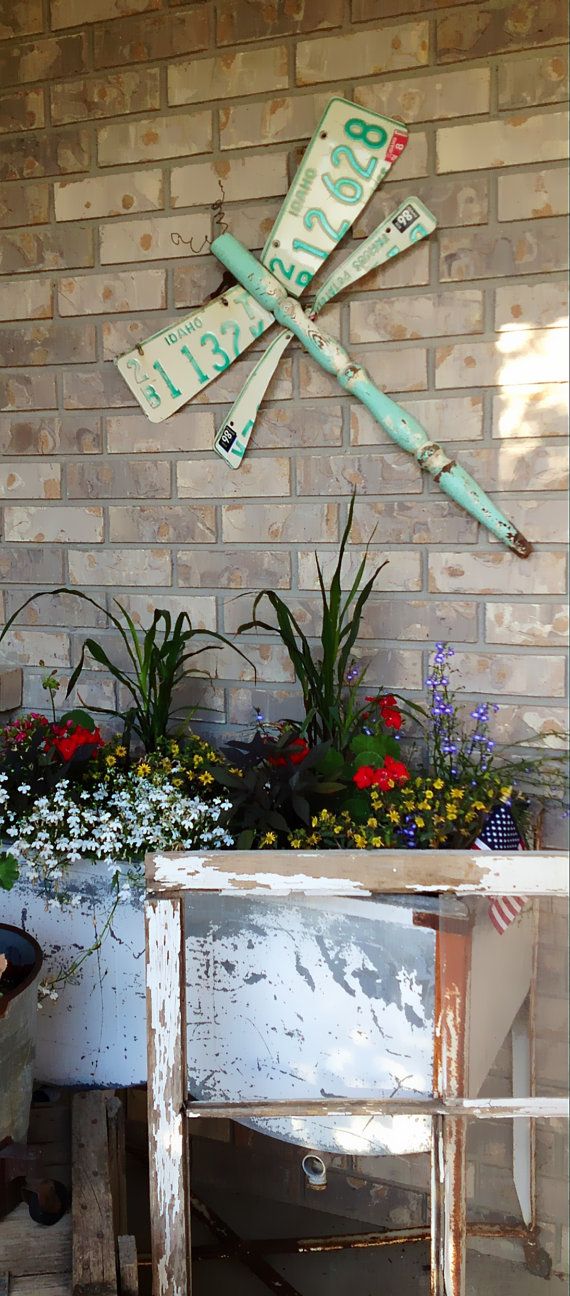
A large smooth rock becomes a mosaic tree: dark trunk tiles, blue circular canopies with orange centers, a heart tile at the fork, set on a stone pile with a rusted industrial gear behind. Salvage and glass tile share one vignette. On tan brick, a seafoam-distressed wooden spindle stretches diagonally as a dragonfly body while license plates flare into wings above a peeling white tub planter packed with geraniums, alyssum, and yellow blooms. A leaning window frame and a tiny flag finish the Americana scrapbook mood. Upcycling here is loud on purpose; quiet matching sets would miss the point.
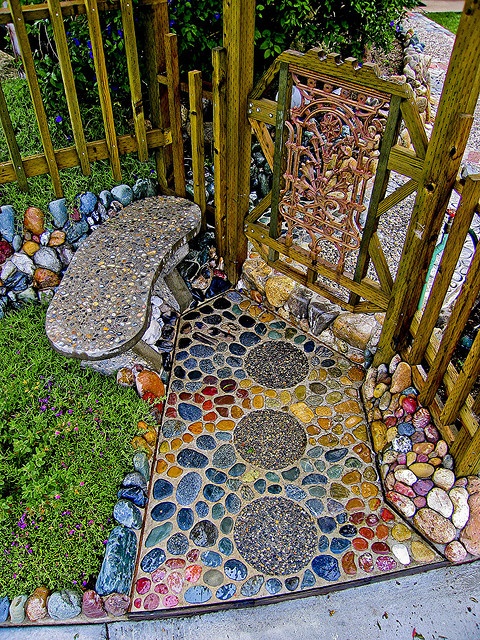
Decoration can live underfoot. A triangular pebble mosaic path mixes blues, reds, tans, and pinks around dark gravel circles, beside a curved aggregate bench and a wood fence interrupted by an ornate metal gate panel. This is permanent craft: excavation, base, drainage, and mortar matter as much as stone choice. Skip the engineering and freeze–thaw cycles will revise your pattern for you.
Soft installations, playful water, and collected corners
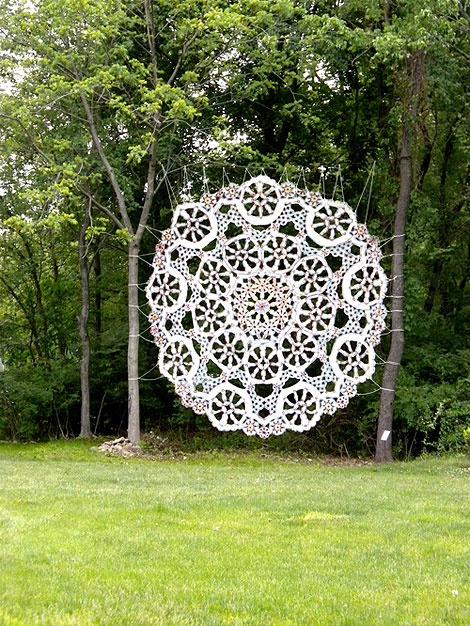
A massive white lace mandala stretched between two trees is the piece the original essay dared readers to imagine owning—the house “with the huge lace installation.” Concentric crocheted wheels float above green lawn on nearly invisible lines. Treat outdoor fiber as seasonal theatre unless you have weatherproof materials and a plan for wind loads; even then, expect fading. Soft art in a hard landscape creates the kind of memory hardscape alone rarely earns.
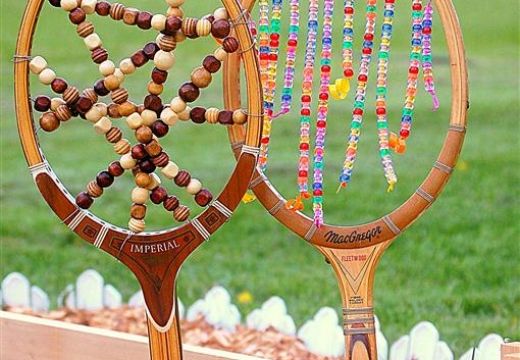
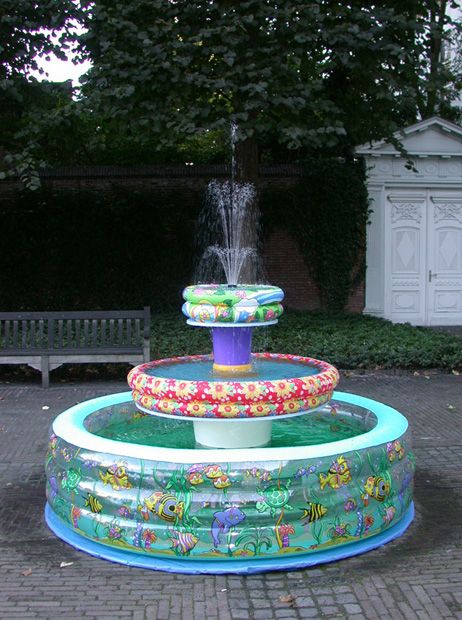
Two vintage wooden tennis rackets planted in mulch replace gut with beadwork—one a wooden sunburst web, the other vertical rainbow strands—against a scalloped white border. Three stacked inflatable pools of shrinking size, raised on columns on brick paving, throw a jet of water into the air like a temporary carnival fountain. Empty and store before cold and UV win. Both projects embrace impermanence; that is allowed in a garden, especially if it buys delight for one bright season.
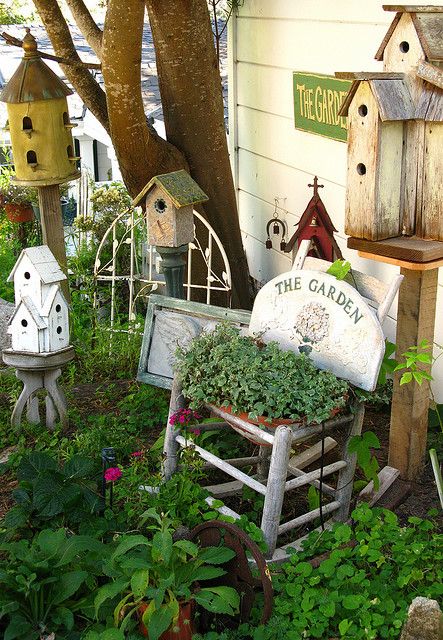
A quieter residential corner gathers birdhouses at mixed heights around a white rocking chair converted into a trailing planter, wall signs naming the space, a horseshoe, pink ground flowers, and the shade of a large tree. This is how festival energy shrinks to a side yard: collect slowly, vary height, let paint peel, and leave soil for plants to soften every prop.
Practical filters before you build
Choose one focal oddity before you import a fairground. Match materials to climate: ceramics crack, textiles fade, vinyl punctures, iron rusts into a look you may want, copper greens into another. Stake tall pieces against wind. Keep sharp metal above the reach of small children. Water features—even playful ones—need slip awareness on brick and a plan for mosquitoes if water stands.
Plant the beds honestly first. Then add the object that makes visitors pause mid-sentence. Gardens people remember are seldom the most expensive; they are the ones willing to hang white lace where only leaves were expected, or to let a shovel bloom where a catalog gnome would have stood.

Comments
Continue reading
Garden Walkway Designs: Materials, Width, Edges, and Planting Ideas
Pathway design ideas for stone, brick, gravel, concrete, and wood—plus width, drainage, edges, and planting that make a walkway work day to day.
How to Create an Indoor Herb Garden at Home
Grow rosemary, thyme, parsley, mint, and dill indoors with the right light, drainage, and planters—from window boxes and wall mounts to simple DIY pots.
Garden Decorations From Empty Bottles
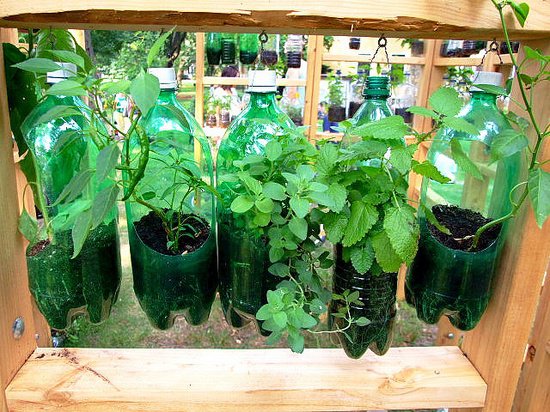
Practical outdoor reuse: hanging bottle gardens, self-watering planters, bed borders, bottle fences, and bottle trees—with drainage, anchoring, and safety notes.