
Nikolaj Arndt’s Mind-Blowing 3D Street Art
German street artist Nikolaj Arndt paints anamorphic animals and ponds on pavement—festival chalk illusions made for crowds to step into.
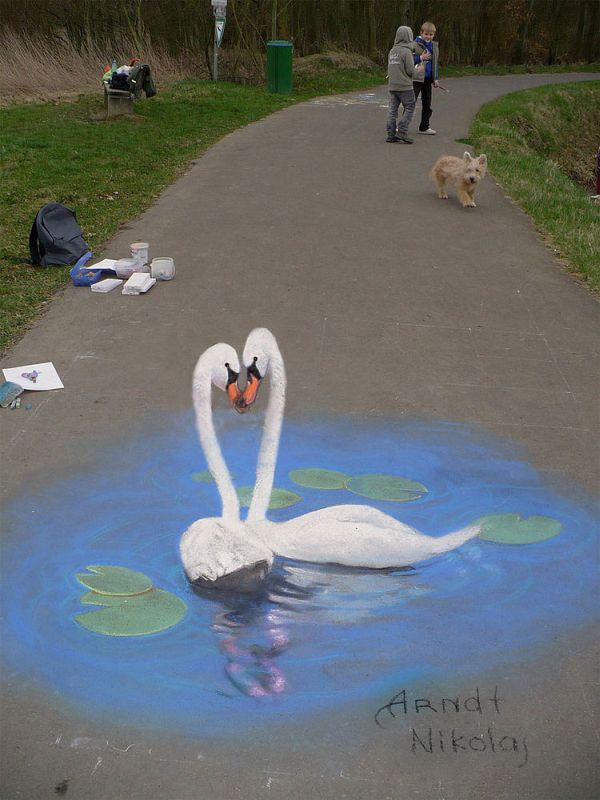
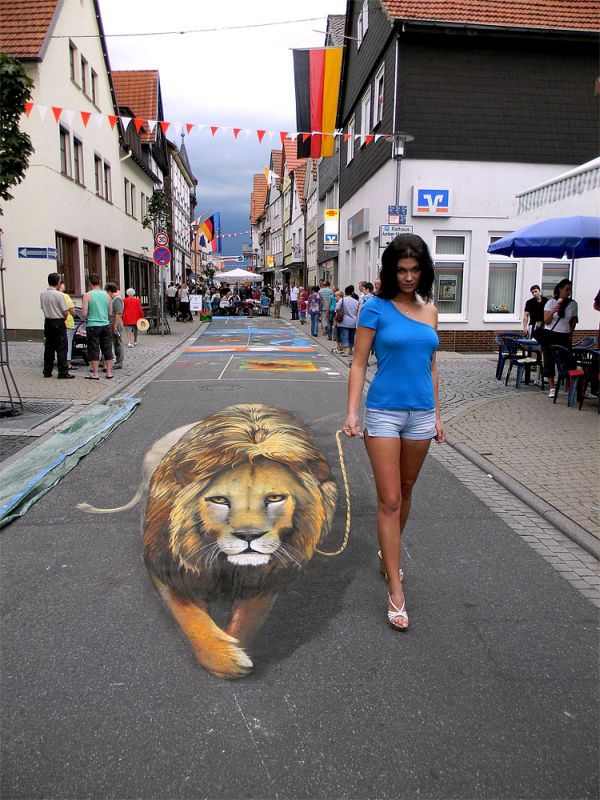
German street artist Nikolaj Arndt paints anamorphic scenes directly onto pavement so that, from one viewing spot, chalk and pastel open into ponds, caves, animals, and storybook depths. The work is public theater: kids, dogs, and festival crowds become part of the picture the moment they step onto the colored asphalt. Where studio illusionists build depth on stacked paper under controlled lights, Arndt works outdoors—on sidewalks, plaza stones, and festival grounds—racing weather, foot traffic, and the sun’s moving shadows.
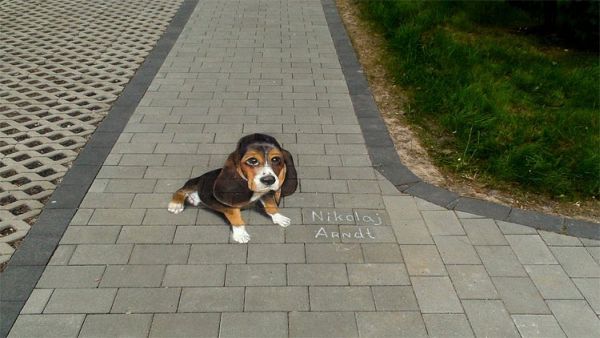
Born in Russia and later based in Germany, Arndt has taken part in street-painting festivals since the late 2000s, often specializing in vivid animal motifs and interactive compositions. The gallery below captures that outdoor language: swans on a painted blue pond signed with his name, creatures bursting through imagined holes in the street, and scenes designed for spectators to pose beside. Enjoy the collection as pavement performance, not desktop drawing. The difference is not snobbery; it is physics. Chalk on stone behaves differently from graphite on paper, and a plaza asks different questions than a studio desk.
How pavement 3D actually works
Street anamorphosis stretches forms across a flat plane so that a single eyepoint restores them to “correct” proportions. Stand in the wrong place and the pond looks like a smeared oval; stand in the right place and water appears to drop away under your shoes. Arndt’s animal specialties—swans, predators, sea life, fantasy beasts—benefit from bold color and clear silhouettes that read from a distance before the depth trick fully clicks. A tourist can recognize a swan from across the lawn and only later notice the shoreline is chalk.
Materials matter. Soft pastels and chalks grip rough asphalt better than delicate studio pencils. Edges must stay readable after a day’s festival dust. Highlights on water or fur need to survive glare. Unlike a paper illusion photographed once under a lamp, a street piece must hold for hours of visitors rotating through the sweet spot, phones raised, kids hopping the “shoreline.” The art is temporary infrastructure for play. Rain is the closing ceremony. Sun bleaches edges. Shoes scuff the brightest blues first.
Artists often grid the ground, stretch outlines using perspective guides, then build from deep “holes” outward toward the spectator zone. The empty foreground is intentional: a place for sneakers, strollers, and posed leaps. Without that empty stage, the illusion has nowhere for the public to enter, and the photo becomes a painting of animals instead of a shared optical instrument.
Street art versus studio 3D drawing
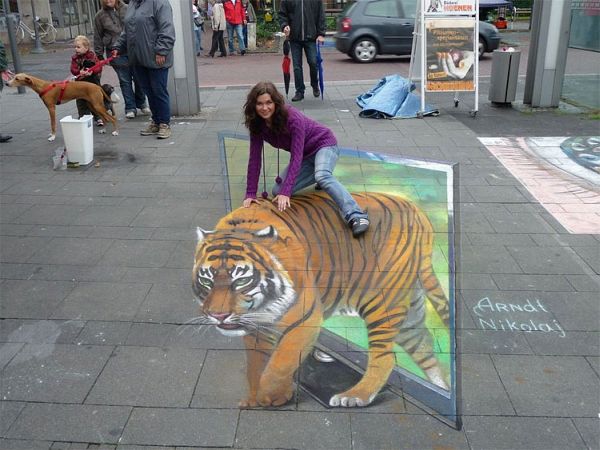
It is easy to file every “mind-blowing 3D” gallery under one tag. The difference in setting changes everything. Studio artists such as Ramon Bruin stage paper stacks indoors and publish a single perfect camera angle. Arndt paints at human scale on public ground; the “camera” is whoever finds the mark and stands still long enough for the illusion to lock. His audience can walk into the picture. That interactivity—posing with a painted tiger, peering into a chalk cave—is the street tradition’s signature.
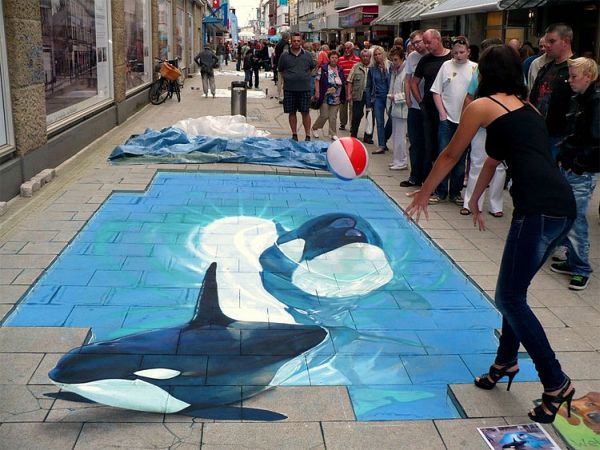
Scale also shifts subject matter. Paper illusions often chase intricate tunnels and floating objects measured in centimeters. Pavement pieces favor large animals, water, cliffs, and narrative beats that survive being photographed by tourists with phone cameras. Color is usually louder outdoors: saturated blues for water, high-contrast animals against grey stone. Soft monochrome graphite tricks that thrill on a desk can vanish under noon sun on asphalt. Bruin’s multi-sheet trains and birds are cousins in geometry, not twins in venue.
Sound and smell even differ. A plaza piece includes festival noise, chalk dust on fingers, and the awkward comedy of strangers coaching each other toward the viewpoint. A studio piece includes quiet concentration and a tripod. Keeping those atmospheres separate helps each artist stay himself when both appear in “3D art” search results.
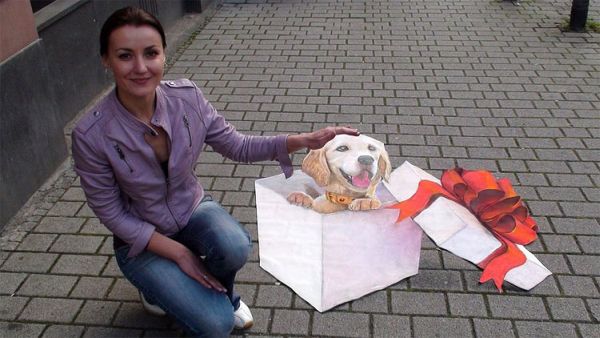
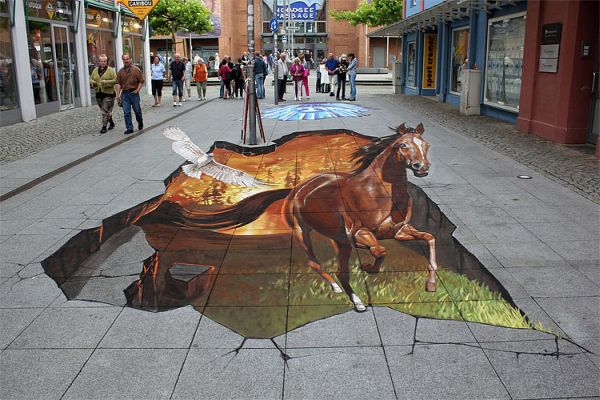
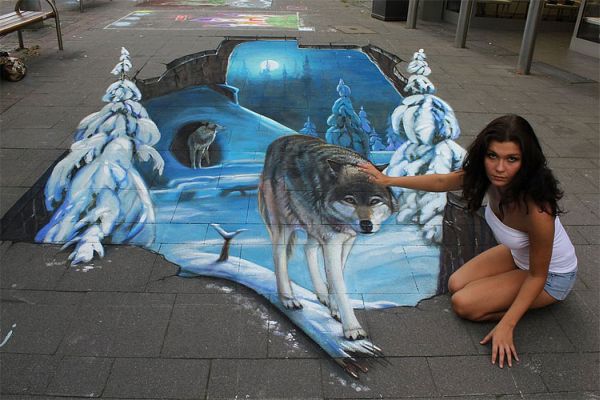
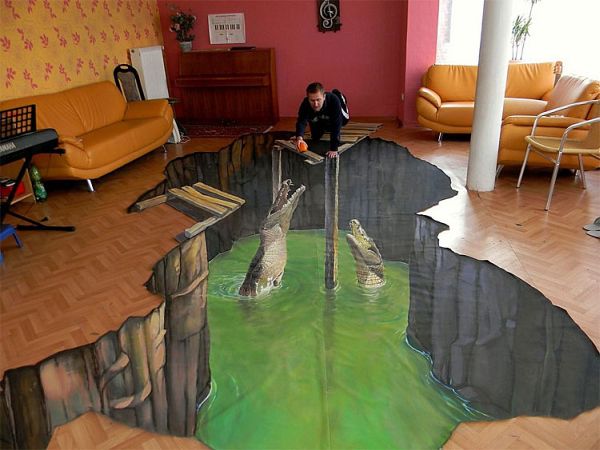
What to notice in Arndt’s scenes
Looking through this set, a few street-specific habits stand out:
- Invitation to enter. Empty foreground space often leaves room for a visitor’s feet or a child’s pose.
- Animal clarity. Creatures are drawn with enough graphic force to read as characters, not only as depth demos.
- Signature placement. Names and credits appear in the chalk itself—part of festival culture and photo sharing.
- Real-world leftovers. Backpacks, benches, grass, and passersby remain in frame, proving the painting lives in a park or plaza rather than a seamless digital void.
- Viewpoint markers. Even when unmarked, the strongest photos imply a single sweet spot; weaker angles look like colorful stains.
- Color against grey. Asphalt’s neutrality becomes a ready-made matte that makes blue water and bright animals pop.
Those leftovers are not mistakes. They certify authenticity. A puppy wandering past painted swans, chalk boxes on the grass, and trees behind the sidewalk remind you that the illusion is temporary civic decoration. Tomorrow the rain may erase it. Tonight it is a stage. In the swan image especially, the mix of art supplies, signed chalk, and everyday life walking through the frame is the whole genre in one shot.
Festival craft and public patience
Making a large pavement piece is endurance work. Crowds gather early. Someone always stands in the wrong place and declares the painting “just flat.” Someone else finds the angle and gasps. That social rhythm—doubt, discovery, photo, share—is part of why 3D street art flourished in the festival and internet eras around the early 2010s. The image is not only the chalk; it is the line of people waiting to stand in the hole that is not a hole. Arndt’s festival circuit reputation grew inside that rhythm: prize stages, public parks, and photographs that travel farther than the pastel ever will.
If you visit a festival piece yourself, give the artist’s viewpoint a fair try before judging. Crouch or stand where the painted horizon lines converge. Keep your camera lens near eye height rather than shooting from a drone-like overhead. Step into the empty zone designed for visitors, then step out so the next person can try. The courtesy is practical: anamorphosis is a shared optical instrument, not a private mural for distant admiration only. Tip the artist if a hat or jar is out; temporary masterpieces still cost hours of knees on stone.
Photographers covering the work can help by including a person for scale and by resisting the urge to over-edit chalk into neon plastic. The grit of the pavement is part of the honesty. When the asphalt texture disappears under heavy filters, the illusion starts looking like a digital composite—and then the magic of “this is really the ground” fades.
Nikolaj Arndt’s work sits in that public tradition—bold animals, bright water, asphalt as stage. Looking at the swan pond again, with chalk supplies on the grass and real life walking past the painted shoreline, you might ask: is the art the depth illusion, or the crowd learning where to stand? On the street, those two answers keep trading places.

Comments
Continue reading
Oakoak’s Playful Urban Street Interventions
French street artist Oakoak turns cracks, hydrants, and overlooked fixtures into small site-specific jokes—minimal marks, pop-culture wit, and ephemeral city play.
Photo-Realistic Muscle Car Paintings by Cheryl Kelley
Cheryl Kelley’s glossy oil paintings of classic muscle cars—photo-based realism, chrome reflections, and a feminine take on automotive glamour, with gallery images.
15 More Incredible Street Art Photos Worldwide
Part two: giant murals from Philadelphia, Lyon, Warsaw, Lisbon, Vienna, New York, Dublin, Berlin, and beyond—plus a few still-unlabeled walls.