
Glenn Jones Glennz Tees, Part 3: Character Contradiction and Loud Archetypes
How Glenn Jones builds Glennz character shirts—ninjas with sousaphones and other role-breaking jokes that work without a caption.
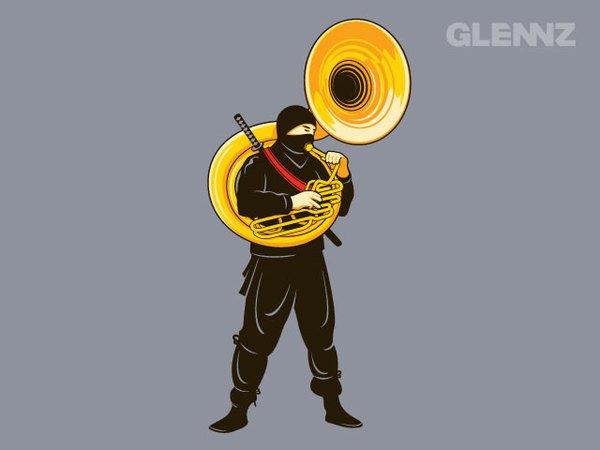
In Glenn Jones’s Glennz catalog, some of the strongest shirts are not about objects or brand mashups. They are about people — or rather, about costumes and archetypes that refuse to behave. This third gallery look centers that character-contradiction humor: a figure you think you know, caught doing the one thing their myth forbids.
The illustration above is the cleanest possible argument for the approach. A black-clad ninja stands full-figure against a cool gray field, katana strapped across his back — and he is playing a giant brass sousaphone. Stealth meets volume. Silence meets parade. The mask stays on; the instrument does not care.
Contradiction as a wearable plot
Glenn Jones, the Auckland designer and illustrator behind Glennz, often builds character jokes the way a sketch writer builds a cold open. Establish the role in the first half-second. Break the role in the next half-second. Stop drawing before the joke explains itself.
The ninja-and-sousaphone shirt follows that beat structure with almost musical timing:
- Beat one: costume, mask, sword, wrapped footwear — every cue says “quiet killer.”
- Beat two: bright brass tubing wraps the body like a marching-band halo.
- Beat three: fingers on valves, posture committed, as if this is simply the job today.
Nothing in the drawing winks at the viewer. There is no caption that says “loud ninja.” The irony is structural. That is why the shirt still works years after first-wave Threadless-era humor: the contradiction is visual, not verbal.
Why archetypes are perfect tee material
Archetypes travel. A ninja is readable in New Zealand, North America, and most of Europe without translation. So is a sousaphone, once you recognize the bell curve over the shoulder. Pairing them creates an international gag that does not depend on a week’s trending hashtag.
Character contradiction also gives Glenn Jones room to show figure drawing skill that object gags do not always need. The ninja has weight. The wraps around the calves suggest fabric under tension. The brass has interior darkness in the bell. Soft shadows pin the figure to the ground so he does not float like a sticker. Costume comedy still has to be good costume illustration.
In the early 2010s, when Glennz Tees and related community platforms circulated designs like this widely, that combination — meme-clear concept plus tidy craft — was a practical advantage. Voting audiences could understand the joke instantly; people who cared about drawing could linger on the folds and metal highlights.
Silence versus spectacle
A lot of Glennz character work plays with volume as a comic resource. Ninjas are culturally coded as silent. Brass instruments are culturally coded as impossible to ignore. Put them together and you get a joke about identity mismatch: the person who wants to disappear has chosen the loudest possible hobby.
You can feel similar tension in other Glenn Jones character setups even when the props change. A solemn figure doing something goofy. A dangerous figure doing something domestic. A mythical figure stuck in a modern chore. The specific ninja-sousaphone pairing is simply the purest version of that dial turned all the way up.
Notice what the design refuses to do. It does not surround the ninja with music notes. It does not add a stage or an audience. It does not break the fourth wall with a sweat drop or a cartoon scream line. The gray background is almost museum-quiet. All the noise is implied by the instrument’s size.
How to read a Glennz character shirt
When you look at character-first work from Glenn Jones, it helps to ask different questions than you ask of his object still-lifes or franchise mashups.
- What role is promised by the costume? Ninja, alien, knight, animal in uniform — whatever the first cue is.
- What action betrays that role? Playing, shopping, gaming, posing for a school photo, whatever breaks the myth.
- Is the betrayal committed or embarrassed? Glennz often chooses committed. The ninja is not ashamed of the sousaphone; he is practicing.
- Does the silhouette still read as the original archetype? If you squint, you should still see “ninja,” not “generic guy with tuba.”
That last point is craft-critical. If the costume collapses under the prop, the contradiction fails. Here the sword hilt, hood, and mask keep the archetype intact while the brass does the comic damage.
Performance humor without a stage
T-shirts are walking stages. Character contradiction designs exploit that fact. When someone wears the ninja sousaphone shirt into a room, they briefly become a tiny theater company: the garment announces a role, then cancels it. Observers get the punchline without a conversation, which is the social utility of good apparel illustration.
Glenn Jones’s freelance background in graphic design and illustration shows in how cleanly that theater is framed. The figure is centered like a product hero shot. Negative space is even. Color blocking is simple enough for screen printing and bold enough for digital prints. Humor does not excuse muddy production thinking.
There is also a gentle kindness in the joke. The ninja is not mocked as incompetent. He is simply versatile. Maybe stealth missions need a brass section. Maybe weekends are for marching band. The shirt leaves that story open, which is better comedy than punching down on the character.
Separating this angle from the rest of the series
Other Glennz installments lean into caution-sign still lifes or pop-culture versus graphics. Those are different machines. Object humor swaps meaning inside a prop. Mashup humor collides two known brands or fandoms. Character contradiction humor keeps one identity and forces it to act against type. If you blur those categories, every Glenn Jones shirt starts to feel interchangeable. They are not.
This part is the character lane on purpose. Study the stance, the prop scale, the deadpan face area above the mask, and the way commitment sells the gag. Once you see that pattern, you can spot it elsewhere in the Glennz archive even when the costume changes.
And if you catch yourself explaining the shirt out loud — “It’s a ninja… with a sousaphone” — notice how little explanation the drawing actually needed. The laugh arrives before the sentence finishes. That timing is the whole craft.

Comments
Continue reading
Fabulous T-Shirt Designs by Glenn Jones (Glennz) — First Gallery
Auckland illustrator Glenn Jones—Glennz—built a Threadless-to-tees career on sharp visual punchlines; a first gallery of his graphic shirt designs.
Glenn Jones Glennz Tees, Part 2: Everyday Objects as Wearable Punchlines
A craft look at Glenn Jones’s object-first Glennz shirts—caution signs, still-life humor, and why mundane props travel farther than catchphrases.
Glenn Jones Glennz Tees, Part 4: Pop Mashups, Versus Graphics, and Gallery Collisions
A catalog pass through Glenn Jones’s mashup Glennz shirts—Star Wars football helmets, rocket popsicles, arcade loops, and how rivalry prints work on cotton.