
Magdalena Wasiczek’s Beautiful Garden: Macro Nature Photography
A look at Polish photographer Magdalena Wasiczek’s dreamlike garden macros—bokeh painting, dew and insects, and how a backyard became a fairy-tale studio.
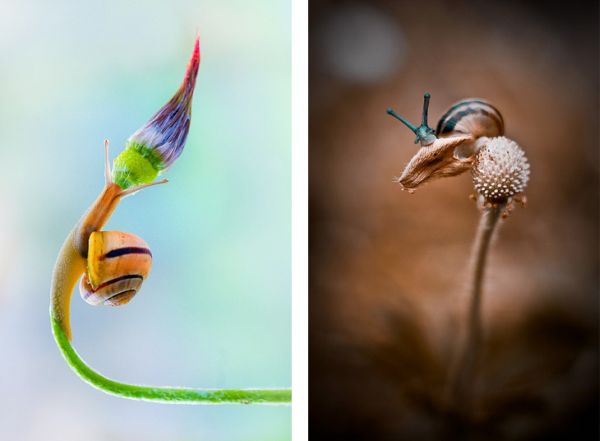
Magdalena Wasiczek photographs gardens as if they were miniature continents. Working from Trzebinia, Poland, she built an international reputation in floral and macro photography by stepping away from the field-guide tradition that once dominated close-up nature work. Instead of pinning every stamen in clinical focus, she often lets edges dissolve, backgrounds bloom into soft orbs of color, and insects become protagonists on petal stages. The images gathered on this page belong to that world: intimate frames where dew, wings, and translucent leaves feel larger than the fence that surrounds them.
This is a guide to looking at Wasiczek’s garden-macro language—how a backyard became a studio, why the pictures feel painted, and what these particular frames demonstrate about atmosphere chosen over pure documentation.
A garden as studio
Wasiczek has described learning to photograph while rooted in family life, with a home garden and nearby meadows serving as ready terrain. Long expedition travel was less available in those years; close looking was always available. Morning moisture on grass, a beetle negotiating a mushroom cap, a spiderweb lit for only a few minutes before the sun erased it—these became enough subject matter for a serious practice. Limitation did not shrink the work. It concentrated it.
The garden setting matters because it is both cultivated and wild at the edges. Flowers grown for beauty sit beside insects that treat the same blooms as territory and food. Wasiczek’s camera frequently sides with the small traveler. A ladybug or bee can dominate the rectangle while the blossom becomes landscape, hill, or cave. That scale flip is one reason children and adults alike read the pictures as storybook scenes. The place is familiar. The viewpoint is not the standing adult’s.
Because the terrain is local and revisitable, the photographs also record seasons of attention. The same bed of plants can yield entirely different pictures depending on weather, hour, and which creature arrives. The garden is not a fixed set. It is a rotating cast with a green stage.
Bokeh as brushwork
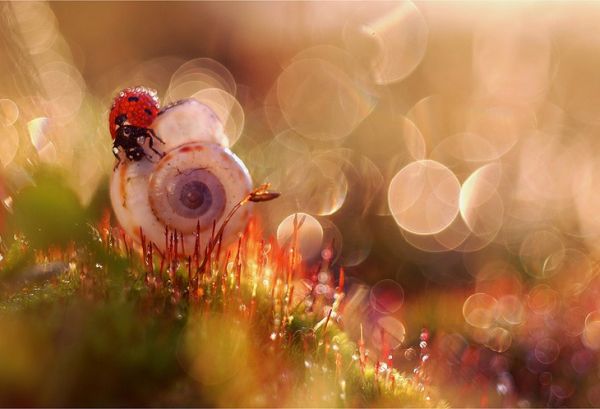
In artist notes and interviews, Wasiczek has explained that she does not prioritize showing the world exactly as it is. Plenty of photographers already do that well. Her aim is an idyllic, fairy-tale register—an “unreal” garden where color and light outweigh taxonomic clarity. She has associated this approach with a kind of bokeh painting: out-of-focus highlights and color fields behaving like wet pigment behind a sharper emotional center.
That choice once ran against macro orthodoxy. Traditional close-up nature photography prized maximum detail and smooth, neutral backgrounds. Softness could be read as error. Wasiczek inverted the hierarchy. Atmosphere became the point. A petal edge might dissolve; a droplet might carry the brightest note in the picture; an insect’s eye might be the only plane that truly holds. The result feels closer to impressionism than to botanical illustration.
She has also emphasized that the magic is usually achieved in camera—optics, timing, available light, occasional sprayed water—rather than as a collage of heavy digital invention. The fairy tale is staged with real plants and real weather. That honesty of means keeps the work tethered to gardening and entomology even when the mood is dreamlike. Viewers sense craft, not only filter.
Motifs that return across the series
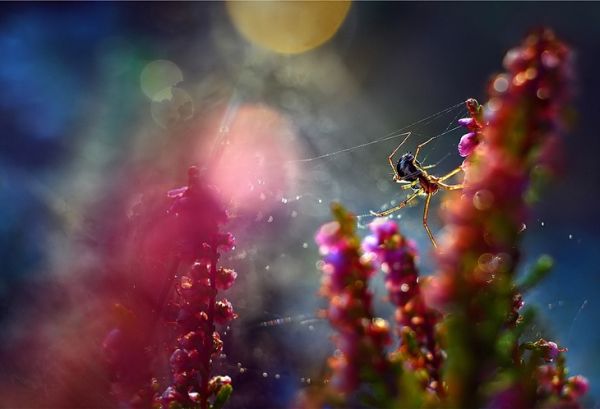
Across a Wasiczek garden set, certain motifs return like refrains. Dew turns grass blades and petal lips into jewelry displays. Mushrooms become mountains for tiny climbers. Flower centers open like theaters. Color temperature shifts from cool dawn blues to warm late-day ambers without needing a caption to explain the hour. The pictures reward slow viewing because the true subject is often a relationship—insect to bloom, drop to leaf, light to translucency—rather than a single named species presented for identification.
That relational focus is why the work travels beyond specialist nature magazines. Fashion and lifestyle publications have also published her images; the emotional temperature is high enough to function as visual poetry. At the same time, garden photographers recognize the discipline underneath: shallow depth of field managed with intention, backgrounds chosen so color chords support the focal point, patience for the minute when a wing opens or a drop trembles without falling.
Look for how often the background is authored as carefully as the subject. In one frame a wash of pink may matter more than botanical accuracy. In another, an insect’s footing on a curved petal supplies the entire narrative tension. Naming the plant can wait. Feeling the weather of the picture comes first.
Recognition without leaving the backyard
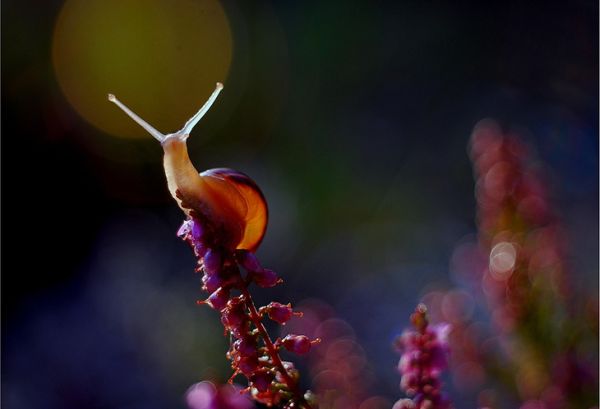
Wasiczek’s competition record—especially her repeated success in the International Garden Photographer of the Year, including overall wins that made her the first triple winner in the contest’s history—confirmed that an impressionistic garden vision could stand beside more documentary entries. Exhibitions in Poland and abroad, along with industry ambassadorships, widened the audience. Publications from photography magazines to broader cultural titles carried the work into living rooms far from Trzebinia.
Yet the imaginative center remains local: a fenced garden, meadows beyond, and the decision to treat that limited acreage as inexhaustible. There is a quiet argument inside that biography. Floral photography is sometimes dismissed as sentimental or temporary—a phase before “serious” subjects. Wasiczek’s career answers by making sentiment rigorous. Softness is composed. Wonder is edited. The childlike invitation she hopes for in viewers depends on adult control of craft.
How to look at this gallery
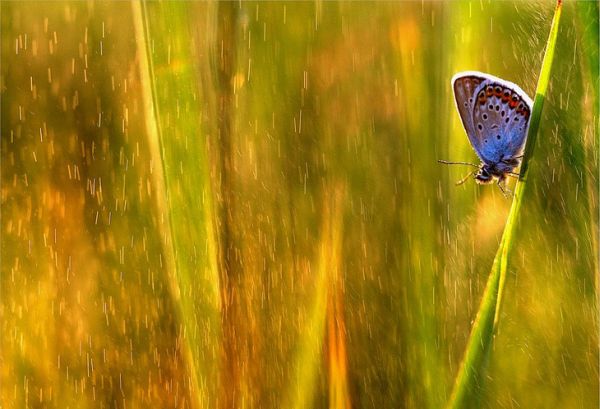
Move through the images without rushing to label every plant. Ask what the light is doing, where the sharpest plane sits, and which color is allowed to dominate. Notice whether the insect is hero, accent, or absent. Notice whether the flower is portrait or environment. Wasiczek’s best frames often refuse a single answer; they hold both portrait and environment at once.
If you photograph gardens yourself, the useful lesson is not to copy a preset. It is to decide what kind of truth you want. Documentary truth says: this is precisely how the rose looked at noon. Wasiczek’s garden truth says: this is how the rose felt in a particular minute of weather, scaled to a beetle’s world. Both are legitimate. Only one of them will make a backyard look like a myth while still smelling like wet soil.
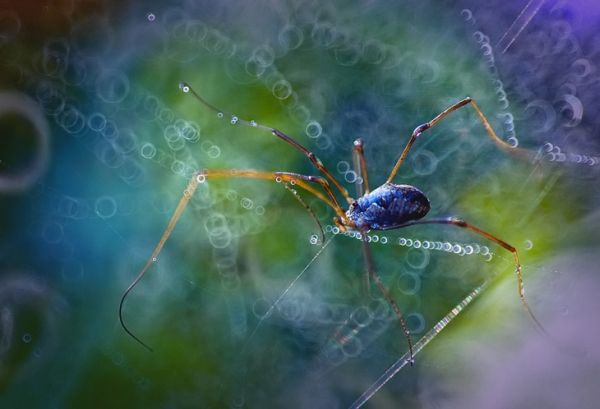
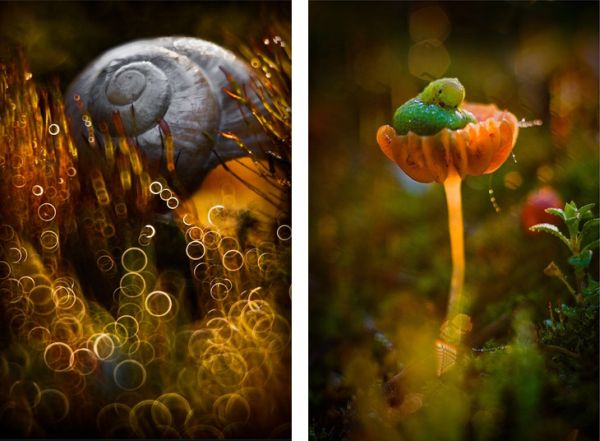
Her own hope for viewers is modest and difficult: that for a moment the pictures restore a child’s sense of a world that is colorful, mysterious, and full of surprises. In a beautiful garden photographed this way, that hope is not abstract. It is hanging on a blade of grass with the morning still on it. The last frames on the page ask for the same patience the photographer gave the subjects—another minute, another highlight, another small miracle stacked until the ordinary plot of land feels inevitable and strange at once.
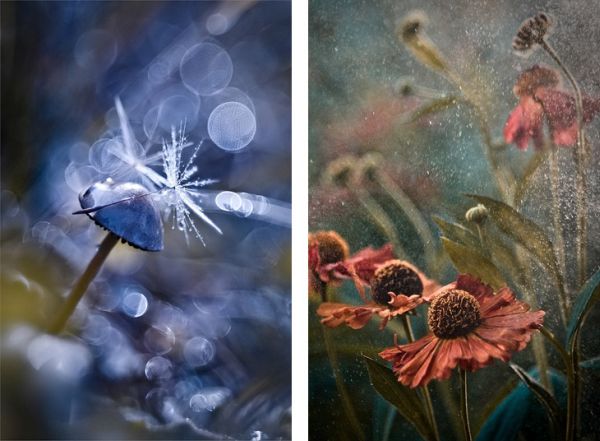
Before you leave, pick one droplet or one rim of light and stay with it. Wasiczek’s gardens are built from those minor intensities. When enough of them gather in a single morning’s work, a beautiful garden stops being decoration and becomes a way of seeing.

Comments
Continue reading
Liz Rusby and the Romantic Beauty of Nature
California photographer Liz Rusby’s soft-focus flowers and spring blossoms—intimate botanical romance without postcard syrup.
Outdoor & Nature Photos #2: More Open Air for Screen-Tired Eyes
A second gallery of outdoor landscape photographs—weather, wide horizons, and quiet light—for anyone still stuck indoors at a computer.
Outdoor & Nature Photos #1: Landscapes for the Desk-Bound
From Polish waterfalls and Yangshuo rivers to Provençal lavender and a Santorini sunset—landscape photographs for anyone stuck indoors at a screen.