
Landscape Photography by Kilian Schönberger
German photographer-geographer Kilian Schönberger on fog forests, mountain weather, and turning colour blindness into pattern-first landscape craft.
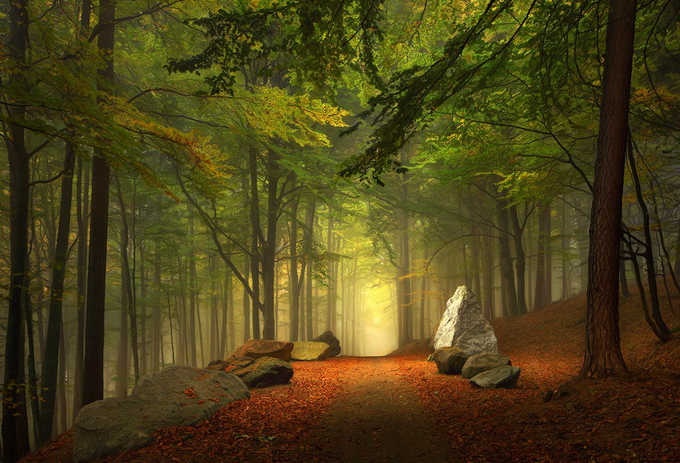
Kilian Schönberger is a German photographer and geographer whose landscape work made a wide internet audience pause on fog, forest structure, and mountain weather. Around the early 2010s—when this page first circulated—he was often introduced as a roughly thirty-year-old professional who photographed both natural landscapes and cityscapes, and who treated colour blindness not as a footnote but as part of his working method. The image below belongs to that conversation: atmospheric landscape photography shaped by pattern-first seeing.
Schönberger’s own explanation, long quoted alongside his pictures, is still the clearest entry point. He recognized that a so-called disadvantage could become a strength. In a chaotic forest scene, he cannot clearly distinguish many green and brown tones. Rather than fighting that limit as if normal colour sorting were the only path to a good photograph, he concentrates on the patterns of the wood—the graphic structure of trunks, limbs, and negative space—to build an impressive image architecture. The camera still records a full colour world; his attention simply prioritizes form before hue.
I recognized that I could turn this so-called disadvantage into a strength, too and developed my own unique photographic view: E.g. while getting a picture of a chaotic forest scene, I can’t clearly distinguish the different green and brown tones. Brushing aside this “handicap” I don’t care about those tones and just concentrate on the patterns of the wood to achieve an impressive image structure.
Geographer’s eye, photographer’s patience
Training in geography matters here more than biography trivia usually does. Schönberger studied geography (including time in Bonn and Bergen) before building a professional photography practice. That background encourages a habit of reading terrain: how weather sits in valleys, how forests regenerate, how human infrastructure interrupts or frames wilderness, how light behaves at temperate and high latitudes. His published interests have long included misted woodlands, alpine edges, northern Europe’s harsh gentleness, and the melancholy that attaches to cool climates.
Viewers often describe his frames as resting places—images that slow an overstimulated scroll. Fog helps. So do repeating verticals, soft gradients of distance, and compositions that feel discovered rather than forced. The work is romantic without needing fairy-tale props. When folklore or storybook mood enters the conversation around his projects, it usually comes from atmosphere and place names, not from costume staging. The land remains the subject.
Colour blindness as compositional strategy
Deuteranopia (a form of red-green colour vision deficiency) changes which differences pop first. Schönberger has described advantages that can accompany that wiring: relatively strong twilight perception and a knack for deciphering camouflage and pattern. In forest photography, where greens and browns can dissolve into visual noise for anyone, a pattern-led approach can be decisive. Instead of chasing the “perfect” autumn palette as the primary win, he builds readable structure—lines that lead, masses that balance, textures that separate subject from tangle.
That does not mean colour is irrelevant in the final file. Modern cameras and editing pipelines still deliver the hues audiences expect from moss, bark, and dusk. The point is sequence of attention. Many photographers start with colour harmony and hope structure follows. Schönberger’s public method flips the order: secure the graphic skeleton, then let recorded colour ride along. For students of landscape craft, that flip is more useful than any gear list.
Subjects that keep returning
Across features and portfolio notes from the years when his work spread widely, several motifs repeat:
- Forests in fog: depth cues collapse; trunks become calligraphy.
- Mountains and cool light: ridges and weather fronts as drama without needing climbers in frame.
- Transitional places: edges between culture and nature, rural quiet and urban geometry.
- High-latitude mood: Norway, Iceland, Scotland, Alpine regions, and other temperate or harsh landscapes that reward patience with weather.
Cityscapes appear too, which keeps him from being boxed as only a woodland specialist. Urban work tests the same structural intelligence against architecture and street rhythm. The through-line is not “pretty nature.” It is attentive placement in complicated visual fields—whether the chaos is branches or buildings.
How to look at a Schönberger landscape
Try a three-pass read on the photograph above (and on any of his forest frames you meet elsewhere).
- Structure first. Squint until colour fades. Do trunks form a rhythm? Is there a clear foreground anchor? Does the mid-ground tangle resolve into layers?
- Weather second. Fog, low cloud, and soft precipitation are not only mood; they are separation tools. They simplify value ranges so pattern can speak.
- Colour last. Notice where hue actually carries meaning—maybe a warm edge of light, a cool distance, a rare accent—and where it is secondary decoration on a strong skeleton.
This looking order mirrors his stated process. It also inoculates you against the shallow compliment that the pictures are “beautiful despite” colour blindness. The stronger claim, the one he has advanced himself, is that the pictures are compelling partly because of how that vision pushes composition.
Practical takeaways for landscape shooters
You do not need the same vision condition to borrow the method. A few field habits travel well:
- Pre-visualize in monochrome. Use a mono preview or simply decide the frame must work as shape before it works as palette.
- Hunt repetition. Forests reward photographers who can find order without cutting every distracting branch out of existence.
- Wait for atmosphere. Flat noon sun in a dense wood often produces camouflage; mist and sidelight produce hierarchy.
- Walk more than you click. Geography-minded shooting means understanding why a ridge holds cloud or why a path curves before you plant the tripod.
- Edit in service of structure. If a colour grade destroys the readability of trunks and gaps, it is fighting the photograph.
Gear chatter is secondary. Schönberger’s public equipment notes have varied with years and assignments; what persists in discussion of his work is not a brand loyalty contest but a way of seeing. Tripods, wide-to-tele choices, and weather protection matter in wet European woods, of course. They matter less than the decision to treat pattern as the primary subject.
Why the work spread when it did
In the early 2010s, large photo platforms and design blogs amplified landscape images that felt both epic and calm—antidotes to noise. Schönberger’s fog forests fit that appetite precisely. They offered escape without looking like generic stock sunsets. The colour-blindness narrative also traveled because it was concrete and generous: a maker explaining a constraint as a craft choice rather than asking for pity. Features in photography media and general-interest sites repeated that story because it helped viewers re-enter the pictures with a new question: What am I sorting on first—hue or form?
For a curiosity site, that question is enough to justify lingering. Landscape photography can slide into checklist tourism (famous peak, golden hour, saturated sky). Schönberger’s better frames refuse the checklist. They ask whether you can find a mental clearing inside visual complexity. The forest stays complicated; the photograph becomes legible anyway.
Where to take the curiosity next
If this single image leaves you wanting a broader map, follow the motifs rather than chasing every viral repost. Look for woodland structure studies, alpine weather sequences, and comparisons between his rural and urban frames. Read his process notes as field advice, not as branding. And when you next stand in a messy thicket with a camera, try his experiment for ten minutes: stop naming colours. Trace patterns until a composition appears. The resulting file may still be full of green. The difference is whether the greens are the boss—or whether the wood’s architecture is.

Comments
Continue reading
David Shield Landscape Photos: Blue Hour, Reflections, and Honest Color
Eighteen landscape photographs by David Shield—coastal twilight, alpine mirrors, and light-handed color that preserves place over spectacle.
10 Norwegian Landscape Photographs by Tore Heggelund
Lighthouses, skerries, winter mountains, and storm light—ten atmospheric landscape photographs by Norway-based photographer Tore Heggelund.
15 Winter Landscape Photos: Alpine Light, Snow, and Mountain Craft
Fifteen Alpine winter landscape frames—plus practical notes on cold light, snow exposure, storm weather, and field craft for mountain photography.