
10 Norwegian Landscape Photographs by Tore Heggelund
Lighthouses, skerries, winter mountains, and storm light—ten atmospheric landscape photographs by Norway-based photographer Tore Heggelund.
Tore Heggelund photographs Norway the way weather actually behaves there: sudden, layered, and rarely polite. Coastal stations, quiet skerries, winter mountains, and open sea all appear in his frames, but the real subject is often atmosphere—how light breaks a storm, how a beacon cuts mist, how still water doubles a village until the horizon feels optional. The ten images gathered here show that range without needing a travel brochure. They are landscapes first, postcards second.
Heggelund’s Norway-based work has long circulated among landscape shooters for exactly this reason. He treats human structures as small anchors inside huge weather systems, and he waits for color that feels earned: indigo night, olive dusk, a thin ribbon of orange under charcoal cloud.
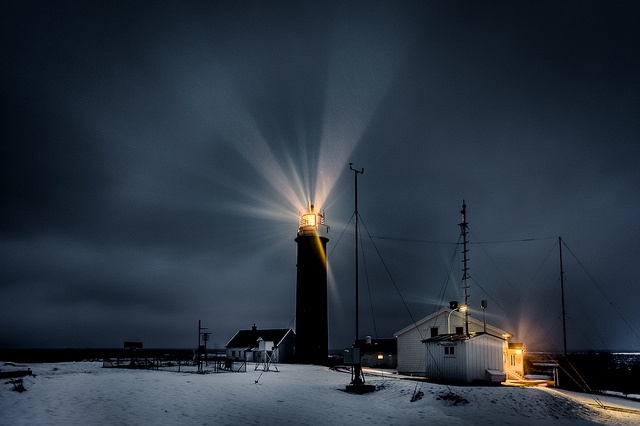
Beacon in snow
A dark lighthouse throws golden starburst beams into a thick indigo night while snow lies thin and clean around white coastal houses. Window lamps warm the cold ground; a mast and antenna remind you this is a working outpost, not a stage set. Long exposure turns the beacon into geometry. The photograph is about guidance under pressure—how a single lamproom can hold a whole weather system at bay for the length of a shutter.
Lighthouse under a racing sky
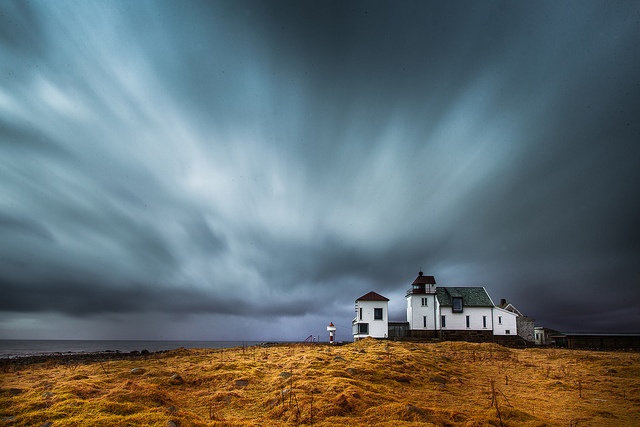
White buildings and a red-capped lantern room sit on ochre coastal grass while clouds streak outward in a radial blur. The low horizon gives the sky most of the frame, and the sea on the left stays dark and secondary. Motion in the cloud layer—whether from wind, exposure, or both—turns a still station into a drama. Heggelund often places architecture where it can survive that drama: small, pale, and necessary.
Clear water and summer boats
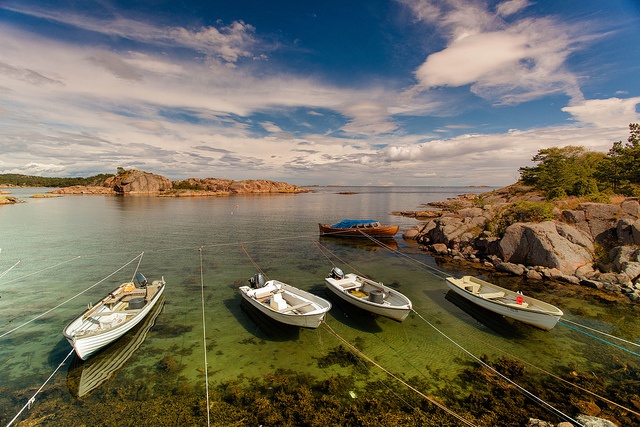
Four white motorboats float in water so clear their shadows mark the sand and weed below. Mooring lines draw diagonals across turquoise shallows; a wooden boat under a blue cover waits farther back among rounded granite. This is the Norwegian skjærgård in a generous mood—bright cirrus, smooth rock, and boats that look parked on glass. After the night and storm frames, the image proves Heggelund can also shoot quiet daylight without losing precision.
Village mirrored in gray
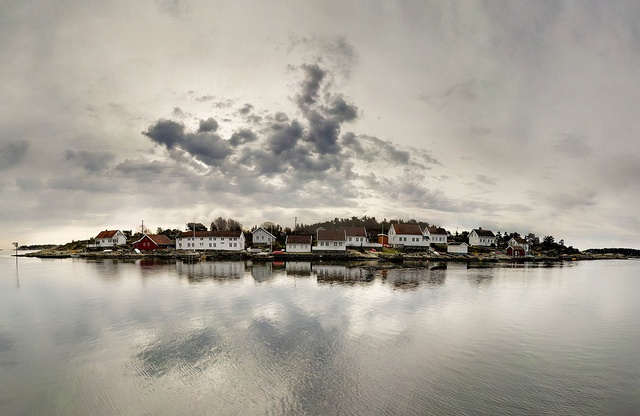
A thin strip of houses—mostly white, one deep red—lines a rocky shore under a heavy gray cloud mass. The water below repeats sky and roofs almost perfectly, so the village becomes a hinge between two nearly identical worlds. Soft light removes hard shadows and leaves texture: cloud grain, still ripples, paint on timber. Symmetry here is not a gimmick; it is what calm weather offers if you wait for the wind to quit.
Winter blue hour in the mountains
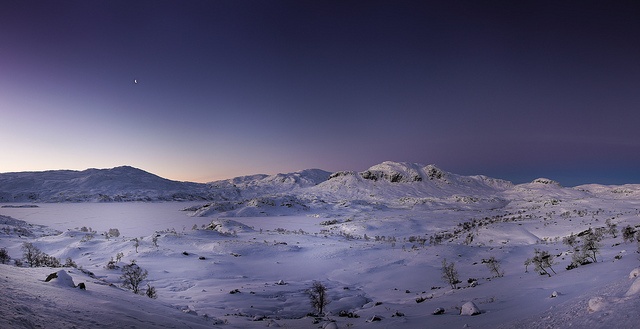
Snow dunes and a frozen expanse run toward distant peaks under indigo-purple twilight. A thin crescent moon sits high left; a faint orange seam warms the far ridge. Bare birch and scrub break the white with dark calligraphy. The panorama emphasizes scale and silence more than peaks as trophies. Heggelund’s winter files often live in this cool register, where cold color is the story and warmth is only a thin reward on the horizon.
Storm light over open sea
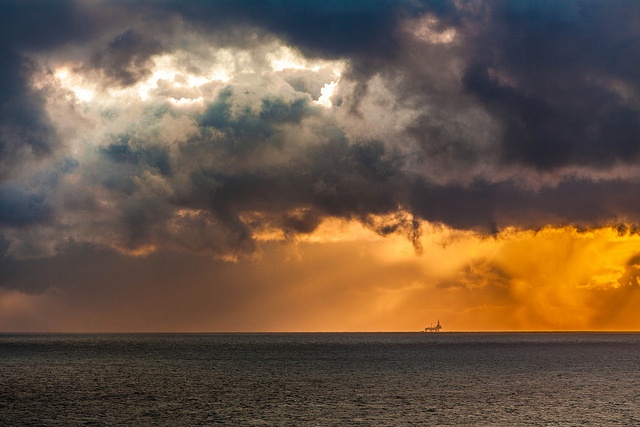
Choppy dark water fills the foreground while heavy slate cloud breaks into gold on the right. A distant offshore platform sits tiny on the horizon, more scale marker than industrial portrait. Curtains of rain catch the warm light. The photograph is about pressure systems meeting work at sea—beauty that does not pretend the coast is empty. Color contrast does the emotional lifting: charcoal against fire, solitude against infrastructure.
Hut, mountains, and a rainbow
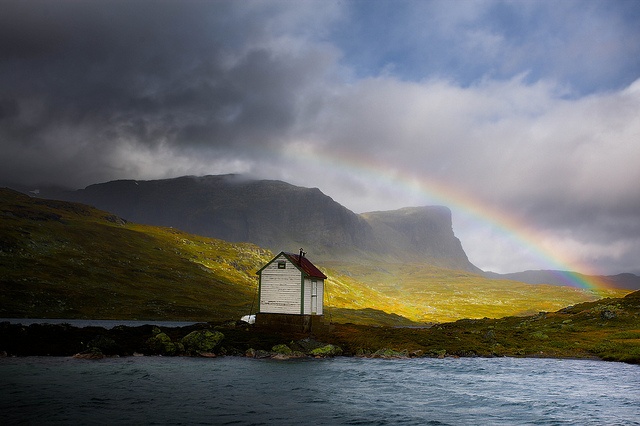
A small white hut on a rocky shore takes a brief sunlit patch while storm shadow holds the left mountains. A rainbow arcs past a flat-topped peak into a brighter valley. Water in the foreground stays dark; grass flares lime where light hits. Weather breaks like this are Heggelund territory—human shelter as a bright speck, mountains as the real architecture, and color arriving only for a minute. Miss the window and the rainbow is rumor.
Two buildings on striped rock
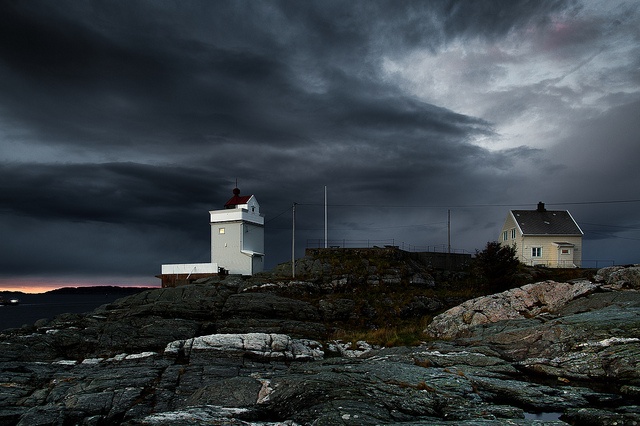
A white navigation building with a red top and a neighboring house stand on a jagged outcrop veined with pale rock stripes. Storm cloud presses down; a thin band of orange-pink light opens on the far left horizon. Utility poles and a low rail keep the scene functional. Dawn or dusk—the light is thin either way—and isolation is the composition’s thesis. Coastal Norway looks lived-in without looking crowded.
Lake gold through the trees
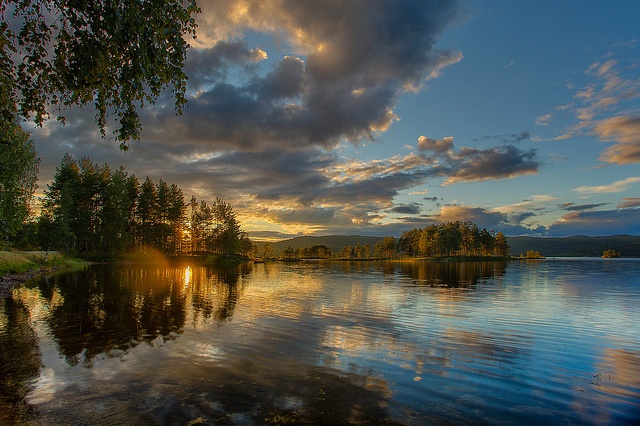
Low sun flares through evergreens on the left shore while a still lake mirrors blue sky and orange cloud. Small tree islands add depth; hanging birch leaves frame the top edge. The reflection pillar under the sun is the file’s bright spine. Inland water gives Heggelund a different tempo from the open coast: softer edges, denser green, and golden hour as a quiet ceremony rather than a storm spectacle.
Winter pier at day’s end
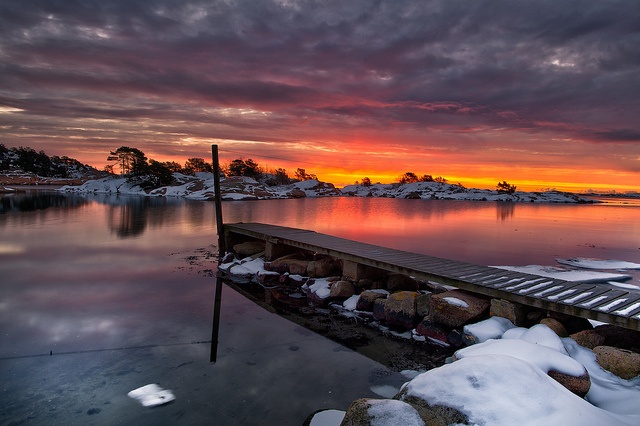
A wooden pier leads from snow-dusted rocks into calm water under a sky that burns orange at the horizon and turns purple-indigo above. Distant skerries carry a few dark trees and snow caps. Slush floats near the planks. The pier is a classic leading line, but the real subject is the temperature of the light—winter cold meeting a brief hot band before night. It is a fitting last frame: simple foreground, huge sky, Norway in one long look.
Reading the set as a whole
Together these photographs sketch Tore Heggelund’s working climate: stations and villages that endure weather, water that either clarifies or mirrors, and skies that refuse to be background. He returns to lighthouses and small houses not as tourist icons but as proof that people live inside these systems. He returns to snow and storm because Norwegian light is rarely flat for long.
If you study the set for craft, watch the horizons. Sometimes they sit low so cloud can perform. Sometimes water takes half the frame so reflection can finish the design. Sometimes a hut or pier is just large enough to keep the wilderness from becoming abstraction. That balance—human scale without dominance—is why Heggelund’s landscapes keep circulating among photographers who care about place as much as peak color.

Comments
Continue reading
David Shield Landscape Photos: Blue Hour, Reflections, and Honest Color
Eighteen landscape photographs by David Shield—coastal twilight, alpine mirrors, and light-handed color that preserves place over spectacle.
15 Winter Landscape Photos: Alpine Light, Snow, and Mountain Craft
Fifteen Alpine winter landscape frames—plus practical notes on cold light, snow exposure, storm weather, and field craft for mountain photography.
Landscape Romania: Photographs by Darran Rees
A gallery feature on Darran Rees’s Romania landscapes—Carpathian weather, rural edges, and a long look at Eastern European land shaped by patience rather than postcard haste.