
Kate Upton for Jalouse, October 2012
Alexei Hay and Jennifer Eymere put Kate Upton on Jalouse’s October 2012 cover in Paris high-fashion volume—coats, gloves, and a deliberate step beyond swimsuit fame.
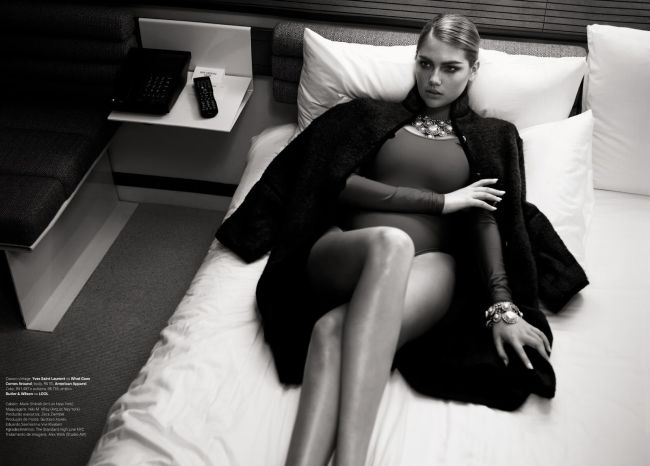
In September 2012, French magazine Jalouse put Kate Upton on its October cover in a high-fashion key that deliberately complicated her swimsuit reputation. Photographer Alexei Hay and stylist Jennifer Eymere dressed the American model in volume, texture, and couture-adjacent armor—wool coats, fur collars, lace, leather gloves, statement headgear—while still allowing the cover enough skin to remain instantly recognizable. The feature circulated under titles such as “Le Révelation” and “Holy Kate,” language that cast Upton as a fashion-system event rather than a one-note pin-up.
Jalouse’s job in Paris media culture was never identical to Cosmopolitan’s job in the United States. The French title spoke to a younger, sharper fashion audience and liked editorial risk. Booking Upton in autumn 2012 was a statement: the model who danced for internet cameras could also hold a French fashion cover if you changed the wardrobe grammar. Hay’s photographs test that claim pose by pose. The test is the reason the cover still matters as a historical document. It is less about gossip than about whether fashion media would expand its definition of who belonged on a serious Paris cover.
Alexei Hay and Jennifer Eymere’s fashion argument
Hay’s camera does not chase barn comedy or men’s-magazine perfume haze. It chases fashion silhouette. Coats become architecture. Hats and draped neck pieces redraw the outline of the head and shoulders. Long gloves turn arms into graphic lines. Even when cleavage remains part of the cover negotiation—as contemporary write-ups noted with some amusement—the surrounding clothes insist on fashion literacy. This is Paris talking, not a beach calendar, and the conversation is conducted in volume and texture.
Jennifer Eymere’s styling pulls from houses and moods associated with serious pages: Prada wool, Burberry outerwear cues, Dior and other designer references noted in period coverage, lace against leather, fur against clean makeup. The accumulation matters. One chic coat can look like a celebrity portrait. A full sequence of heavy, textured, sometimes almost costume-like fashion looks like an editorial thesis. Jalouse’s thesis: Upton can wear fashion’s difficulty without disappearing inside it.
Beauty finishes reinforce the upgrade. Coverage at the time praised polished, near-airbrushed makeup and precise hair that read as French magazine gloss rather than California beach shine. The face stays Kate Upton; the finish relocates her to Jalouse’s visual country. That relocation is half the story. Without it, the coats would look like borrowed costumes. With it, they look like a magazine inventing a new season of her image.
Why “covered up” still counted as a revelation
American blogs joked that Upton was “kind of” covering up for Jalouse—more fabric than a bikini story, still enough body to satisfy recognition. That joke misses the fashion point. In 2012, “more clothing” for Upton was itself news because her public image had been so tightly braided to swimwear and viral movement. Putting her in thick wool and gloves was a rebranding gesture aimed at editors who claimed she was “too obvious” for high fashion.
Those critics were part of the atmosphere around her rise. Some fashion voices dismissed her body type and fame pathway as incompatible with elite taste. Bookings like Jalouse, and her work around Carine Roitfeld’s CR Fashion Book orbit the same season, were counter-evidence. Whether every critic converted is beside the point. Magazines vote with covers. Jalouse cast a vote for range, and Hay’s images are the ballot.
In interview remarks circulated with the feature, Upton described fashion as a clique that wants difference staggered across ideals of perfection—not merely prettiness. The quote fits a model mid-ascent, learning the politics of the industry that was both using and judging her. Jalouse’s pages give that politics a wardrobe: difference expressed through silhouette and texture rather than through another swimsuit variation. The clothes become the argument she was making in words.
October cover energy in a French glossy
October issues often lean into fall fashion’s heavier fabrics and darker romance. Jalouse’s Upton cover rides that seasonal logic. Fur collars and wool coats are not random; they are calendar-correct fashion signals. The cover still has to seduce at the kiosk, so the magazine keeps a recognizable body cue. That tension—seasonal fashion seriousness versus celebrity recognizability—is the cover’s engine. Remove either side and the issue either becomes anonymous fashion or becomes a tabloid with nicer type.
Compared with Elle France’s January 2013 “American Beauty” casual story, Jalouse October 2012 is sterner and more stylized. Compared with Cosmopolitan’s November western lingerie package, it is fashion-first rather than advice-and-flirtation-first. Compared with GQ Italia’s soft sensuality by Guy Aroch, it is colder, more structured, more about clothes as sculpture. Same model, four magazine dialects—and Jalouse is the dialect that most aggressively insists on fashion-system membership.
Paris cover culture also rewards a certain cool distance. Hay’s Upton is glamorous, but she is not always “friendly” in the Cosmo sense. The magazine can afford a little aloofness because the clothes are doing conversational work. Readers are meant to study the look, not only envy the body. That is a different reader contract from an American mainstream women’s title, and the photographs honor it.
How to look at the Jalouse set
Start with outline, not skin. Ask what the coat does to the shoulder line, what the hat does to the face’s scale, how gloves change gesture. Then notice where Hay leaves breathing room—moments when Upton’s expression softens the armor. The best frames in stories like this usually balance fashion difficulty with human readability. If the clothes win completely, the celebrity disappears; if the celebrity wins completely, Jalouse looks like a tabloid in nicer type. The successful images hold both forces in view at once.
Also watch the progression that American headlines teased: looks that gradually add clothing and fashion density. Whether or not every frame follows a literal “more clothes” sequence, the editorial’s reputation rested on proving Upton could escalate from body-famous to fashion-costumed without losing presence. That escalation is the plot. Read the gallery as a conversion narrative told in fabric weight, not as a random assortment of pretty pictures.
- Photographer: Alexei Hay
- Stylist: Jennifer Eymere
- Issue: Jalouse, October 2012
- Register: Paris high-fashion volume, fall textures, cover recognition negotiated with cleavage and couture cues
- Context: Upton’s 2012 push into fashion-facing titles beyond swimsuit fame
- Contrast file: Cosmo (flirt), GQ Italia (soft sensual), Elle France (casual chic), Jalouse (fashion armor)
File this one under French fashion conversion narrative. Alexei Hay and Jennifer Eymere did not ask Kate Upton to abandon the body that made her famous; they asked the body to wear Jalouse’s autumn language—coats, gloves, hats, and the cool distance of a Paris cover.

Comments
Continue reading
Kate Upton on Vogue Brasil July 2013: E o Novo Sexy
Henrique Gendre and Luis Fiod put Kate Upton on Vogue Brasil’s July 2013 cover in Miu Miu—a Brazilian newsstand thesis on “the new sexy.”
Kate Upton for GQ Italy, August 2012
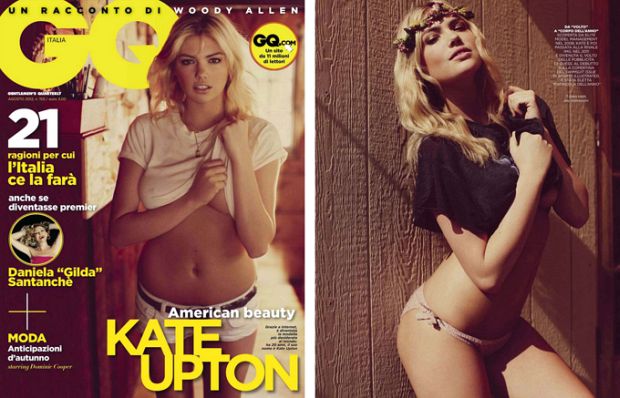
Guy Aroch photographs Kate Upton for GQ Italia’s August 2012 cover, styled by Emily Current and Meritt Elliot—soft, retro-leaning European men’s-magazine sensuality.
Kate Upton for Vogue Germany January 2013: Bruce Weber
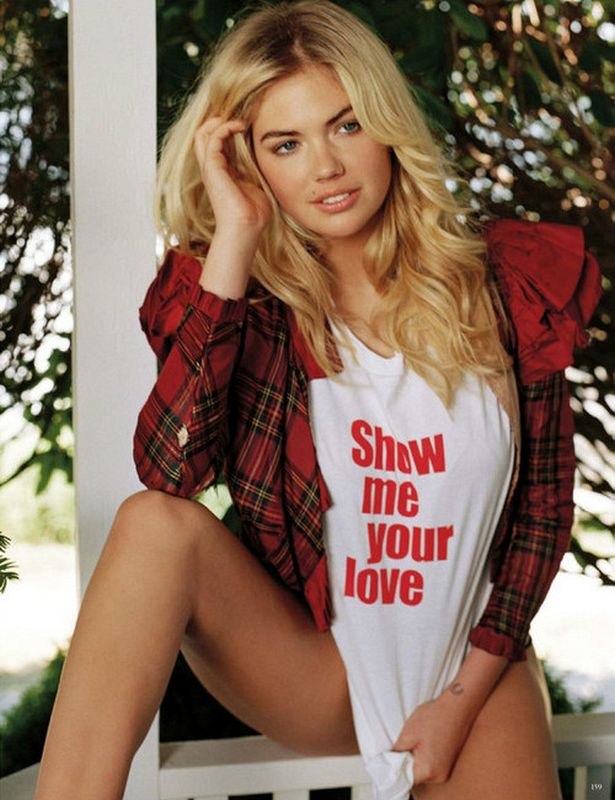
Bruce Weber and Anne Christensen’s January 2013 Vogue Germany feature—outdoor European wardrobe romance, from Ackermann to Eres.