
Tomás Sánchez’s Meditative Landscape Paintings
Fifteen tropical landscapes by Cuban artist Tomás Sánchez—waterfalls, flooded forests, crater voids, and tiny wanderers inside hyperreal quiet.
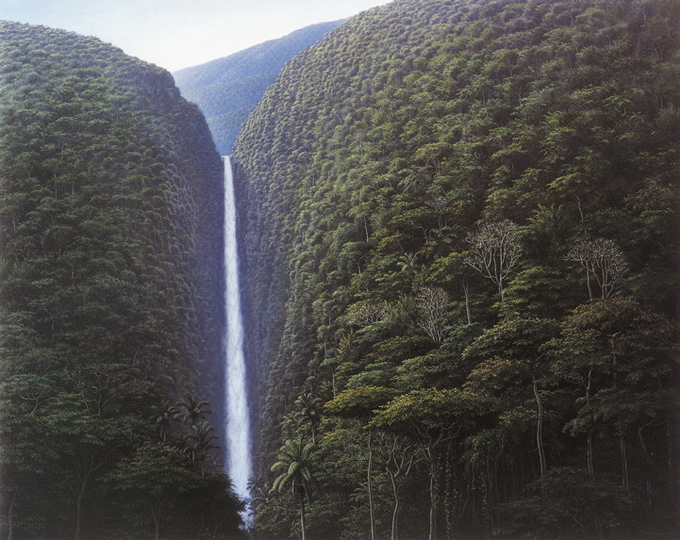
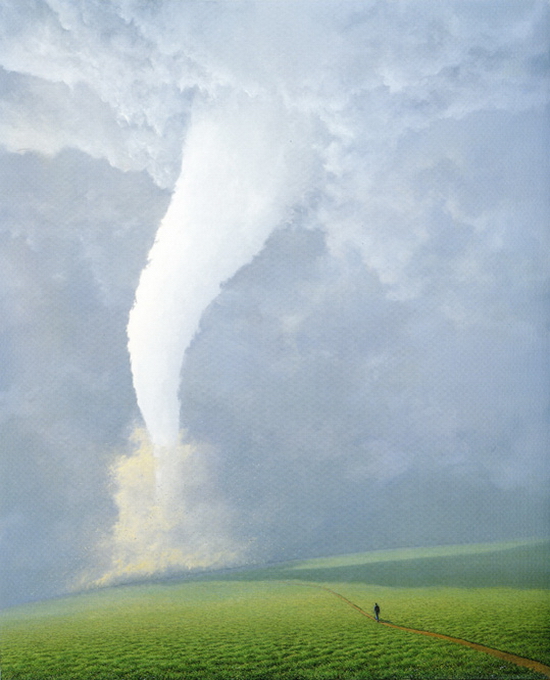
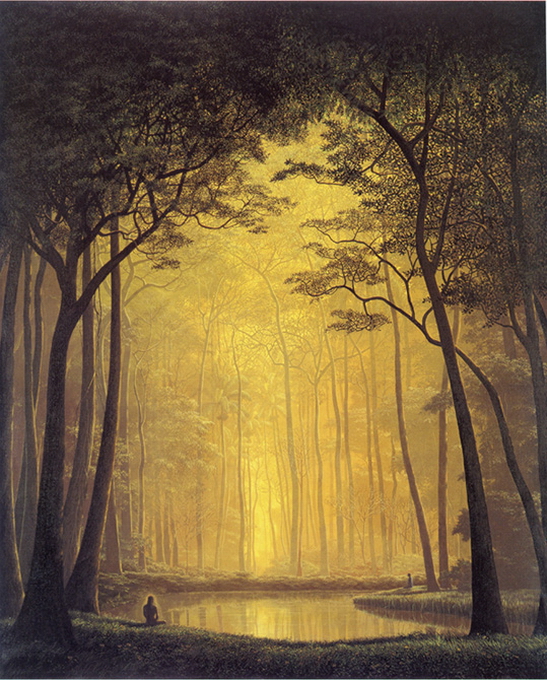
Tomás Sánchez paints forests as if silence had a topography. Canopy after canopy, river after river, the Cuban artist and photographer builds tropical worlds so densely articulated that the eye keeps finding new leaves long after the mind has already understood the scene. These landscapes are not travel postcards. They are meditations staged as wilderness—places where water falls in clean geometry, where flooded trees become archipelagos, and where a human figure, when it appears at all, is almost a punctuation mark.
The set gathered here shows the range of that vision: V-shaped valleys with ribbon waterfalls, circular voids cut into jungle, mirror lakes around solitary islands, high aerial rivers, and tall palms casting long shadows across grass. Look slowly. Sánchez’s detail is not decoration; it is how the paintings argue that nature deserves sustained attention.
Hyperreal canopy, surreal calm
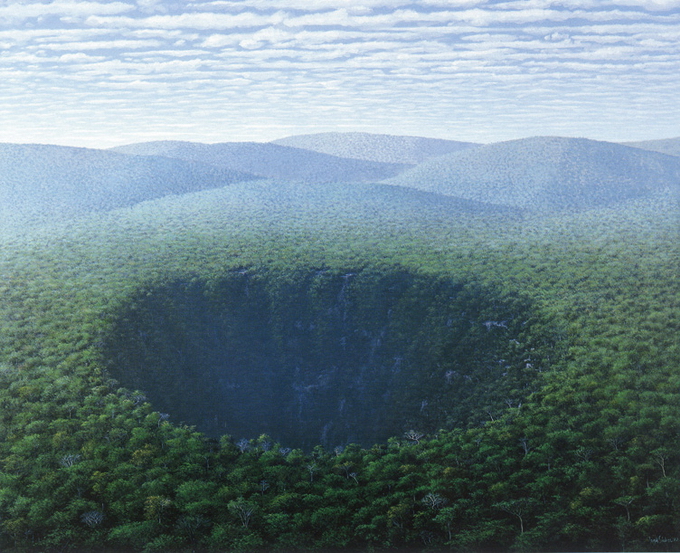
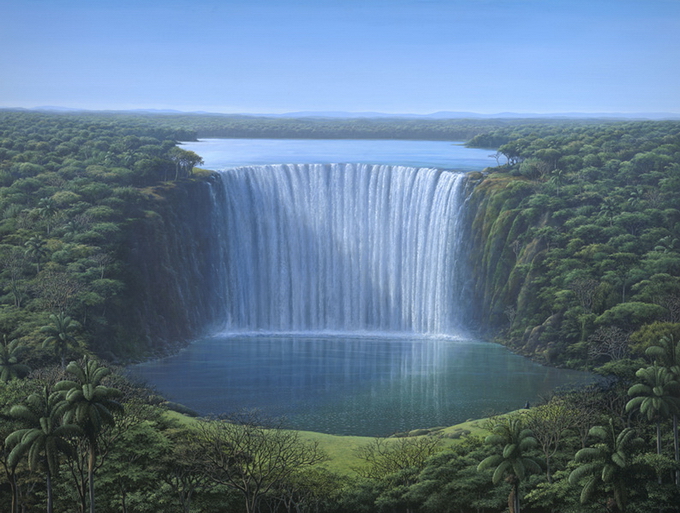
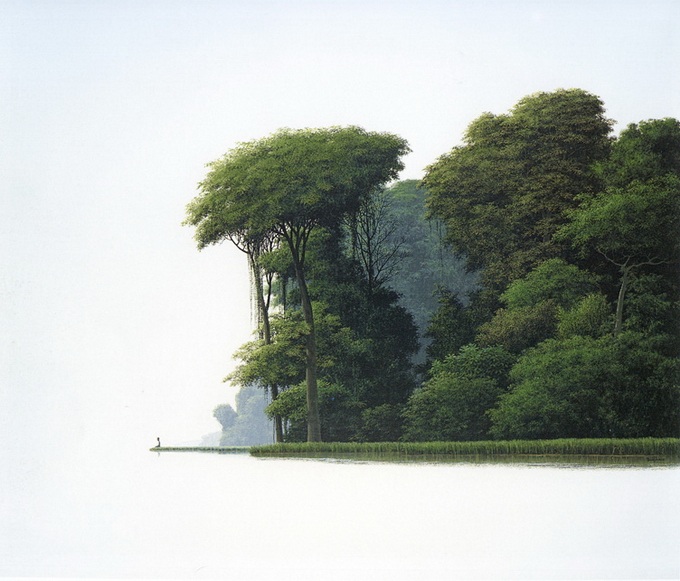
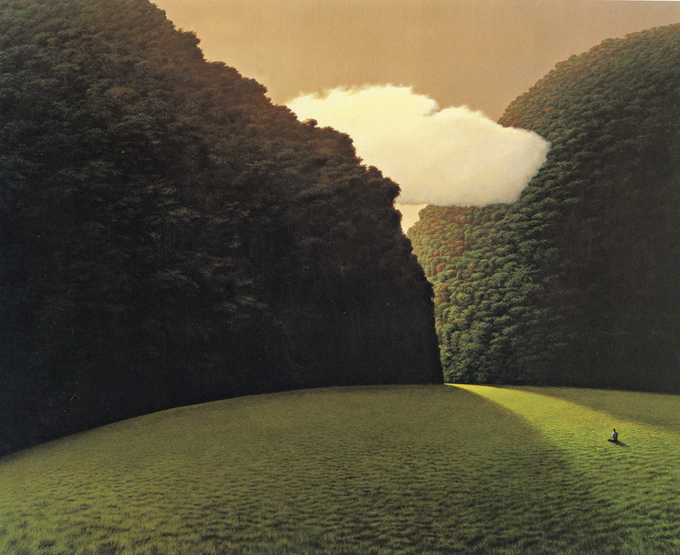
Call the style hyperreal if you need a gallery word, but notice what the realism is doing. Individual crowns, palm silhouettes, and atmospheric blues into distant hills create belief. Then the compositions quietly exceed ordinary sightseeing. A waterfall drops as a single white axis between twin forested slopes. A circular crater opens in the middle of unbroken green like a pupil. A curtain of water falls in countless vertical threads from a flat upper lake into a turquoise pool. These are landscapes that feel discovered and invented at the same time.
That double feeling is central to Sánchez’s reputation. Viewers often sense both environmental reverence and an interior, almost spiritual quiet. The jungle is lush enough to be ecological testimony; the stillness is strong enough to feel like a mind cleared of chatter. Painting becomes a way to hold both at once without turning either into a slogan.
Water as path, mirror, and measure
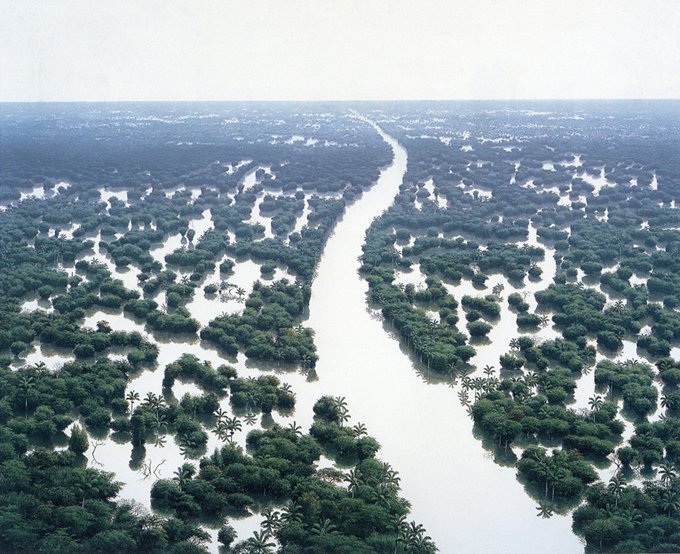
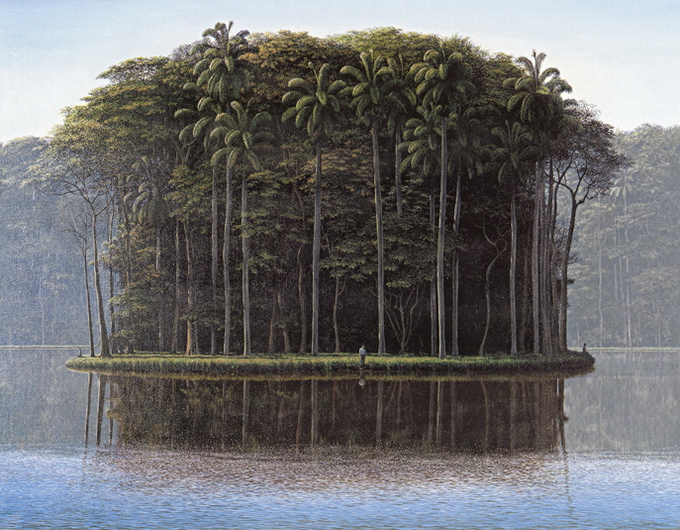
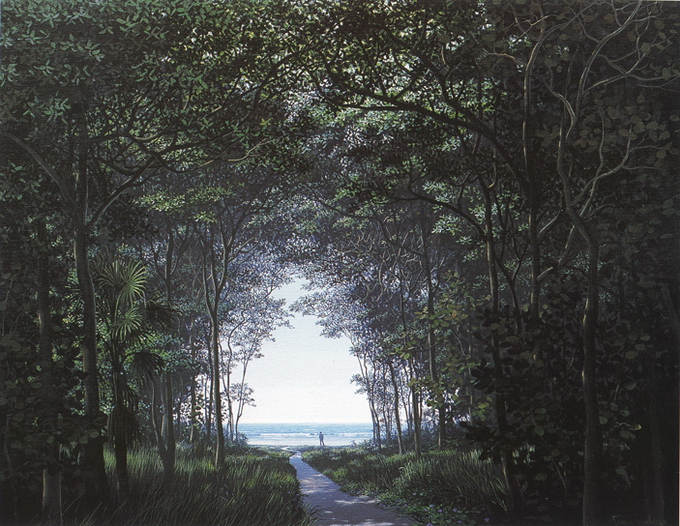
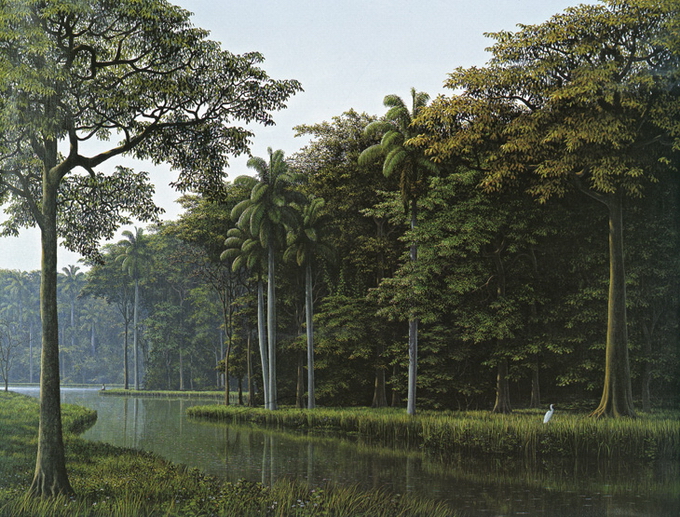
Across these works, water is rarely chaotic. It is a pale channel winding through flooded forest, a mirror holding an island’s reflection, a vertical fall that organizes an entire valley. Still surfaces amplify solitude: every palm and every cloud edge returns as a second world. Moving water, when it appears as falls, tends to be disciplined—threads, ribbons, curtains—so motion stays readable against the dense stillness of trees.
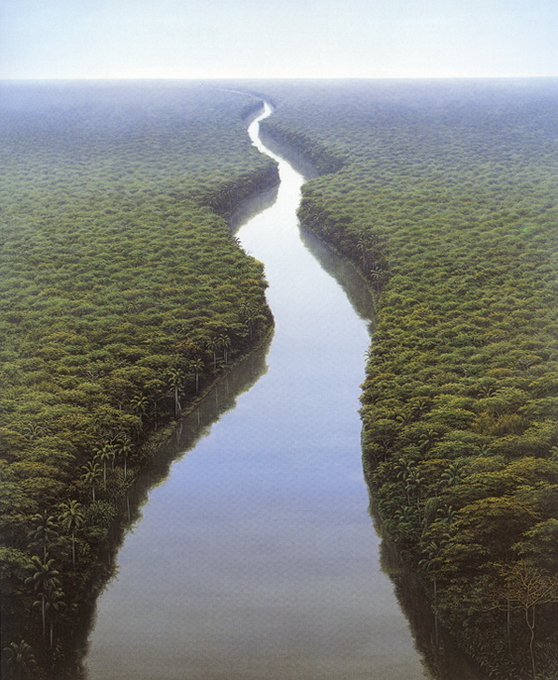
Flooded landscapes turn canopy tops into dark green islands scattered across silver. The high horizon makes the world feel continuous, almost endless. You are invited to travel by eye along the bright water the way a canoe might travel in reality, except nothing here hurries. Sánchez paints looking as a form of walking.
On the circular island painting, scale snaps into focus when a tiny figure stands on the grassy rim facing the trees. That human mark does not conquer the scene. It measures it. The forest becomes cathedral-tall; the water becomes a courtyard of light. A second small presence at the far edge can feel like an echo—another seeker, or the same solitude doubled.
The void and the endless green
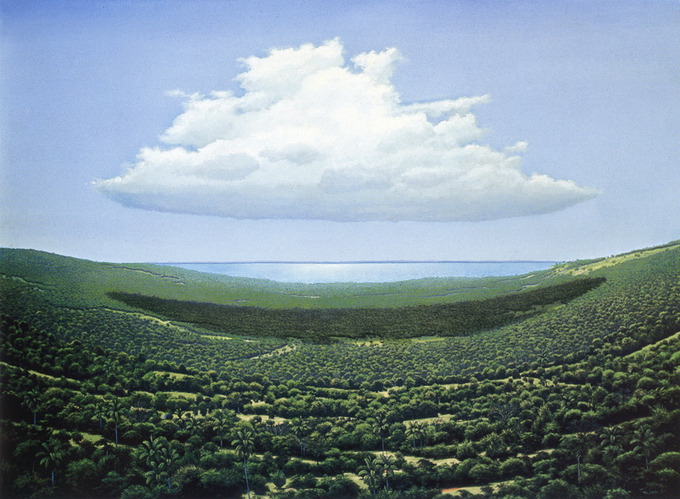
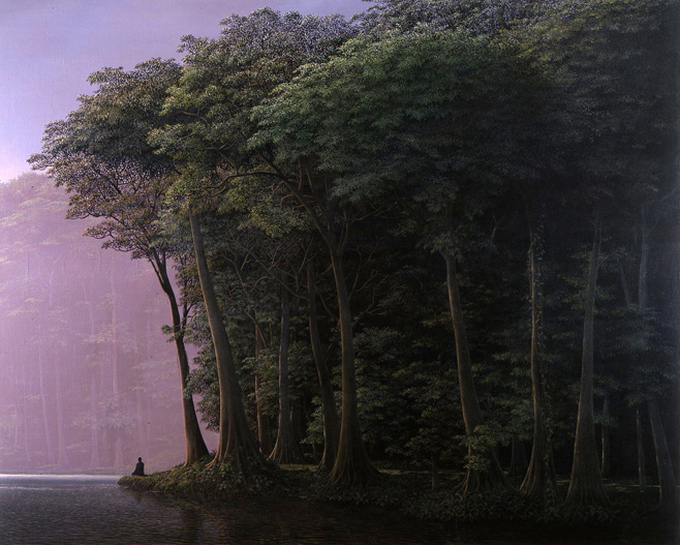
The crater-in-jungle motif is one of Sánchez’s most memorable confrontations. An unbroken carpet of trees meets a circular darkness whose bottom refuses to explain itself. Light grazes the canopy; the pit keeps its secret. In a body of work already devoted to plenitude—leaf on leaf, hill on hill—the void is a necessary counterweight. Fullness needs emptiness to remain spiritual rather than merely decorative.
Elsewhere, plenitude wins without apology. Aerial rivers S-curve through textured green that softens into blue distance. Atmospheric perspective does quiet engineering: near trees stay crisp and varied; far ridges cool and simplify. The sky often stays pale, almost emptied, so the land can carry the drama. Clouds, when present, tend to be thin and horizontal, like calm weather that refuses melodrama.
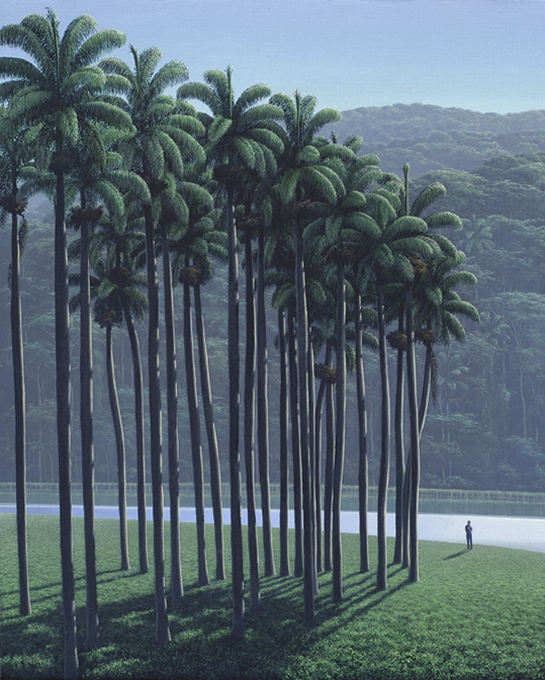
Palms recur as signature verticals—slender trunks, crown bursts, sometimes fruit clusters—especially eloquent in upright compositions where a wanderer stands small beside a row of royal palms and long ground shadows. Those shadows prove the sun’s angle and the ground’s flatness in one stroke. Vertical trunks versus horizontal field and water: a classical balance achieved with tropical vocabulary.
How to look without rushing
Start with structure. Find the axis—waterfall, river bend, crater rim, palm line—and let it organize your first pass. Then drop into texture. Sánchez rewards the second looking: the way one crown sits slightly lighter than its neighbor, the thin bright grass rim of an island, the soft glints on near water before the mirror goes perfect. That shift from map-reading to leaf-reading is part of the pleasure.
Notice absence as carefully as presence. Roads, buildings, smoke, and litter do not belong to these worlds. The omission is ethical as much as aesthetic. Idealized wilderness can be criticized as fantasy, yet Sánchez’s fantasy is disciplined: it asks what attention to an intact world feels like. In an era of fragmented attention and damaged habitats, the paintings function as both longing and standard.
If a tiny walker appears, resist treating the figure as the “subject.” The subject remains the land. The person is a tuning fork for scale and a model for behavior—stand, look, do not dominate. Titles and series themes around seekers, wanderers, and arrivals fit that stance. Arrival is quiet. The forest does not applaud.
Painting as slow ecology
Labor is visible even when brushwork hides itself. Canopies this dense imply time: decisions about value, temperature, and edge repeated thousands of times. That labor mirrors ecological complexity. A forest is not one green; it is a society of greens. Sánchez paints the society. Viewers who only glance see “pretty jungle.” Viewers who stay begin to sense systems—water feeding trees, trees holding hills, hills holding weather, weather returning as reflection.
Because he is also a photographer, clarity and framing in the paintings often feel camera-aware without becoming photoreal copy. Compositions have the decisiveness of a well-chosen viewpoint: high enough to reveal pattern, close enough to keep intimacy with palms and shorelines. The result is neither pure document nor pure dream. It is a constructed paradise that still obeys gravity, light, and botanical persuasion.
Taken together, these landscapes form a portable gallery of Tomás Sánchez’s central argument: that looking at nature carefully is a moral and spiritual act, not only an aesthetic hobby. Waterfalls divide valleys like thoughts dividing silence. Craters open questions. Islands mirror themselves until self and world blur. Palm shadows stretch across grass like sundials for solitude. Stay with any one panel until the first wow fades; what remains is slower—an invitation to seek landscapes not as trophies, but as places where the mind can finally match the hush of leaves.

Comments
Continue reading
Brian Mashburn’s Ominous Oil Cityscapes: Fog, Industry, and Gothic Skylines
Inspired by travel through Hong Kong, Thailand, and China, Brian Mashburn’s meticulous oil paintings stage gloomy cityscapes where nature, culture, and industry share an uneasy sky.
Photo-Realistic Muscle Car Paintings by Cheryl Kelley
Cheryl Kelley’s glossy oil paintings of classic muscle cars—photo-based realism, chrome reflections, and a feminine take on automotive glamour, with gallery images.

Ray Massey’s Hand Paintings: Trompe-l’oeil Athletes, Castles, and Everyday Objects
Ray Massey’s painted-hand photographs turn fingers into footballers, sprinters, castles, pencil cups, and bananas—studio trompe-l’oeil with lasting wit.