
Ray Massey’s Hand Paintings: Trompe-l’oeil Athletes, Castles, and Everyday Objects
Ray Massey’s painted-hand photographs turn fingers into footballers, sprinters, castles, pencil cups, and bananas—studio trompe-l’oeil with lasting wit.
Ray Massey’s hand paintings begin with a problem every photographer knows: hands are difficult. They crease, shine, fidget, and refuse to look as elegant as the objects advertising wants them to become. Massey’s answer was not to hide the hands but to conscript them. With body painters—among them Annie Ralli and Annie Miller—and with professional hand models hired for stamina as much as for appearance, he built a set of trompe-l’oeil photographs in which palms, knuckles, and fingertips impersonate athletes, architecture, desk tools, fruit, and blunt commercial puns.
Many of the frames later traveled as viral curios; their origin sits closer to the studio than to the meme. Massey’s commercial practice already favored precision. Here that precision meets hours of paint (often four to six) and a remaining day of lighting, pose micro-corrections, and shutter work. Some images connected to an Ecclesiastical Insurance campaign around the phrase “You’re in good hands.” The slogan fits the pictures; the pictures do not need the slogan to remain interesting.
Athletes built from fingers
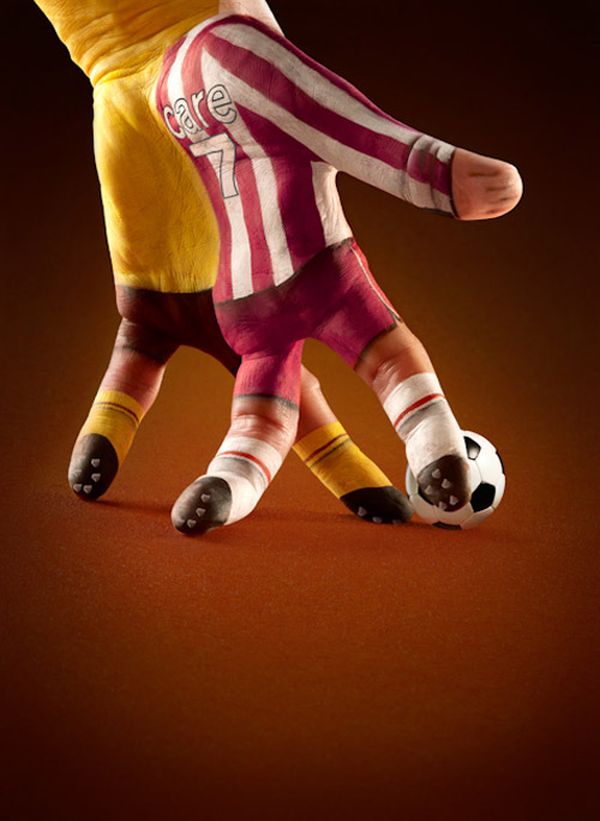
On a warm brown ground that reads as dried pitch, two hands become footballers contesting a ball. The nearer figure wears red-and-white vertical stripes; across the back of the hand the word “care” and the number 7 sit where a squad name and number would. Painted socks run down the index and middle fingers into black-and-white cleats at the tips. A thumb becomes an arm in a white sleeve. Behind, a yellow-kit challenger mirrors the pose. A small real football rests at the striped player’s boots. Soft light from above left drops short shadows so the “legs” feel weight-bearing. The joke is instant; the difficulty is continuous—stripes that wrap living knuckles, stud detail that survives a tight crop, two models holding a tackle angle without tremor.
A second sporting image moves outdoors in spirit if not in fact. Two hands crouch on a red synthetic track in lanes marked 1 and 2, yellow and red singlets painted onto the skin. Minimal faces occupy the knuckle zone: thin eye marks on one runner, a slanted scowl on the other. Fingers stretch into braced arms and starting-block legs. A blurred stadium crowd supplies depth without stealing focus. Where the football scene needs a prop ball, the sprint scene needs cultural memory—the crouch every viewer has seen on television—so paint can stay economical and still feel complete.
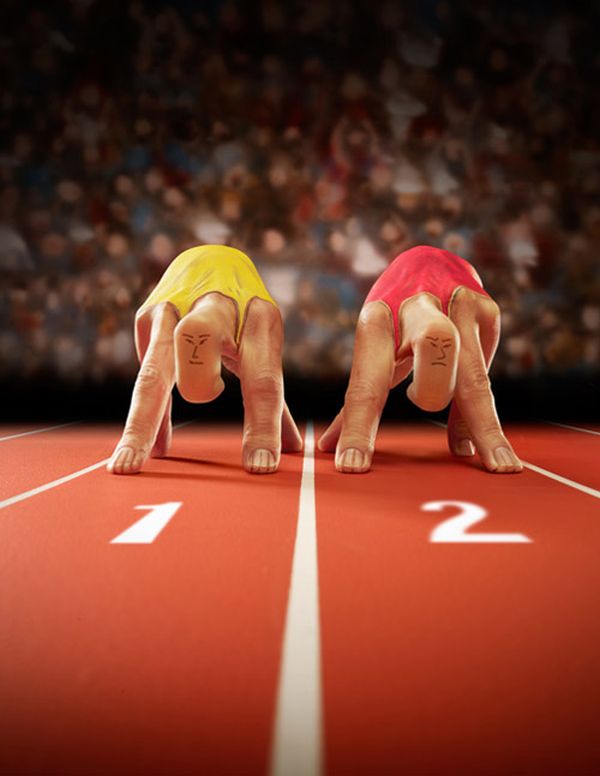
Both sports pictures use the hand’s length as limb length. That mapping is obvious once seen and almost impossible to unsee. Massey’s lighting refuses beauty-filter softness; it models volume the way product photography models a bottle, because the painted jersey is a product surface on a living form.
Wordplay and walls
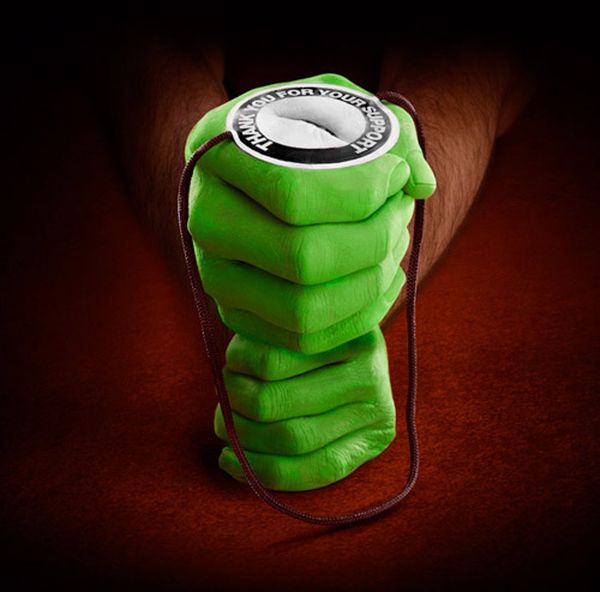
Stacked fists painted solid lime green become an athletic supporter. A circular badge on top reads “THANK YOU FOR YOUR SUPPORT”; a dark strap loops down the front. Unpainted forearms enter from a dark upper field; a spotlight isolates the green mass against a reddish table. The gag is unsubtle. The photograph is not—it is composed like a catalog hero shot, edges clean, color saturated, humor delivered without clutter. Commercial body art risks tipping into novelty-shop tone; Massey’s framing keeps it closer to campaign still-life.
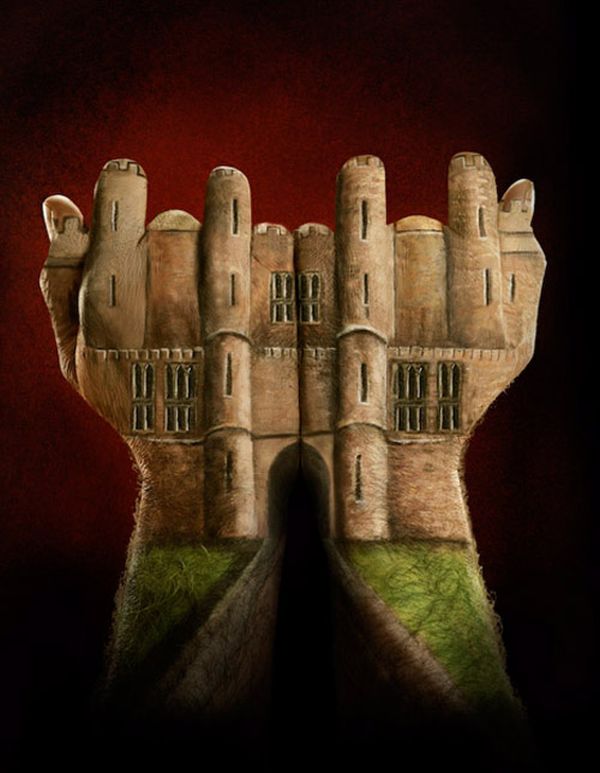
Architecture asks more of the paint. Two hands pressed together form a medieval castle: crenellations on fingertips, towers along the outer digits, rows of tiny windows, arrow slits, and a dark arched gate where the palms meet. Lower palms and wrists turn into a green embankment leading to the walls. Stone color sits in earthy tans and browns against a moody red-to-black ground. Faint skin texture under the paint keeps the fortress slightly haunted—never a pure illustration, always a body pretending. Perspective must hold across two hands that want to shift; models who can “pose their hands,” as Massey has put it, are not a luxury here.
Everyday objects, closely observed
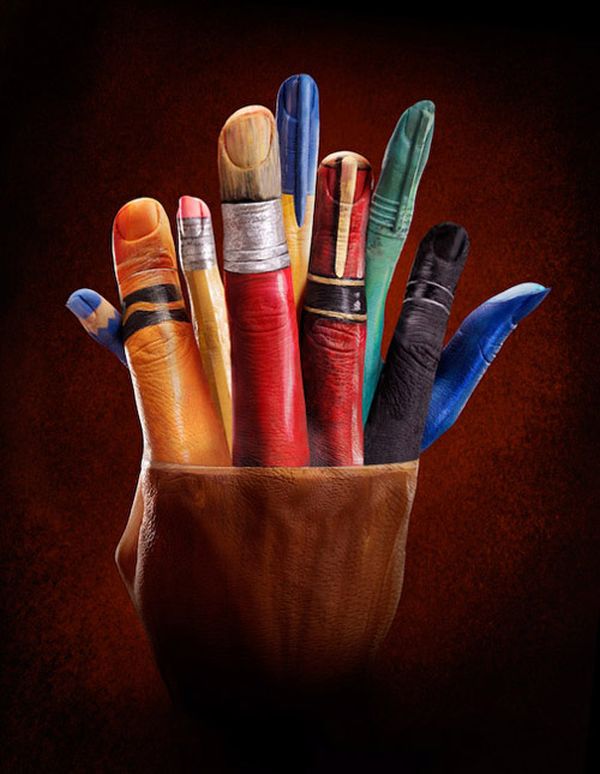
A pencil cup may be the series’ most persuasive ordinary object. The palm and wrist become a matte brown wooden vessel; fingers and thumb become the contents—an orange crayon with black bands, a yellow pencil with ferrule and pink eraser, a red brush with silver collar and tan bristles at the tip, ballpoints and a fountain pen with gold rings, cooler teal and black pens filling the gaps. Knuckles supply natural segmentation along barrels. Against dark reddish texture, the tool colors behave like real desk clutter under a lamp. Viewers do not need a slogan to understand the image; they have owned the cup.
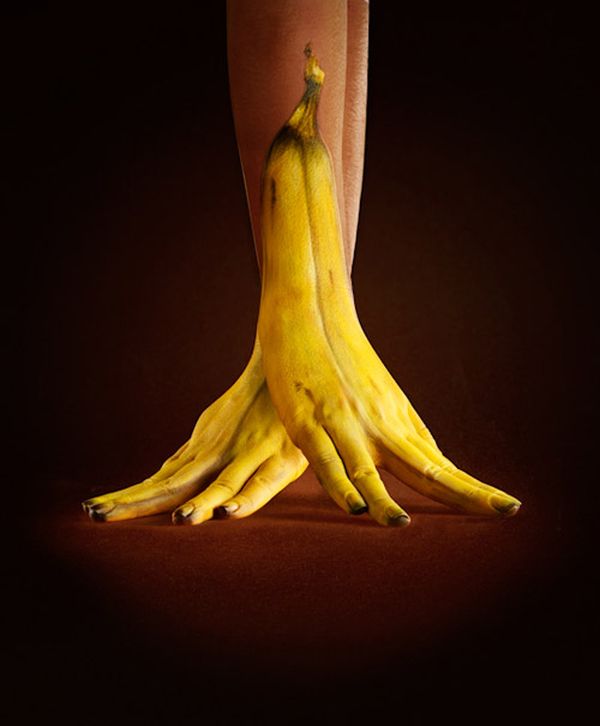
The banana is pure silhouette discipline. Two forearms join at a dark stem; yellow paint carries ridge lines and bruise marks down the length; hands cross at the wrists so darkened fingertips splay on the table like the spotted end of the fruit. Any shake would kink the curve. The photograph freezes a hold that took patience to find and more patience to keep. Skin still whispers under the yellow, which is why the piece feels surreal rather than like a prop banana hung in front of the lens.
Craft, collaboration, and what remains
It is fair to credit the chain of making. Body painters translate Massey’s concepts onto skin with materials safe enough for models who must return tomorrow. Hand models supply the rare combination of photogenic structure and muscular control. Massey’s role is the final authoring: choose the camera height that sells a tackle or a castle gate, set depth of field so a crowd softens while cleat studs stay crisp, decide when a real miniature football helps and when lane numbers are enough.
Digital compositing could approximate these ideas with less sweat now. What the series keeps is friction—paint thickness on pores, the slight asymmetry of real knuckles, the knowledge that someone held still while the shutter fired. That friction is why the footballers still look mid-challenge and the pencil cup still looks borrowable.
Seen together, the six images outline a method: invent a silhouette a hand can honestly become; paint only the cues the silhouette needs; light for volume; crop until the pun or the object is inevitable. Ray Massey’s hand paintings endure because they never quite finish transforming. For a second you see players, a fortress, a banana. Then you see hands again—and the second seeing is as carefully directed as the first.

Comments
Continue reading
Photo-Realistic Muscle Car Paintings by Cheryl Kelley
Cheryl Kelley’s glossy oil paintings of classic muscle cars—photo-based realism, chrome reflections, and a feminine take on automotive glamour, with gallery images.

Evgeny Lushpin’s Evening Journey: Twilight Cities, Canals, and Cable Cars
A gallery walk through Evgeny Lushpin’s twilight paintings—from St. Petersburg roofs and European canals to Montmartre rain and the San Francisco Evening Journey canvas.
Photo-Realistic Paintings by Patrick Kramer
Utah painter Patrick Kramer’s photoreal oil works—why handmade perfection still matters beside photography, with a look at process and portfolio images.