
Evgeny Lushpin’s Evening Journey: Twilight Cities, Canals, and Cable Cars
A gallery walk through Evgeny Lushpin’s twilight paintings—from St. Petersburg roofs and European canals to Montmartre rain and the San Francisco Evening Journey canvas.
Evgeny Lushpin paints cities and villages as if the day has already excused itself and left the lights on. Born in 1966 and trained in classical European schools, the Russian painter became widely known for hyper-detailed twilight scenes: wet cobblestones, snow-laden roofs, canal reflections, and windows that burn amber against cool blue air. His work travels—St. Petersburg, Paris, Venice, San Francisco, alpine villages—yet the hour rarely changes. It is always the hinge between day and night, when artificial light begins to outrank the sky.
This gallery gathers paintings long associated online with Lushpin’s evening mood, including the San Francisco cable-car canvas often titled Evening Journey (2012). Together they read less like tourist postcards than like a single sensibility repeated across climates: romance without spectacle, solitude without emptiness, and craft that invites you to count chimneys before you notice how quiet the street feels.
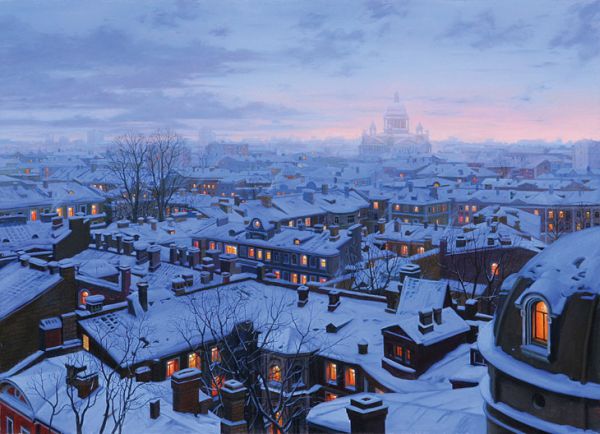
Rooftops toward St. Isaac’s
From an elevated winter vantage, snow covers a dense field of chimneys and pitched roofs while St. Isaac’s Cathedral holds the horizon. A single arched window in a turret glows close to the viewer; farther out, hundreds of smaller panes flicker like embers. Lushpin’s snow is never blank. It holds lavender and pale pink from the sky, then yields warm spill wherever glass meets interior light. The city feels inhabited without a single figure in the street—only evidence of rooms still awake.
Canal boats and amber windows
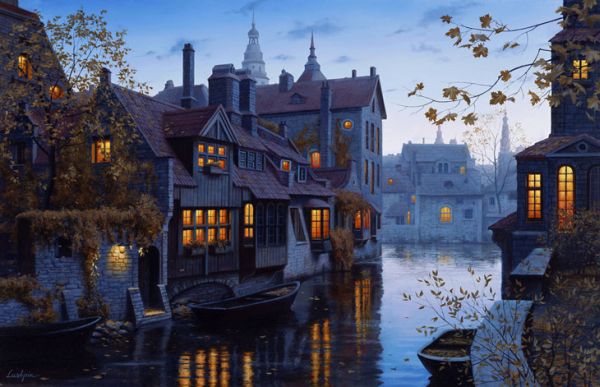
Stone walls, timber gables, and red roofs lean toward a narrow canal. Two empty wooden boats rest against the banks while autumn leaves drift on dark water. Warm interior light stretches into long reflections; distant church towers dissolve into misty blue. Complementary color does the emotional work: teal dusk versus orange rooms. You sense people behind the glass without needing their silhouettes on the quay.
Stairs, lamps, and an umbrella
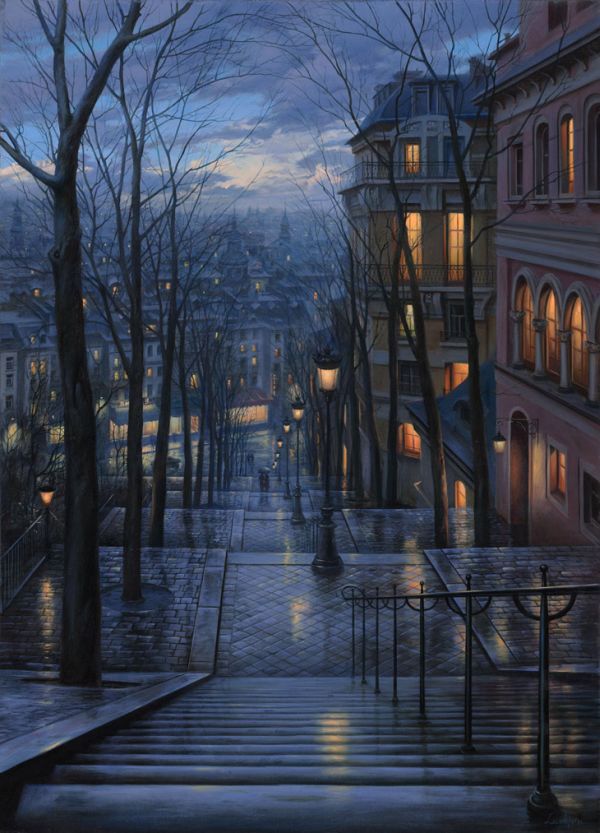
A steep flight of wet stone steps drops toward a valley of roofs. Antique lamp posts throw amber pools onto reflective paving; bare trees rake the indigo sky. Far down the path, a couple shares one umbrella—the smallest narrative mark in a large vertical composition. Lushpin often places people as punctuation, not protagonists. Weather and architecture carry the plot; the figures confirm that someone chose to walk through it.
Bridge, café, and bicycles
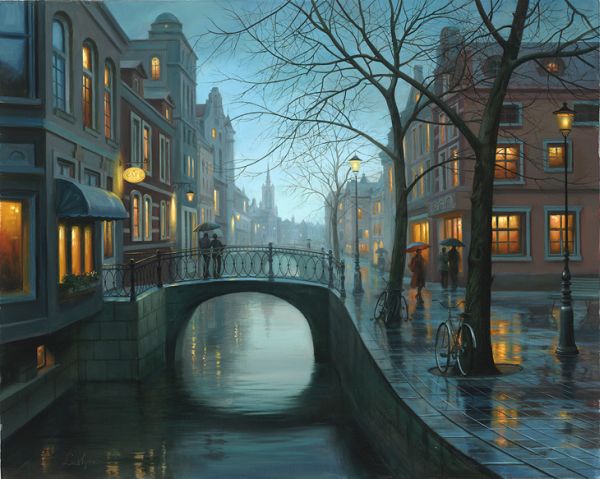
An arched bridge crosses a canal while a lit café sign hangs over wet sidewalks and parked bicycles. Pedestrians with umbrellas move through haze toward a distant spire. Rain here is not gloom; it is a mirror. Lushpin’s wet surfaces multiply every lamp until the street becomes a second sky, cooler above and warmer below.
Snow village on still water
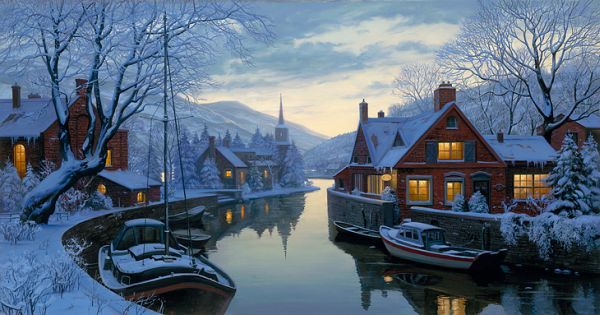
Brick houses, icicles, evergreen banks, and a slender church spire gather around a glassy canal. A dark barge and a smaller white craft sit under thick snow while window light prints gold on the water. Mountains soften into dusk behind the trees. The painting treats winter as shelter rather than hardship: cold air outside, unbroken warmth inside, and boats waiting as if the next voyage can wait until morning.
Autumn brick house and stone arch
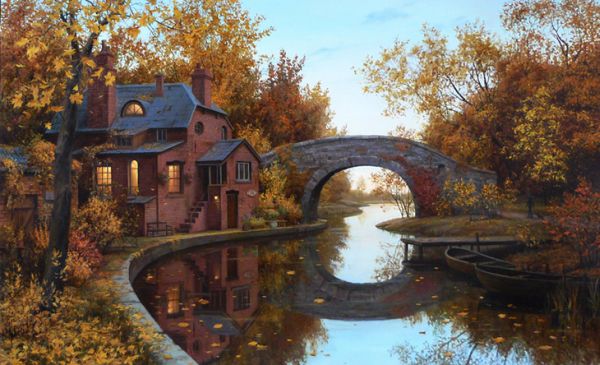
A red-brick house with glowing windows stands among gold foliage. A stone arch and its reflection nearly close into a circle; two rowboats rest near a simple pier. Fallen leaves float like quiet commas. Where earlier canal scenes lean toward blue hour drama, this one leans toward harvest warmth—still evening, still reflective water, but with a softer invitation to linger on the bank.
Venetian gondolas at dusk
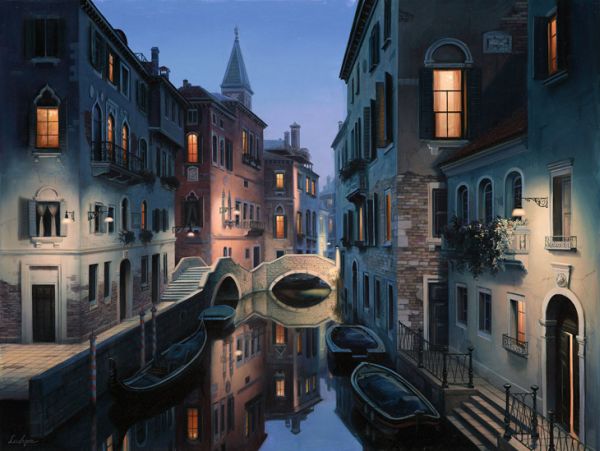
Tall masonry façades press a narrow canal into a corridor of shutters, balconies, and flower boxes. Gondolas hug the walls; a stone footbridge and a green-spired tower complete the Venetian grammar. Wall lamps cool the plaster while windows heat the water’s surface. Lushpin’s Venice is not carnival. It is after the day’s noise, when boats are tied and the city seems to hold its breath.
Winter road and a single car
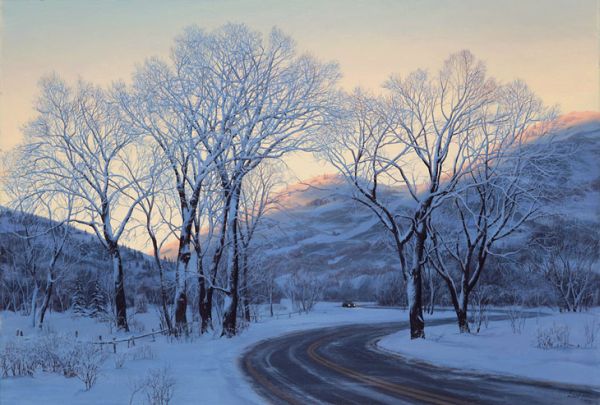
Not every evening in this set is urban. A wet asphalt road curves through snow-heavy trees toward a mountain brushed with peach light. One dark car shows headlights—tiny, purposeful, almost shy. A buried fence and powder-coated shrubs keep the foreground human-scaled. Here the “journey” of the title becomes literal: motion through cold air toward a lit destination you cannot yet see.
Alpine cabins as sanctuary
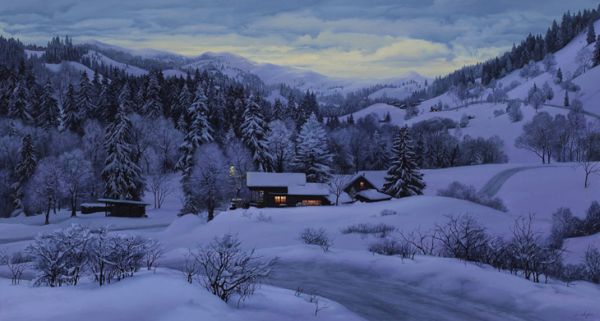
Wooden cabins sit on a hillside under deep blue snow and evergreens. Golden windows do the emotional heavy lifting: sanctuary against expanse. A pale path or frozen stream leads the eye inward. No figures appear, which sharpens the fantasy of arrival—you imagine knocking, stomping boots, and finding the light already on.
Hilltown steps under a crescent moon
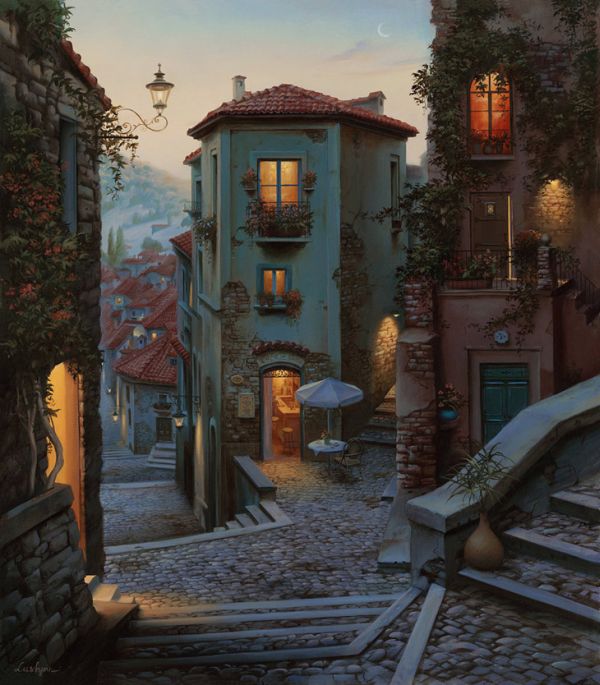
Stone stairs drop into a tight intersection of plaster walls, flower boxes, and terracotta roofs. A teal corner building opens a lit doorway; a round café table waits under an umbrella; a thin crescent moon floats in lavender sky. Ivy softens a salmon façade. Mediterranean warmth replaces northern snow, but Lushpin’s grammar stays: cool ambient dusk, warm human interiors, and cobbles that catch both.
Autumn park bridge
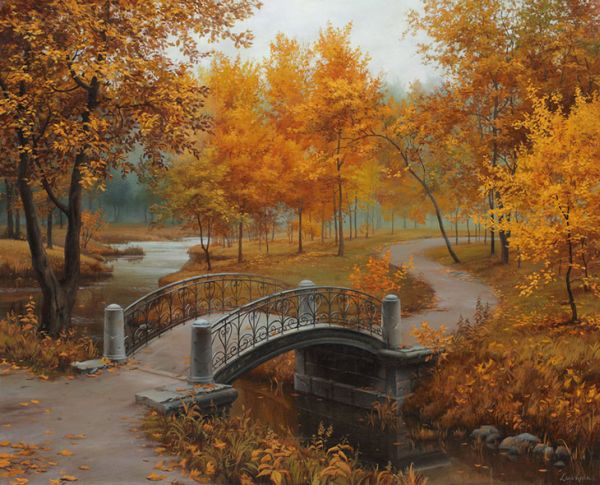
A low stone footbridge with wrought-iron scrollwork spans a dark stream. Gold and amber leaves fill the grove; mist softens the far trees. Without shop signs or cable cars, the painting still belongs to the evening-journey family: a path that asks you to cross, then disappear into seasonal color. Diffused light replaces lamp drama; atmosphere does the persuasion.
Montmartre twice over
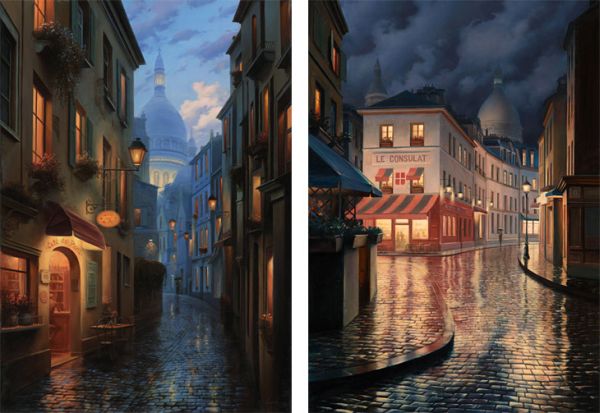
A paired view of Paris: a café-lit alley under Sacré-Cœur’s pale dome, and a later, rainier corner centered on Le Consulat’s red façade. Wet cobbles again act as Lushpin’s favorite collaborator. The basilica appears first as a soft landmark, then as a darker silhouette—proof that the same neighborhood can shift from blue-hour romance to deeper night without changing the artist’s loyalties: glass, stone, and reflected amber.
Evening Journey: San Francisco cable cars
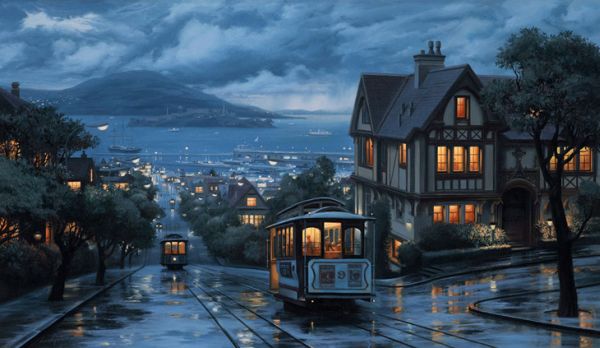
This is the canvas most often named Evening Journey: steep tracks, two vintage cable cars, a half-timbered house glowing on the right, and a bay opening beyond the hill under heavy cloud. Interior light from cars and windows prints long reflections on wet asphalt. The painting memorializes a specific San Francisco street romance—rain, grade, and domestic warmth overlooking water—while fitting the larger Lushpin theme of transit through twilight. Motion is gentle; the destination is atmosphere itself.
Paris roofs toward Sacré-Cœur
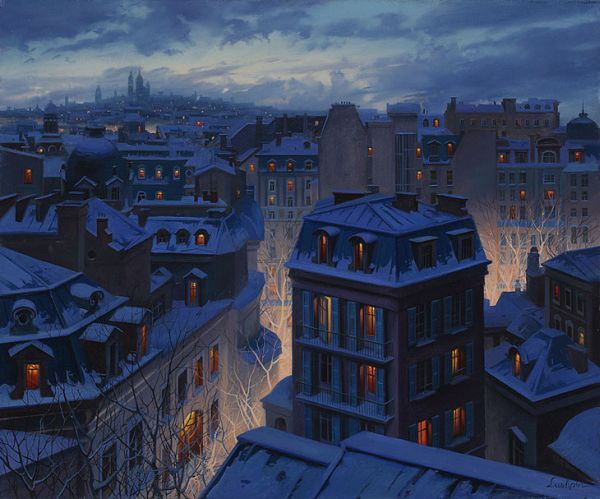
From above the mansards, chimneys and dormers stagger toward a distant dome on a hill. Snow clings to roof edges; windows bloom gold against slate-blue cloud. Like the St. Petersburg rooftop view, this Paris panorama turns domestic light into a constellation. You read the city as a field of rooms rather than as monuments first—then notice the landmark waiting on the skyline.
Gallery street and distant clock tower
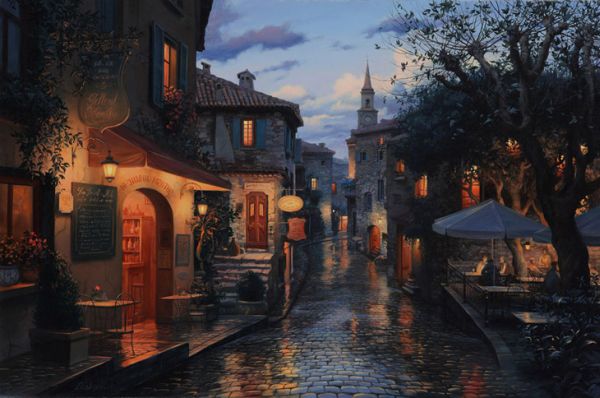
A lit storefront spills onto damp cobbles beside a small iron table; farther along, figures sit under white umbrellas while a clock tower or steeple closes the vista. Shutters, stone arches, and patio glow finish another Lushpin evening: public life slowed to a murmur, private light doing most of the talking.
What holds the set together
Across snow cities, canal towns, alpine cabins, Venetian waterways, Montmartre corners, and the San Francisco grade, Evgeny Lushpin returns to the same contract with the viewer. Trust the hour. Trust wet or frozen surfaces to double every lamp. Trust that a window can outrank a landmark. Photoreal detail sells the textures—brick, iron, leaf, snow—yet the paintings are not documents. They are edited realities where weather softens edges and interiors refuse to go dark.
If you walk these images in order, the “evening journey” becomes a route through climates rather than a single street. Start on northern roofs, drift through canals and stairs, pause in winter valleys, climb Mediterranean steps, cross an autumn bridge, and end among Paris and San Francisco lights. Lushpin does not hurry you. He leaves the lamps on and lets the road, canal, or cable track decide when you are ready to move again.

Comments
Continue reading
Photo-Realistic Muscle Car Paintings by Cheryl Kelley
Cheryl Kelley’s glossy oil paintings of classic muscle cars—photo-based realism, chrome reflections, and a feminine take on automotive glamour, with gallery images.

Ray Massey’s Hand Paintings: Trompe-l’oeil Athletes, Castles, and Everyday Objects
Ray Massey’s painted-hand photographs turn fingers into footballers, sprinters, castles, pencil cups, and bananas—studio trompe-l’oeil with lasting wit.

Photo-Realistic Paintings by Patrick Kramer
Utah painter Patrick Kramer’s photoreal oil works—why handmade perfection still matters beside photography, with a look at process and portfolio images.