
Adrian Sommeling’s HDR Photo-Stories
Dutch photographer Adrian Sommeling compresses whole narratives into single HDR frames—one child, one empty road, and storm light that behaves like plot.
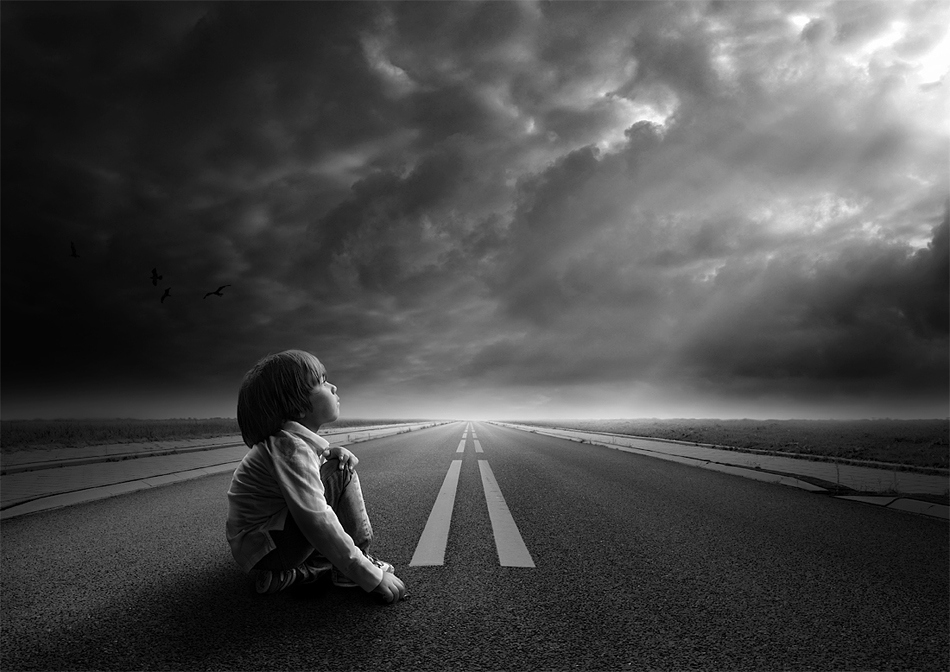
A single photograph can hold a whole plot if the maker knows where to put silence. Dutch photographer Adrian Sommeling builds that kind of frame: one figure, one horizon, and a sky that behaves like weather and stage lighting at once. His work is often filed under HDR—high dynamic range imaging—and Photoshop craft, but the real subject is narrative compression. He does not ask you to scroll through a sequence. He asks you to stay inside one image until a story arrives.
The frame preserved here is a clear example. A child sits on a long asphalt road that runs toward a bright vanishing point. Double center lines pull the eye forward. On either side, the land stays nearly featureless, so scale has nowhere to hide. Above, storm clouds mass and break; light fans down in hard rays; a few birds hang as small marks in the darker left sky. The boy looks upward, not at the camera. The picture is black and white, full of asphalt grain and cloud texture, and it feels less like a snapshot than like a still from a quiet film.
What “HDR” means in Sommeling’s hands
Technical HDR, in the strict sense, is a way to hold detail in both deep shadow and bright highlight when a single exposure would fail. Photographers bracket frames, merge them, and tone-map the result so the eye can travel through a wider luminance range. In popular conversation, though, “HDR” also became a look: exaggerated local contrast, crisp micro-detail, skies that feel carved. Sommeling sits in the second conversation without being trapped by it. His images use that extended tonal reach as theater lighting. The road’s texture stays readable. The cloud interiors keep structure instead of collapsing into flat gray. The bright rays still punch without erasing the darker storm mass.
That control matters because his subjects are usually simple. A person. A road. Weather. If the processing shouted louder than the figure, the story would thin out into effect. Instead, the processing supports readability at every distance: the child stays solid in the foreground; the road keeps its long geometry; the sky keeps drama without becoming noise. HDR here is not a filter badge. It is a way to keep every zone of the frame articulate so the narrative can use the whole rectangle.
Photoshop enters as the editing room after the capture. Sommeling is widely associated with constructed photographs—composites and carefully finished tonal worlds rather than unaltered documentary frames. That does not make the emotion fake. It makes the emotion directed. Like a short story writer choosing which room to leave empty, he decides which details survive and which distractions disappear. The nearly blank roadside in this image is such a decision. Nothing competes with the boy’s posture or the sky’s event.
Storytelling with one figure and one vanishing point
Can a photograph tell a story? Sommeling’s answer is practical: give the viewer a character, a setting with direction, and a weather event that feels like plot. The child on the road supplies character without costume drama. Clothing stays ordinary—light sleeves, dark trousers—so the extraordinary part of the scene can live above him. Looking up is the verb of the picture. Wonder, waiting, prayer, curiosity: the expression is open enough that different viewers write different captions, which is how single-image narrative often works best.
The road is the sentence structure. Linear perspective is an old tool, almost blunt in its clarity, and that bluntness helps. Parallel lines converging to a bright point create expectation. Something is ahead, or something is coming, or the journey itself is the subject. Placing the boy off-center in the lower left keeps the right side free for light to enter like an arrival. Birds on the left add a quiet counter-rhythm—small living marks against monumental weather—so the frame does not become pure geometry.
Black and white removes the easy charm of color weather and forces attention onto value relationships. In color, golden rays might tip the image toward postcard warmth. In grayscale, the same rays become graphic: white cutting through charcoal. That graphic quality suits Sommeling’s cinematic instinct. The photograph reads like a title card for an untold film about scale—how large the sky can feel when a child is the only measure of height.
Childhood scale against weather theater
Many of Adrian Sommeling’s strongest public images lean on human smallness inside oversized environments: empty roads, vast skies, solitary figures in suits or everyday clothes standing where ordinary life should not look so mythic. The child in this frame inherits that motif in a gentler key. Adults in surreal composites can feel like symbols of isolation or absurdity. A child looking at storm light tends to feel like attention itself—unarmored noticing.
That is why the asphalt matters. It is not a meadow or a fairy-tale path. It is infrastructure, hard and scratched, with paint that has lived through traffic. Setting wonder on a road instead of a meadow keeps the dream from floating away. The photograph suggests that extraordinary weather can land on ordinary routes. You do not need alpine drama for an epic sky; you need patience, timing, and the willingness to treat a straight road as a stage.
Scale also depends on emptiness. Featureless verges are not laziness; they are negative space doing narrative work. If houses, signs, or cars lined the edges, the image would become documentary traffic. Emptiness lets the vanishing point stay sacred. It also makes the child’s body the only nearby mass, so every cloud feels larger by comparison. Photographers who chase “epic” often add more elements. Sommeling often subtracts until the remaining elements can speak clearly.
Craft choices you can learn from without copying the look
Studying this kind of work is useful even if you never chase an HDR signature. First, decide what the photograph is about in one sentence before you edit. Here the sentence might be: a child meets weather on an empty road. Every tonal decision should serve that sentence. Brighten the boy enough to keep him present; protect the ray structure so the sky event remains legible; keep asphalt detail so the ground feels real enough to sit on.
Second, respect the hierarchy of sharpness and contrast. If every cloud ridge and every road crack scream at the same volume, the eye has nowhere to rest and the story dissolves into texture. Sommeling’s better finishes usually keep a clear primary subject and let supporting zones stay rich but subordinate. The child’s face and posture remain the entry point; the sky is the drama; the road is the path connecting them.
Third, treat composite logic as continuity, not collage. When skies and grounds come from different moments—or when local contrast is pushed hard—the danger is a floating subject, wrong shadow direction, or mismatched haze. Believable contact between shoes or seated body and asphalt is non-negotiable. Believable light direction across face, shirt, and road paint keeps the miracle from looking pasted. Surreal mood still needs physical agreements.
Fourth, use monochrome as a design choice, not a rescue. Converting a weak color image to black and white rarely invents structure. Starting with strong shapes—road lines, cloud masses, a readable human silhouette—gives grayscale material to work with. Then the HDR-style expansion of midtone detail can reveal asphalt and cloud architecture without inventing a composition that was never there.
Why these photo-stories travel
Images like this travel because they are immediate and unfinished at the same time. Immediate: you understand the scene in a second—child, road, storm light. Unfinished: you do not know what happens next, or what the boy thinks, or whether the light is blessing or warning. That gap invites projection. People share photographs that let them complete a sentence.
There is also a technical fascination layered under the emotion. Viewers who care about process notice the retained highlight detail, the deep cloud blacks that still hold form, the crispness of painted lines. Process curiosity and narrative hunger reinforce each other. Someone arrives for the “HDR look,” stays for the child looking up, and leaves remembering a feeling rather than a slider setting.
Sommeling’s public reputation has long included teaching energy—tutorials and workshop culture around how such images are built. The deeper lesson for viewers, though, is not a software recipe. It is permission to treat a photograph as a short story with weather as co-author. You can stage, select, and finish deliberately without apologizing, as long as the finished frame still feels inhabited by attention rather than by effects.
How to look at the image again
Return to the boy’s upward gaze and stay there for a few breaths. Then follow the road lines until they thin into the bright distance. Then climb into the broken cloud and notice how the rays create a second geometry—diagonal energy against the road’s strict recession. Finally notice the birds: tiny, almost easy to miss, yet they keep the left sky from becoming a dead dark field. That triangular reading—child, vanishing point, storm light—is the photograph’s plot outline.
Ask what would break if you moved one piece. A centered child would turn the road into a pedestal. A busier roadside would turn wonder into commute. A softer sky would leave the boy stranded in emptiness without an event to meet. The strength of Adrian Sommeling’s approach, in this frame and in much of his wider storytelling work, is that each major element has a job, and none of the jobs are decorative filler.
Single-image stories do not need captions that explain everything. They need enough clarity for the eye to enter and enough mystery for the mind to stay. This road, this child, and this storm-broken light manage both. The HDR craft keeps every zone readable; the composition keeps every zone meaningful. What remains, after the technical talk fades, is a durable human picture: someone small enough to sit on asphalt, looking up at weather large enough to rearrange the day.
If you carry anything from Sommeling’s example into your own looking or making, let it be that discipline of one story per frame. Choose a character. Give the land a direction. Let the sky argue. Finish the tones until the argument can be heard in both the brightest ray and the darkest cloud. Then stop adding. The empty road already knows how to hold a plot.

Comments
Continue reading
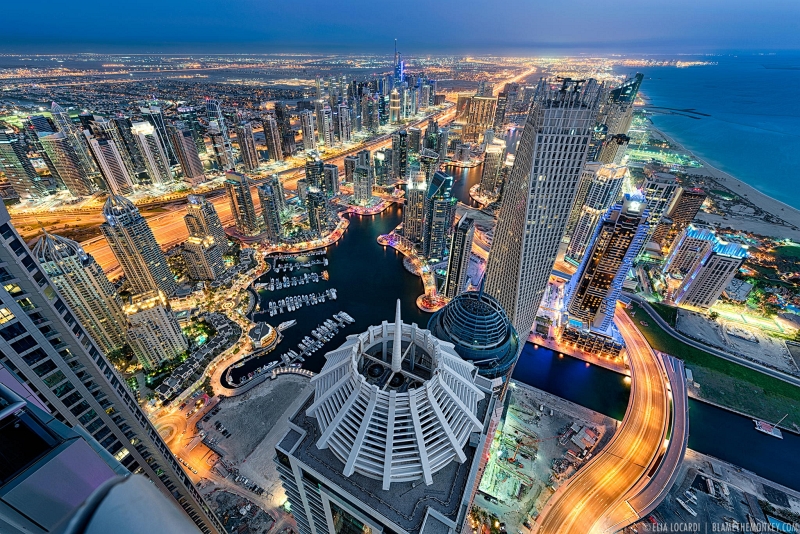
Elia Locardi’s HDR Travel Photography: Light, Place, and Life on the Road
A look at Elia Locardi’s HDR travel photography—balanced exposure blending, immersive location work, and the location-independent path he and his wife took after 2012.
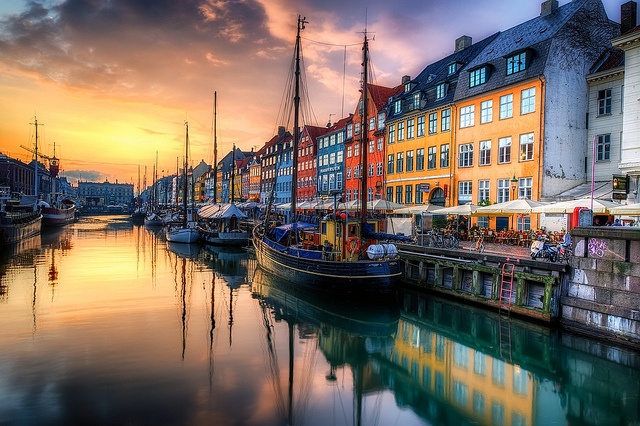
HDR Travel Photography by Jim Nix
Austin-based photographer Jim Nix pairs travel observation with Photomatix HDR—colorful cityscapes and landscapes published on a steady Nomadic Pursuits rhythm.
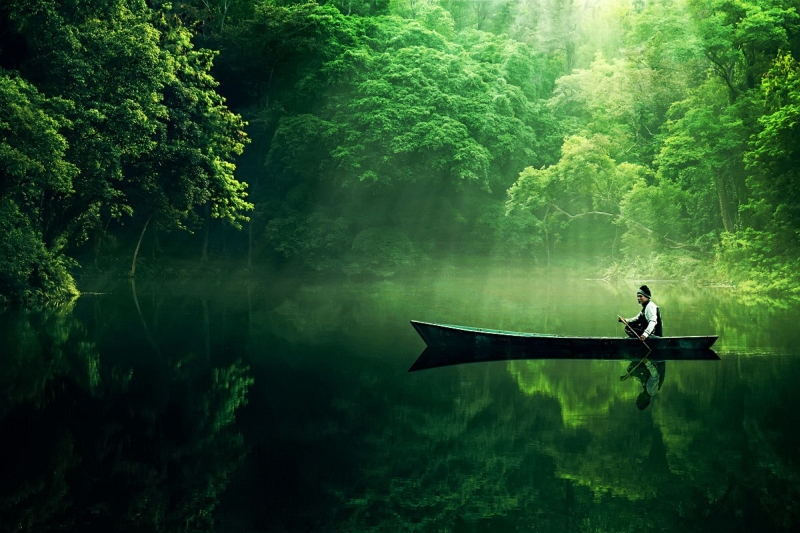
Dramatic Photo Art by Sukron Ma’mun (Ipoenk Graphic)
Cirebon, Indonesia photographer Sukron Ma’mun uses theatrical natural light to frame village life, play, and place in lyrical photo art.