
Reaping for Dummies: Norway’s Trainee Grim Reaper Western
Five Idèfagskolen graduates send Death’s intern into a ghost town—where one stubborn prospector turns the harvest into slapstick.
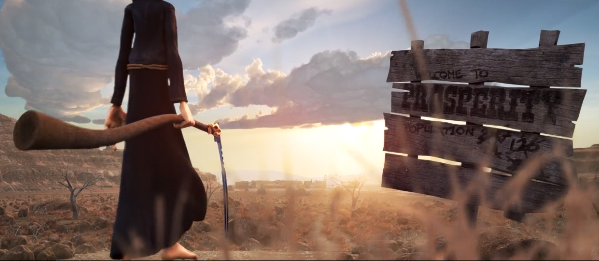
Death clocks in for training day and meets a prospector who has other plans. That is the joke engine of Reaping for Dummies, a 2013 Norwegian CG short made as a graduation project by five students from the 3D design and animation course at Idèfagskolen in Tønsberg: Jonas Martin Larsen, Øyvind Fiksdal, Eilef Sandnæs, Eskild Carlsen, and Yvonne Engbråten. Roughly five minutes long, the film sends a trainee Grim Reaper into a Wild West ghost town to collect a short, stubborn baldie—and discovers that the last man standing has studied the coyote-and-roadrunner curriculum.
Production ran mainly from October 2012 through July 2013, with later tweaks until the soundscape landed; music and sound were finished in December by an outside team. The December 2013 release timing matches the film’s festival-and-Vimeo afterlife as a compact slapstick calling card rather than a solemn student thesis about mortality.
Western set, cartoon rules
Genre mashups fail when both halves dilute each other. Reaping for Dummies keeps the Western readable—dust, isolation, a town emptied down to one holdout—and keeps the cartoon physics honest. The reaper is not a metaphysical essay. He is an intern with a scythe and a checklist. The prospector is not a tragic last pioneer. He is a survivor who treats Death like a problem that can be outmaneuvered with traps, timing, and sheer refusal.
Gizmodo’s write-up framed the conflict as roadrunner-and-coyote energy, which is the right family tree. Chuck Jones comedy depends on clear roles: pursuer with a plan, pursuee with counter-plans, environment as accomplice. A ghost town is perfect furniture for that structure. Empty streets make chases legible. Abandoned props become gag inventory. When only one living target remains, every failure is personal.
IMDb’s one-line synopsis stays usefully blunt: a reaper trainee comes to the Wild West to reap a short baldie who proves a challenge. The baldie’s stature is part of the comic casting—Death expected an easy harvest and got a compact engine of spite. Character design does the exposition. You do not need a monologue about gold-rush loneliness when the town itself is already a punchline: everyone else left or died; this guy is still bargaining.
Characterization, imagery, timing
The original Sortrature blurb praised characterisation, imagery, and timing. Those are the correct three dials for this short. Characterization here means opposition of body language: the trainee’s procedural anxiety versus the prospector’s practiced stubbornness. Imagery means a Western palette and silhouette clarity—hats, scythes, doorways, and desert light that read in a second. Timing means the student team understood that slapstick dies when cuts arrive early or holds arrive late.
Trainee characters are comedy gold because incompetence is motivated. A master Reaper who fails feels like a broken myth. A trainee who fails feels like orientation week. The audience roots for both sides in alternating seconds: we want the underdog mortal to escape, and we also recognize the workplace panic of someone who cannot close a simple job. That double rooting system keeps five minutes lively without moralizing about death.
Because the short is dialogue-light in spirit even when sound carries reactions, staging has to sell cause and effect. A trap that works once teaches the reaper nothing if the camera does not show him learning the wrong lesson. A victory for the prospector lands harder if we briefly believe Death had the upper hand. Student films that nail this usually share a board-driven discipline: each beat changes advantage. Reaping for Dummies aims for that ping-pong rather than for atmospheric wandering.
Five students, one finished cartoon
Idèfagskolen’s 3D course context matters less as branding than as production reality. Five people sharing modeling, animation, lighting, and editorial labor on a Western comedy means ruthless scope control. You cannot build an epic town. You build a usable town. You cannot animate twelve townsfolk. You animate the conflict that remains when townsfolk are gone. Graduation deadlines force the question every commercial short also faces: what is the minimum world that still supports the joke?
Larsen’s project notes describe the October–July core production and the later sound finish. That sequence is familiar in school pipelines: picture lock first, then a sound pass that makes hits land. Slapstick especially depends on audio punctuation—whooshes, impacts, the wrong kind of silence before a pratfall. Outsourcing or specializing sound at the end is not a footnote; it is often what turns a nice animatic into a short people share overnight.
Online circulation in late 2013 and early 2014 treated the film as palate-cleanser animation: not prestige melancholy, not experimental abstraction, just a clean comic premise executed with CG craft. That lane is crowded, which makes clarity valuable. “Trainee Death vs. unkillable prospector” is a poster you can pitch in one breath. The team delivered the poster and then filled it with gags instead of padding it with lore.
What to study if you animate comedy
Steal the casting of power. Death should look official; the mortal should look inconvenient. Steal the location as gag library. A ghost town is a storage unit of chairs, doors, alleys, and vertical drops waiting to become punchlines. Steal the trainee frame so failure stays funny. Steal the refusal to explain the afterlife bureaucracy beyond what the scythe and the assignment imply.
Also study restraint. The short does not need a sequel hook, a tragic flashback, or a twist that Death was the real protagonist all along. It needs a chase that escalates and a character who will not surrender his soul on schedule. When student CG looks “professional,” it is often because the storyboard was professional first: readable wants, readable obstacles, cuts that protect the laugh.
If you watch for craft, track who owns each half of the frame during a gag. Does the reaper occupy the tall space while the prospector owns the low clever space? Do props enter early enough to feel fair? Does the town stay consistent so geography jokes work? Fairness is underrated in slapstick. Audiences laugh harder when they could have seen the trap coming and still enjoy the trainee missing it.
A short that knows its job
Reaping for Dummies is not trying to redefine Scandinavian animation. It is trying to land a Western cartoon about a bad day at Death’s internship. On that assignment, Larsen, Fiksdal, Sandnæs, Carlsen, and Engbråten clear the bar that matters for five-minute comedy: you understand the conflict instantly, you root in both directions, and you leave with the satisfied feeling that the prospector earned his stubbornness.
Mortality tropes will always return in student shorts—hourglasses, doors of light, gentle goodbyes. This one chooses the other tradition: Death as a fallible employee, the living as a scheduling conflict. In a ghost town with one resident left, that conflict is enough. The scythe may be sharp. The lesson plan is still in progress.

Comments
Continue reading

Still-Life Photography by Margareth Perfoncio
São Paulo photographer Margareth Perfoncio’s still lifes of food and flowers—Old Master light, dark wood, and tables that feel inevitable.

Meaningful Love Quotes for Inspiration (and Ink)
Meaningful love quotes that still feel true — short lines for tattoos, gifts, and everyday reminders, with placement and wording tips.

Christina Hess’s Animals From History: Costumed Pets as Playful Portraits
Illustrator Christina Hess reimagines historical icons as ornate animal portraits—Elvis Petme and friends—mixing puns, costume detail, and soft history lessons.