
Thomas Allen’s Book-Cut Illustrations
Michigan illustrator Thomas Allen cuts pulp paperback figures into 3D tableaux, photographs them in shallow focus, and gathers the practice in his Aperture book Uncovered.
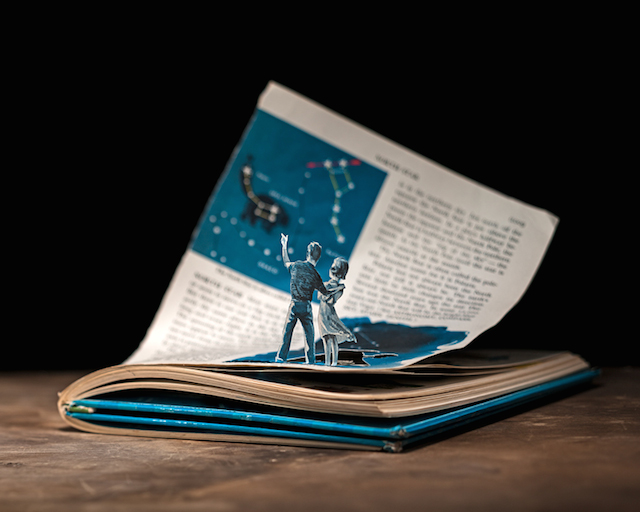
Michigan-based illustrator and photographer Thomas Allen builds stories out of other people’s covers. He cuts figures from vintage paperback art, folds them into standing poses, and photographs the resulting miniature dramas. The characters seem to climb out of the book before you open it—gumshoes, femmes fatales, sailors, and western extras given one more scene after the print run ended.
The method sits between collage, pop-up craft, and still-life photography. Allen is not illustrating a new novel so much as casting the old cover art in a second play. That double life—print as sculpture, sculpture as photograph—is what makes the work linger.
Pulp covers as a ready-made cast
Mid-century paperbacks sold themselves with eye-popping cover art. Sales depended on seduction, menace, and color more than on subtle typography. Allen treats those covers as talent pools. The figures already know how to pose; his job is to free them from the flat plane without killing the graphic punch that made them famous.
He has described the process as cutting, crimping, and creasing until a tableau appears—an idea fed by a long affection for pop-up books and other three-dimensional toys. An X-acto knife becomes a casting tool. Leave the right connections intact, fold carefully, and view the piece from a single vantage point, and the illusion locks: a figure stands in space while still belonging to the book that printed her.
The humor is affectionate, not mocking. These are bit players from dime-novel fame, invited back for a slightly different production. Judging a book by its cover becomes a joke Allen is happy to prove true.
Stagecraft in a few inches of paper
Allen’s roles multiply quickly. Beyond photographer, he acts as talent scout, casting director, stage manager, lighting supervisor, and editor. A single scene may need a sultry reach toward a bottle on a neighboring volume, a man teetering at the edge of a stack, a dog mid-howl, a punch mid-flight. Ships sail. Skirts swing. The narrative is pulp-short: one beat, clearly read.
Because the sets are tiny, precision matters more than spectacle. A fold that is a millimeter off collapses depth. A cut that removes too much attachment turns a character into a loose doll. The craft lesson is restraint: do only what the illusion requires, then stop.
Shallow focus finishes the theater. Allen photographs the arrangements so that depth of field softens like a View-Master reel—dreamy enough to feel toy-like, sharp enough that the key gesture reads. The final print is not a documentary of a craft table; it is a still from a movie that never needed a full set.
Uncovered and the book as object
Allen’s monograph Uncovered, published by Aperture with an introduction by Chip Kidd, gathers this pulp-pop practice into a physical book that behaves a little like a toy itself—board-book heft, images that seem ready to spill off the page. Kidd’s own cover design work has long crossed paths with Allen’s sensibility; the monograph sits naturally in a conversation between photography, graphic design, and popular print culture.
Seeing the work in book form doubles the joke. You hold a book about books that have been surgically opened. The characters that once sold paperbacks now sell a different kind of looking: attention to how covers manufacture desire, and how a knife plus a camera can redirect that desire into comedy, noir, or quiet absurdity.
Collectors of illustration and design photography often meet Allen here first. The images travel well in magazines and galleries, but the book frames them as a series with rhythm—femme, fight, fall, flirt—rather than as isolated novelties.
Why the cut illustrations feel narrative before you read
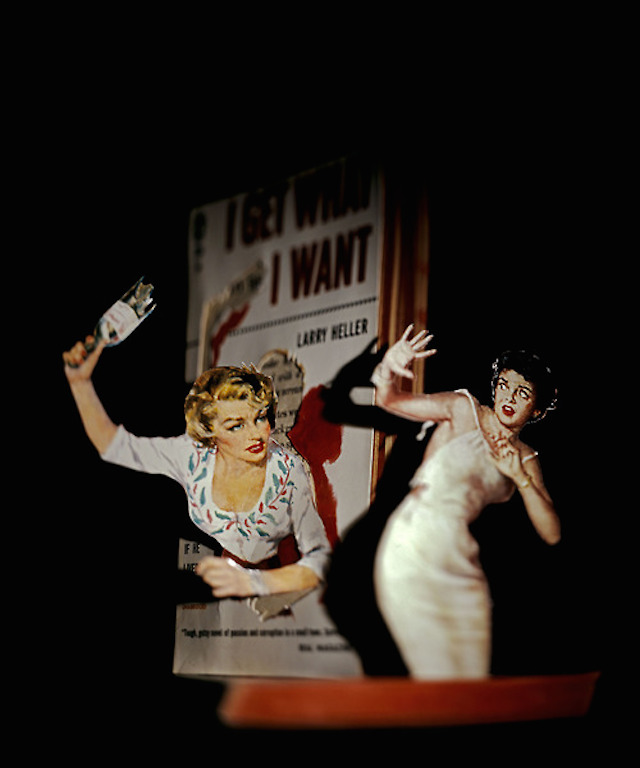
Most book art waits for the reader. Allen’s cut figures perform first. You understand conflict, flirtation, or danger from body language alone. That pre-reading storytelling is the charm of the URL topic: book-cut illustrations that demonstrate a tale in advance.
The effect depends on cultural memory. Viewers who grew up with noir posters, western stills, or drugstore racks recognize the archetypes instantly. Allen does not need long captions. A tilted hat and a raised fist already contain a chapter. The photograph simply freezes the chapter mid-sentence.
There is also a tactile pleasure for anyone who has ever wanted to peel a figure off a cover. Allen does it carefully enough that the vandalism becomes reverence. The books are altered, but the alteration honors the original illustrators’ drama by extending it into space.
Lineage: from science books to pulp stages
Allen’s constructed work did not begin with pulp alone. Earlier experiments with children’s books and altered science volumes trained the same instincts: rearrange printed matter, invent fiction from nonfiction diagrams, photograph the result. The paperback covers arrived as a kind of accident—cut far enough to remove an illustration, then notice that partial attachment plus careful folding creates a pop-up illusion from one angle.
That accident became a vocabulary. Once the knife language existed, Allen could cast across genres: crime, romance, adventure, western. Hollywood noir and cult westerns echo through the lighting and poses. Pop-up books echo through the engineering. The hybrid feels inevitable after the fact and unlikely before it.
Living and working from Michigan, Allen has also taught and lectured widely, carrying the practice into classrooms where students can see how small physical decisions—crease, light, camera height—control whether a paper figure feels alive or merely crafty.
What to notice when you look
On a first pass, enjoy the gag: a printed person standing in real shadow. On a second pass, watch the joins. Where does the figure still belong to the cover? Where does the fold invent a knee, a waist, a lean? Those hinges are the drawing.
Then watch the relationships between books. Allen often builds scenes across multiple volumes so that characters from separate novels share a stage. The stack becomes architecture. Spines become walls. A bottle printed on one cover becomes a prop for a hand cut from another. Collaboration between dead print runs is the quiet joke inside the louder pulp humor.
Finally, notice how little set dressing he needs beyond the books themselves. No elaborate diorama city. No digital composite excuses. Paper, knife, light, lens. The economy is part of the elegance.
Browse more of the work via Allen’s site and sit with a single frame longer than a scroll usually allows. Somewhere in the shallow focus, a bit player from a drugstore rack is still waiting for their cue—and for once, the cover is allowed to finish the scene it always promised.

Comments
Continue reading
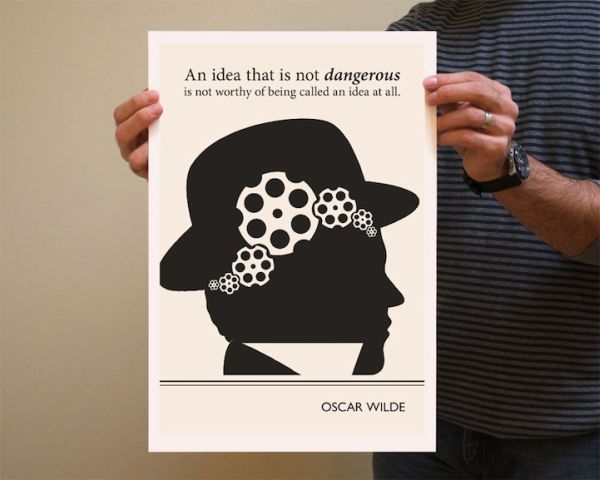
Evan Robertson’s Illustrations from Underlined Book Quotes
Through Obvious State, designer Evan Robertson turns underlined literary lines into black-and-white posters where text and drawing think together.
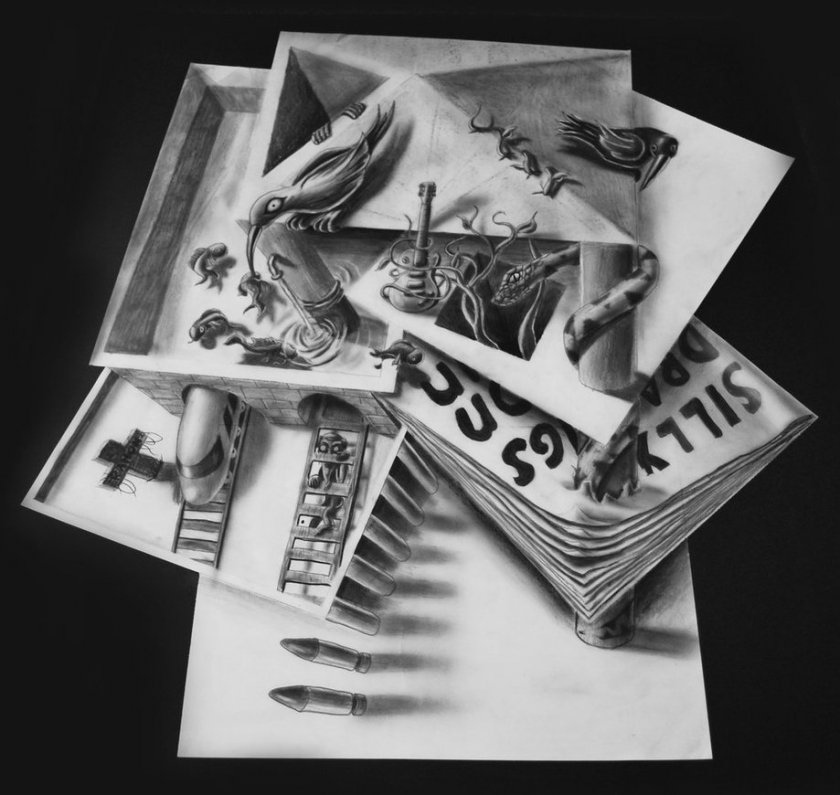
Ramon Bruin’s Studio 3D Optical Illusion Drawings
Dutch artist Ramon Bruin builds tabletop anamorphic drawings on stacked paper—airbrush and graphite illusions locked to a single camera angle.
3D Origami Sculptures by Jaroslav Mishchenko
Kyiv artist Jaroslav Mishchenko folds painted three-dimensional origami sculptures—animals, objects, and abstract forms—where crease, color, and careful light share the work.