
The Escape: Enspire Studio’s 2012 CGI Chase Short
Andre Surya and Enspire Studio’s three-minute short The Escape—Eliana, a stolen teleport device, futuristic pursuit, and a Jakarta studio’s festival calling card.
In 2012, Jakarta’s Enspire Studio released a roughly three-minute CGI short called The Escape. Directed by Andre Surya (with Evann Tjokrosetio also credited in festival listings), it plays like a compressed chase reel that also happens to be a studio calling card: lighting, texture, environment design, and character motion all shoved into a single breathless run. The plot is deliberately thin. The craft is the point—and, for a few festival seasons, the craft was enough to put a young Indonesian animation house on maps that usually favor longer résumés.
Somewhere in a near-future city, a teleportation device that opens another dimension exists. Eliana has stolen it. Police close in. She ducks into an alley that becomes a dead end. Trapped, she hits the button, closes her eyes, and hopes. That is almost the entire narrative spine. What surrounds it is atmosphere: wet streets, hard light, gymnastic movement, and a destination that feels less like a plot twist than a sudden change of visual weather.
A chase built as a demo—and still a film
Enspire has been open that The Escape began as promotional proof. Founded by Andre Surya Wiyono as an animation studio in 2012 (later formalized as a business with Christian Purnama joining as CEO in 2016), the young company needed a piece that could travel: festival selections, award circuits, and a reel that showed cinematic CGI without waiting for a client brief. The short won multiple festival honors—among them Best Animation Short recognition at the Asians on Film Awards—and racked up official selections from Europe to North America and Australia. For a debut project, that is a loud arrival.
Knowing the commercial motive does not empty the film of pleasure. It clarifies the editing priorities. Environments get loving detail. Costumes show graphic design muscle. The teleport payoff spends its seconds on a new world rather than on dialogue. If you arrive expecting a short story with character arcs and moral ambiguity, you will feel the thinness. If you arrive wanting to watch a studio flex under chase pressure, the thinness becomes a feature: nothing slows the sprint.
Future city, familiar grammar
Eliana’s city reads as tomorrow built on today’s street plan—alleys, corners, vertical signage energy—then thickened with tech just alien enough to signal “not now.” Reviewers at the time reached for easy cousins: the neon grit of Blade Runner, the athletic dodge grammar of The Matrix, costume echoes of Tron: Legacy, floating-island vibes adjacent to Avatar’s Pandora once the teleport lands. Those comparisons are fair as mood boards. They are also a little unfair as verdicts. A three-minute demo will borrow genre fluency; originality, if it comes, comes from execution density rather than from inventing a new mythology on the spot.
What works on screen is specificity of craft inside those borrowed moods. Rain-slick surfaces catch practical-looking highlights. Depth cues stack through haze and practical lamps. The camera stays close enough to Eliana’s urgency that the city feels navigated rather than merely rendered. You believe the alley is a trap because the geometry closes, not because a caption says so.
Eliana as motion first, biography second
We learn almost nothing about who Eliana is beyond thief-on-the-run. That absence can frustrate viewers who want motive. It also frees the short to treat her as a kinetic instrument. Parkour lines, sudden stops, the held breath before the button—performance here is animation performance: weight, timing, the believable panic of a body that has run out of corners. Her costume’s graphic clarity helps read silhouettes in fast cuts. In a longer film those design choices might need more character writing underneath. In this runtime they function like racing stripes: you track her because the eye can.
The police presence matters less as personalities than as pressure system. Sirens, pursuit framing, the narrowing options—they are weather that forces the device into play. The teleport is not a carefully foreshadowed MacGuffin with lore cards. It is a last door.
The other side of the button
When Eliana activates the stolen device, the film spends its remaining currency on destination spectacle. The new space opens into something brighter, more floaty, less street-bound—an elsewhere that reviewers alternately praised for beauty and dinged for familiarity. Both reactions can be true. The cut from alley dead-end to otherworldly expanse is the short’s emotional hinge: from claustrophobia to awe in one gesture. Whether that elsewhere feels earned depends on what you wanted. As narrative closure it is abrupt. As demo climax it is efficient: “We can also build this.”
That dual purpose—story beat and portfolio page—is the film’s defining tension. Watch it twice. First for the chase adrenaline. Second for material passes: how metal, fabric, wet asphalt, and sky are differentiated; how light motivators change between city night and the destination realm; how little dialogue the piece needs when sound design and cutting carry panic.
Why a thin plot still traveled
Festival programmers in the early 2010s were hungry for CGI shorts that looked expensive without being studio-tentpole leftovers. The Escape offered a clean package: readable premise in ten seconds, action that showcases rigging and environment art, a visual punchline, and a runtime friendly to mixed programs. Awards and selections then became marketing that fed more selections—a virtuous loop many young studios never catch.
For viewers discovering it years later on short-film roundups, the context shifts. The piece no longer needs to prove Enspire can exist. It sits instead as a time capsule of 2012 digital craft ambitions in Southeast Asian CGI: global genre fluency, local studio hunger, and a bet that polish can outrun plot length. Enspire’s later identity as a Jakarta house for cinematics, series, and commercials makes retrospective sense. The short was never shy about being a handshake.
How to watch it now
Give it one uninterrupted pass in the dark if you can—phone brightness down, headphones on. Let the city soundscape do half the storytelling. Notice where your eye goes when Eliana moves: costume edge, foot plant, background parallax. Ask whether the teleport world feels like escape or like another kind of capture. The film will not answer with speeches. It answers with images and a held breath.
Then, if you care about studio history, read the runtime as a business document as well as a chase. Three minutes to say: we can light a city, dress a runner, stage a pursuit, and open a door to somewhere else. For Enspire in 2012, that was enough to start. For the rest of us, it is still a sharp little sprint—thin on biography, thick on forward motion—ending exactly where its title promised: not with explanation, but with getting out.

Comments
Continue reading
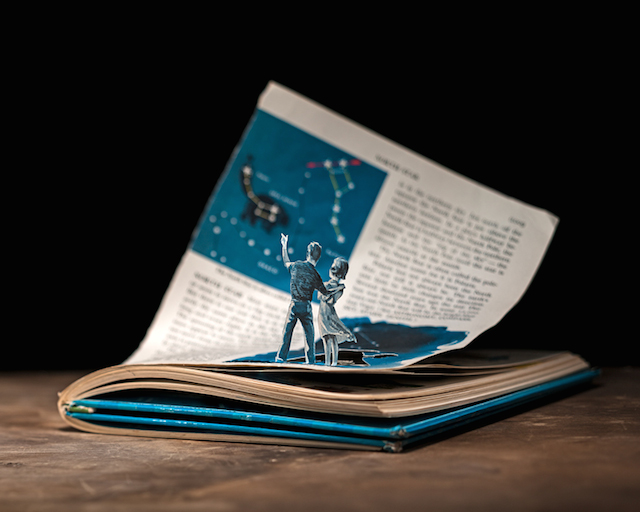
Thomas Allen’s Book-Cut Illustrations
Michigan illustrator Thomas Allen cuts pulp paperback figures into 3D tableaux, photographs them in shallow focus, and gathers the practice in his Aperture book Uncovered.
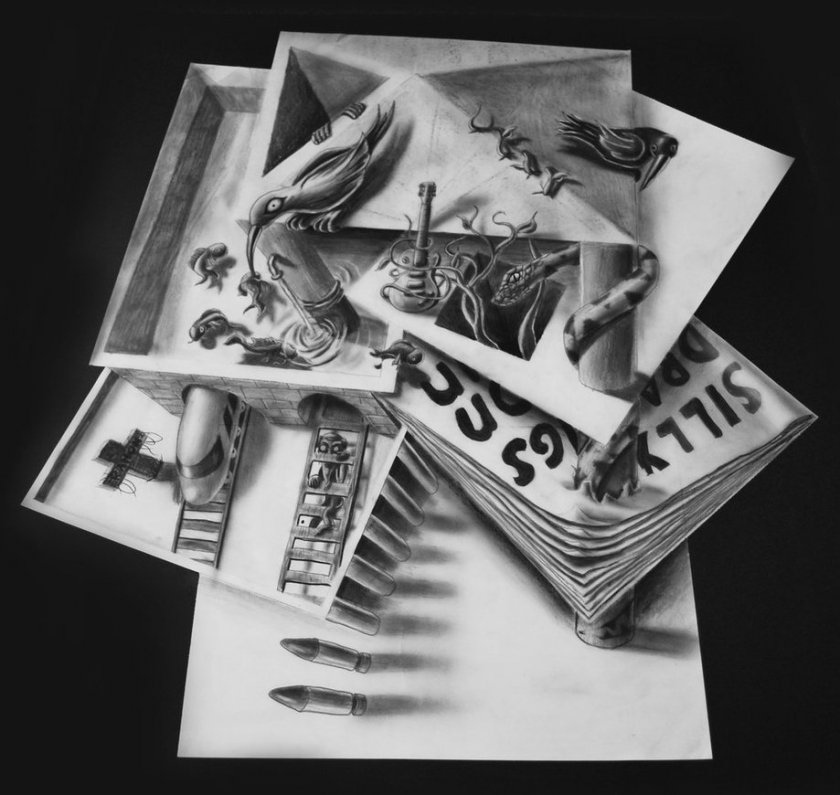
Ramon Bruin’s Studio 3D Optical Illusion Drawings
Dutch artist Ramon Bruin builds tabletop anamorphic drawings on stacked paper—airbrush and graphite illusions locked to a single camera angle.
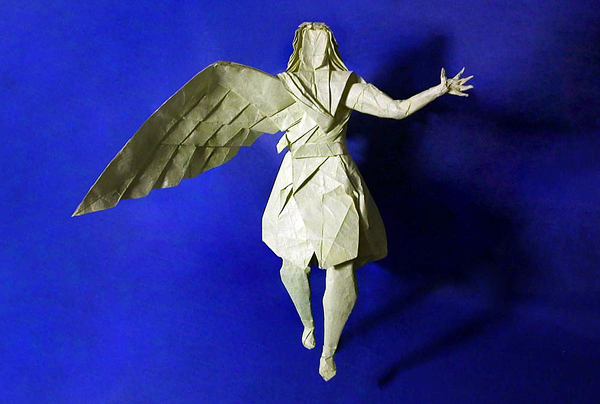
3D Origami Sculptures by Jaroslav Mishchenko
Kyiv artist Jaroslav Mishchenko folds painted three-dimensional origami sculptures—animals, objects, and abstract forms—where crease, color, and careful light share the work.