
Makeup Art by Svenja Schmitt
Berlin artist Svenja Schmitt (PixieCold) builds macro eye worlds from pigment, glitter, feathers, and props—temporary theaters photographed before they wash away.
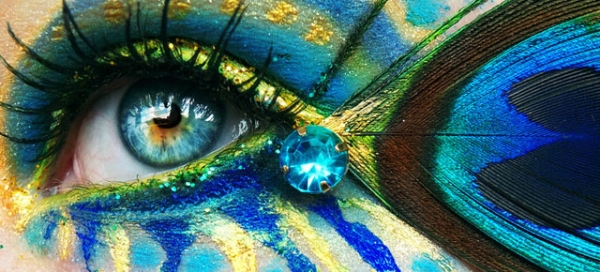
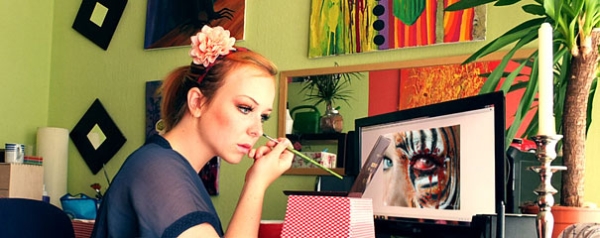
Svenja Schmitt treats an eyelid the way some painters treat a small canvas: as a complete world with weather, creatures, and a horizon line. Berlin-born and known online as PixieCold, she crossed from traditional media—watercolor, acrylic, collage—into makeup and macro photography around 2012, the same year this gallery first circulated. The move did not abandon painting so much as relocate it. Pigment still matters. So do glitter, feathers, rhinestones, contact lenses, and the occasional starfish charm. The difference is that the support breathes.
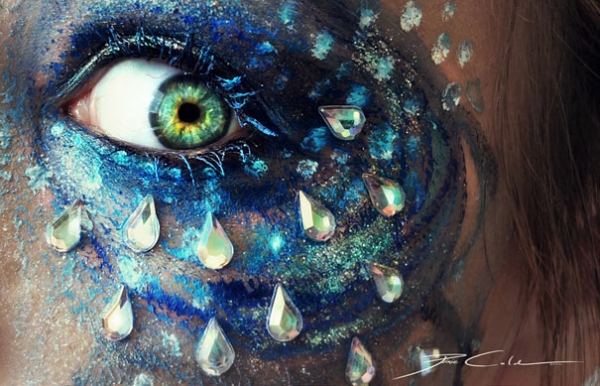
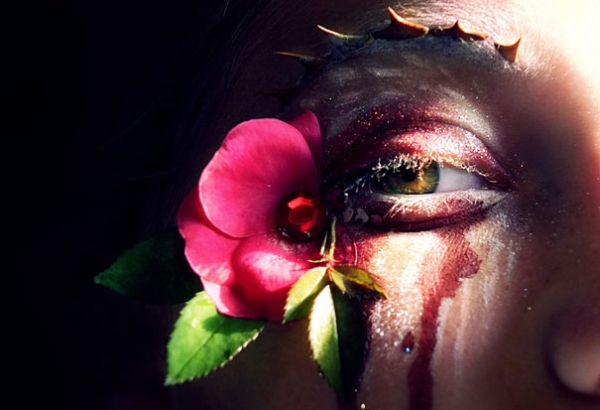
Eyes were already her obsession on paper. In makeup they become architecture and narrative at once. A single socket can hold ocean, plumage, animal pattern, or wet-looking drama. The photographs freeze the work at the scale where craft is visible: individual grains of glitter, brush ridges in paint, the wet edge of a fake drip.
If you want to try some of these brilliant arts, Schmitt has shared process through tutorial videos and online galleries under names linked to PeeGeeArts and PixieCold—useful for seeing how layers build, not as a shopping list.
From Berlin sketchbooks to living surfaces
Schmitt grew up in a large creative household in Berlin, where art was ordinary rather than exceptional. What began as pastime hardened into profession after difficult years when drawing became refuge and then public work. Early street-influenced subjects darkened and abstracted; eyes remained the constant, the feature she trusted to carry unspoken story. Makeup offered a larger toolbox and a stranger intimacy: the artist is often also the model, applying and enduring the piece in the same body.
That dual role shapes the photographs. They are not distant beauty campaigns. They are documents of a temporary sculpture made on skin, lit to celebrate chroma and specular sparkle. Macro distance collapses social space. You are not looking at a face in a room; you are looking into a designed weather system around an iris.
Mixed media on a moving canvas
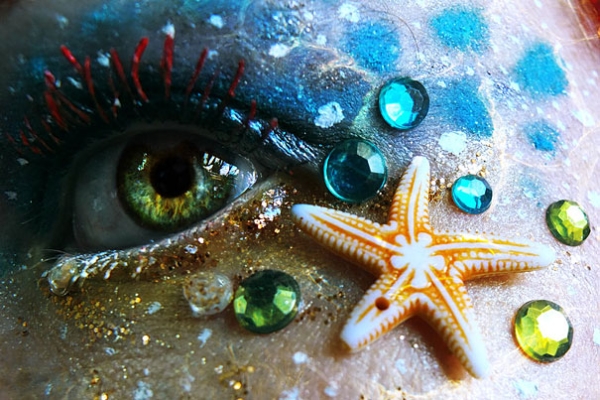
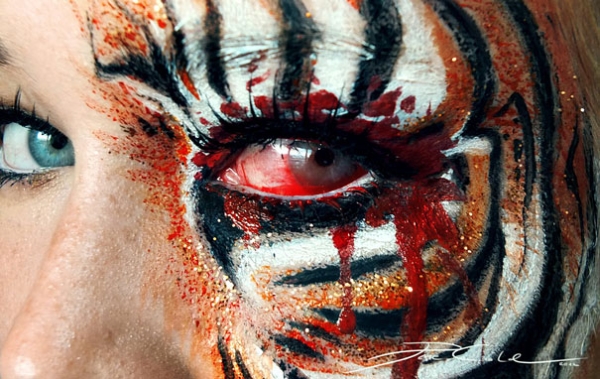
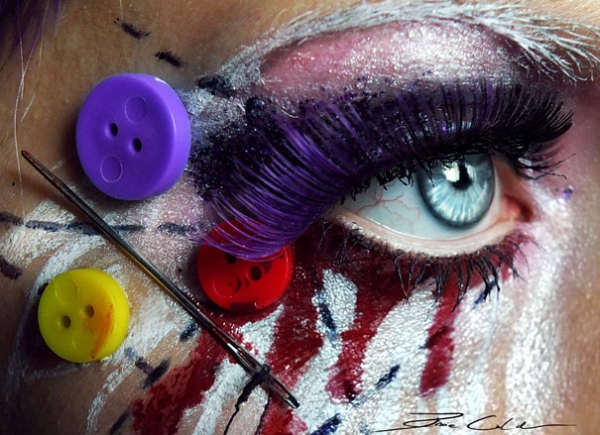
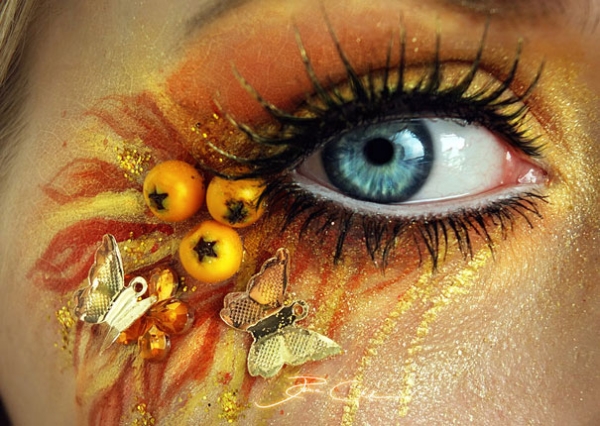
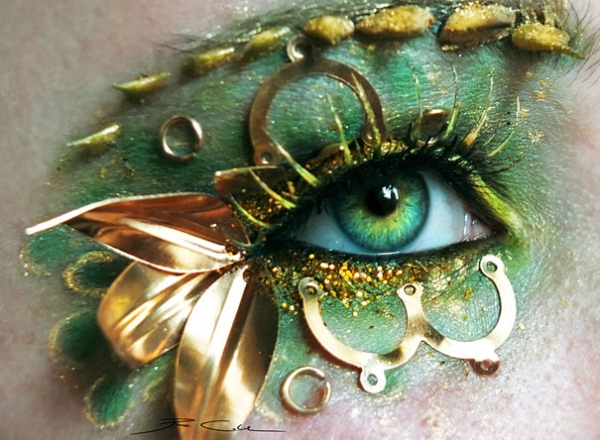
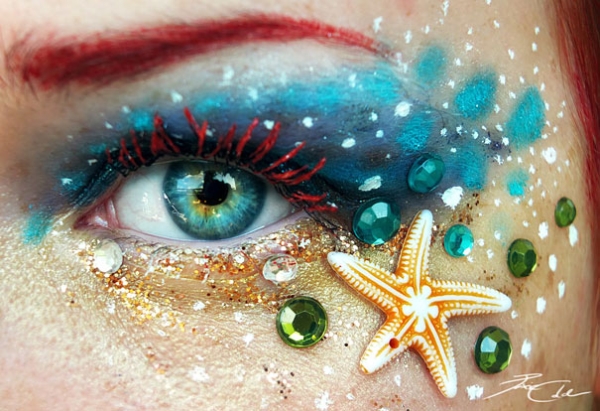
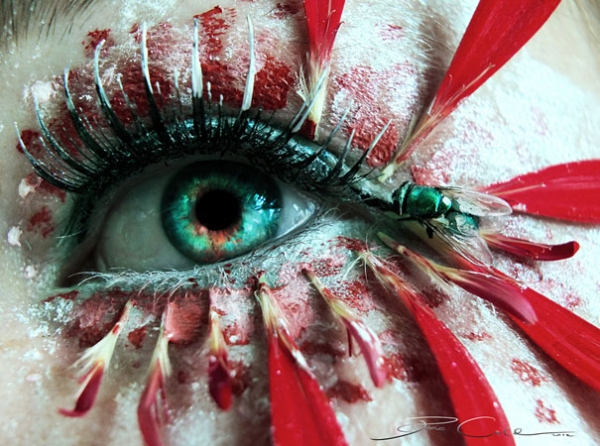
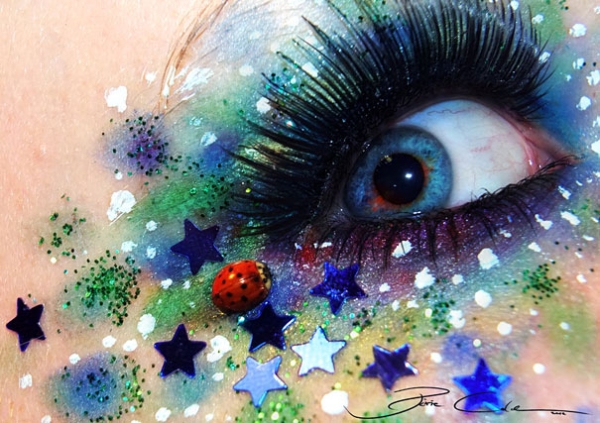
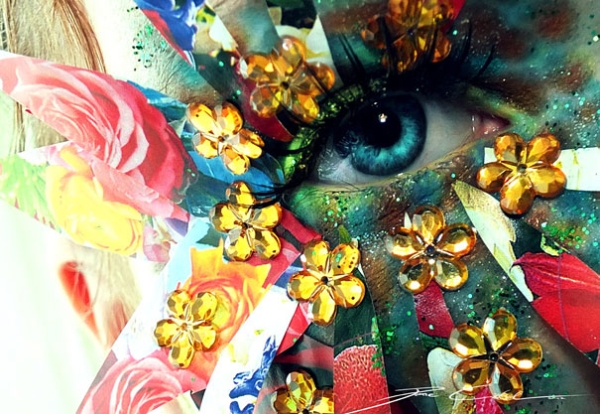
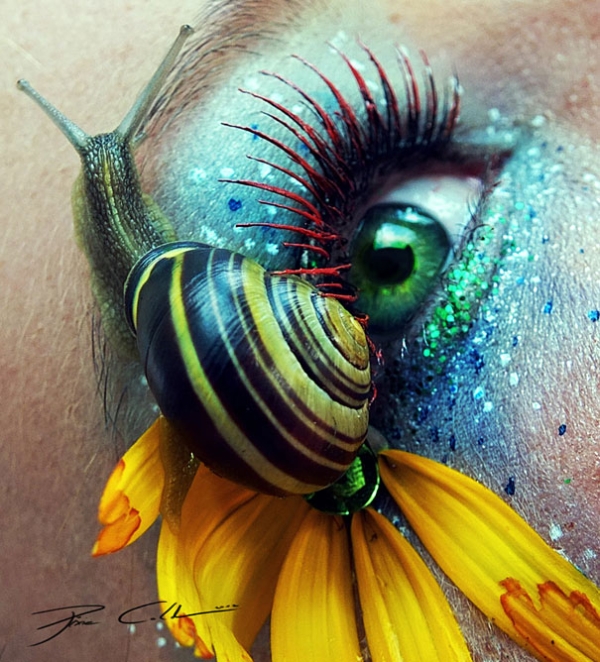
Classic makeup tools are only the beginning. Schmitt’s pieces freely add watercolor behavior, chunky glitter, colored lenses, feathers, buttons, and miniature props. In one frame, a peacock feather extends the outer corner into iridescent narrative, anchored by a blue gem where quill meets skin. In another, a starfish charm and scattered rhinestones turn the under-eye into a shoreline. Elsewhere, tiger stripes and glossy red “blood” effects push beauty toward theater and shock without abandoning precision.
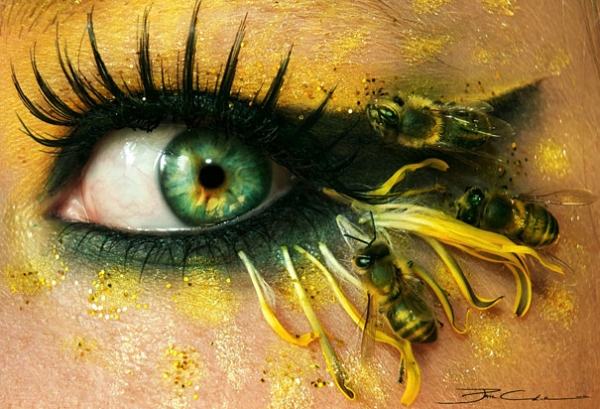
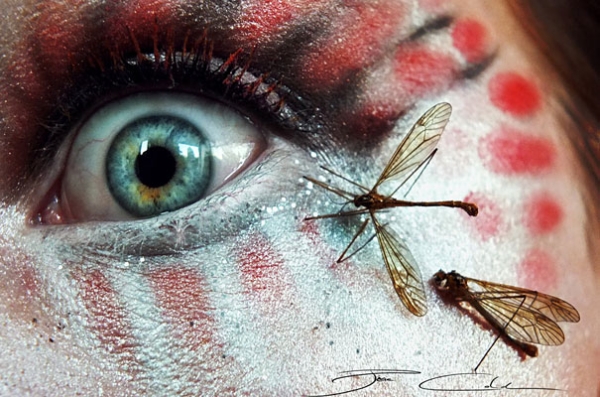
She has also worked with insects in some series—dead and living—handled, by her account, with care and with the intention to polarize, to shock, and to redirect attention toward creatures usually ignored or feared. Whether or not a particular gallery image includes that motif, the ethic of unexpected combination remains: makeup plus nature, glamour plus grit, prettiness plus unease. The twist is the point.
Macro photography as the second medium
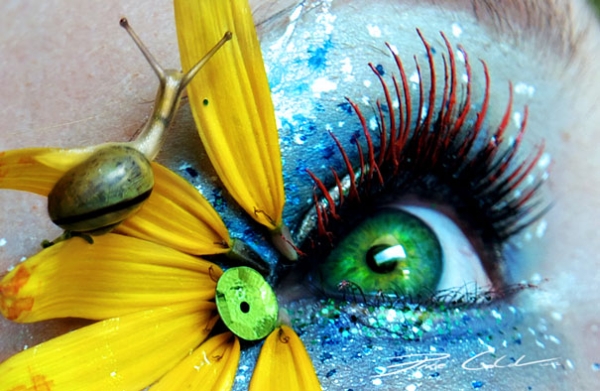
Without close photography, much of this work would remain private performance. Macro turns pores, mascara clumps, and pigment edges into landscape. It also demands technical control: shallow focus must choose the iris or the gem; light must make metallics flare without bleaching the story. Schmitt’s images usually keep the eye sharp enough to meet you while allowing peripheral glitter to bloom.
Color strategy is maximal but not random. Turquoise against gold, navy against foam-white speckles, orange stripes against crimson drips—each look builds a limited chord and then intensifies it. The human iris becomes the quiet center, sometimes left natural, sometimes altered with specialty lenses so the sclera itself participates in the fiction.
Tutorial culture without losing the artwork
Part of Schmitt’s early public life included showing process—how a lid becomes an ocean, how a charm is seated, how layers of glitter catch light only after a matte base is secure. Tutorials can flatten art into steps, but in her case they also reveal discipline. Extravagance is planned. Color chords are chosen. Props are tested against skin tone and against the camera’s tendency to exaggerate specular highlights. The finished macros look spontaneous; the craft behind them is closer to set design at fingernail scale.
Sharing method also clarifies authorship. In an internet era quick to crop watermarks and strip credit, process videos and signed frames (several images in this set carry a small artist mark) insist that the eye-world has a maker. PixieCold is not a filter pack. It is a person building temporary theaters on her own face and then photographing them before soap ends the run.
Reading the gallery as a sequence of climates
Move through the images as if changing rooms. One climate is avian and jewel-toned: peacock barbules, turquoise dust, a gem at the outer canthus. Another is tidal: navy foam-spots, frosted lower lashes, a starfish beached on the cheek. Another is feral and theatrical: stripes, wet red paint, a lens that refuses the calm white of a normal sclera. Later frames continue the tour—graphic blocks of pigment, soft blooms of glitter, vertical crops that turn a socket into a canyon wall.
What unifies them is scale and sincerity of saturation. Schmitt does not apologize for brightness. She also does not hide texture. You can see where a brush dragged, where glitter clustered, where a prop casts a tiny shadow. That visibility is respectful of the viewer. It says: this was made by hand, on skin, under lights, for a camera that will not flatter away the labor.
Beauty, shock, and what remains after washing
Schmitt has said she no longer intends to be a conventional artist. The statement fits the work’s refusal of wearable “office” beauty. These looks are not tutorials for disappearing into a crowd. They are temporary installations that ask for a camera, patience, and a willingness to look strange at close range. When the makeup comes off, the photograph keeps the extravagance; the skin returns to ordinary daylight.
Shock, in her vocabulary, is not only gore or insects. Shock can be too much color, too much attention on a body part people usually glance past, too much willingness to let beauty become uncanny. The eye is both window and billboard. Schmitt fills it until looking itself feels like entering a miniature theater—feathers in the wings, glitter in the lights, and a pupil still doing the oldest work: meeting yours and refusing to explain everything.
Leave the gallery with one practical habit: the next time you see extreme eye art online, resist treating it as a costume gag. Ask what climate it built, what materials carried the weather, and how long the maker held still while the shutter worked. Svenja Schmitt’s macros reward that slower looking—and they still look like nobody else’s rain.

Comments
Continue reading
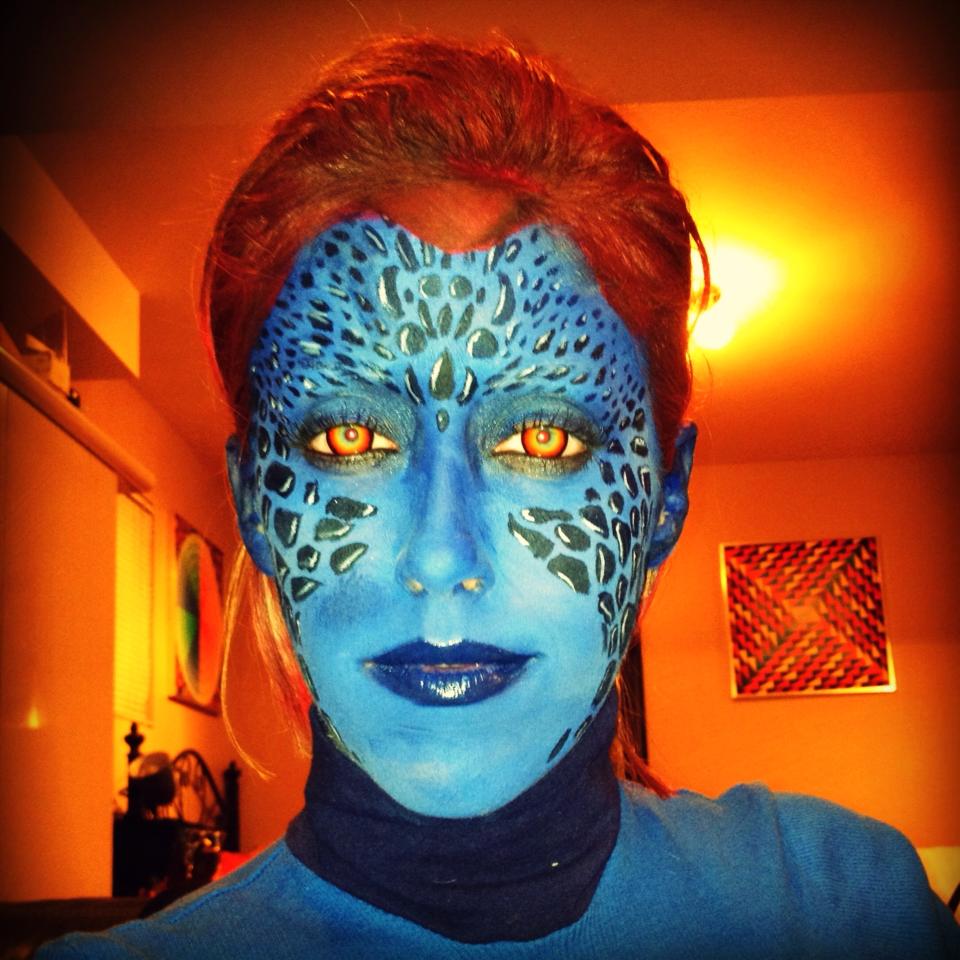
Carly Paige Transforms Herself into Celebrities and Characters
Montreal’s self-taught Carly Paige—then at Sephora, aiming for film FX—built a weekly gallery of celebrity and character faces on her own skin, from Mystique to Heisenberg.
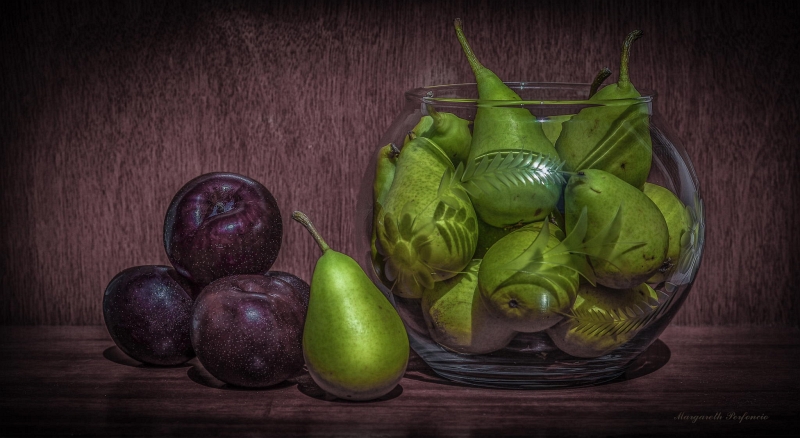
Still-Life Photography by Margareth Perfoncio
São Paulo photographer Margareth Perfoncio’s still lifes of food and flowers—Old Master light, dark wood, and tables that feel inevitable.

Meaningful Love Quotes for Inspiration (and Ink)
Meaningful love quotes that still feel true — short lines for tattoos, gifts, and everyday reminders, with placement and wording tips.