
Rihanna on Vogue US, November 2012
Annie Leibovitz photographed Rihanna at Tejon Ranch for the November 2012 U.S. Vogue cover—her second—capturing the pixie-cut era between Talk That Talk and Unapologetic.
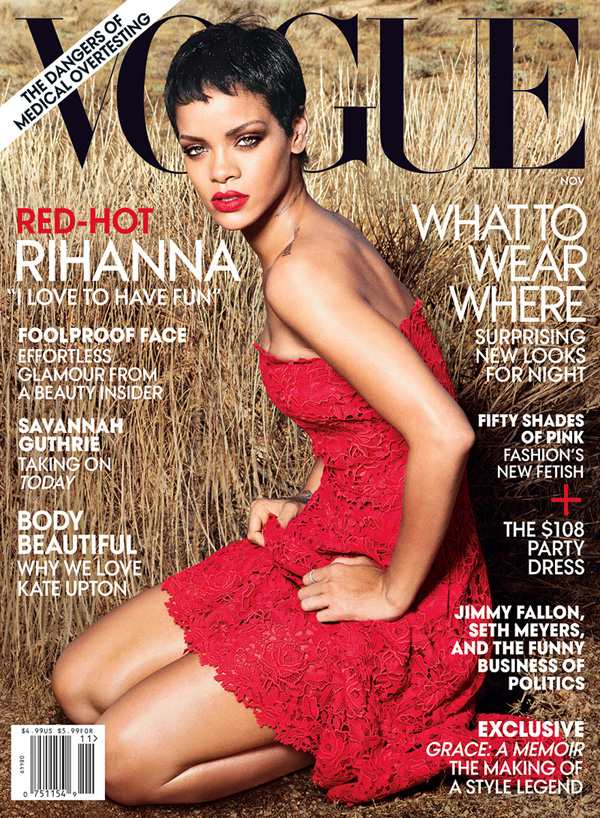
In October 2012, American Vogue put Rihanna on its November cover for the second time. Photographed by Annie Leibovitz at Tejon Ranch in Lebec, California, the feature arrived at a peak moment: a new pixie cut, a slate of hits still dominating radio, and another studio album already underway. The cover line—“Red-Hot Rihanna: ‘I Love To Have Fun’”—promised glamour with bite. Inside, the fashion editorial and profile framed a 24-year-old star who moved like a rock star in a pop industry that had spent years sanding edges smooth.
This gallery collects images from that November 2012 U.S. Vogue moment—the desert light, the couture, the short hair still surprising to fans who had last seen her with long red curls on the April 2011 cover. It is a period fashion feature, not a later career retrospective, and not a men’s-magazine profile from another title. What follows is the context of that specific issue: who shot it, where it was made, what it said about Rihanna in late 2012, and how the pictures still read years later.
Second Vogue cover, different silhouette
Rihanna’s first U.S. Vogue cover had come in April 2011—long hair, water, a mermaid-adjacent fantasy. By November 2012 the silhouette had flipped. She had cut her hair short around the MTV Video Music Awards that September, a spur-of-the-moment change she later described as unplanned: the hair for the night was supposed to fall long; instead the public met a Sabrina-era Audrey Hepburn pixie. Leibovitz’s California frames treat that cut as architecture. Without a cascade of curls to soft-focus the face, every dress and stance has to do more work. The cover and interior frames lean into that new severity—lace, leather, dust, open sky.
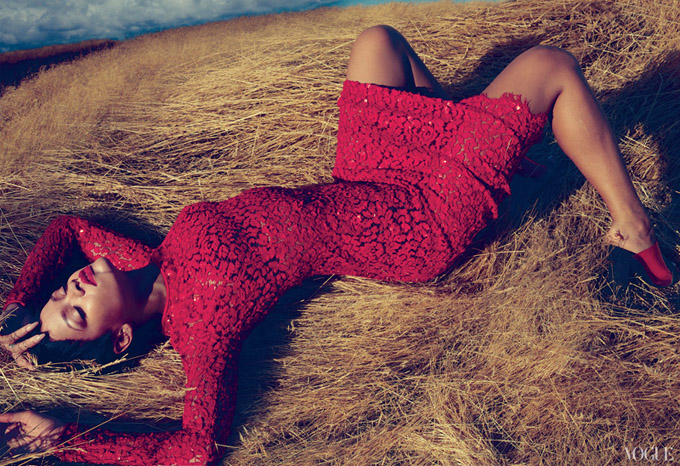
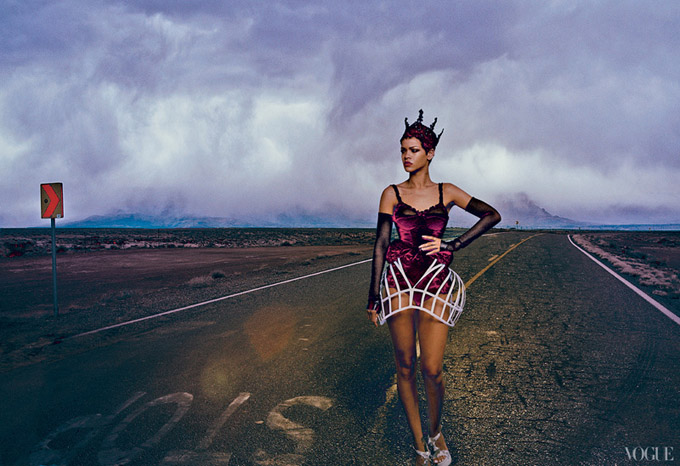
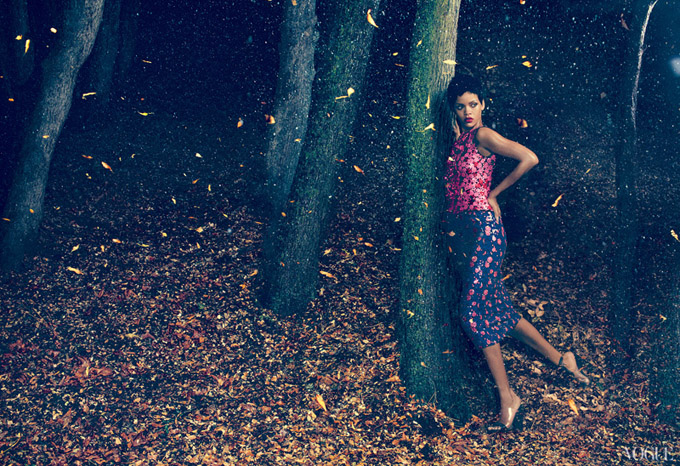
Fashion editor Camilla Nickerson shaped the looks. Credits that circulated with the published pictures include a Valentino lace dress with leather bodice (the wheat-field and dust-kicking frames that defined the cover buzz), Dior Haute Couture embroidery, Michael Kors crimson lace, Marc Jacobs sequins, Rosamosario and Revillon evening pieces, Céline mules, Gaspar gloves. Hair was Ursula Stephen; makeup, Aaron de Mey; set design, Mary Howard Studio. The location mattered as much as the clothes: Tejon Ranch’s dry hills and hay gave Leibovitz a Western-American stage that felt far from Caribbean postcard imagery or nightclub neon. Rihanna looks planted in landscape, not floating above it.
What the November 2012 profile was doing
The accompanying story—published under the “Unstoppable” banner—was a long-form celebrity profile timed to the issue, not a capsule caption. It opened on the 2012 VMAs backstage circus at the Staples Center: Taylor Swift, Miley Cyrus, Katy Perry, One Direction, Lil Wayne on a skateboard, then Rihanna cutting through in sheer red Adam Selman and Balenciaga leather, Jeremy Scott machine-gun sunglasses still on. The profile’s argument was that, in a decade when pop had grown cautious and minivan-safe, Rihanna operated like an old-fashioned rock star—messy, funny, unfiltered, and commercially relentless.
Career numbers cited around that moment were already staggering for someone not yet 25: tens of millions of albums sold worldwide, a run of chart-topping singles, billions of YouTube views, multiple Grammys, and a move into film with Battleship (2012) and the then-upcoming This Is the End. Manager Jay Brown framed the release pace as intentional—six albums in seven years, another on the way—comparing new music to the annual refresh cycle of consumer tech. Rihanna herself was in the studio selecting tracks; “Diamonds” was among the demos played for the writer before it became the lead single for what would be Unapologetic.
The interview also mapped her daily velocity: Japan, Barbados, the Amalfi coast, London, Paris, Los Angeles in quick succession; dinners at Giorgio Baldi in Santa Monica when she was briefly home; a Twitter audience larger than the U.S. president’s at the time. Tom Ford, Stella McCartney, and her mother Monica Braithwaite appear as witnesses to a public figure who was both shrewd business and still “Robyn” in private. The piece did not dodge the long shadow of February 2009 and her complicated public relationship to Chris Brown; it recorded her insistence that outsiders could not see what she saw from inside the friendship. That material belongs to the historical record of the feature. It is not the center of these fashion frames, but it is part of why the November issue felt charged rather than merely decorative.
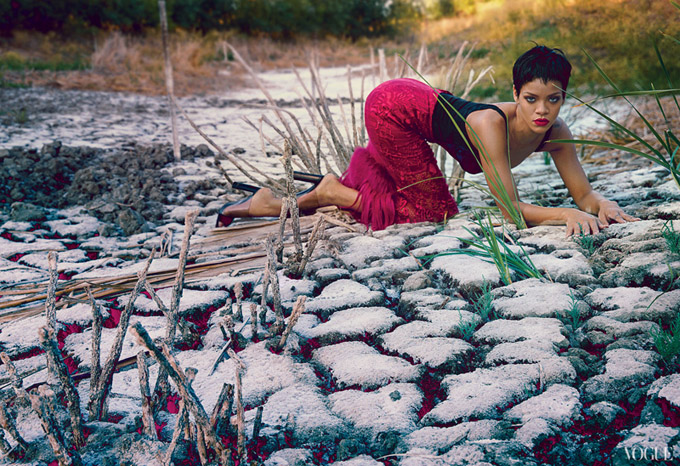
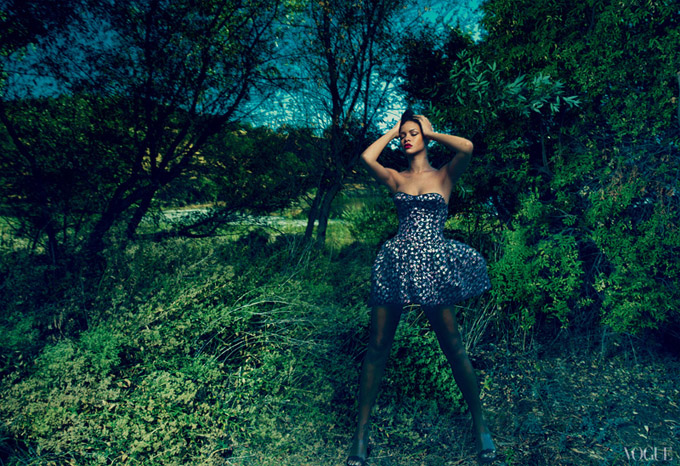
How to read the pictures
Leibovitz’s Rihanna at Tejon Ranch is not nightlife documentation. The light is hard and golden; the ground is dust and straw; the body language toggles between coiled stillness and movement that kicks weather into the frame. Lace against ranch earth creates a deliberate clash—eveningwear surviving outdoors, couture refusing the studio. Look for the hands and gloves, the cut of the pixie against open sky, the way sequins and embroidery catch California sun instead of club strobes. Fashion here is weatherproofed myth-making: a pop star staged as if she had always belonged to American landscape photography as much as to Billboard.
Compared with many celebrity covers of the early 2010s, the November 2012 set trusts quiet. Some frames look almost sullen; that coolness was part of the reception when the cover first leaked and then landed on newsstands. It also fits Leibovitz’s long habit of letting subjects hold tension rather than beam on command. Rihanna’s public brand in 2012 already included wink-and-grind VMA energy; these photographs answer with severity and space. The two modes are not contradictions—they are different instruments in the same season.
Credit remains straightforward: Rihanna, photographed by Annie Leibovitz for U.S. Vogue, November 2012, Tejon Ranch, California, fashion editor Camilla Nickerson. Behind-the-scenes footage released by the magazine around mid-October showed the singer on her second cover set talking through the new look that matched the new album cycle. That BTS material belongs to the same campaign as these stills. Together they mark a hinge between the Talk That Talk era and Unapologetic—between long hair and short, between one kind of cover fantasy and another.
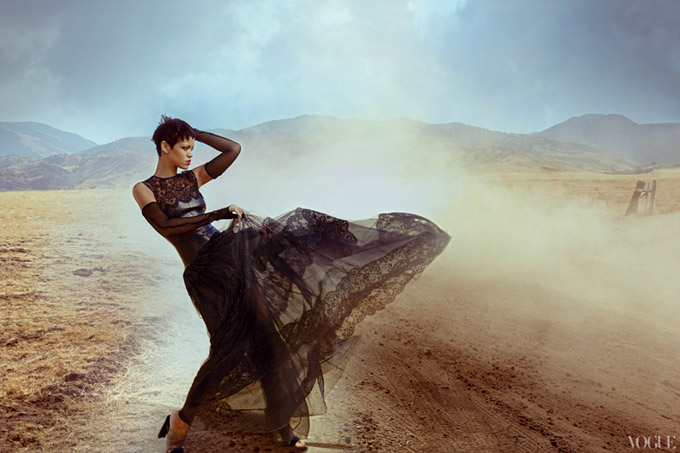
Why the November 2012 issue still matters
Magazine covers age oddly. Some become trivia; a few become visual timestamps. Rihanna’s November 2012 Vogue belongs to the second group because it freezes several overlapping stories at once: Annie Leibovitz working a major music star in landscape rather than white cyclorama; Camilla Nickerson’s couture choices translating club-and-red-carpet Rihanna into ranch light; a second Wintour-era cover that refused to repeat the first; and a profile that treated social media candor as rock-star continuity rather than PR accident.
Looking at these frames now, you are not watching a career summary. You are looking at a single editorial season—hay, lace, pixie, dust—when one of the decade’s defining pop figures sat for American fashion’s most scrutinized monthly and chose severity over softness. The photographs do not need a later legend to justify them. They already knew what they were doing: putting Rihanna in the open, under California sun, in clothes that could survive the wind.

Comments
Continue reading
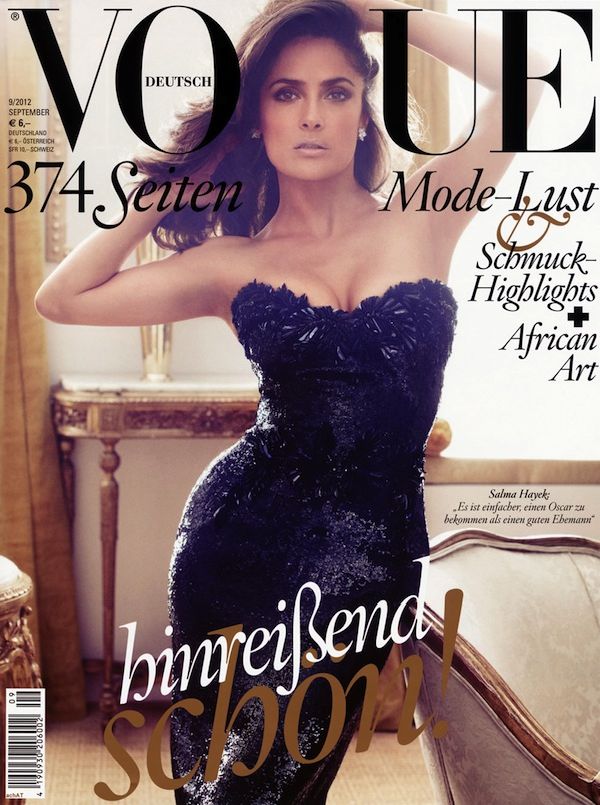
Salma Hayek by Alexi Lubomirski for Vogue Germany, September 2012
Period look at Salma Hayek’s September 2012 Vogue Germany cover story—photographed by Alexi Lubomirski in an after-hours fashion editorial.
Kate Upton on Vogue Brasil July 2013: E o Novo Sexy
Henrique Gendre and Luis Fiod put Kate Upton on Vogue Brasil’s July 2013 cover in Miu Miu—a Brazilian newsstand thesis on “the new sexy.”
Beyoncé for Vogue US, March 2013 Power Issue
Beyoncé on the March 2013 Vogue US Power Issue—Patrick Demarchelier’s period editorial of fashion, control, and cover-star glamour.