
Bettina Güber’s Little People at the Office
German photographer Bettina Güber turns staplers, hole punches, and desk clutter into comic infrastructure for tiny office adventures.
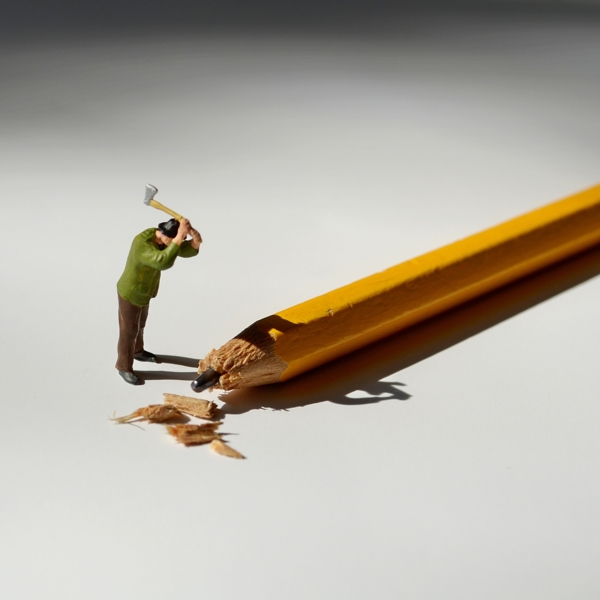
German photographer and media designer Bettina Güber turned the most ordinary workplace into a stage. In her series often shared as Office Supplies – Small People (also discussed as office-life miniatures), tiny figurines climb, hide, celebrate, and panic among staplers, hole punches, paper clips, and desk clutter. The humor is sharp because the props are familiar: anyone who has sat through a long afternoon at a desk recognizes the landscape, even when it suddenly belongs to people the size of a thumbtack.
Güber, based in Krefeld, Germany, began photographing seriously around 2012 while working as a media designer. She has said she admired other “small people” photographers and wanted to build scenes of her own—first single humorous frames, then a connected series in which the same miniature cast experiences adventures inside her office. The desk becomes a city. Stationery becomes architecture, machinery, and weather. Scale flips so completely that a stapler reads as infrastructure and a pile of punched paper discs becomes confetti for a wedding.
Why the office, not a fantasy set
Plenty of miniature photography builds elaborate custom worlds. Güber’s office work does the opposite: it stays inside a real workplace and asks what already lives there. That constraint is the joke and the craft. A hole punch is not redesigned into a sci-fi prop; it remains a hole punch—until a figurine stands beside it and the machine suddenly looks enormous, industrial, and slightly threatening. The viewer supplies the rest of the story in a second.
Office life also carries ready-made narrative pressure. Deadlines, boredom, tiny rebellions, awkward celebrations, and the sense that objects outlast the people who use them—all of that sits in the background of a stapler photo without needing a caption essay. Güber’s figures act out those moods in miniature: peril on the edge of metal jaws, romance among paper scraps, exploration across keyboard landscapes, idle wandering between piles of work that will never finish.
Because the setting is her own desk, the series also feels like a break-time invention. Inspiration arrives between tasks. The camera documents a private game that happened to travel well online: look closer at what you already own, and the day becomes a comic strip.
How the pictures work
Technically, the office miniatures depend on three choices that amateurs often underestimate.
- Eye level for the figurines. Shooting from above turns toys into toys. Dropping the camera toward the height of a plastic person’s head makes a desk lamp into sky and a ruler into a highway.
- Selective focus and shallow depth. Soft background blur sells the illusion that the figurine occupies a deep space, not a flat desktop photograph.
- One clear action. The best frames usually hinge on a single readable verb—climbing, fleeing, kissing, waiting—so the scale gag lands instantly.
Lighting matters as much as posing. Desk lamps, window light, and the cool glare of screens already exist in offices; using them keeps the scenes believable. Over-lit studio drama can flatten the humor. Soft, slightly imperfect workplace light says: this really happened between emails.
Props do double duty. Paper clips become ladders or fences. Binder clips become shelters. Sticky notes become cliffs or billboards. The series teaches a collector’s eye for scale relationships: what object is tall enough to be a building, wide enough to be a plaza, sharp enough to be danger.
Storytelling without speeches
Güber’s public note about the project is disarmingly direct. She hoped viewers would enjoy watching the tiny people’s exciting office life. That aim—pleasure first—keeps the work from tipping into heavy allegory. You can read the stapler as capitalism if you want, but the photographs do not insist. They prefer the shorter laugh of recognition: yes, that machine always looked a little murderous.
Recurring characters help. When the same cast returns across scenes, the office becomes a soap opera with stationery as set design. A couple among hole-punch confetti reads differently if you have already seen them elsewhere on the desk. Continuity turns a novelty genre into a miniature neighborhood.
Compared with food-based miniature projects—where pastry and fruit provide lush color and edible topography—the office series is cooler, grayer, and more satirical. Metal, plastic, and paper replace cream and glaze. The palette alone changes the emotional register: less picnic fantasy, more workplace comic. That difference is worth keeping clear. Güber’s desk world is not a bakery diorama; it is a workplace seen through a magnifying glass and a smile.
Looking at the frame above
Spend a moment with the photograph on this page before scrolling past. Ask three practical questions:
- Where is the horizon for the little people, and how does that horizon reorganize the desk?
- What single office object carries the drama—the “main building” of the scene?
- What human mood is being acted out: risk, celebration, boredom, teamwork, escape?
Those questions turn passive amusement into active looking. Miniature photography rewards attention to gesture. A raised arm, a turned head, or a figure mid-step can decide whether the scene feels staged or alive. Güber’s stronger frames usually look like candid moments from a world that happens to be small, not like toys arranged for a product shot.
Why the series still travels
Office miniature humor ages well because offices keep recycling the same tools. Software changes; staplers stubbornly remain. Anyone who has ever daydreamed during a meeting understands the urge to invent another life inside the one they already inhabit. Güber simply built that daydream with figures and a camera, then shared it far enough that desk workers everywhere could borrow the joke.
There is also a craft lesson for anyone interested in tabletop photography. You do not need a custom diorama kit to start. You need scale contrast, a low camera angle, and an everyday object willing to play architecture. The office is an underrated studio: abundant props, controllable light, and a built-in theme—work, interruption, and the small rebellions that make a day bearable.
If you want to explore more of Güber’s miniature experiments beyond this desk chapter, her Behance presence (under the profile long associated with her photography) has been the usual public doorway. The office series remains the clearest introduction: tiny people, big stationery, and the reminder that creativity often begins by looking again at what sits within arm’s reach.
Next time a stapler sits closed on your desk, imagine the jaws from ankle height. The room will feel larger, stranger, and briefly funnier—which is exactly the gift this series keeps offering.

Comments
Continue reading
Still-Life Photography by Margareth Perfoncio
São Paulo photographer Margareth Perfoncio’s still lifes of food and flowers—Old Master light, dark wood, and tables that feel inevitable.
Meaningful Love Quotes for Inspiration (and Ink)
Meaningful love quotes that still feel true — short lines for tattoos, gifts, and everyday reminders, with placement and wording tips.
Christina Hess’s Animals From History: Costumed Pets as Playful Portraits
Illustrator Christina Hess reimagines historical icons as ornate animal portraits—Elvis Petme and friends—mixing puns, costume detail, and soft history lessons.