
Impressive Architectures of Spain: Sagrada Família and Guggenheim Bilbao
A travel and design look at Gaudí’s Sagrada Família in Barcelona and Gehry’s Guggenheim in Bilbao—form, light, city fabric, and how to see both beyond a photo stop.
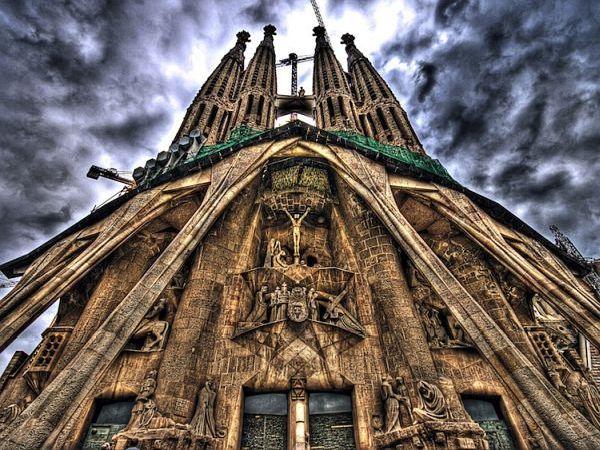
Spain’s architecture rewards slow looking. Gothic stone and late-twentieth-century titanium can sit a few hours apart by train, and both reshape how a city feels underfoot. Two landmarks often lead that conversation for travelers and design readers alike: Antoni Gaudí’s still-growing Sagrada Família in Barcelona, and Frank Gehry’s Guggenheim Museum along the river in Bilbao. Together they sketch a clear contrast—organic vertical ambition versus sculptural riverside spectacle—without reducing Spain to a single style or a single century.
This is a travel-and-design reading of those two buildings: how they work as form, how they meet their cities, what light and material do on site, and what a visitor should notice beyond a quick photo stop.
Sagrada Família: a vertical forest of stone
Barcelona’s Sagrada Família is less a sealed monument than a long experiment in how a church can grow. Gaudí took over the project in the 1880s and transformed it into a personal cosmology of nature, light, and Catholic narrative. Towers rise like trunks; façades carry dense sculpture; interiors filter daylight through stained glass so the nave shifts color through the day. Even while unfinished, the building already behaves as a city landmark—visible from many neighborhoods, magnetic to visitors, and still under active construction with contemporary methods answering Gaudí’s models.
From the street, the first impression is vertical density. Pierced stone, angled roofs, and clustered spires refuse the calm silhouette of a classic basilica. Gaudí wanted structure and ornament to argue from the same logic: columns that branch like trees; surfaces that catch Mediterranean light in sharp relief; façades that teach stories in stone instead of treating sculpture as optional cladding. The building does not sit politely inside the Eixample’s chamfered grid; it erupts from the block with a different geometry than the apartments around it.
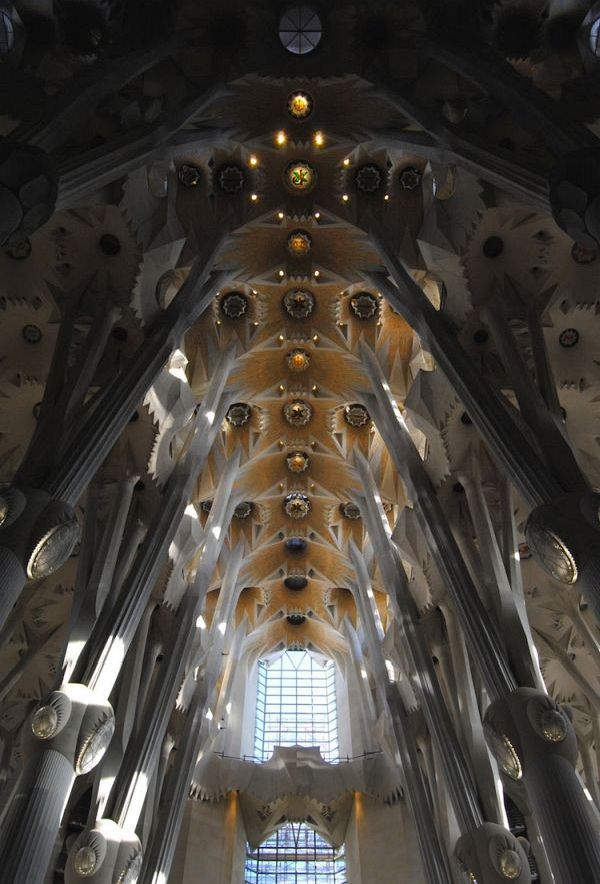
Detail rewards patience. Fruit motifs, biblical scenes, and abstract geometries crowd the façades without reading as decoration bolted onto a box. Up close, craft and engineering share the load: carved stone, later materials added in successive phases, and a continuous negotiation between historic intent and modern construction. The project’s long timeline is part of its meaning. Each generation inherits a living site rather than a museum piece locked in one decade’s taste.
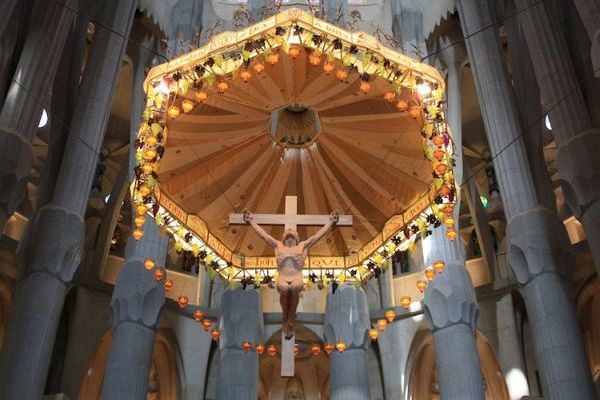
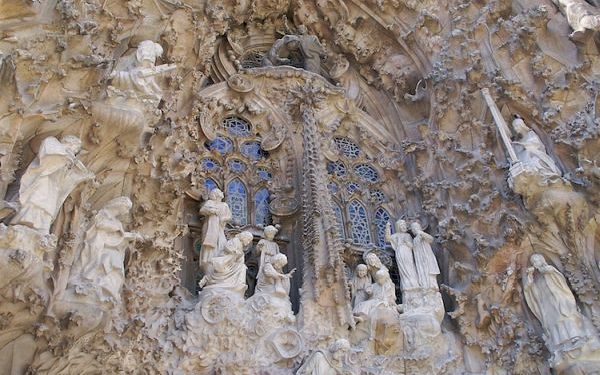
Inside, with a timed ticket, the forest metaphor becomes spatial. Inclined columns create a canopy overhead; the plan feels both Gothic and strangely modern. Light is the real guide. Cooler tones through one set of windows, warmer through another, so the interior climate changes as you walk. Even travelers who are not religious usually respond to that choreography—architecture as an atmosphere engine rather than a static shell.
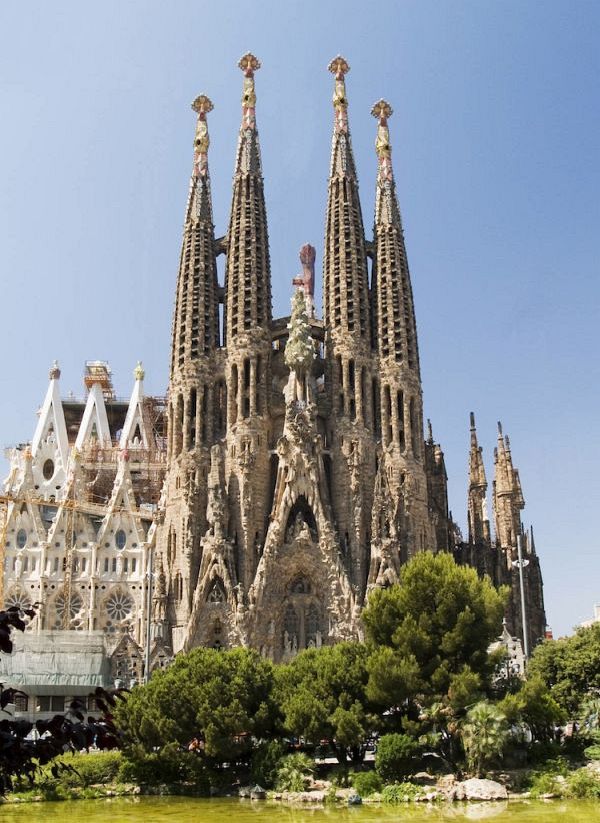
Design takeaways for a Barcelona stop: approach on foot from more than one angle; look up at tower profiles against ordinary apartment blocks; if you enter, give the nave time before photographing; notice how stained glass paints the stone rather than merely coloring the air. The building teaches that organic form can still be rigorous—every curve solving structure, light, or story.
Guggenheim Bilbao: metal that behaves like water
In Bilbao, the Guggenheim Museum Bilbao (opened 1997) flipped a different switch. Frank Gehry’s titanium-clad volumes curve along the Nervión like a ship mid-morph. Where Sagrada Família climbs, the Guggenheim spreads and folds. Reflective skin catches weather and water; limestone volumes ground the composition; glass atriums pull daylight into the lobby. The museum became shorthand for architecture-led urban regeneration—the so-called Bilbao effect—because the building itself is a destination before visitors even reach the collection.
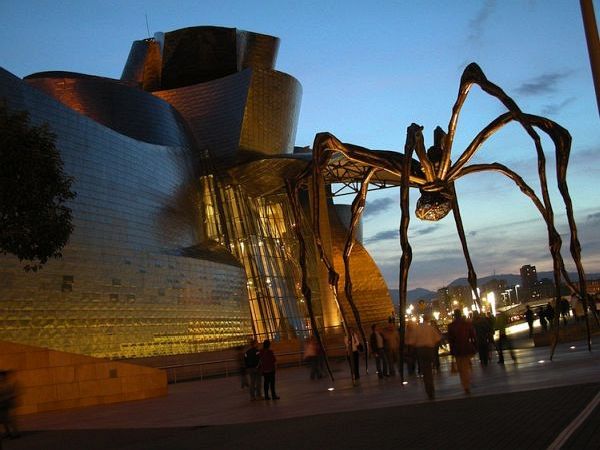
From the river promenade, the museum reads as a sequence of gestures rather than a single façade. Curves reverse, overhangs create shade, and the titanium scales shift from cool silver to warm gold depending on cloud cover. The riverside setting is not decorative filler. Bridges, walkways, and water reflections complete the composition. Public sculpture and plazas extend the experience outdoors, so the architecture works as civic landscape as much as gallery envelope.
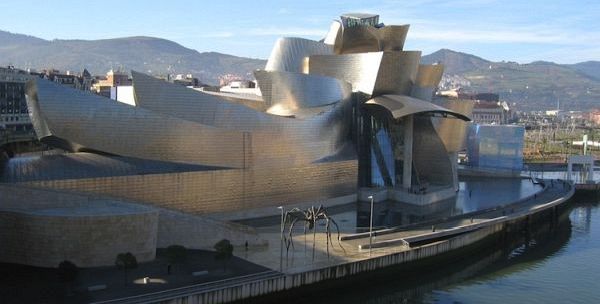
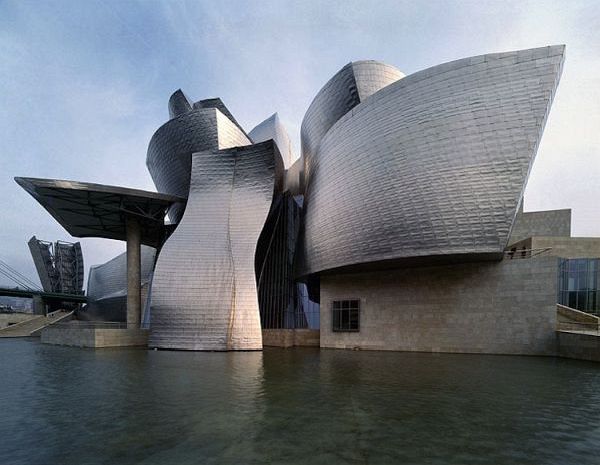
Inside, the atrium is the signature spatial event—a tall, irregular volume that orients visitors and makes movement feel exploratory rather than linear. Galleries vary on purpose: some are conventional enough for paintings and quieter works; others are vast enough for large contemporary installations. That mix matters. Spectacle alone would age quickly. The building still has to serve art, climate control, circulation, and the unglamorous logistics of a working museum. Critiques of “icon” architecture often use Bilbao as Exhibit A, yet the museum’s lasting power comes from how exterior drama and interior function keep negotiating with each other.
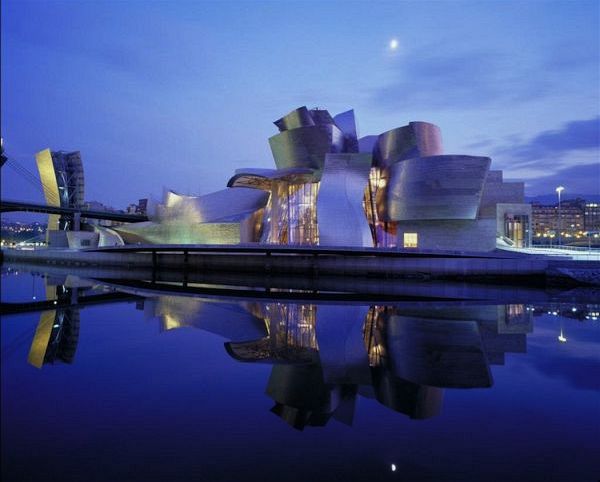
Design takeaways for a Bilbao stop: walk the river edge at more than one time of day; notice titanium versus stone under changing weather; enter through the atrium and pause before rushing galleries; step back outdoors to reconnect building, bridge, and water. The lesson is that contemporary form can be exuberant and still site-specific when climate, river, and city fabric are part of the brief.
Two Spanish lessons side by side
Placed together, these projects show Spain’s architectural range without pretending the country has only two buildings worth visiting. Sagrada Família argues for patience, craft continuity, and nature as structural metaphor. Guggenheim Bilbao argues for bold material invention and urban reinvention through a cultural anchor. One is vertical, spiritual, and centuries-deep in process. The other is horizontal, civic, and timed to late-twentieth-century museum culture and digital design tools.
Travelers often treat both as checklist icons. A better approach is comparative looking:
- Silhouette: towers versus folds—how does the skyline change from a few blocks away?
- Material: carved stone and glass versus titanium, limestone, and glass—how does weather rewrite the surface hour by hour?
- Public space: dense city block versus river promenade—who owns the approaches, and how do people linger?
- Time: unfinished sacred project versus completed cultural machine—what kind of future is each building betting on?
Spain holds far more than these two—Islamic heritage in Andalusia, Roman traces, Mudéjar brickwork, rationalist blocks, coastal modernism—but Sagrada Família and the Guggenheim remain unusually clear teaching tools. They are photogenic for a reason: both make structure expressive rather than hiding it behind flat walls. If you can visit only one, choose by appetite: interior light and vertical awe in Barcelona, or riverside reflection and contemporary volume in Bilbao. If you can visit both, let the contrast do the teaching. Few countries stage that conversation so sharply within a single trip.
- Book Sagrada Família timed entry; mornings can be kinder for light and crowds.
- Give Bilbao a full outdoor loop before museum hours if titanium under changing sky is your priority.
- Carry a light layer—stone naves and riverside wind both surprise.
- Look at neighboring ordinary buildings; icons make more sense against everyday fabric.

Comments
Continue reading
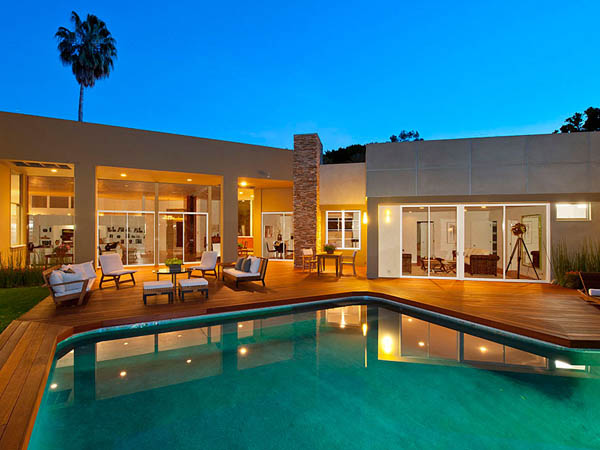
Beverly Hills Villa by William Stephenson
A renovated 1956 William Stephenson villa in Beverly Hills—four bedrooms, five baths, gallery hall, garden pool—documented from its early-2010s listing era.
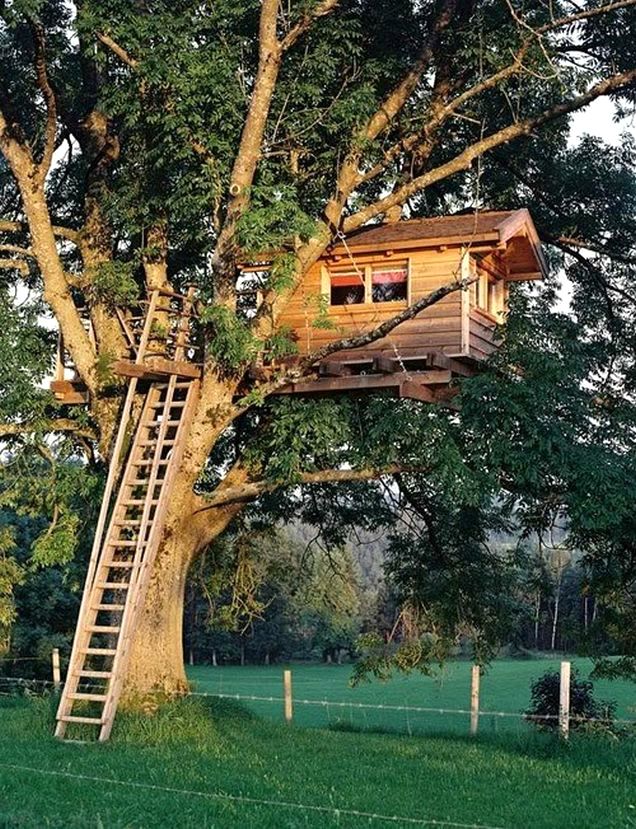
Tree House Designs: Elevated Cabins, Pods, and Canopy Rooms
From classic platform forts to architect pods in the canopy—how tree-house designs balance wonder, structure, and care for the living trees that hold them.

Yumiko Matsui’s Adorable Miniature Paper Tokyo
Paper artist Yumiko Matsui folds coloured sheets into detailed Asakusa streetscapes—miniature Tokyo rebuilt shopfront by shopfront.