
Impossible Photo Art by Erik Johansson
How Swedish photographer Erik Johansson builds surreal scenes that still read as photographs—idea first, self-shot parts, and retouching that respects light and scale.
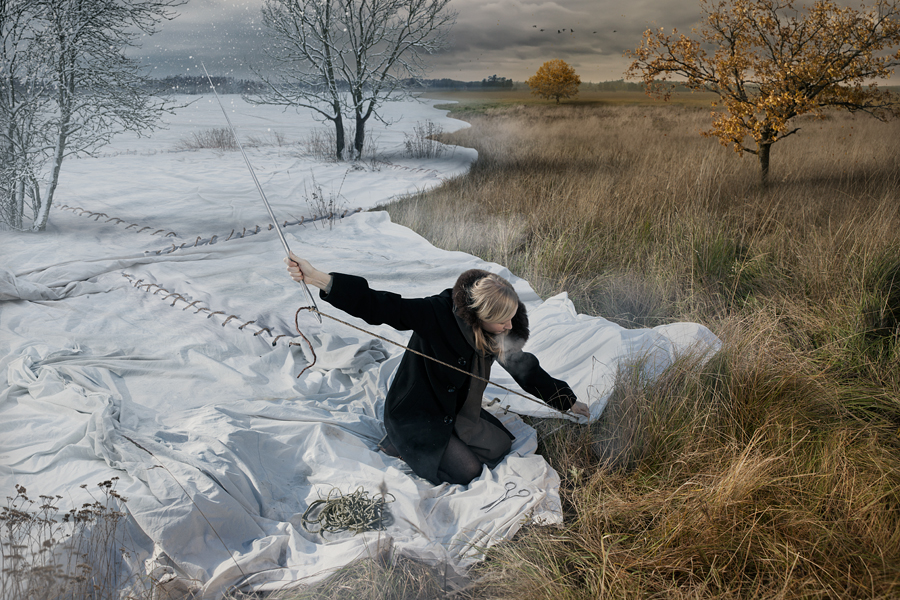
Erik Johansson treats the camera as a collector of parts, not as a witness to a single lucky moment. The Swedish photographer and retoucher builds scenes that look photographed in one click—until you notice a road folded like paper, a house drifting, or a forest that swallows logic. The illusion only works if every edge, shadow, and texture agrees. That demand for realism inside impossibility is the center of his work.
When this overview first circulated widely, Johansson was a young freelancer who had already moved from Sweden into Berlin’s creative circuit. The pictures below—and the titles he gives them—still map the same obsession: sketch an idea, shoot the pieces himself, and assemble a frame that refuses to look like a collage even when you know it must be one.
What follows is a guide to how his “impossible” photo art is made, how to read specific pieces, and why the seams matter as much as the punchline.
Photography as problem-solving
Johansson often describes the job as solving a puzzle: an idea arrives first, then the question becomes how to capture each element so the final composite feels optical, not illustrated. He prefers photographing his own material—landscapes, props, figures, skies—over stock libraries or pure CGI. Physical builds and on-location shoots feed the file. Retouching joins them with matching perspective, light direction, and grain.
That workflow matters because surreal photography fails when one layer betrays another. A hard studio shadow under a subject standing in open daylight breaks the spell. Mismatched horizons do the same. Johansson’s best frames survive zooming in: asphalt texture continues under a fold, tree bark stays consistent across a cut, water behaves like water even when the narrative is absurd.
He has said he wants manipulations to look as if they were captured. The ambition is not to hide software; it is to make software serve a photograph’s grammar—depth of field, lens distortion, atmospheric haze—so the brain accepts the scene before the intellect protests.
Reading the early impossible scenes
Titles do real work in his portfolio. They are short, slightly wry captions that nudge interpretation without explaining the trick.
Helping fall and A safe place, drifting away play with shelter and motion—homes or ground that should stay put, but do not. Arms break, vases don’t flips expected fragility. Be careful, the deep forests can be dangerous turns landscape into threat with a near-fairy-tale tone. Breaking up and Cut and Fold announce the craft literally: surfaces behave like paper, maps, or tearable planes.
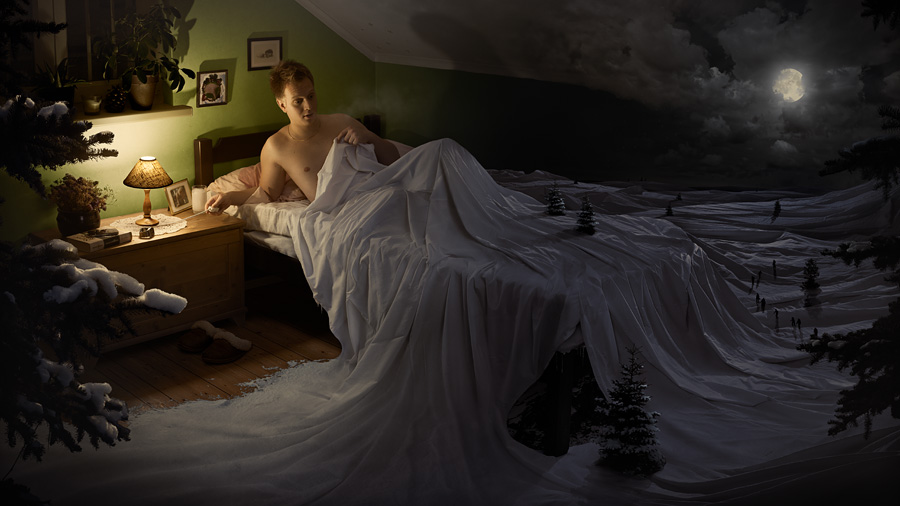
Cutting Light and Expecting Winter push weather and illumination into sculptural roles. Light becomes something you could almost slice; winter becomes a state you can stage rather than wait for.
Go your own road is the kind of piece that made his work travel online: a path that refuses ordinary engineering, yet still casts believable shadows. Lazy Dog keeps humor in the mix—surrealism does not always need dread.
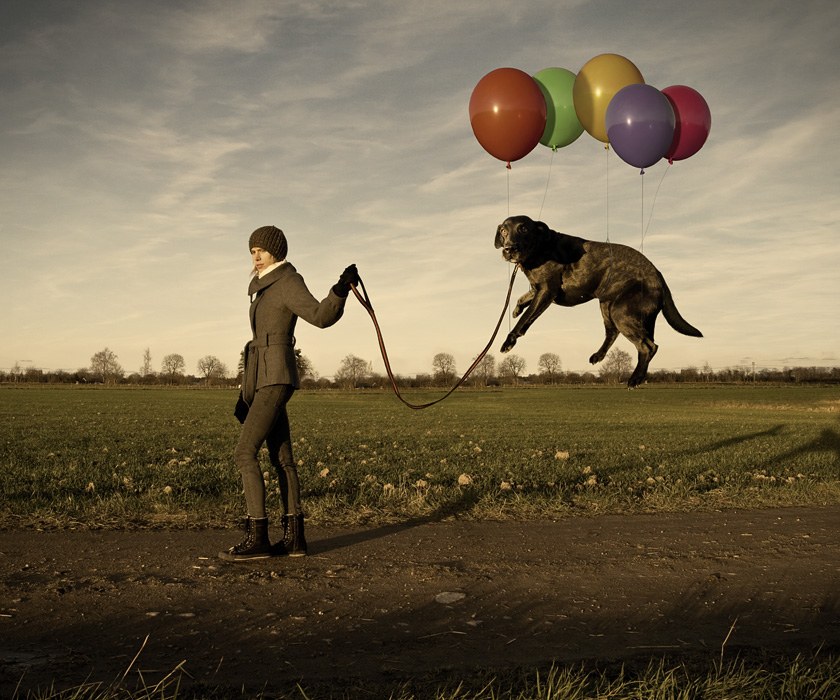
Set them free, Snow Cover, Work at sea, and A painting too real widen the set: liberation metaphors, weather skins, labor on water, and the old tension between painted illusion and photographic proof.
What makes the composite hold
Several craft habits separate Johansson’s impossibilities from quick filter tricks:
- Matched vanishing points. Roads, rooms, and fields share a coherent perspective grid even when the story folds space.
- Consistent light logic. One sun, one sky temperature, shared bounce—unless the concept deliberately splits worlds, and then the split is designed.
- Material honesty. Dirt, paint, fabric, and water keep photographic micro-contrast; over-smoothed CGI sheen is avoided.
- Scale discipline. A figure, a tree, a car, or a house must agree on size, or the brain rejects the scene before it enjoys it.
- Edge craft. Seams are painted with care: no halo, no repeated clone patterns, no soft blur that screams “mask.”
He has also built props and partial sets when a detail cannot be found outdoors. That hybrid—carpentry plus photography plus retouching—keeps textures under his control. The final file may contain dozens or hundreds of source photographs; the viewer is meant to feel one exposure.
Humor, unease, and clean composition
Johansson’s scenes are often quiet. Large empty fields, simple skies, and central subjects give the surreal twist room to land. Humor appears without slapstick: a lazy animal, a polite disaster, a title that undercuts the drama. Unease appears without gore: forests, breaks, drifts, and cuts that suggest consequence.
Compositionally, many frames use a clear primary read at thumbnail size—important for how these images circulated on the web—then reward a longer look with secondary jokes in the corners. That two-speed reading is useful for advertising commissions as well as personal work: a brand needs the idea to land fast; an exhibition visitor wants the craft to hold up close.
How to look without spoiling the magic
If you want to study the technique without turning every piece into a tutorial checklist, try this sequence:
- Accept the story for ten seconds. What is “impossible” here in one sentence?
- Find the brightest highlight and the deepest shadow. Do they belong to the same weather?
- Trace a continuous surface—road, wall, water. Where does geometry change, and does the texture still match?
- Only then guess the shoot plan: which parts were likely real props, which were landscape plates, which were sky swaps.
Teachers and TED-stage talks later made his process famous, but the pictures themselves still teach best when you argue with them. Ask where the camera would have stood if the event were real. Ask what would break first if gravity returned. Those questions reveal how tightly the composite is engineered.
Why “impossible” still looks photographic
Digital culture is full of obvious fakes. Johansson’s work stays interesting because it respects photographic constraint even while inventing events. The camera remains the gatherer of evidence; imagination becomes the editor of that evidence. Sweden’s open landscapes and European city bases over the years gave him both empty stages and production access, but the constant is the rule set: no element gets a free pass on light or scale.
Browse Expecting Winter again after Lazy Dog and Snow Cover. One leans toward climate as sculpture, one toward wit, one toward weather as skin. Across that range, the same promise holds: if you half-close your eyes, it could almost be a straight photograph—and that “almost” is exactly where the art lives.

Comments
Continue reading
Photo Manipulations by Caras Ionut: Whimsical Surreal Composites
Romanian artist Caras Ionut blends his own photographs into dreamlike Photoshop manipulations—whimsical surreal scenes taught through tutorials as carefully as they are shown.
Dramatic Photo Art by Sukron Ma’mun (Ipoenk Graphic)
Cirebon, Indonesia photographer Sukron Ma’mun uses theatrical natural light to frame village life, play, and place in lyrical photo art.
Bird’s-Eye Views: Florian Beaudenon’s Instant Life
Paris photographer Florian Beaudenon’s Instant Life series captures people in their rooms from above—intimate, collaborative overhead portraits of everyday joy.