
Home Dream Home Part 7: Daydream Retreats at Home
Fireplace baths, hallway reading nooks, and personal living corners—how to design small escapes inside an ordinary floor plan.
Some dream-home rooms are for showing guests the good china. Others are for disappearing into for twenty quiet minutes. Part 7 of Home Dream Home is about the second kind: soaking tubs set against stone and fire, hallway benches that interrupt the rush, living corners with a personal color story, and small architectural pauses that make an ordinary plan feel like a retreat.
Daydream rooms share a structure. They have an edge—an alcove, an arch, a raised platform—that separates them from traffic. They offer one soft place to stay. They use warm light instead of office glare. And they include one sensory luxury: fire, water, books, plants, or a framed view. Use the gallery as a checklist for those ingredients, not as a mandate to rebuild your whole suite.
When the bath becomes a private landscape
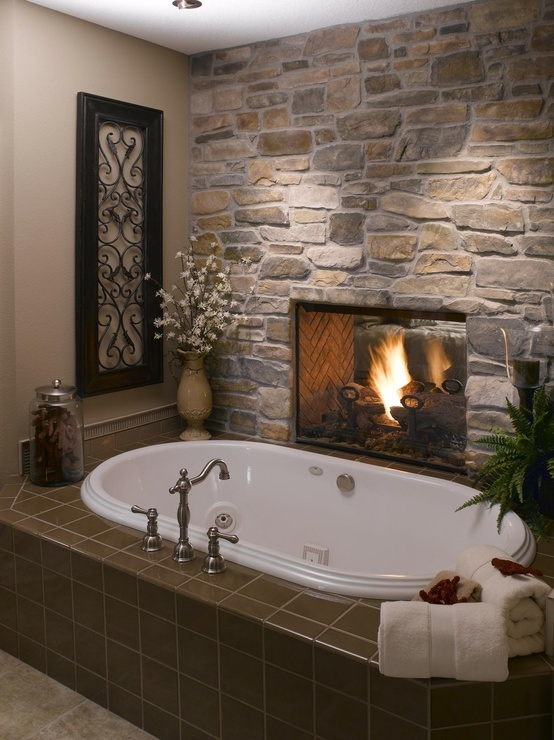
A drop-in oval tub against stacked stone, with a glass-front fireplace at eye level, turns bathing into a destination. Olive-tan tile on the surround, rolled towels on the ledge, a fern, and a branch of white blossoms keep the palette earthy. Heat, water, and texture share one sightline. That adjacency is the dream—more than any single fixture brand.
You can borrow the logic without a chimney in the wet room. Pair a deep tub with one honest material field behind it: stone veneer rated for humidity, large-format tile with natural variation, or a sealed wood-look surface designed for baths. Add a warm light layer separate from the bright vanity cans. Keep ledge décor to a short list: towels, one jar, one plant, one quiet art piece. Crowded ledges turn spa into storage.
Cross-handle taps and classic profiles usually sit more comfortably against rustic stone than ultra-flat contemporary fittings, unless the rest of the bath is equally spare. Choose metals that tolerate moisture and match nearby hardware so the retreat does not look assembled from three different catalogs.
Maintenance is part of the fantasy. Steam peels the wrong paint and fogs the wrong art. Run ventilation, pick materials for wet zones, and store daily bottles in a closed niche so the scenic wall stays scenic. A retreat that is hard to clean stops being used, and an unused fireplace tub is only an expensive photograph.
Hallway nooks that slow the house down
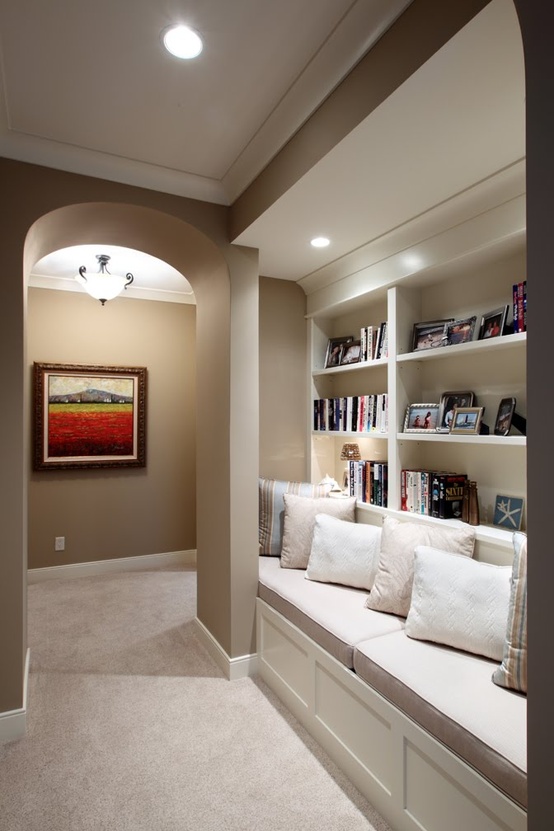
Not every escape needs a door. A white built-in bench under shelves, set into a warm tan hall with an arch beyond, proves that a pause can live inside circulation space. Cream and soft-blue pillows, a small shelf lamp, books mixed with framed photos, and carpet underfoot create a pocket of quiet between rooms. The arch frames movement; the nook argues for staying.
In a rental or a tight plan, approximate the built-in with a shallow storage bench, a fitted cushion, two floating shelves, and a plug-in or battery light. Keep depth honest: deep enough to sit, never so proud that laundry baskets bruise hips. Leave walking clearance clear; a nook that blocks the hall becomes a complaint, not a luxury.
Personal objects belong here more than in formal parlors. A few family frames and a novel you are mid-way through signal private life. Resist turning shelves into overflow for gifts and seasonal décor. Gaps between objects are what make the composition feel intentional rather than stuffed.
Acoustic softness helps. Carpet, a runner, or even a thick seat cushion dampens footsteps so the nook feels quieter than the rest of the corridor. If the hall is echoey, the bench will never feel like a retreat no matter how pretty the pillows are.
Living rooms that daydream in color and memory
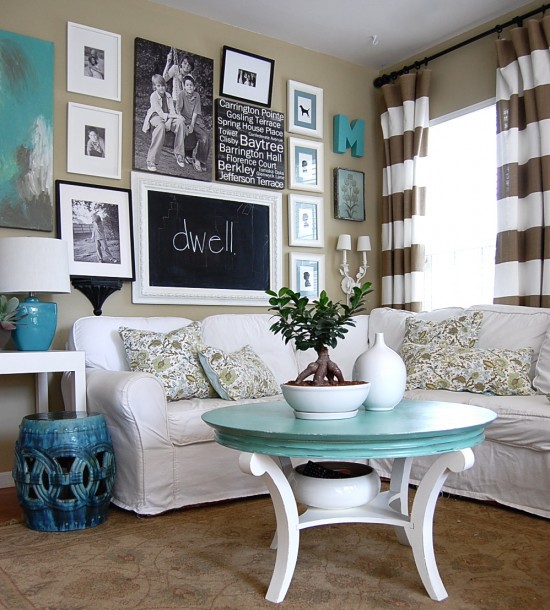
Retreats are not always spa-white. A white sectional against a tan gallery wall, bold striped curtains, and a turquoise table can feel like a daydream because the room is specific: someone’s photos, someone’s letter form, someone’s repeated accent color. Deep seating and a round coffee table invite lingering; the gallery gives the eye a personal landscape when conversation pauses.
Build a retreat-minded living room around seat comfort and lamp light first. Matching furniture sets are optional. A ceramic garden stool can hold a drink or a book. A typographic print or small chalkboard can calm a busy wall of frames. Repeat one accent three times across lamp, table, art, or stool so the palette feels deliberate, then stop adding. Collected should not become crowded.
If a television shares the room, deny it the hero wall. Let the gallery, the window, or the hearth take visual priority so the first story of the space remains human. Soft rugs and curtains absorb sound—useful when one person reads while another cooks. A retreat living room fails if every surface is hard and every light is overhead.
Thresholds, niches, and other psychological distance tricks
Arches, niches, raised tub decks, and framed openings change how a house feels without adding square meters. They create thresholds: you leave the busy hall and enter the nook; you step onto the tub platform and leave the day behind. Even a paint change inside a recess can simulate that shift on a small budget.
Ceiling moves concentrate attention. Recessed lights over a bench, a lower header over a seat, or a focused pendant over a tub ledge create a pool of intimacy. Flat, even office lighting erases retreat mood. Aim for brightness where you need it for safety and softness where you want to linger.
Materials should invite the hand. Stone texture, woven pillows, book spines, wood grain, and plant leaves give restless fingers something to do while the mind slows. All-gloss rooms photograph crisply and often feel cold in person. Pair one rough or matte field with smoother companions so the retreat has tactile contrast.
Choose a ritual before you choose a feature
Before you chase a fireplace bath or a hall library, inventory habits you already have. Do you soak or mainly shower? Do you read upright on a bench or only propped in bed? Features that fight your rituals become guilt storage. Pick the retreat that matches a weekly practice, then remove friction: towels within reach, a place for a glass and a book, an outlet for a lamp or speaker, a hook for a robe.
Budget in layers. Paint, lighting, and textiles first; stone and carpentry after you have tested the layout with temporary furniture. Many of the strongest daydream rooms succeed because they are specific and maintained, not because every surface is premium.
- One edge that separates the retreat from traffic
- One soft seat or deep tub worth twenty unhurried minutes
- One warm light source that is not overhead glare
- One sensory luxury: fire, water, books, plants, or a view
- One storage habit that keeps the retreat from becoming a dump zone
When those five are present, an ordinary Tuesday can still feel like a short getaway—and that is the daydream worth designing toward.

Comments
Continue reading
Home Dream Home: Romantic Details for Soft, Vintage Rooms
Ethereal light, French-inspired silhouettes, and weathered whites—how to add romance with sheers, candles, and inherited-feeling pieces.
Home Dream Home: Simplicity as Everyday Sophistication
Edited rooms, quiet planes, and scarce accents—how simple interiors stay sophisticated without feeling empty or austere.
Home Dream Home Part 2: Soft Renovation and Layered Interiors
Inspiration for gentle home updates—fireplace restyles, pastel dining chairs, texture layering, and a weekend plan that turns photos into real moves.