
Famous Paintings Recreated with Found Objects by Jane Perkins
Jane Perkins rebuilds iconic portraits and masterpieces from buttons, toys, beads, and other found plastics—color left exactly as found.
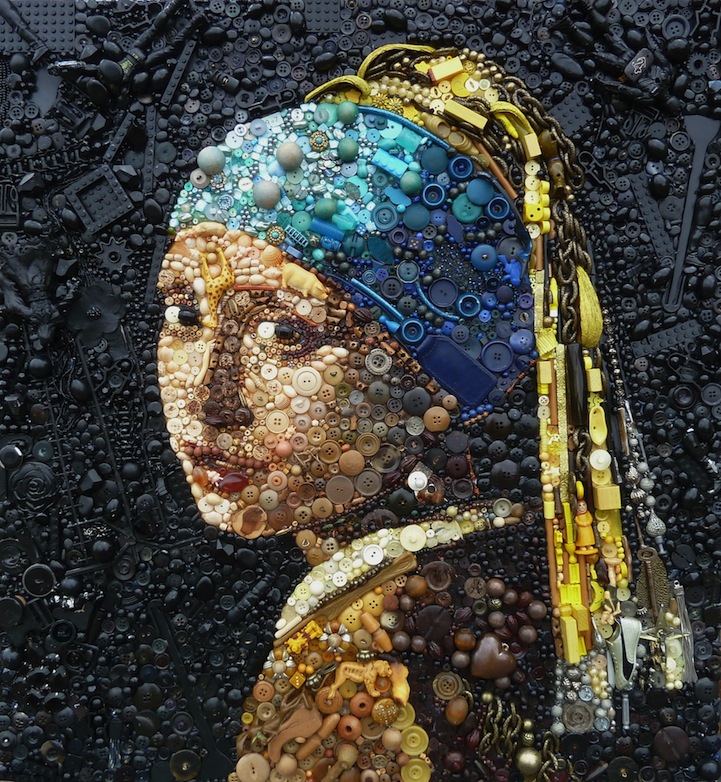
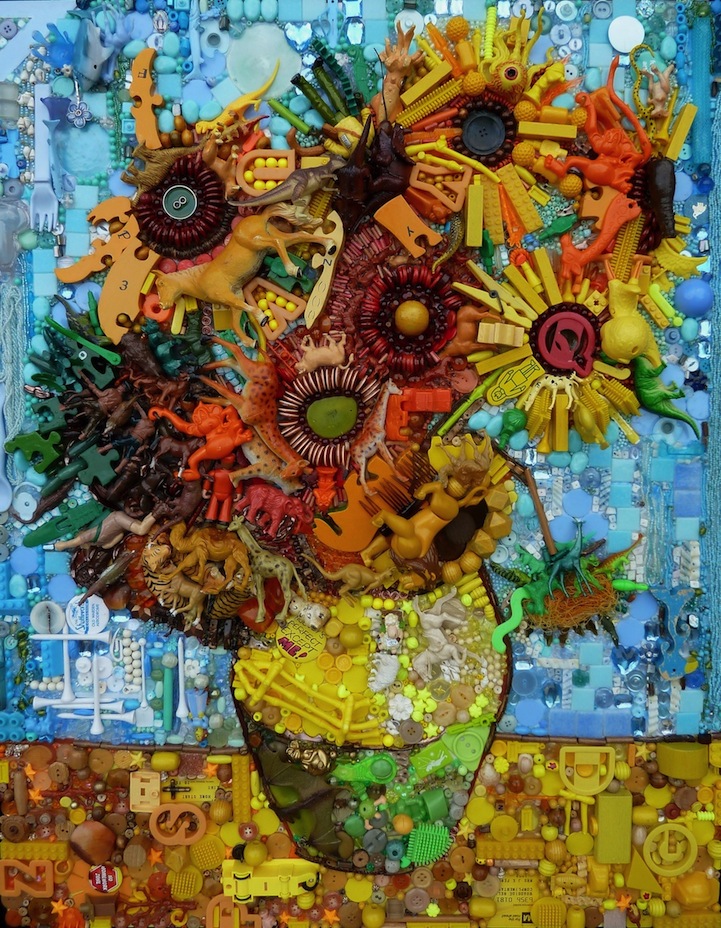
UK artist Jane Perkins rebuilds famous portraits and paintings from the small stuff most households throw away or shove into a drawer: buttons, beads, broken jewelry, plastic toys, shells, LEGO pieces, clothespins, and other found odds. Up close, each work is a textured field of unrelated objects. Step back, and the familiar image snaps into place—Einstein, a Vermeer-like girl, a Van Gogh field of color. The series, often grouped under titles such as Plastic Classics, treats discarded plastic as both pigment and brushstroke.
Perkins does not repaint the trinkets. Color stays as found. Shape stays as found. The artistry is selection and placement: matching hue, value, and scale so thousands of tiny decisions add up to a readable whole. That rule is stricter than it sounds. Without tinting or carving, she has to hunt for the right blue bead or yellow toy fragment the way a painter squeezes a tube—except the “tube” is a junk shop, a charity sale, or a friend’s cleared cupboard.
From nursing to Plastic Classics
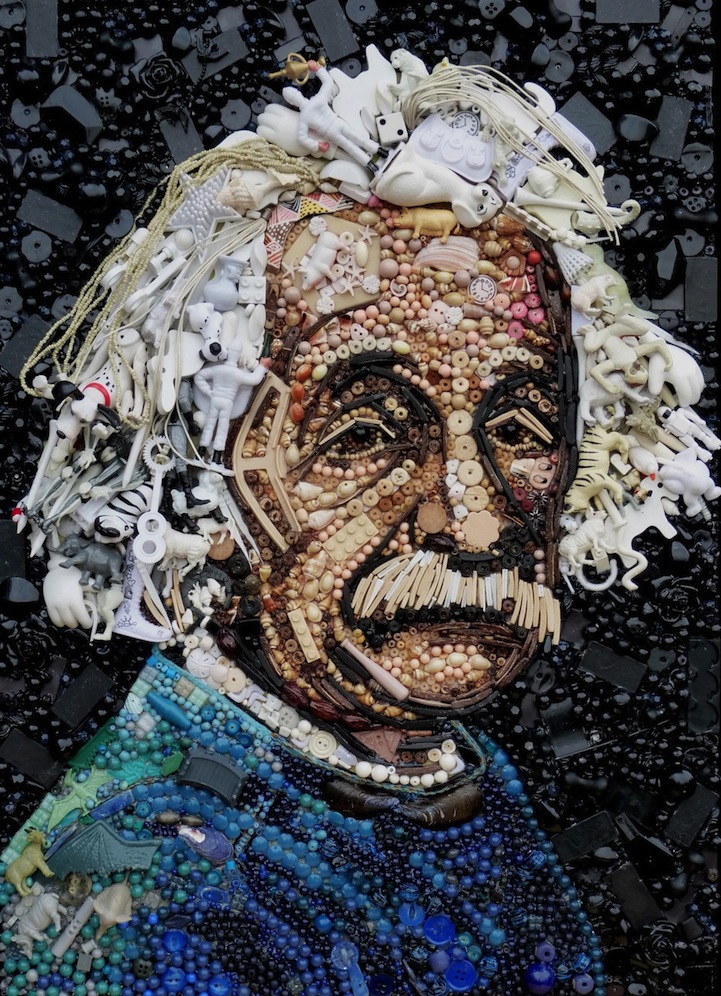
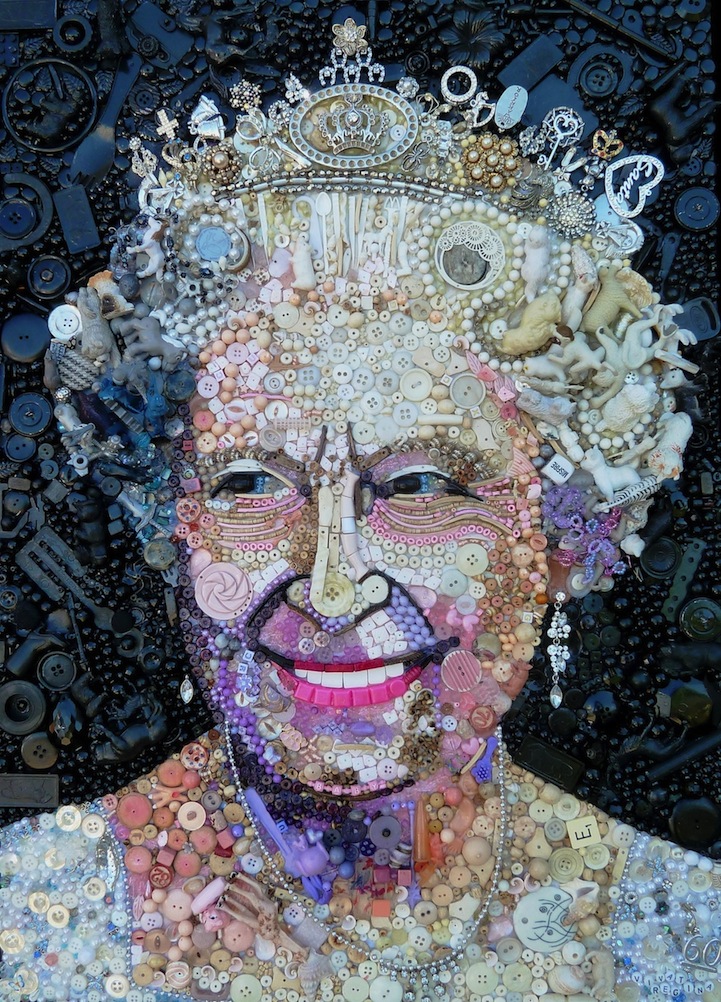
Perkins came to this work after a first career in nursing. In her late forties she went to art school and began making “memory brooches”—jewelry assembled from friends’ childhood toys and keepsakes. The unexpected collisions in those small pieces pointed toward larger surfaces. By around 2008 she was building full portraits and, soon after, remakes of canonical paintings in her Devon studio. Early standouts included a portrait of the Queen and a dense Einstein head that rewards nose-to-surface inspection.
She works on firm board with hot glue for speed, then seals with a final adhesive layer and PVA once the composition settles. The process is patient and physical. Every object must lock into a plan that still reads from across a room. Impressionist and post-Impressionist sources suit her especially well: Van Gogh’s thick paint already behaves like a relief surface, so plastic petals, buttons, and toys can stand in for impasto without feeling like a mismatch.
Two distances, one image
Perkins has described the necessary viewing mode in plain terms: see the whole from a distance; identify the materials up close. That is the Impressionist contract restated in plastic. From far away, edges soften into likeness. From near, the likeness dissolves into a census of junk—dice in a beard, an astronaut in a hairline, toy animals nesting where brushstrokes once lived. The Einstein portrait is a favorite teaching example for exactly that reason. What looks like gray curls at gallery distance becomes a playful inventory when you lean in.
That double reading is not a gimmick layered on top of skill; it is the skill. Color matching has to survive both scales. A bead that is “close enough” from two meters may scream wrong from twenty centimeters, and a clever toy that delights up close may punch a hole in the likeness if its value is too bright. Perkins’s eye for value and temperature—more than any single witty object—is what keeps the portraits coherent.
What she remakes
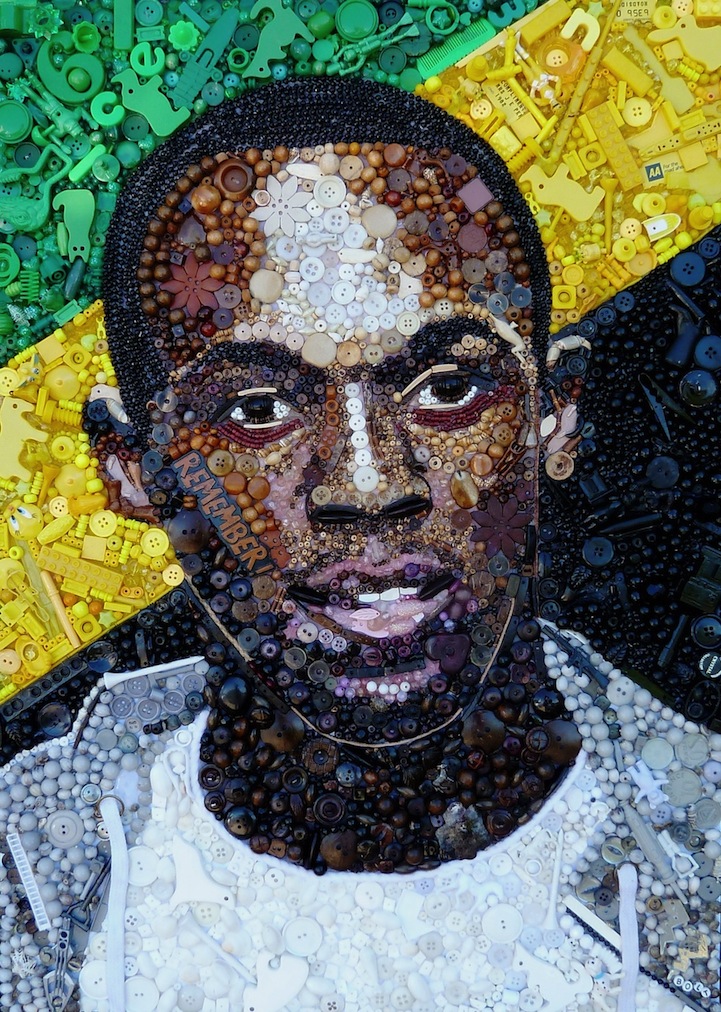
The Plastic Classics range stretches from Old Masters to modern icons. Vermeer’s Girl with a Pearl Earring, Van Gogh’s sunflowers and starry fields, Monet’s waterlilies, Klimt’s kiss, Hokusai’s wave, Warhol’s Marilyn, and sacred subjects after earlier painters all appear in her documented inventory. She has made multiple sunflower versions because Van Gogh himself revisited the motif; each remake is unique to the materials available at the time. That constraint keeps the series honest. Scarcity of the right yellow object is part of the composition.
Reinterpretation has a long art-historical pedigree—students copying masters, Picasso circling Velázquez, Duchamp giving the Mona Lisa a mustache. Perkins’s twist is material rather than stylistic parody. She is not mocking the originals. She is translating them into a contemporary waste stream, asking whether recognition survives when oil paint becomes a button and canvas becomes a board of glued plastic. The smile she hopes for is affection, not ridicule.
Waste, wonder, and craft limits
Because the palette is found, the work quietly comments on consumption. Plastic that would have been landfill becomes the only “paint” allowed. Yet Perkins’s tone stays playful. She calls herself a remaker who likes fun and the unexpected. The environmental reading is available, but the pictures do not lecture. They invite you to notice how much chromatic life already exists in discarded things.
There are practical limits. Hot glue sets fast, so placement decisions are committed quickly. Objects have fixed thickness, which creates a bas-relief topography that photography flattens. In person, shadows between toys deepen the likeness; in a flat photo, you rely more on color blocks. That is why seeing the work—or at least studying detail crops—matters. A phone thumbnail shows the famous face. A close crop shows why the famous face holds.
Collectors and students looking at these images can practice a simple method: cover half the picture and name the materials you still recognize; uncover it and check whether the likeness survives. Then reverse the test—squint until only value masses remain. If both tests pass, the assemblage is doing its job. If only one passes, you are looking at either a clever texture without a portrait or a portrait without a material story.
How to look at the gallery on this page
Start with the widest crop of each piece and confirm the reference—who or what is being remade. Then move to the densest passages: hair, jewelry, floral centers, dark backgrounds where tiny bright objects act like highlights. Ask what each object contributes beyond color. A toy animal in Einstein’s hair is not only gray-brown mass; it is a narrative wink that rewards the second look without breaking the first.
Compare how different source styles translate. Smooth classical faces demand finer grain and subtler transitions. Van Gogh’s broken color tolerates bolder, chunkier parts. Pop portraits can lean into flat graphic zones. Perkins’s success is not that every remake looks identical in technique, but that each one respects the optical habits of its source while obeying the as-found rule.
Return to that Einstein hairline for a moment: toy cats, dogs, dice, an astronaut—junk elevated into likeness. The portrait works because you can enjoy the census and still believe the face. That balance is Jane Perkins’s real subject, as much as any single masterpiece she remakes.

Comments
Continue reading
Still-Life Photography by Margareth Perfoncio
São Paulo photographer Margareth Perfoncio’s still lifes of food and flowers—Old Master light, dark wood, and tables that feel inevitable.

Meaningful Love Quotes for Inspiration (and Ink)
Meaningful love quotes that still feel true — short lines for tattoos, gifts, and everyday reminders, with placement and wording tips.
Christina Hess’s Animals From History: Costumed Pets as Playful Portraits
Illustrator Christina Hess reimagines historical icons as ornate animal portraits—Elvis Petme and friends—mixing puns, costume detail, and soft history lessons.