
David’s Cutest Street Art, Part 2: Craft, Cracks, and Chalk That Vanishes
A craft-first look at David Zinn’s ephemeral Ann Arbor chalk work—pareidolia, quiet anamorphosis, found-object props, and why Sluggo’s rain-washed endings matter.
Rain is the co-author. That fact separates David Zinn’s chalk creatures from almost every other kind of “cute street art” that circulates online. A spray-painted character on a legal wall can last for years. Sluggo, the green stalk-eyed resident of Ann Arbor’s sidewalks, often lasts days—or hours—before a storm turns him into watercolor memory. Part of the charm people feel in photographs is knowledge of that countdown. The drawing was never meant to harden into monument. It was meant to visit.
This second look at Zinn’s work stays with the same universe—Sluggo since 2008, Philomena the flying pig, improvised companions, Michigan pavement—but shifts attention from introductions to craft. How does a temporary doodle convince adults to crouch on a curb? Why do cracks and utility covers matter more here than a clean slab would? What does it mean to build a public practice out of materials that apologize as they disappear?
Ephemeral on purpose, not by accident
Zinn works with chalk and charcoal plus whatever the street already provides. No resin sealant heroics. No overnight clear-coat. The pieces are improvised on location, which means the artist cannot fully pre-design a creature in the studio and then transfer it like a sticker. He has to arrive, read the ground, and invent under the pressure of weather, foot traffic, and the specific weirdness of that square meter.
Ephemerality changes the ethics of the work. Because the drawing will wash away, it can be playful without claiming permanent ownership of civic space. It also changes the viewer’s role. Locals become temporary custodians: they notice, they tell a friend, they take a phone picture, they walk differently for a block. When the rain comes, grief is mild and built-in. You were always going to lose him. That soft goodbye is part of why the cuteness does not curdle into kitsch. Kitsch wants to stay. Sluggo knows better.
Pareidolia as a working method
Many illustrators start with a blank field and impose a figure. Zinn often starts with a figure the world almost suggested. A stain that wants to be a shoulder. A seam that wants to be a doorway. A leaf print that wants to be hair. Pareidolia—the habit of seeing faces and bodies in random patterns—is usually treated as a psychological quirk. In his practice it is a production pipeline.
Sluggo’s birth story is the clearest case study. What began as an attempt to draw a dancing child on driveway marks became a too-tall head with no good place for a human face. Instead of correcting the sidewalk into obedience, Zinn followed the error into character design. The stalk eyes are not a random cute feature glued on later; they are a solution to a problem the pavement posed. That origin keeps the whole series honest. Even when Sluggo appears in a “finished” looking photo, you can sense that some piece of the city spoke first.
Zinn has described outdoor surfaces as a cure for blank-canvas fear. The lesson travels well beyond chalk. Constraints are not the enemy of charm. They are frequently the engine of it.
Anamorphosis without the circus
Internet culture loves extreme 3D street paintings that look correct only from a single camera mark on the asphalt. Zinn’s dimensional tricks are quieter. He uses shading, scale, and viewpoint so a creature appears to sit in a hole, lean on a ledge, or poke through a crack—convincing from ordinary standing height, not only from a tripod on a taped X. The goal is not to fool you into thinking a canyon opened downtown. The goal is to let a small invented animal share real volume with real concrete.
That restraint keeps the work neighborly. You do not need a festival map. You need to be walking. When a drawing succeeds, the anamorphic effect feels like manners: the creature respects your eye level and your city’s textures instead of shouting for a viral drone shot.
Found objects as cast members
Chalk alone can do a lot. Chalk plus a leaf, a bottle cap, a stick, or a painted curb line can do something sharper. In Zinn’s best pieces, the found object is not decoration; it is a prop the character needs. A leaf becomes a broom. A crack becomes a window. A metal cover becomes a stage. Remove the object in your mind and watch the narrative wilt. That test is a useful way to separate true site-specific play from cute characters merely placed near scenery.
This is also where “jack of few trades” Sluggo earns his reputation. Because his body can be partial—just eyes and hands at a gap—he can take jobs that a fully drawn mascot on a flat wall cannot. He can be mid-emergence. He can be mostly underground. He can treat the city’s infrastructure as his house rather than his background. Flexible personal architecture is not only a joke in the old character blurb. It is a formal strategy for incomplete surfaces.
A second cast, a second tempo
Philomena the flying pig changes the air pressure of a scene. Where Sluggo tends to negotiate with gravity and dirt, Philomena suggests lift, drift, and deadpan airborne patience. Nadine the adventurous mouse accelerates things: smaller scale, quicker plots, different kinds of daring. Around them, one-day creatures appear whenever a particular mark demands a new species. Keeping multiple tempos in the chalk ecosystem prevents Sluggo from becoming a single joke told forever.
For viewers following the work across many photos, that variety matters. Cute fatigue is real. A green monster forever doing the same wink would flatten. Zinn’s sidewalk opera stays fresh because the cast can reshuffle and because the street keeps offering new stage directions.
Street art without the usual armor
Much contemporary street art arrives with bravado: height, scale, risk, permanence, branding. Zinn’s practice is almost anti-bravado. He kneels. He uses children’s materials. He lets weather win. The courage is social rather than athletic—the willingness to make something tender in public where irony is often safer. Ann Arbor’s sidewalks become a testing ground for whether strangers will accept gentleness without a caption explaining it.
They usually will. That is the quiet news inside all the shareable photos. People stop. People grin. People photograph carefully so they will not step on a chalk hand. For a few minutes, infrastructure becomes a commons of attention. Then everyone continues on, slightly altered, which is a decent definition of successful public art at human scale.
Looking harder at a temporary drawing
When you next encounter a Sluggo photo—or, luckier, a live drawing—try a craft-first pass:
- Identify the non-chalk element that makes the joke possible.
- Check the shadow logic. Does the creature cast and receive light as if it shares the sidewalk’s sun?
- Notice crop. Is the photo taken from the standing viewpoint the drawing expects?
- Ask what will destroy the piece first: rain, shoes, or sun fade. That question returns the work to time.
- Only then enjoy the personality. Character lands harder after craft is visible.
This order reverses the usual scroll habit. Feeds reward face and color first. Zinn’s work rewards site literacy first. Training yourself to see the crack before the creature is how you start to understand why these drawings feel more alive than many polished stickers on street poles.
What remains after the washout
Because the physical pieces vanish, the archive is photographic and communal. That can feel like a loss if you think art must be an object. It can also feel like a correct ending if you think some art should behave like weather. Sluggo’s adventures—helping, hiding, befriending pigs, treating ledges as balconies—were always stories about brief presence. The chalk is honest about that. It colors the claim and then lets the claim go.
So here is a different kind of takeaway than a character introduction. If you want more of David Zinn’s world in your own city, you do not necessarily need his exact monster. You need his ratio: one part observation of what the ground already contains, one part willingness to look silly in public, one part acceptance that rain will edit your draft. Practice that ratio on a spare afternoon with a few sticks of chalk. If a stalk-eyed green neighbor shows up, welcome him. If someone else shows up instead, that is fine too. The sidewalk was never asking for a franchise. It was asking for company—until the next storm rewrites the page.

Comments
Continue reading
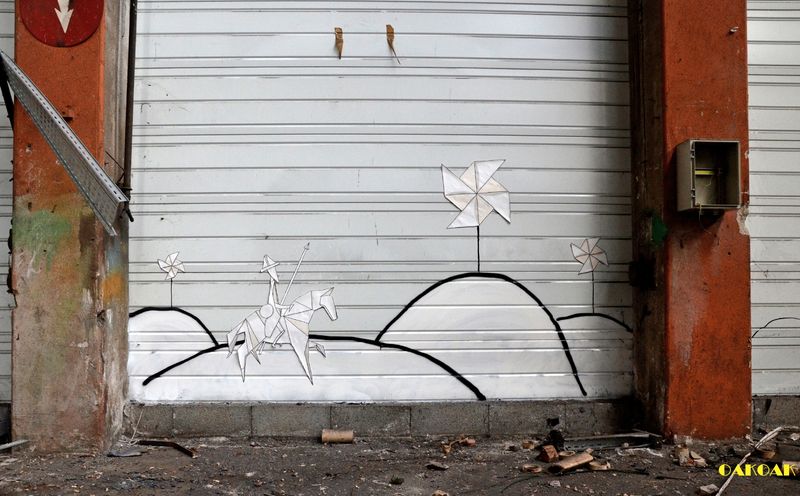
Oakoak’s Playful Urban Street Interventions
French street artist Oakoak turns cracks, hydrants, and overlooked fixtures into small site-specific jokes—minimal marks, pop-culture wit, and ephemeral city play.
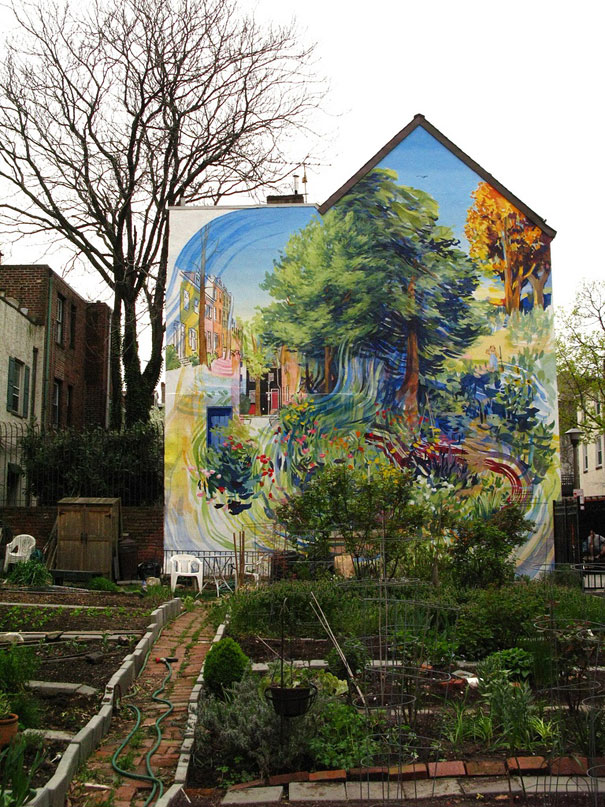
15 More Incredible Street Art Photos Worldwide
Part two: giant murals from Philadelphia, Lyon, Warsaw, Lisbon, Vienna, New York, Dublin, Berlin, and beyond—plus a few still-unlabeled walls.
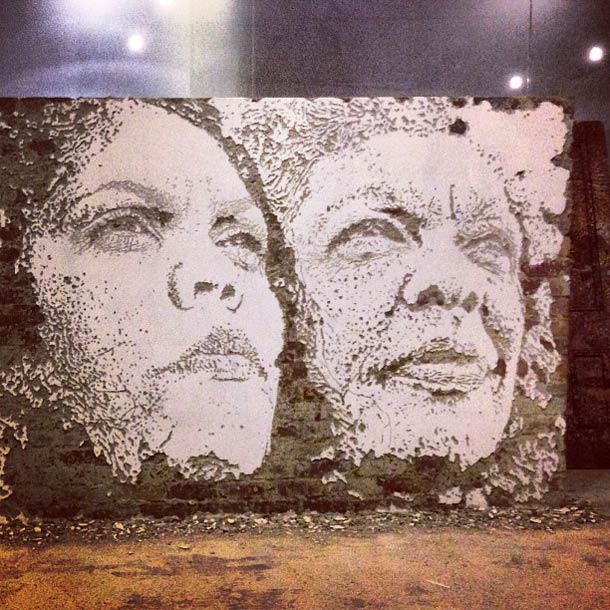
Scratching the Surface: Street Art Carvings by Vhils
Portuguese artist Alexandre Farto, aka Vhils, digs portraits from city walls—subtractive street art that treats plaster, brick, and posters as a living palette.