
Celebrity Portraits in Corn Flakes by Sarah Rosado
Sarah Rosado builds famous faces from breakfast cereal—mosaic likenesses where corn flakes stand in for paint, shadow, and pop memory.
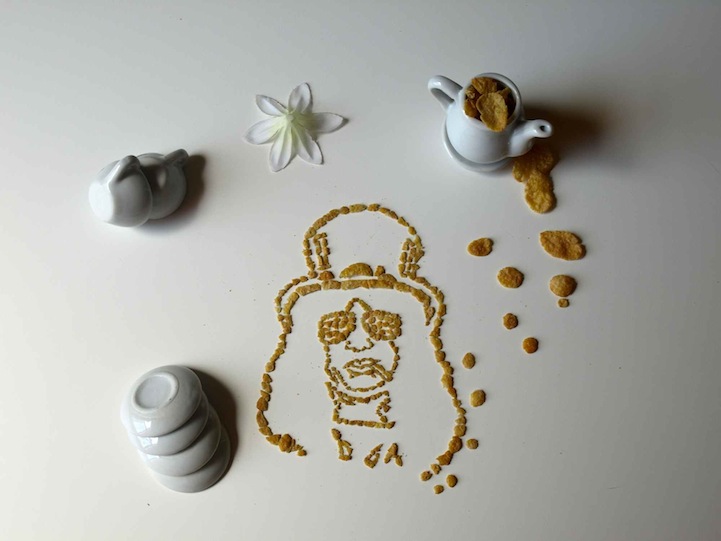
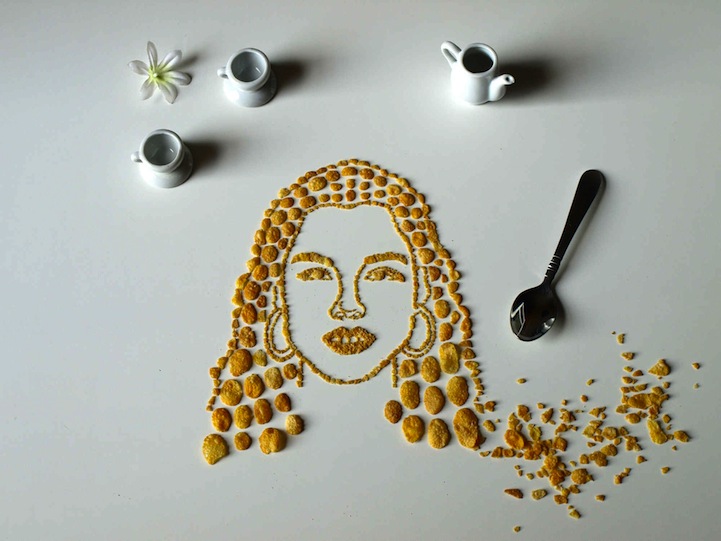
Latte art gets endless social-media applause. Breakfast cereal rarely does. New York artist and photographer Sarah Rosado flipped that imbalance by building celebrity faces out of corn flakes—arranging golden shards like mosaic tiles until a recognizable musician or star emerged on the tabletop. The joke is edible; the craft is not casual. Each portrait is a slow negotiation between snack food and likeness, between a supermarket aisle and a face the public already thinks it owns.
Rosado was already known to some viewers for earlier playful series work, including her “Dirty Little Secrets” pieces. The corn-flakes portraits arrived as a breakfast-minded sibling to more fashionable food trends: same appetite for transformation, different pantry. She has framed the spark as a morning thought while listening to music—something close to “music has never tasted so good”—and then followed the gag into hours of careful placement. What began as a witty premise became a repeatable studio problem: how do you make corn flakes behave like value, edge, and expression?
How cereal becomes a face
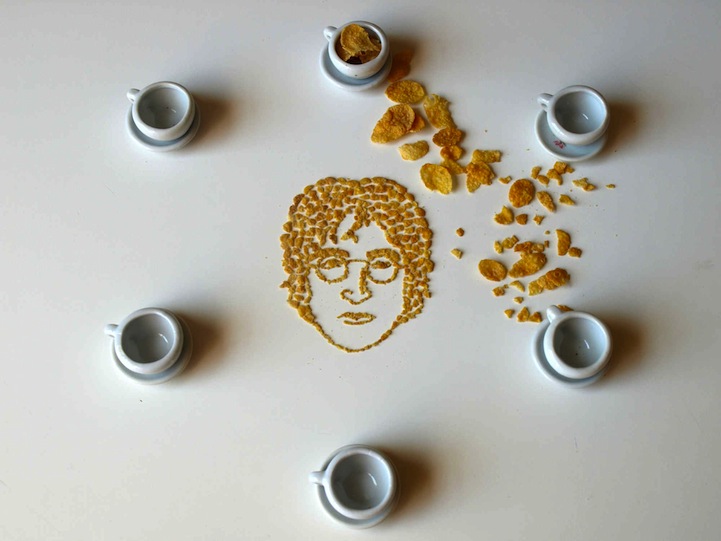
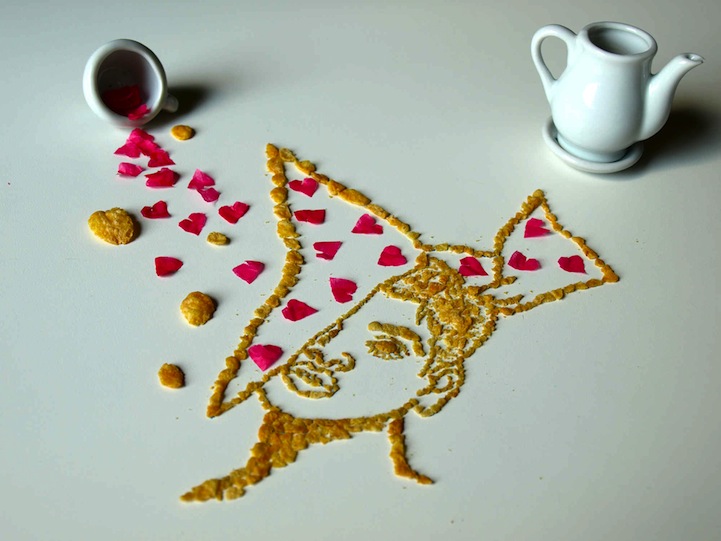
Rosado’s process, as she has described it in interviews around the series’ wider circulation, usually begins with a pencil sketch. The drawing sets proportions: eye spacing, jawline, the landmarks that make a famous face survive abstraction. Then come the flakes. Whole pieces create larger planes; broken edges fill smaller features. A pin becomes a precision tool for eyes, nostrils, and mouth corners—the zones where a millimeter decides whether the portrait looks like John Lennon or only like “a man with round glasses.”
Reports from the period often put a single portrait near the five-hour mark. That number matters because it recalibrates the viewer’s first laugh. Yes, it is cereal. It is also timed labor, triage, and revision. Flakes shift. Gaps appear. Shadows have to be invented from overlapping edges rather than from paint value. Photography then freezes the arrangement before gravity and humidity win. Without that final frame, the work is only a temporary still life waiting to be eaten by accident.
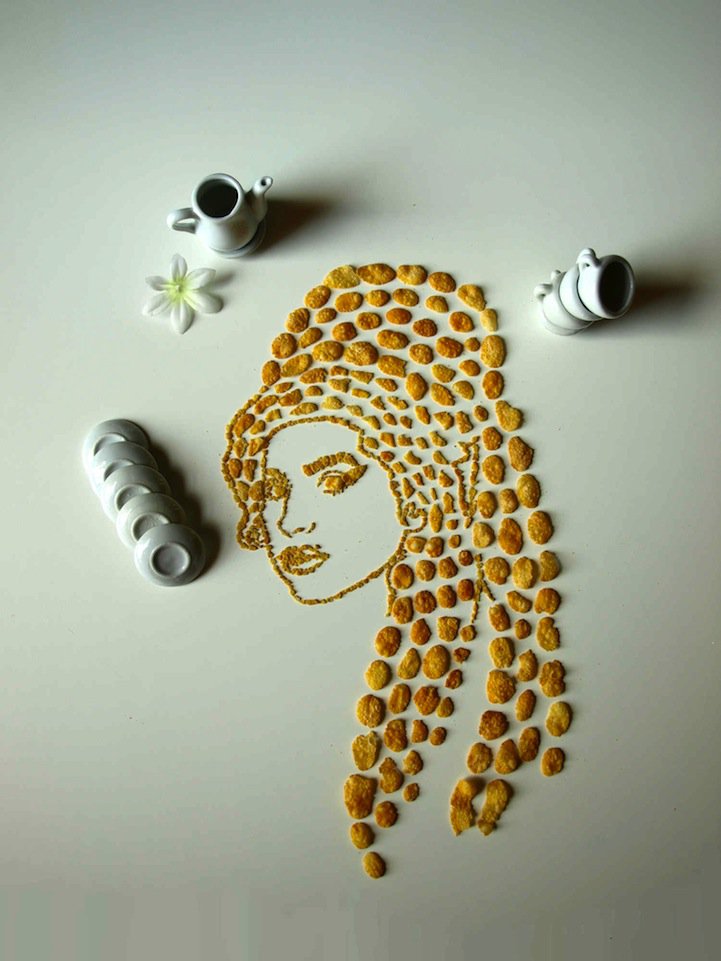
The medium’s limits are part of the aesthetic. Corn flakes are roughly one color family—creams, golds, toasted browns—so “shading” is mostly about density, overlap, and the dark table or paper showing through. That constraint pushes the work toward graphic clarity. Hair becomes a field of parallel shards. A smile becomes a curved seam. A cheek turns into a weather system of overlapping curves. The portraits succeed when recognition hits before you finish cataloguing the materials.
There is also a tactile intelligence at work. Flakes have curl, thickness, and fracture lines. Choosing which side faces up changes how light catches the surface in the documentary photo. Rosado is not only placing shapes; she is casting tiny topographies that the camera will later flatten into an image we can share.
Why musicians fit the material
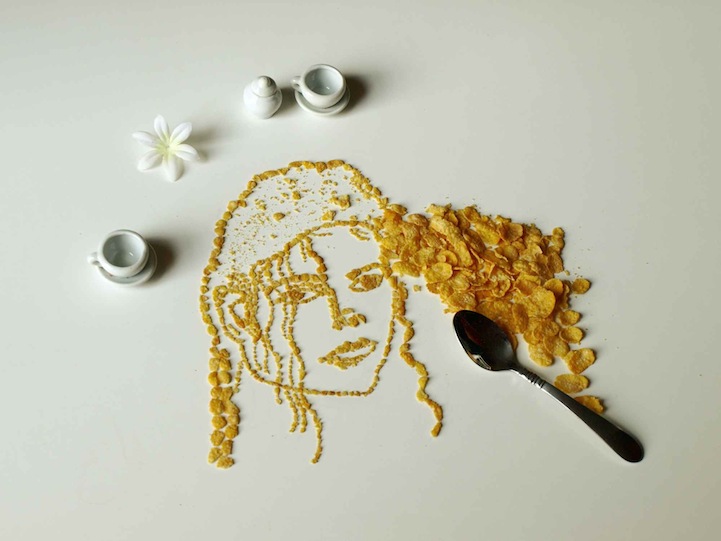
Rosado’s cereal gallery has often leaned toward musicians and pop figures—faces the public already carries as simplified icons. Lennon and Amy Winehouse appear in discussions of the series as memorial as well as likeness: cereal as an unlikely way to hold someone who is gone. Other widely circulated subjects in related cereal work have included names such as Michael Jackson, Beyoncé, Elvis, Bob Marley, and a rotating cast of contemporary chart figures. The point is not a fixed census; it is the collision of disposable breakfast texture with durable fame.
Music suits the gag because album-cover culture already trains us to accept stylized faces. A cereal Lennon rhymes with pop’s history of graphic reduction—Warhol’s repetitions, stencil culture, magazine illustration. Winehouse’s beehive and winged liner are practically designed for high-contrast translation. When the material is humble, iconic features become even more important. The portrait has to borrow the public’s memory to finish itself.
There is also a gentle memorial logic in choosing artists who died young or whose images remain permanently mid-career. Food art can feel trivial until you notice the care. Then the perishable medium starts to speak about time: flakes go stale; fame’s photographs do not; the portrait sits awkwardly between those clocks. That tension is more interesting than the punch line alone.
Pop faces also travel well across platforms. A cereal portrait of a musician is almost engineered for the mid-2010s share cycle—surprising enough to stop the scroll, clear enough to survive compression, light enough in tone to invite comments without demanding art-historical homework first.
Food art without the usual preciousness
A lot of contemporary food art aims for jewel-box perfection—mirror glazes, microscopic sugar work, plating that pretends dinner is sculpture class. Rosado’s corn flakes sit closer to kitchen-table invention. The materials are supermarket-ordinary. The skill shows in patience and eye, not in rare ingredients. That accessibility is why the series traveled well through magazines and share culture in the mid-2010s: anyone could imagine starting; few would finish with a likeness this tight.
Photography is the quiet co-author. Without a clean documentary frame, the flakes are only a pile. Lighting has to reveal edges without melting the tonal range into a yellow blur. Scale cues help—enough context to believe the object is handmade, enough closeness to admire the pinwork around an eye. Rosado’s dual identity as artist and photographer serves the project; the making and the recording are one loop.
Compared with her earlier surprise-driven series, the cereal portraits trade shock for sustained looking. You can laugh in the first second and still spend the next minute tracing how a cheek was built. That second minute is where the work earns its keep. Novelty opens the door; draftsmanship keeps you in the room.
It also helps that corn flakes carry childhood associations for many viewers. Using them for adult pop icons creates a gentle dissonance—nostalgia meeting chart culture—without needing a manifesto. The material does some of the storytelling before the face even coheres.
What the images ask of you
First, play the recognition game honestly. Who is it before you read any caption? Which feature locked the identity—glasses, hair shape, lip line? Second, look at negative space. The gaps between flakes are as deliberate as the flakes. Third, consider permanence. These works exist for most viewers as photographs of temporary arrangements. The “original” is partly performance, partly sculpture, partly documentation.
If you make things, the series is a prompt disguised as a breakfast pun: pick a material with stubborn limits and force a portrait through it. Rice, seeds, ticket stubs, pencil shavings—any modular scrap can test whether you understand a face or only know how to copy a photo with familiar tools. Rosado’s corn flakes succeed because she accepts the material’s stubbornness instead of fighting it into paint.
Teachers and workshop leaders could build a whole exercise from one of these images: restrict the palette, ban continuous outlines, and require likeness anyway. Students quickly learn that celebrity recognition is a collaboration between artist and audience memory. The flakes only propose; the viewer completes.
A small looking checklist
- Identify the darkest “shadows”—usually denser overlaps or exposed ground.
- Find the largest single flake shapes; they often map to forehead or cheek planes.
- Check the hairline; cereal portraits often win or lose there.
- Ask whether the photo crop helps the illusion by hiding the surrounding mess.
- Imagine the five-hour middle: the stretch after the joke and before the finish.
Rosado’s corn-flakes celebrities are easy to share and harder to dismiss once you grant them time. They sit at an odd intersection of pop remembrance, craft stubbornness, and kitchen humor. Scroll back to the first image and hold on the moment recognition arrives. That click—when breakfast becomes a person—is the whole exhibition in one second, and it is worth waiting for every time.

Comments
Continue reading
Still-Life Photography by Margareth Perfoncio
São Paulo photographer Margareth Perfoncio’s still lifes of food and flowers—Old Master light, dark wood, and tables that feel inevitable.

Meaningful Love Quotes for Inspiration (and Ink)
Meaningful love quotes that still feel true — short lines for tattoos, gifts, and everyday reminders, with placement and wording tips.
Christina Hess’s Animals From History: Costumed Pets as Playful Portraits
Illustrator Christina Hess reimagines historical icons as ornate animal portraits—Elvis Petme and friends—mixing puns, costume detail, and soft history lessons.