
Alex Hanoko Landscape Photos: Indonesian Light, Coast, and Terraces
Fourteen landscape photographs by Alex Hanoko—golden-hour coasts, rice terraces, and tropical atmosphere shot with patience over postcard gloss.
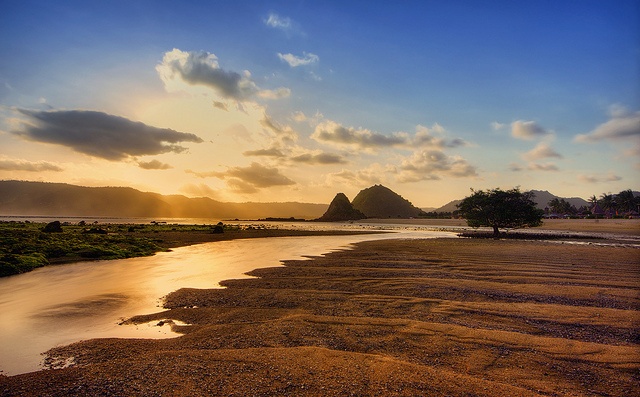
Alex Hanoko’s landscape photographs favor places where weather still does most of the directing. Coastal inlets catch fire at the horizon, rice terraces fold into green geometry, and temple or village silhouettes sit quietly enough that light can finish the sentence. Circulated widely in the early 2010s through image blogs and Flickr, his frames helped introduce many viewers to Indonesian light without turning every scene into a postcard sticker.
Hanoko, often associated with Jakarta as a base and with travel across the archipelago, shoots landscapes that feel walked into rather than helicoptered over. The fourteen photographs gathered here reward slow looking: leading lines in water and terrace edges, color temperature that shifts from gold to cool green, and compositions that leave room for weather. They are travel pictures in the best sense—evidence of time spent—not destination logos with a sunset pasted on.
Golden hour as structure, not filter
The coastal frame above is a lesson in how water can organize a photograph. A shallow channel pulls the eye from rippled sand toward conical hills; sky color doubles in the mirror path; a lone tree anchors the right bank while palms and low buildings hint at human presence without crowding the drama. Crepuscular rays break from a darker cloud mass—evidence of timing, not of a preset.
Hanoko’s stronger sunsets avoid centering the sun as a logo. Instead, luminance becomes a path, a wedge, or a field that the land interrupts. That habit keeps tropical color from tipping into candy. You feel heat and humidity, but you also feel place: the particular bend of a tidal cut, the specific silhouette of hills against a glowing band.
Technically, scenes like this ask for exposure discipline. Protect the brightest cloud edges so they keep shape; accept a deeper foreground if needed; lift shadows later with a light hand if the file supports it. Clipped gold-hour skies are hard to forgive because the whole emotional argument lived in that glow.
Terraces and the human landscape
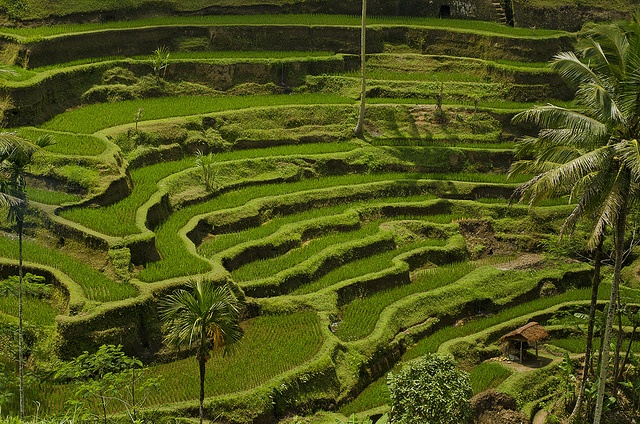
Rice terraces are easy to over-photograph into abstract wallpaper. Hanoko’s terrace views keep agricultural logic visible: curved bunds, tonal steps from chartreuse crop to darker mossed walls, palms interrupting the rhythm, a thatched hut scaled to work rather than to tourism branding. The high angle clarifies pattern without erasing labor. Someone maintains these edges; the photograph respects that fact by staying specific.
Green-on-green scenes demand careful exposure and careful white balance. Blow the brightest paddies and the whole hillside flattens. Hold too much shadow and the curves vanish. Cool the file too far and the crop turns sickly; warm it too far and chlorophyll becomes plastic. These files sit in the workable middle—texture survives in both crop and embankment.
Including a hut or path also solves a scale problem. Without a human-scale object, terrace geometry can read as texture swatches. With one, the land becomes a place you could walk, which changes how long a viewer stays.
Depth, haze, and tropical air
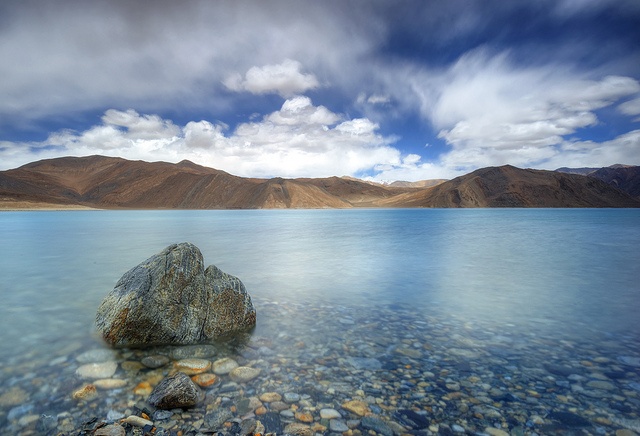
Indonesian landscapes often carry moisture in the air—softening distant ridges, cooling shadows, and making midground trees stand forward like stage flats. Hanoko uses that atmosphere instead of fighting it into fake clarity. Layers stack: foreground detail, midland mass, pale horizon. The result feels climatic. You can almost guess the hour by how hard the haze sits.
When mountains or coastal rock appear, they rarely dominate every inch of the frame. Negative space—sky, open water, quiet sand—gives the land room to breathe. That restraint is easy to miss if you only scroll for saturation. Sit with one image and notice how much of the rectangle is deliberately calm. Calm is not empty; it is the resting tone that makes the bright band or green step feel earned.
Haze also teaches humility about gear. No amount of sharpness recovery invents air that was never clear. Working with the weather you have is part of landscape literacy in the tropics, where clarity and softness trade places within a single afternoon.
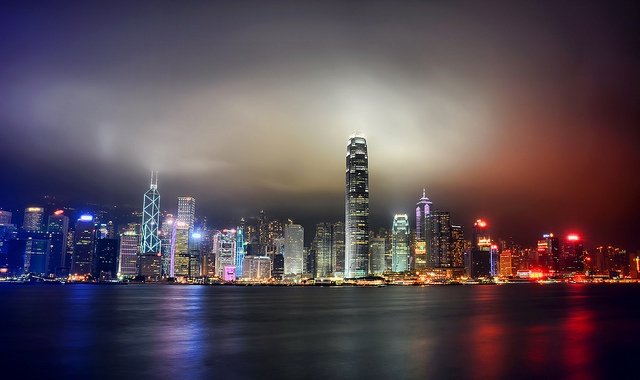
Temples, coasts, and travel without checklist energy
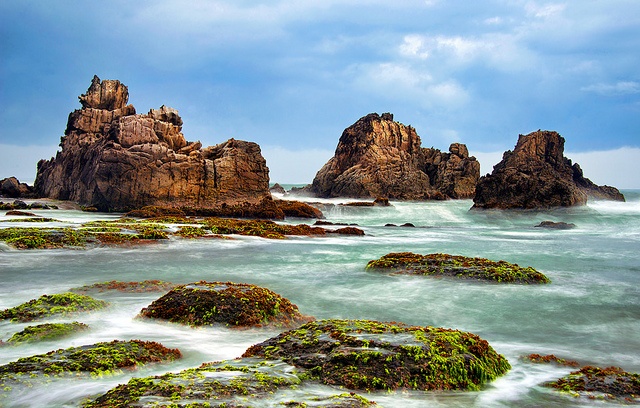
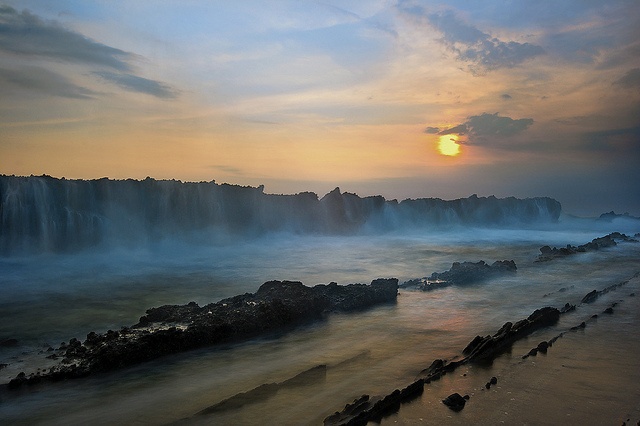
Hanoko’s wider published work has included familiar Indonesian landmarks—Borobudur at first light among them—and quieter coastal stretches such as Parangtritis moods after sunset. The attitude across those subjects is consistent: arrive early or stay late, let weather rearrange the icon, and resist treating every famous site as a stamp to collect.
In this set, even when human structures appear, they behave as scale notes. A hut, a palm line, a distant roof—enough to locate culture, not enough to turn the frame into a brochure cover. Travel photography fails when destination names do more work than light. These pictures reverse that ratio.
Checklist travel produces repetitive files: the same railing angle, the same midday white sky, the same centered monument. Hanoko’s better frames suggest a different itinerary logic—fewer stops, more returns to the same inlet or hillside when cloud behaves. That is harder to schedule and easier to remember.
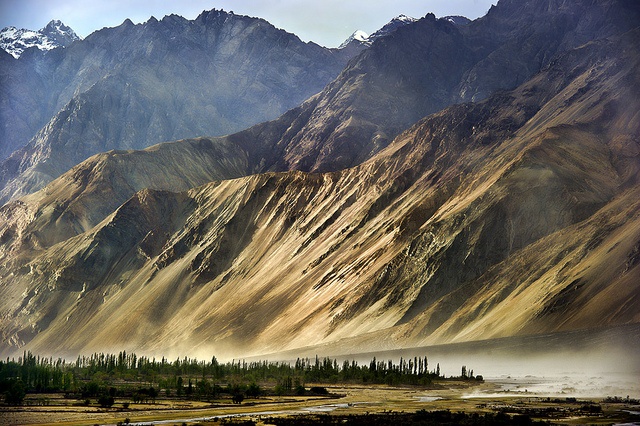
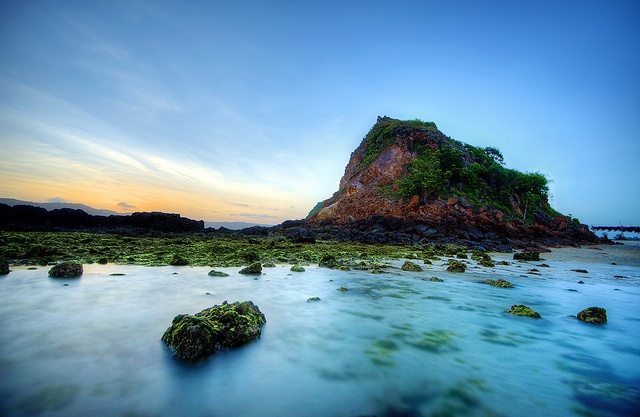
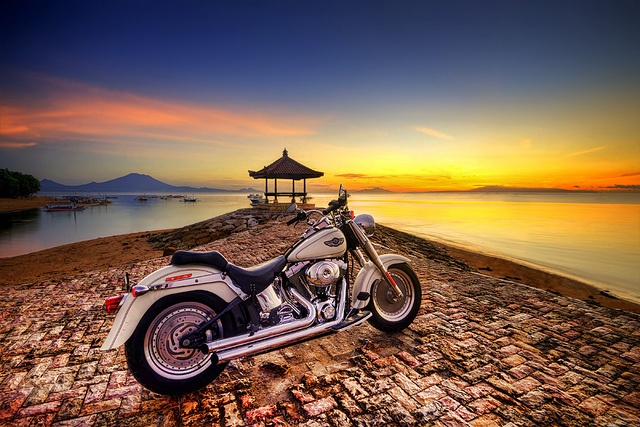
Reading the fourteen as a set
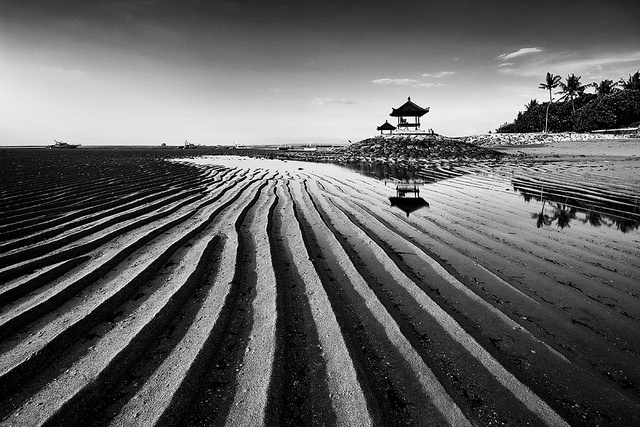
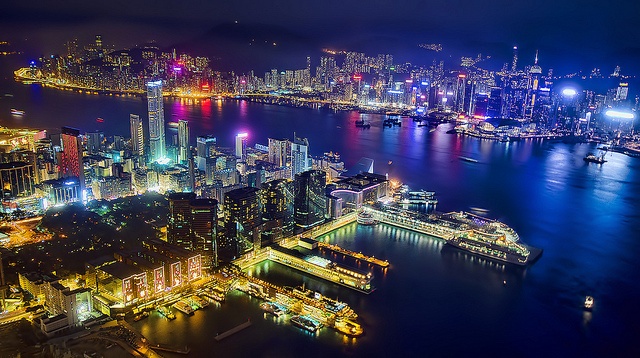
A single hero sunset can go viral; a coherent set teaches. Across these fourteen files, watch how often Hanoko builds depth with a near detail—sand ripple, palm frond, terrace lip—before releasing the eye into distance. Watch how skies vary: hard gold, soft haze, open blue with weather cells. Variety of weather inside one photographer’s voice is a better lesson than fourteen identical golden hours.
Also notice what is absent: heavy borders, stamped watermarks fighting the image, and the mid-2010s habit of crushing blacks until every scene looks nocturnal. The pictures trust subject and light. That trust ages better than fashionably heavy contrast.
What photographers can borrow
You do not need Hanoko’s itinerary to steal his priorities. Scout water that can act as a leading line. Shoot terraces and hillsides when side light separates planes. Expose for the brightest important highlight in gold-hour skies, then lift shadows gently if needed—do not rescue a clipped sunset with heavy-handed global contrast. Include one human-scale object when a vast scene risks abstraction.
Protect lenses from salt spray and sudden tropical rain. Carry a cloth you will actually use. Arrive for the second sunset of a trip, not only the first; local cloud behavior rarely reveals itself on day one. Most of all, edit for coherence. A set of fourteen images should feel like one photographer’s weather diary, not fourteen unrelated trophies gathered for a feed.
Stand again with the inlet at dusk or the terrace hut in green shade and ask a simple question: where does the eye enter, and what weather made that path inevitable? Answer that honestly in your own locations, and Hanoko’s influence becomes method rather than imitation.

Comments
Continue reading
David Shield Landscape Photos: Blue Hour, Reflections, and Honest Color
Eighteen landscape photographs by David Shield—coastal twilight, alpine mirrors, and light-handed color that preserves place over spectacle.
10 Norwegian Landscape Photographs by Tore Heggelund
Lighthouses, skerries, winter mountains, and storm light—ten atmospheric landscape photographs by Norway-based photographer Tore Heggelund.
15 Winter Landscape Photos: Alpine Light, Snow, and Mountain Craft
Fifteen Alpine winter landscape frames—plus practical notes on cold light, snow exposure, storm weather, and field craft for mountain photography.