
Wayne Simpson’s Canadian Winter Landscapes
Ontario photographer Wayne Simpson’s winter Canada—snow shores, mirrored lakes, and pink alpine dawn light held in still cold water.
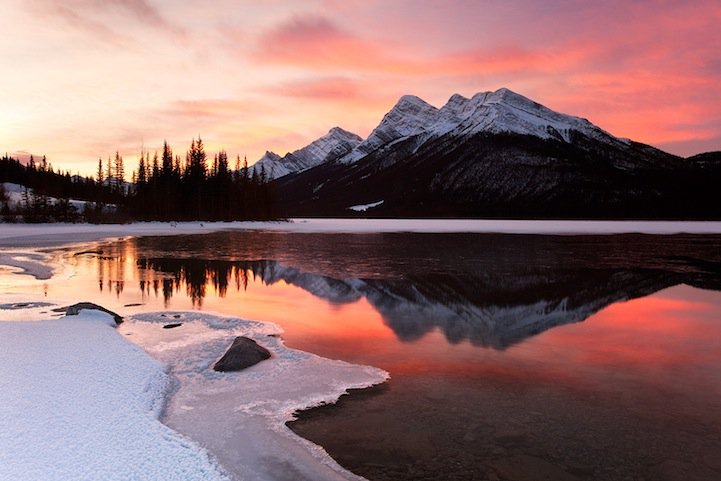
Winter turns landscape photography into a negotiation with cold, light, and time. Snow simplifies color, then sunrise returns it in sudden pinks and oranges that last only minutes. Ontario-based photographer Wayne Simpson works that negotiation with patience. His Canadian winter frames—mountains, lakes, forest edges, ice underfoot—treat snow not as a blank cover but as a surface that feeds reflection, silhouette, and quiet drama.
The photograph preserved here is a clear statement of that approach. Jagged, snow-dusted peaks sit in shadow against a sky burning from orange at the horizon into saturated pink and magenta above. A calm stretch of lake mirrors sky and ridgeline almost symmetrically. To the left, a dark evergreen line stands in silhouette. In the near corner, ice and textured snow meet open water around a dark rock—proof that you are standing at the cold edge of the scene, not floating in a postcard abstraction.
Why winter portfolios keep calling photographers back
Landscape photography thrives in every season, but winter offers a distinct grammar. Deciduous clutter thins. Snow unifies midground and distance into large tonal planes. Evergreens become graphic verticals. Open water, when it remains, turns into a mirror that doubles the sky’s brief theater. The season is hard on batteries, fingers, and schedules, which is partly why the successful frames feel earned. You cannot casually wander into alpenglow with numb hands and a fogged lens and expect miracles without preparation.
Simpson’s winter work belongs to that prepared tradition. The original feature introduced him as an Ontario photographer making stunning Canadian winter landscapes for nature lovers—sunrise and sunset, forest and animals, snow as both blanket and life-giving weather. The surviving image leans into still water and mountain silhouette rather than wildlife, yet the same seasonal logic holds: cold clarifies, light arrives like an event, and the land becomes a stage for a short performance.
Calling snow a “bed cover” is folk language with a technical truth underneath. Snow softens ground texture, raises midtone brightness, and throws fill light into shadows. It also creates exposure traps. Bright snow fools meters into underexposure; colorful dawn skies beg for highlight protection. The best winter files usually come from photographers who expose for the sky’s brightest cloud edge, then lift the land carefully, or who bracket and merge with restraint so the pink does not turn neon and the snow does not turn gray mud.
Reading the reflection as craft
Symmetry is seductive and dangerous. A perfect mirror can look cheap if the photographer ignores the foreground or centers the horizon with no thought. Simpson’s frame avoids that trap by keeping ice and rock in the lower left—imperfect, tactile, slightly broken. The reflection does the lyrical work; the shoreline does the believable work. You feel temperature because you can almost hear the ice edge and see the water’s near clarity through the color wash.
Mountains in shadow against a luminous sky are a classic winter choice. When peaks go dark, their ridgelines become calligraphy. Snow in the crevices still reads as pale stitching, so the forms do not collapse into silhouettes without information. The eye travels ridge to ridge, then drops into the reflected twin, then returns to the tree line for a vertical rest. That circuit is composition doing its job without shouting about rules.
Color temperature tells the hour. Warm orange near the horizon and cooler magenta higher up often mark sunrise or sunset when thin clouds catch light while the land has already lost direct sun—or has not yet received it. Feathery cloud texture keeps the upper sky from becoming a flat gradient. Without those clouds, the pink might feel painted; with them, it feels weather.
Field craft behind a quiet picture
Images like this imply decisions made before the shutter. Location scouting matters: a lake that faces the right horizon, a shoreline with ice interest, a mountain mass that holds a strong profile. Wind forecast matters: ripples kill mirrors. Timing matters: arrive early enough that the color climb is not a panicked sprint. Safety matters on ice—never treat a pretty edge as an invitation to walk out without knowing thickness and local conditions.
Gear choices in deep cold are practical more than glamorous. Spare batteries live in inner pockets. Gloves that allow finger control beat fashion. Lens cloths fight condensation when you move between car heat and lake air. A tripod steadies long exposures as light falls, but it also slows you down enough to notice whether the reflection is clean. Filters can help manage sky-to-land contrast; so can a measured HDR merge. Either way, the finish should still feel like a winter morning, not a software demonstration.
Wildlife and forest life belong to many Canadian winter portfolios even when a single featured frame is pure landscape. Tracks in snow, a distant animal on a ridge, birds moving at the tree edge—these elements remind viewers that “empty” cold is inhabited. Simpson’s broader seasonal work has been associated with that fuller natural world. The lake mirror here simply chooses stillness over motion for its particular story.
Canada’s winter as subject, not backdrop
Photographing Canadian winter is not only about finding prettier mountains. It is about attending to a climate that shapes culture, travel, and attention. Short days compress the golden window. Storms erase roads and open dramatic skies afterward. Lakes freeze and thaw in patterns that change week to week. An Ontario base places a photographer within reach of varied cold geographies—Great Lakes weather, northern forests, and longer trips toward larger western ranges—while demanding respect for local conditions rather than postcard fantasy.
Nature-lovers respond to these images because they recognize a truth: winter is not only hardship. It is also clarity, color, and a kind of hush cities rarely offer. A photograph that holds pink sky in black water lets people borrow that hush without standing on the ice themselves. That borrowing is one of landscape photography’s honest gifts. It is also why makers have a responsibility not to trash the places they celebrate—stay on durable surfaces, pack out what you pack in, and leave fragile shorelines unscarred by the hunt for “the spot.”
What to practice if this frame moves you
You do not need Simpson’s exact lake to learn from his balance. Practice three habits. First, always give the sky’s brightest highlight a safe home in the histogram; winter color dies when clipped. Second, include one tactile foreground—ice crust, rock, reed, snow ridge—so the viewer has a place to stand. Third, wait for wind to die or shoot in the brief calm between gusts; a half-second of glass water is worth more than twenty frames of chop.
Study silhouette without fear. Dark trees against bright color can be elegant if the tree line has rhythm—tall spikes, gaps, a varied edge—not a boring hedge. Study reflection without obsession. If the mirror is 80 percent perfect, protect the imperfect 20 percent that proves reality. Study cold as a collaborator: it slows you, clarifies the land, and punishes haste.
Finally, build seasonal portfolios as sequences, not one-off trophies. Dawn, midday blue shadows on snow, storm light, clear night cold—winter has chapters. Wayne Simpson’s reputation in this feature rests on that seasonal commitment: returning to snow country until sunrise, forest, and water begin to feel like a single conversation. The conversation in this frame is brief and luminous. Mountains keep their counsel in shadow. The lake answers in pink. Somewhere on the iced shore, a photographer stood still long enough for Canada’s winter to finish a sentence.
When you leave the image, take the hush more than the palette. Color fades from memory; the feeling of a world simplified by cold and briefly gilded by light is what tends to stay. That is the quiet ambition of strong winter landscape work—and the reason Simpson’s Canadian scenes still reward a long look on a warm screen far from any frozen shoreline.

Comments
Continue reading
David Shield Landscape Photos: Blue Hour, Reflections, and Honest Color
Eighteen landscape photographs by David Shield—coastal twilight, alpine mirrors, and light-handed color that preserves place over spectacle.
10 Norwegian Landscape Photographs by Tore Heggelund
Lighthouses, skerries, winter mountains, and storm light—ten atmospheric landscape photographs by Norway-based photographer Tore Heggelund.
15 Winter Landscape Photos: Alpine Light, Snow, and Mountain Craft
Fifteen Alpine winter landscape frames—plus practical notes on cold light, snow exposure, storm weather, and field craft for mountain photography.