
Christiane Vleugels: Hyperrealistic Oil Portraits That Still Feel Warm
A close look at Belgium-based painter Christiane Vleugels—technique, light, and four superb oil portraits where hair, fabric, and gaze carry equal weight.
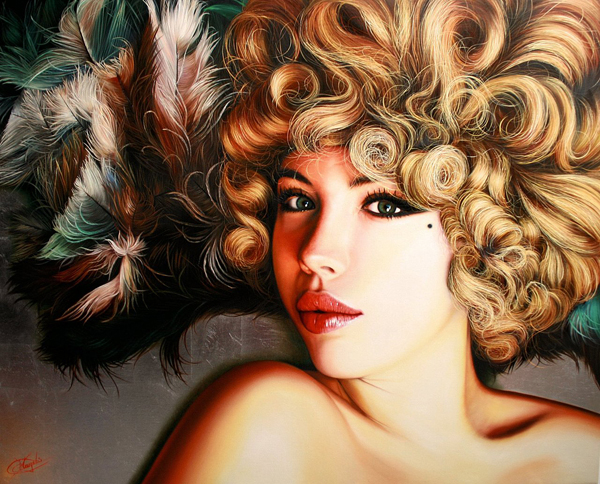
Christiane Vleugels paints as if oil could remember skin better than a camera. Based in Belgium—long associated with Antwerp’s academies and studio culture—she has built a reputation for hyperrealistic portraits that refuse to feel cold. Hair catches light strand by strand. Fabric turns translucent or weighty on cue. Eyes hold a gaze that seems to answer yours. The works gathered here are superb examples of that craft: intimate, theatrical, and exacting without losing warmth.
Vleugels trained in a classical path that included study at fine-art academies in and around Antwerp, and she has often worked from photographic archives of models who sat for her over years. The photographs are starting points, not finish lines. What ends on panel or canvas is staged light, edited color, and an emotional temperature she chooses stroke by stroke. Viewers sometimes call the results photographic; look longer and the hand reveals itself in how highlights are organized, how shadows soften, how a signature sits quietly in a corner.
Hyperrealism with a pulse
Hyperrealism can become a contest of trivia—count the pores, name the brand of lipstick reflection. Vleugels’ best pictures dodge that trap. Detail serves presence. A beauty mark is not a gimmick; it anchors a face in particularity. A peony is not a prop checklist item; it is a second subject sharing the frame’s tenderness. Sheer magenta cloth is not only a texture study; it is weather around a body.
Her later public statements and exhibitions have often framed the practice as sitting between hyperrealism and a more poetic, magical register—figures that are optically convincing yet emotionally heightened. You do not need the label to feel the effect. Stand in front of one of these portraits and the room noise drops. That is the point of the labor.
Golden curls, feathers, and a direct gaze
This close portrait is a demonstration of controlled glamour. Voluminous golden curls occupy the right side of the face with a luminosity that borders on metal and silk at once. On the opposite side, darker, almost feathered textures—hints of teal and olive among deep tones—complicate the blonde brilliance so the painting never settles into a single hair-color cliché. Emerald eyes, smoky liner, and a glossy red mouth deliver theatrical contrast against fair skin and a muted ground.
Light arrives from one side with conviction. Half the face blooms; the other half softens into warm shadow. A mole on the cheekbone reads as a small act of honesty inside all that polish. The bare shoulder at the lower edge implies a body beyond the crop without turning the picture into a nude study. Vleugels’ signature appears in red at the corner—another small insistence that this is paint, not a filtered photograph.
What makes the piece superb is not only fidelity. It is the editorial courage to let hair and feathers behave like characters. Portraiture here is also still life: textures negotiating for attention while the sitter holds the center.
Back turned, peony held, teal drapery
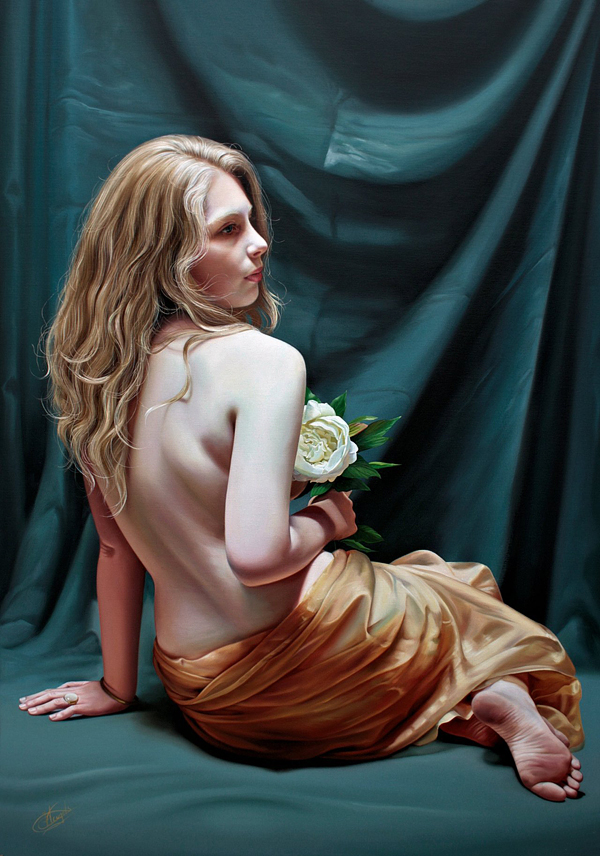
Compositionally quieter and more narrative, this painting shows a young woman seated on deep teal fabric, body angled away, face turning back over the shoulder. Long blonde waves spill down an exposed back. A shimmering golden-beige cloth pools around the hips and legs; bare feet keep the scene human rather than mythic. In her hand, a full white peony with green leaves becomes a soft counterweight to the dark, folded backdrop.
Jewelry details—bracelet, a ring with a pale stone—reward close looking without shouting. The teal drapery is almost a second model: heavy folds, cool depth, a stage curtain that refuses to be mere background. Light from above left models the spine and shoulder blades with the kind of anatomical patience academic training enables, then softens into the flower’s petals where edges dissolve into cream.
The emotional register is contemplative rather than seductive. She is present and elsewhere at once. That double attention—body in the room, mind slightly beyond it—is something Vleugels returns to often. Hyperrealism here is a way to slow the viewer down until they notice the pause.
Magenta veil and rose-dark ruffles
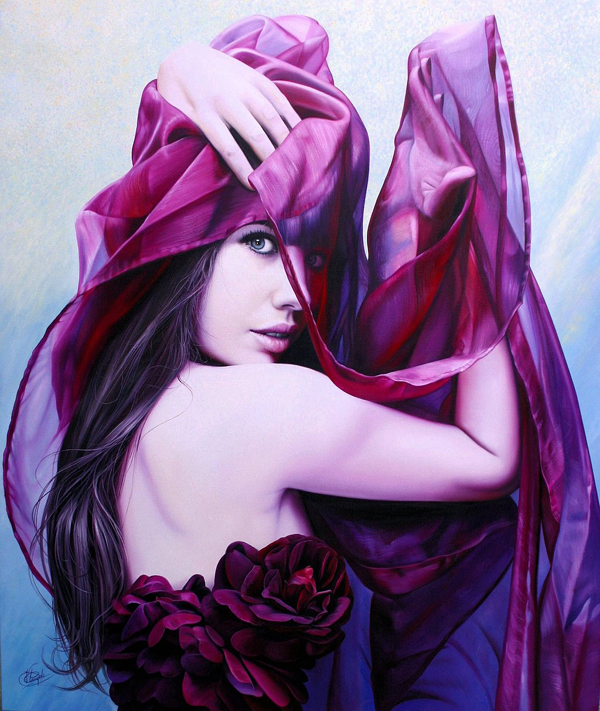
Color does the storytelling in this vertical portrait. A pale-skinned woman with dark hair and a blunt fringe looks back over her shoulder through a swirl of sheer magenta and purple cloth. Arms lift and cross so fabric becomes architecture around her. Where the veil thins, hair and skin show through—an invitation to admire how oil can mimic gauze without becoming mushy.
At the lower edge, deeper burgundy forms suggest rose-like ruffles or velvet petals, grounding the airy veil with weight and shadow. The background stays cool and light—soft blues and greys—so the warm fabric advances. Blue-grey eyes meet the viewer with calm directness. Nothing in the face is exaggerated; the drama lives in chroma and motion.
This is the painting to study if you care about edges. Hard where a jaw meets air, soft where cloth dissolves, crisp where a highlight rides a fold. Hyperrealism is often described as “more than photography,” but the better description is selective emphasis. Vleugels decides which transitions deserve a knife-edge and which deserve a breath.
Turban, lace, and layered gold
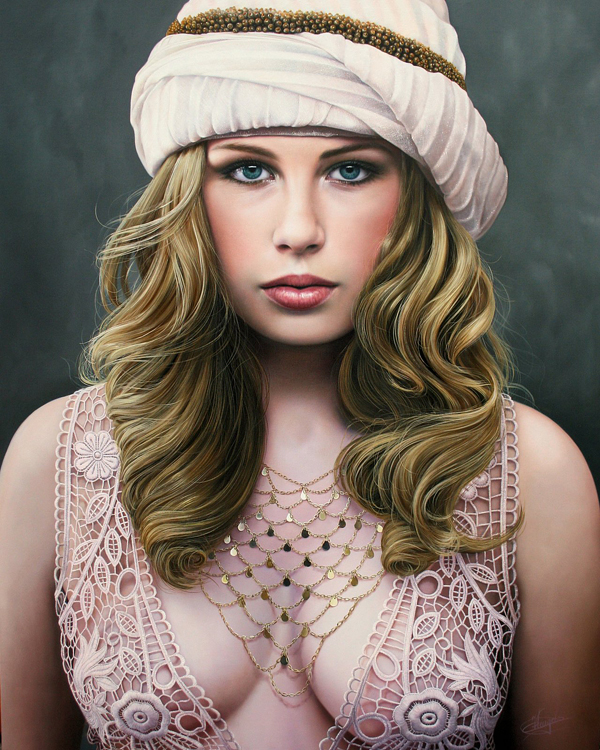
A quieter luxury governs this bust-length portrait. Soft blonde waves escape a pale pink or off-white turban wrapped with a fine bronze-gold beaded band. Light blue eyes hold a steady, unforced gaze. Lips stay natural in mauve-pink rather than theatrical red. The clothing is intricate lace in pale pink, open at the neckline so a multi-strand gold necklace of small hanging discs can catch every available glint.
Against a dark charcoal ground, the subject seems lit from within. That is partly palette—creams and pinks against gloom—and partly the discipline of value control. Lace is a notorious trap for painters; too much detail and it becomes noise, too little and it becomes blobs. Here the lattice and floral patterning read as fabric at conversational distance and as architecture up close.
If the feathered blonde portrait is nightclub drama and the peony figure is chamber music, this one is daylight elegance. Same artist, same medium, different emotional key. That range is why a handful of Vleugels paintings can feel like a fuller survey than a dozen interchangeable hyperreal faces.
What to notice across the set
Several habits recur. Women are central, often meeting or nearly meeting the viewer’s eyes. Hair is treated as a major compositional mass, not an afterthought. Textiles—silk, veil, lace, drapery—share billing with flesh. Backgrounds stay relatively quiet so faces and fabrics can perform. Signatures remain modest. The overall effect is intimate theater: costumes and light without irony.
Materials matter to that effect. Oil’s slow drying time lets an artist blend skin transitions to an almost porcelain continuity, then return later for sharper accents in jewelry or catchlights. Working at ambitious scale—common in her practice—forces those accents to hold from across a room. What looks like microscopic fuss in a phone photo is, in person, structural clarity.
Context helps, too. Belgium’s figurative tradition and Antwerp’s academy culture reward draftsmanship; Vleugels’ path through those institutions shows in anatomy and drapery. At the same time, her pictures speak a contemporary fashion-adjacent visual language—hair, makeup, and styling that feel current even when the lighting tips toward Old Master drama. That bridge between atelier seriousness and modern glamour is part of their public appeal.
Looking without rushing
Online thumbnails flatter hyperrealism and also flatten it. Give these paintings the courtesy of sequence. First, read the face. Second, track the light direction. Third, pick one difficult texture—curls, peony petals, sheer magenta, lace—and follow how edges change as forms turn. Fourth, notice what she leaves unresolved. The “superb” claim is not that every square centimeter is equally sharp; it is that sharpness is spent where emotion lives.
Christiane Vleugels’ oil paintings reward that slower looking. Whether you meet them as portraits, as costume studies, or as essays in light on skin, they insist that realism is not a style of denial. It is a style of attention—and attention, in her hands, still feels like care.

Comments
Continue reading
Photo-Realistic Muscle Car Paintings by Cheryl Kelley
Cheryl Kelley’s glossy oil paintings of classic muscle cars—photo-based realism, chrome reflections, and a feminine take on automotive glamour, with gallery images.
Ray Massey’s Hand Paintings: Trompe-l’oeil Athletes, Castles, and Everyday Objects
Ray Massey’s painted-hand photographs turn fingers into footballers, sprinters, castles, pencil cups, and bananas—studio trompe-l’oeil with lasting wit.
Evgeny Lushpin’s Evening Journey: Twilight Cities, Canals, and Cable Cars
A gallery walk through Evgeny Lushpin’s twilight paintings—from St. Petersburg roofs and European canals to Montmartre rain and the San Francisco Evening Journey canvas.