
Annalisa Hartlaub’s Counter // Culture Self-Portraits
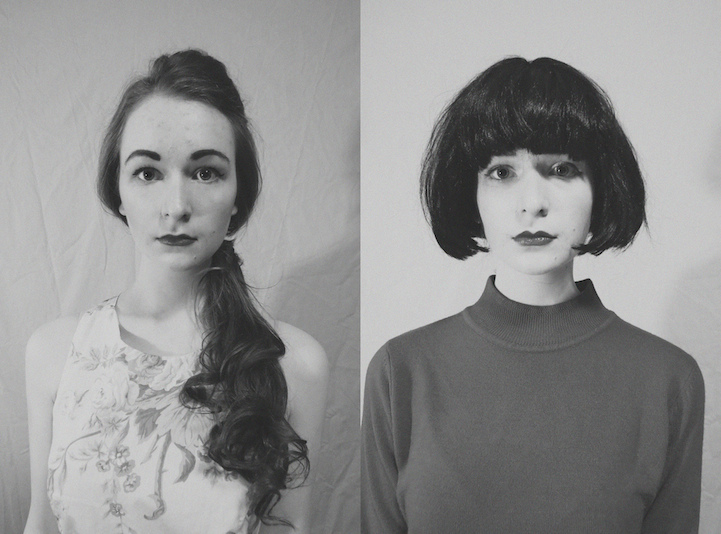
Sixteen-year-old photographer Annalisa Hartlaub pairs mainstream and counterculture looks from the 1920s to the 2010s in her series Counter // Culture.
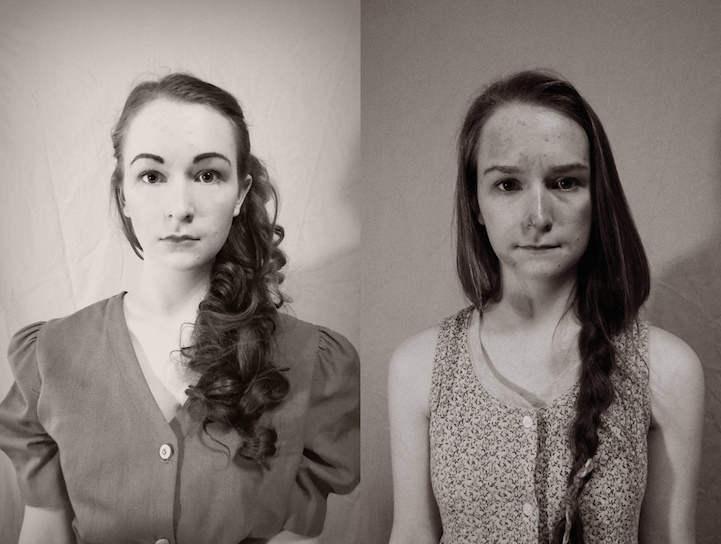
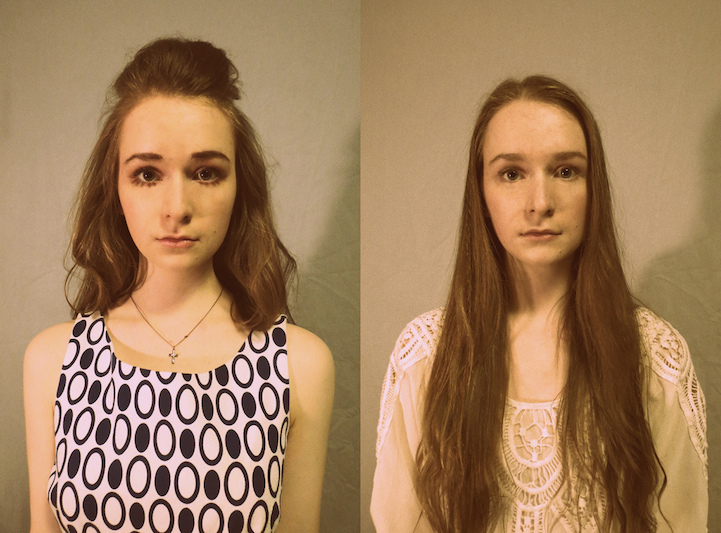
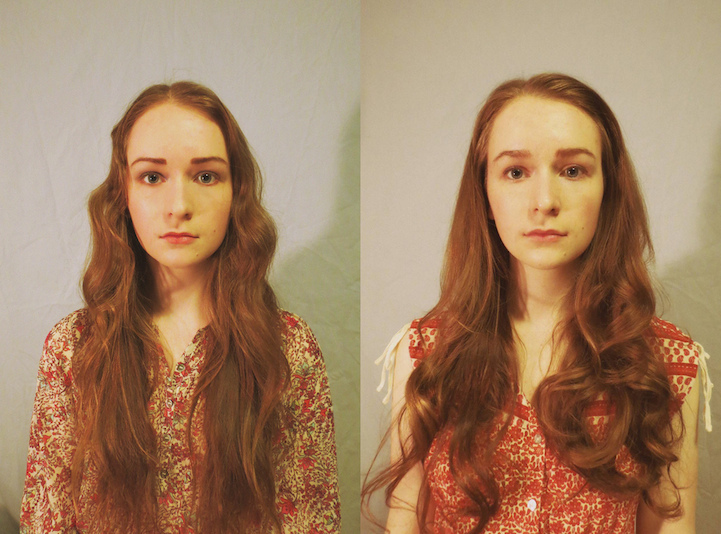
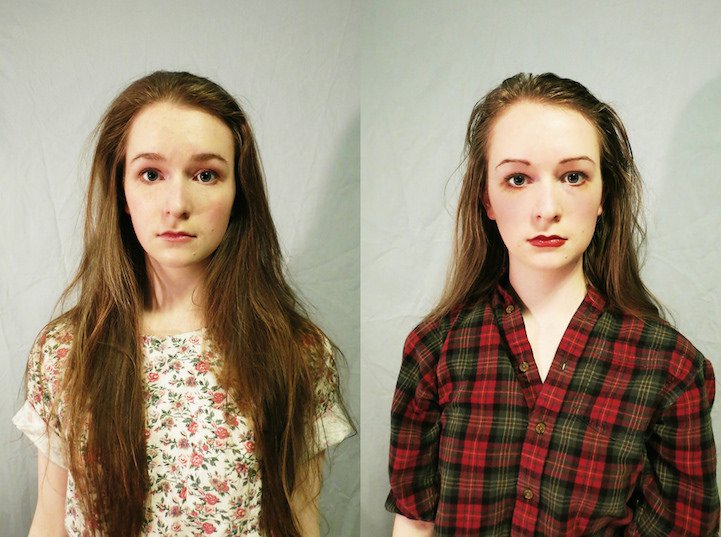
Annalisa Hartlaub’s series Counter // Culture treats fashion history as a photographic problem. At sixteen, while studying photography through Ohio State University coursework as a post-secondary student from the Westerville, Ohio area—and still enrolled in high school—she built paired self-portraits that walk decade by decade from the 1920s through the 2010s. Each era appears twice: one frame tuned to mainstream fashion of the moment, the other tuned to the counterculture that pushed against it. Hair, makeup, clothing, posture, and even the apparent “age” of the photographic surface become tools. The project is not a costume party for social media. It is portraiture used as cultural comparison.
Hartlaub has described a long fascination with how counterculture reshapes values and, eventually, the mainstream itself. Counter // Culture mixes that interest with fashion, makeup, and the camera. The assignment began in a Photography I class; the finished set of roughly twenty self-portraits—ten decade pairs—later traveled far beyond the classroom via Tumblr and wider features. The work still reads best when you meet it as an artist’s study: one face, many eras, a consistent method, and a clear refusal to let budget stand in for intention.
Self-portraiture as research method
Using herself as model solved a practical problem and created a conceptual one. Practically, a student working without a large production budget could control schedule, fittings, and retakes. Conceptually, the same face across a century of styles forces the viewer to compare eras instead of comparing celebrities. Continuity of sitter turns fashion history into a controlled experiment. What changes is not identity in the biographical sense; what changes is the social costume wrapped around identity.
Hartlaub has noted that she worked in a tight window, without a professional wardrobe budget, and without assuming she needed expensive gear to make serious pictures. That constraint shows in the resourcefulness of the looks—pieces already owned, thrifted, or improvised—and in the photographic finishes that mimic older processes and print wear. A 1920s pair can carry a worn, plate-like softness even when the historical process is only evoked. Style of capture becomes part of the decade’s costume, the way a modern selfie’s hard flash becomes part of a 2010s look.
That choice matters for anyone teaching or learning portraiture. Students often wait for perfect lights and rented clothes. Hartlaub’s series argues that research, consistency, and finishing decisions can carry as much meaning as equipment lists. The camera is a time machine only if the photographer designs the rules of the trip.
How to read a decade pair
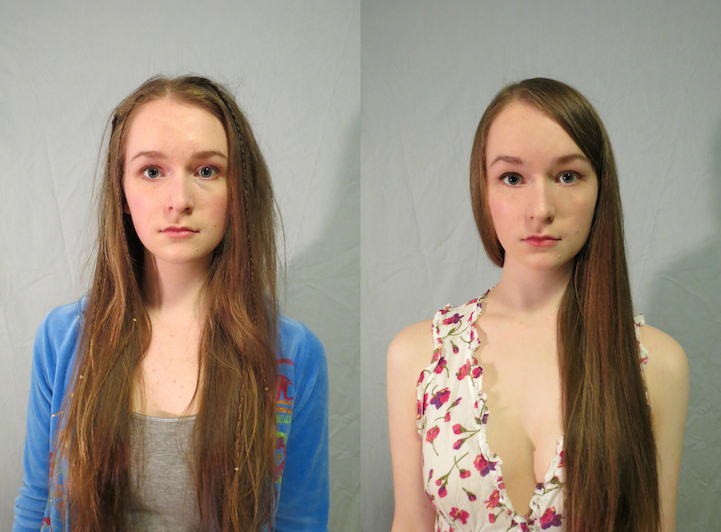
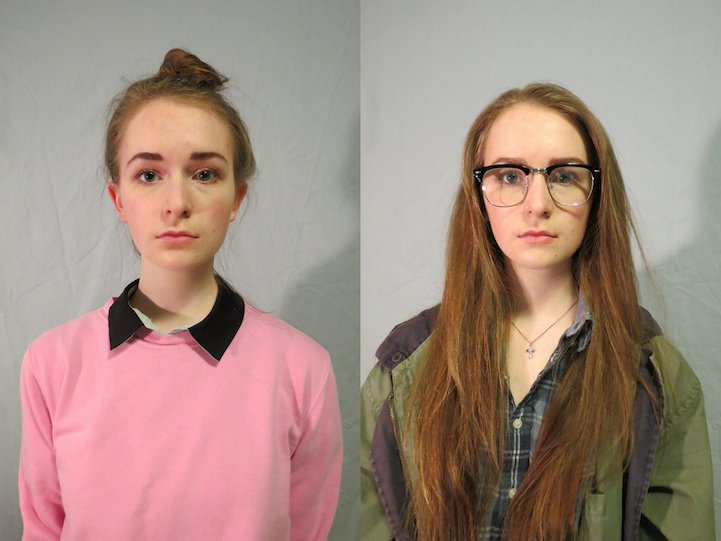
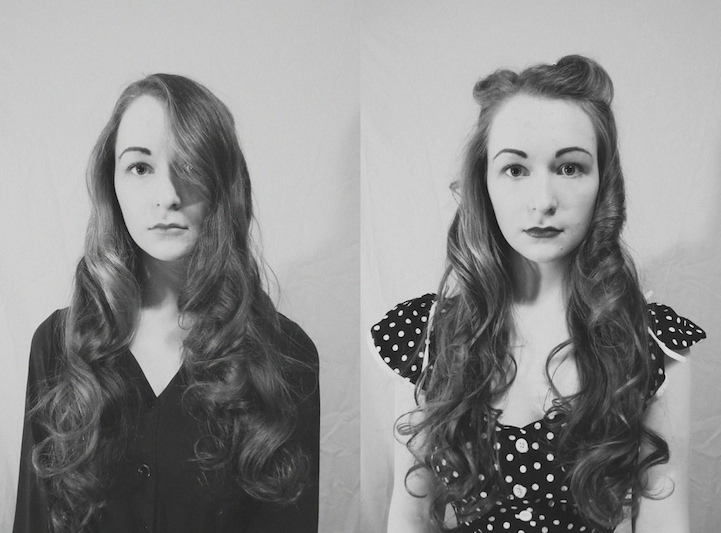
Look at each pair as a conversation, not as two unrelated cosplays. Mainstream frames tend to show the acceptable silhouette, the department-store possibility, the photograph that could have sat in a family album without scandal. Counterculture frames tighten the rebellion: flapper energy against propriety; wartime and postwar tensions around gender and work; beat and hippie refusals; punk and grunge abrasions; later decades’ remixes of irony, street style, and internet-era self-display.
Ask a few questions of every pair before you decide which side you “like” more:
- What do the hairline and makeup claim about gender performance in that decade?
- Where does the clothing sit on a spectrum from polished to homemade, from expensive signal to thrifted defiance?
- Does the photographic texture—contrast, softness, color cast, simulated wear—belong to the era’s media, or is it a contemporary gloss?
- Would this look have been safe at school, church, or a first job—or would it have cost the wearer something social?
Those questions keep the series in the realm of photography and cultural reading. The fun of guessing decades is real; the deeper pleasure is noticing how quickly “normal” and “radical” trade places once a look is absorbed by the center. Yesterday’s threat becomes today’s thrift-store Halloween aisle. Hartlaub freezes the argument before that absorption is complete.
Favorite eras, favorite frames
In interviews around the project’s wider circulation, Hartlaub pointed to the 1980s photograph as a personal favorite for accuracy and for the fun of assembling it, while naming the hippie movements of the 1960s and 1970s as the countercultures that most fascinated her—movements that, in her view, altered beliefs about what counted as an acceptable life. That split is useful for viewers: craft satisfaction and historical admiration are not always the same decade. A photographer can love building one look and intellectually admire another.
The series also quietly teaches a production lesson that outlasts any single outfit. When makers assume they cannot produce strong work without studio packages and rented wardrobes, Counter // Culture answers with process: research silhouettes, control the face as a constant, let makeup and hair carry as much information as clothing, and finish the file so it feels period-true. Limitation becomes style. The grade on the assignment may have been perfect; the more durable result is a method other young artists can borrow without copying her exact decades.
Time travel without leaving the chair
Calling the work “travel back in time” is accurate only if we mean imaginative travel. No set is a perfect museum diorama. Stereotypes risk flattening whole decades into one outfit. Hartlaub’s pairing strategy fights that flattening by refusing a single emblem per era. Mainstream and counterculture share a calendar year and still disagree about sleeves, hemlines, and attitude. The disagreement is the subject.
For artists watching the series now, the prompt is portable: pick a span of decades, hold the sitter constant, and invent a visual rule that marks each period—grain, color grade, lens feel, print damage. For historians and fashion lovers, the prompt is comparative: which side of each pair would you have been pushed toward by family, school, or scene? For casual viewers, the game of “name that decade” is enough to slow the scroll and make looking active again.
There is also a quiet ethics of representation here. Self-portraiture lets Hartlaub wear looks without casting strangers as props for someone else’s nostalgia. She is both researcher and subject. That does not erase the risk of reducing complex movements to hairstyles, but it keeps the power dynamic honest: the teenager studying counterculture is also the body risking looking odd in the attempt.
Why the project still holds as photography
Internet circulation made Counter // Culture famous as a teen’s viral assignment, but fame is a weak frame for looking. Better to see a young photographer treating the self-portrait as archive and mirror at once—archive of silhouettes she researched, mirror of how easily a person can be rescripted by clothes and light. The century on display is incomplete on purpose. It is a syllabus in images, not an encyclopedia of every subculture that ever named itself.
Spend another minute with the frames above before you decide which decade “wins.” Winning is beside the point. The sharper questions are which look still feels like rebellion, which already feels like costume nostalgia, and which mainstream option now looks stranger than its counterculture twin. Fashion moves; Hartlaub’s pairs freeze the argument long enough to see it. If you leave with only one habit, make it this: the next time a decade gets summarized in a single Pinterest board, remember that every year had at least two wardrobes arguing in public—and a photographer can still stage that argument on one face.

Comments
Continue reading

Funny Animal Signs That Warn People (While Animals Ignore Them)
From a seagull on a no-birds disc to classic zoo and park ironies—why animal warning signs get funny, and what the rules are still for.
How to Find Local Amenities on Vacation: Mechanics, Haircuts & More
Locate trustworthy local services and everyday spots while traveling or settling in—using publications, reviews, map apps, neighbor tips, and low-pressure exploration.
Kristen Stewart for V Magazine, Spring Preview 2013
V81’s Wild at Heart cover story—Kristen Stewart shot by Inez & Vinoodh, styled by Joe McKenna, in pale minimal spring glamour.