
Funny Animal Signs That Warn People (While Animals Ignore Them)
From a seagull on a no-birds disc to classic zoo and park ironies—why animal warning signs get funny, and what the rules are still for.
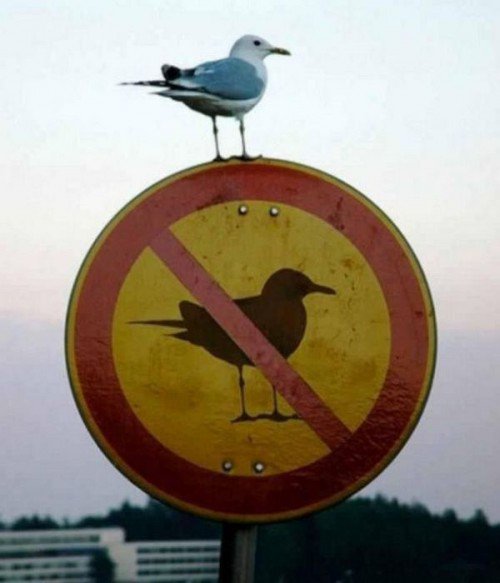
Warning signs are supposed to be serious. Animals rarely read them. That gap—between human rules and animal indifference—is why funny animal signs travel so well: the notice says one thing, and the creature in the frame calmly does another.
Zoos, wildlife parks, beaches, farms, and trailheads are full of boards meant to protect visitors, staff, and the animals themselves. Every so often a bird, goat, or monkey turns the board into a prop. The photo becomes a joke without anyone writing a punchline.
The image above is a textbook case. A round yellow sign with a thick red border shows a bird silhouette crossed by a red diagonal—keep birds away. A live seagull has claimed the top edge as a perch, feathers neat, beak pointed sideways, as if the ban applied to every bird except this one. Weathered bolts and a pale sky finish the scene. The humor needs no caption: the subject of the prohibition is holding court on the prohibition itself.
Why animal warning signs get funny
Most public signs try to prevent a specific problem—feeding wildlife, climbing barriers, leaving gates open, standing too close to a fence, or roosting where droppings and noise become a nuisance. Animals do not share that agenda. They sit on the post, chew the corner of the board, nest behind it, or wander through the pictogram’s personal space. Photographers notice the mismatch; visitors share it because the joke is instant and visual.
Three patterns show up again and again across parks and roadsides:
- Irony of placement. The animal uses the sign as furniture, shade, a lookout, or a windbreak.
- Literal pictograms. A silhouette of a deer, dog, or bird looks oddly specific when a real animal of that type stands next to it.
- Tone clash. Official language—“Do not feed,” “Danger,” “Keep out,” “No birds”—meets a face that looks bored, curious, or mildly offended.
That mix of bureaucracy and biology is durable comedy. Fashion in internet jokes changes; a goat on a “keep gate closed” board never gets old.
What those signs are actually for
Behind the meme, many animal warnings are practical and hard-won:
- Do not feed. Human snacks change wildlife behavior, spread disease between animals, and can make bold individuals aggressive toward visitors carrying bags.
- Keep distance / do not climb. Barriers protect people from bites, kicks, horns, or falls—and protect animals from stress, flash photography pressed to glass, and objects tossed into enclosures.
- Close the gate. One open latch can mean a lost farm animal on a road or a dangerous mix of species in a holding area.
- Watch for wildlife on roads. Deer, moose, livestock, and even bird-crossing notices exist because collisions are costly and sometimes fatal.
- Bird control and nesting areas. Some signs protect nests during breeding season; others try (sometimes in vain) to discourage roosting on boats, docks, plazas, and outdoor seating.
- Hygiene and facility care. “No birds” graphics near food areas or waterfronts often aim to reduce droppings, nesting debris, and conflicts with diners—not to win an argument with a seagull.
The seagull photo sits in that last category: a graphic meant to discourage roosting, defeated by a bird that treats the metal disc as premium real estate. The rule still matters for maintenance; the bird simply does not care. Laughing at the image does not make the maintenance problem imaginary.
How to enjoy the humor without missing the point
A “do not pet” notice near a large animal can be hilarious when the animal looks soft and still be excellent advice. The best funny-sign photos keep both layers visible: the joke and the reason the board was installed. When the hazard is real—venomous snakes, territorial birds during nesting, animals that bite—the comedy should never become a dare.
If you visit a zoo or park, treat the comedy as a bonus, not a loophole. Feeding bans, barrier lines, and quiet zones exist because someone measured risk the hard way. Take the photo from a safe path. Do not climb for a better angle, do not shake the post, and do not bait an animal into the frame with snacks. The seagull did not need coaching; most great shots do not either.
Classic setups photographers look for
You do not need a rare species—only timing and attention to posts, gates, and pictograms:
- Birds on anti-bird spikes, wires, or “no birds” discs (as in the photo here).
- Cats sitting on “no dogs” benches, or dogs posing under leash-law notices.
- Goats, deer, or cows lined up under “watch for livestock” road signs.
- Monkeys near “do not feed” boards in parks where feeding was once common.
- Squirrels or raccoons investigating picnic-area warnings about wildlife.
- Waterfowl ignoring “stay back from the edge” rails beside ponds.
Overcast light, as in the seagull shot, helps a lot: the yellow and red of the sign stay saturated, and the animal’s outline reads clearly against a pale sky. Midday harsh sun can bleach the board and put the animal’s eyes in shadow. Early morning and late afternoon add long shadows that can either help or clutter—watch the post’s silhouette.
Composition tips that keep the joke readable at phone size: include the full pictogram, keep the animal large enough to recognize, and avoid cropping the red slash or key words. If the sign text is in another language, the pictogram usually carries the meaning for international viewers.
Design notes: why pictograms win
Funny animal signs often use simple silhouettes because pictograms work across languages and ages. That same simplicity makes the irony sharper. A detailed painting of a seagull would be art; a black bird shape with a red slash is a rule—and rules are funnier when nature ignores them.
Weathered paint, rust around the bolts, stickers layered over older stickers, and a slightly crooked post add character. They suggest the sign has been losing this argument for years. Brand-new glossy boards can be funny too, but age implies a history of failed enforcement, which deepens the joke.
Color matters. High-visibility yellow and red are chosen for safety, yet they also make the animal’s gray, brown, or white feathers pop in photographs. Designers did not plan the meme; they planned stop-and-read contrast. Biology supplied the rest.
Sharing the joke well
If you post a find from a zoo, farm, or trail:
- Keep the animal’s welfare first—no chasing, no food lures, no blocking escape routes for a shot.
- Include enough of the sign’s text or symbol that strangers get the punchline without a long explanation.
- Skip fake “warning” props that confuse real safety messaging in sensitive areas.
- Credit the place when it helps others visit respectfully—and skip precise locations when the site is private, fragile, or already overcrowded.
- Resist editing the animal into a sign it never visited; the whole genre depends on real coincidence.
Collections of bizarre zoo and park signs have circulated for years for the same reason this seagull works: bureaucracy meets biology, and biology wins the pose. Staff still need the boards. Visitors still need the rules. Cameras simply catch the moments when a feathered or furry critic files a dissenting opinion from the top bolt.
Next time you pass a stern animal pictogram, glance at the top edge of the post before you walk on. Something may already be holding court there—proof that the warning was seen, filed, and cheerfully disregarded.

Comments
Continue reading
Beautifully Timed Photos: Funny, Ironic, and Decisive Moments
A look at photographs where perfect timing creates comedy, irony, or quiet beauty—and how photographers catch those coincidences.
How to Find Local Amenities on Vacation: Mechanics, Haircuts & More
Locate trustworthy local services and everyday spots while traveling or settling in—using publications, reviews, map apps, neighbor tips, and low-pressure exploration.
Kristen Stewart for V Magazine, Spring Preview 2013
V81’s Wild at Heart cover story—Kristen Stewart shot by Inez & Vinoodh, styled by Joe McKenna, in pale minimal spring glamour.