
Toilet Paper Roll Crafts: Organizers, Toys, and Ornaments
Cardboard tubes become pencil holders, wreaths, cord cubbies, monsters, race cars, ornaments, and more—structural DIY distinct from magazine-page crafts.
Empty toilet paper rolls are cardboard tubes with surprising range: short cylinders that hold pencils, stack into wreaths, hide charging cords, or become kid-scale monsters and race cars. Unlike magazine-page crafts—which lean on print, color, and folding—tube crafts lean on structure. You are working with a ready-made hollow form. That difference matters when you plan a craft night: save glossy pages for frames and coasters; save tubes for organizers, ornaments, and dimensional toys.
Collect clean, dry rolls. Remove leftover paper bits. Keep a small stash in a shoebox so projects do not wait on the next empty tube. Basic kit: scissors, craft knife, white glue or hot glue (adult use), paint, washi or masking tape, string, and scrap paper or fabric for covering. Kids’ projects need non-toxic paint and supervision around knives and hot glue.
Pencil holder
Stand several tubes upright inside a shallow box lid or on a cardboard base, glue them together in a honeycomb cluster, and paint or wrap the outsides. One tube holds pens; neighbors hold scissors, brushes, or makeup pencils. Trim tubes to staggered heights if you want a skyline look. Weight the base with a hidden cardboard disk so the cluster does not tip when you grab a fat marker.
This is the fastest “adult useful” project in the set—fifteen minutes plus drying time—and it proves the tube is a container, not only a kids’ craft leftover.
Tube books with pull tabs
Flatten a tube gently into an oval, or leave it round and treat the cylinder as a tiny tunnel book. Cut a lengthwise window, insert accordion-folded paper scenes or sequenced drawings on a pull strip, and decorate the exterior like a miniature hardcover. Children can draw a simple story (seed to flower, caterpillar to butterfly) on the pull strip so sliding the tab reveals the next panel.
Educational bonus: counting, sequencing, and fine motor practice. Keep stories short—three to five panels—so the strip does not jam. Reinforce the pull end with tape so it survives eager hands.
Wreaths from stacked rings
Two wreath styles show how flexible tubes are. One approach slices tubes into rings and nests or overlaps them into a circular wreath form, then paints the rings metallic, white, or seasonal colors. Another keeps tubes longer, flattens sections into petal or leaf shapes, and fans them around a cardboard ring. Add a ribbon hanger and keep the scale modest for an interior door—cardboard wreaths are light, which is a feature.
Seasonal variants: autumn with earth paints and twine; winter with white and silver; spring with pastel petals. Because tubes are uniform, wreaths look intentional even when made by beginners.
Ribbon organizer
Craft rooms drown in ribbon spools that tangle. Stand tubes horizontally in a shallow tray or mount them inside a drawer like miniature dowels: feed ribbon through each tube so the working end peeks out. Label the tube ends by color. You can also cluster vertical tubes in a box and drop rolled ribbon bits into each “cubby.”
The organizer succeeds when every ribbon has an address. It fails when tubes sit loose and tip. Glue or tape the tube grid to a base before you load it.
Wall art flowers and geometric panels
Slice tubes into rings, pinch one side into a petal point, and glue petals around a center circle to make flowers. Paint before assembly for cleaner edges, or paint after for a unified coat. Arrange multiple flowers on a backing board for wall art, or scatter single blooms as gift toppers.
For a more abstract panel, glue whole tubes or rings into geometric honeycombs and paint a single matte color so shadows do the decorating. Tube wall art reads as design, not “look what we recycled,” when color is disciplined and spacing is even.
Cord storage box
Charging cables and headphone cords multiply. Build or cover a small box, then glue a grid of short upright tube segments inside so each cord coils into its own cell. Cut a finger notch in each tube rim for easy grab. Label cells for phone, camera, laptop, guest charger.
This project is pure utility. Skip elaborate decoration if you want; a plain painted interior already reduces drawer chaos. Keep tubes short so the lid still closes.
Monsters for kids
Paint a tube, add paper arms, googly eyes or drawn eyes, and yarn hair. Cut a zigzag mouth. Make a family of monsters in different heights by trimming tubes. Kids can invent names and personalities while adults handle hot glue.
Play pattern: monsters “eat” crumpled paper balls, or stand as characters in a cardboard-box stage. The craft is the toy; storage afterward is a mug on a shelf.
Tube race cars
Cut a tube to car length, add cardboard wheels on axles (skewers or pencils), paint racing stripes, and add a paper windshield. A plastic bottle cap can become a driver’s helmet peeking from a cockpit hole. Race cars on a clear floor—no need for a track beyond painter’s tape lanes.
Compete for distance with a gentle shove. Rebuild crashed wheels with spare cardboard. This is the high-energy sibling of the quiet pencil holder: same material, opposite mood.
Christmas ornaments
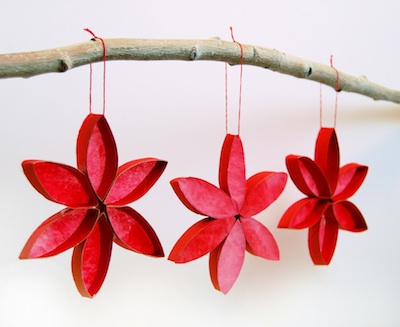
Slice a tube into rings, arrange rings into snowflake or poinsettia-like shapes, paint, and add a string loop. Flat ornaments store easily between seasons; dimensional ones (stacked rings, glitter centers) catch tree lights. Work in batches of six so the tree gets a matched set rather than one lonely experiment.
Seal glitter projects so sparkle stays on the ornament, not on the carpet. Soft gold, white, and deep red read festive without needing licensed characters or store-bought kits.
Bird feeder (simple, supervised)
Cover a tube in peanut butter or sun butter, roll it in birdseed, and hang from string on a branch. Use unsalted seed mixes appropriate for local birds, hang where predators and windows are considered, and take feeders down if they mold. This is a short-lived project—weather dissolves it—which is fine. The point is observing birds for a few days, not building permanent hardware.
Adults should check tree health and hanging height. Skip this idea if allergies or outdoor pests make nut butters a bad fit; switch to a painted ornament or pencil holder instead.
Tube craft vs. magazine craft
If your recycling pile includes both glossy pages and cardboard tubes, split the session. Magazines excel at surface: color, text, weave, collage. Tubes excel at form: holders, rings, wheels, petals, cells for cords. Mixing both in one object can work—cover a tube pencil holder in magazine strips—but learning each material alone first keeps frustration low.
- Sort tubes by length before cutting so sets match.
- Paint on a wire rack or parchment so wet cylinders do not stick to newspaper and tear.
- Hot glue is fast; white glue is safer for young kids and more forgiving for repositioning.
- Photograph kid projects before they are loved to pieces.
Pick one organizer and one playful build—say a cord box for the household and a race car for whoever needs to move—and empty the shoebox of tubes by the weekend. The next empty roll will not feel like trash. It will feel like inventory.

Comments
Continue reading
DIY Ideas for Old Socks: Rugs, Puppets, Mittens, and More
Sort leftover socks by fiber, then turn them into braided rugs, hand puppets, soft toys, mittens, and pin cushions with practical cutting and sewing tips.
DIY Ideas with Lace Doilies
Upcycle heirloom lace doilies into framed art, runners, pillows, lamps, and more—practical craft projects that keep the crochet visible.
Holiday Tie-Dye Projects: Tees, Shibori, Shoes, and Home Accents
Plan a dye day for spirals, shibori totes, kid-friendly marker crafts, powdered dyes, canvas shoes, lampshades, and hoop wall art—with rinse and wash tips that keep colors bright.