
Steampunkesque Cityscapes by Pete Amachree
British digital painter Pete Amachree’s neon night cities—Flatiron-inspired Downtown and a companion district—read as lived steam- and dieselpunk environments, not costume kits.
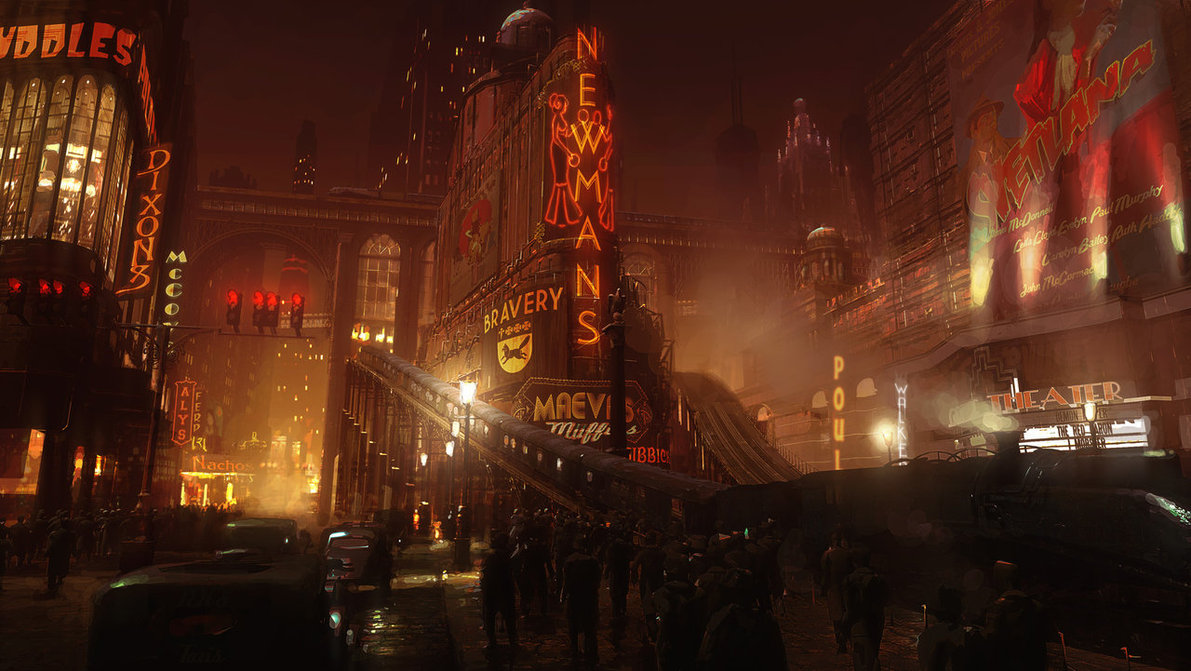
Pete Amachree builds cities that look remembered from a film you never quite saw. British digital painter, concept artist, and long-time worker in games and visual effects, he paints dense urban stages where neon, steam, elevated rails, and period architecture share one continuous night. The set gathered on this page leans steampunkesque without needing a costume checklist: dark atmospheres, saturated lights, and fictitious places that still obey gravity, traffic, and the logic of crowded streets.
Amachree has said the first picture here, “Downtown,” drew partly on New York’s Flatiron Building—and, in his own notes elsewhere, on 1920s–30s dieselpunk aesthetics as much as Victorian brass. That mix matters. Steampunk in popular shorthand often means goggles and gears; his stronger cityscapes feel like lived districts with weather, signage, and crowds. They read as movie establishing shots because they are built like environments first and genre labels second.
Reading “Downtown”
“Downtown” is a lesson in vertical storytelling. The eye climbs façades, catches elevated transit, and sinks into street-level glow. A Flatiron-like wedge gives the composition a recognizable spine, then the rest of the frame invents neighbors that never existed—signage, light temperature, and crowd density tuned until the place feels specific. Neon is not decoration sprayed on afterward; it is how the city breathes after dark.
Notice how little the painting depends on a single hero figure. People appear as scale markers and motion cues. The protagonist is the intersection of architecture and atmosphere. That is classic concept-art discipline: sell a world a viewer could walk into, even if no script has been written yet. Amachree’s industry background shows in that priority. Decades in computer games and movie VFX train an artist to think in readable silhouettes, depth layers, and light that guides the camera before any character close-up arrives.
The steampunk or dieselpunk label fits as a temperature reading rather than a rulebook. Brass and iron ages collide with electric night. Vehicles and rails suggest alternate industrial timelines. Yet the emotional hook is ordinary urban desire: to stand on a corner that feels busier and more storied than the one outside your window.
A second night, same city logic
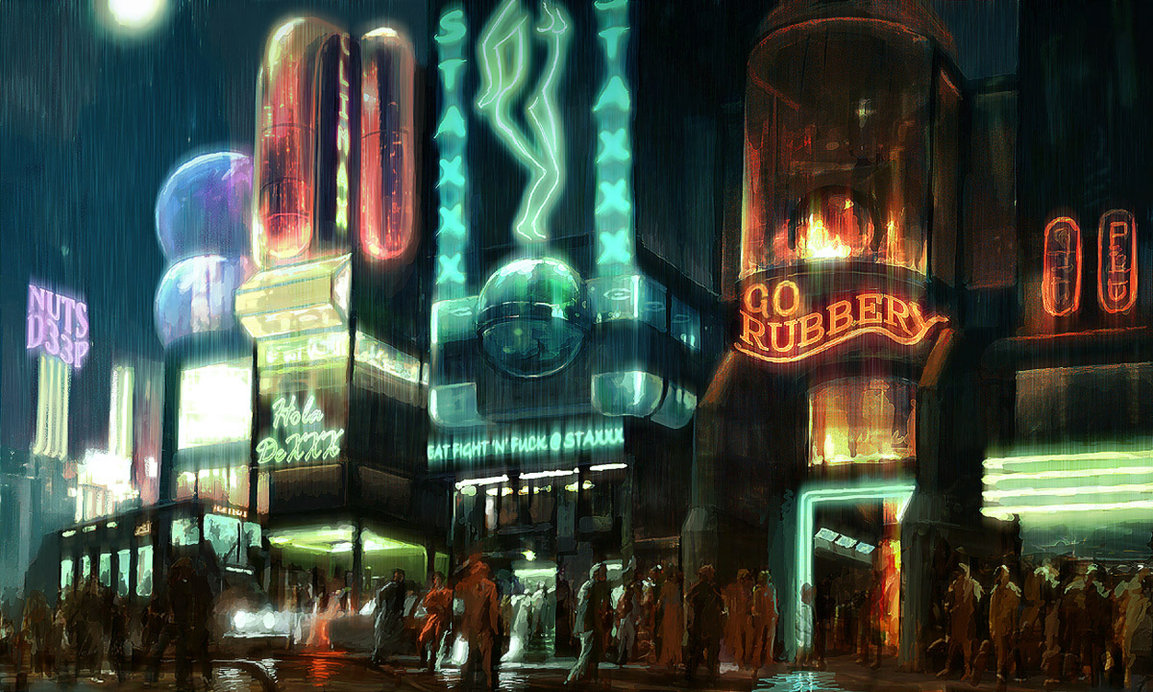
The companion image keeps the nocturnal contract and changes the street plan. Where “Downtown” organizes around a famous architectural idea, this second view proves the method travels: stack density, control fog and bloom, let practical lights—windows, signs, lamps—do narrative work. Fictitious places become believable when every light source has a job and every façade has a material personality.
Compare the two frames as a pair rather than as duplicates. One may feel closer to a known skyline hybrid; the other may push further into invented geography. Together they argue that Amachree’s subject is not a single landmark homage but a genre of night city—crowded, luminous, slightly dangerous, and meticulously scheduled by light.
Viewers often say these pieces look like film stills. That reaction tracks the craft: cinematic color grading instincts, deep space with foreground anchors, and just enough weather to soften edges without erasing detail. Digital painting here is not a shortcut around drawing; it is a way to iterate atmosphere until the mood locks.
Steampunkesque, not costume steampunk
The steampunk-influenced reading fits the neon-and-iron vocabulary, and Amachree’s wider portfolio, discussed in genre magazines and on his art platforms, also wanders into dieselpunk squares, Martian monuments, and other alternate-history civic spaces. The useful distinction for looking is this: costume steampunk sells character kits; environmental steampunk sells civic systems—transit, monuments, commerce, night labor.
His cities imply stories without illustrating a single plot point. Who rides that elevated line? Who owns the glowing signs? What battle or boom built the monument in a related Victorian square elsewhere in his catalog? The paintings leave those questions open on purpose. Concept environments are invitation engines. They ask directors, writers, and daydreamers to populate them.
Color does ideological work too. Warm sodium and cold neon share frames; smoke and haze unify eras that “should not” coexist. The anachronism feels intentional rather than sloppy because perspective and scale stay disciplined. Fantasy cities fail when the horizon lies or the crowd floats. These do neither.
How to look slowly
Start at the brightest practical light, then follow the brightest architectural edge. Name three depth layers: street, mid-rise, skyline. Find the quietest corner of the frame; Amachree often hides calm pockets inside noise, which is how real cities feel. Then ask what time the painting claims—late evening commute, deeper night, or a festival density that never quite ends.
Second pass: materials. Glass versus stone versus metal read differently under the same bloom. Third pass: human scale. Are figures hurrying, lingering, clustered at crossings? Even tiny silhouettes teach you the city’s tempo. If you sketch, try copying only the light shapes in grayscale; you will see how much of the “wow” is value design before hue arrives.
These looking habits turn a quick scroll into craft study. They also explain why the images survive blog compression and thumbnail culture: the large shapes read at small sizes, then reward zoom with ornament.
Craft context and where to see more
Amachree presents himself as a digital artist with long professional experience in games and film visual effects—freelance concept and illustration work built on industry hours, not only gallery whim. Personal pieces like “Downtown” sit beside client-driven environments; the personal work often looks freer because it can chase pure atmosphere. Platforms such as DeviantArt and ArtStation have carried these cityscapes to genre audiences who collect steam- and dieselpunk worlds the way others collect skyline photography.
If this pair hooks you, his wider galleries extend the civic fantasy: other districts, other monuments, other skies. Keep credit clear when you share—these are finished artworks by Pete Amachree, not anonymous “steampunk wallpaper.” The difference between inspiration and erasure is a name and a link.
For artists studying the style, the portable lessons are sober. Invented cities need real structural grammar. Neon needs darkness to matter. Homage to a known building works best when the surrounding blocks are invented with equal conviction. Genre flavor is a spice; readable space is the meal.
Why these cityscapes still hold
Internet art cycles burn through aesthetics quickly. What keeps Amachree’s night cities interesting is not a checklist of valves and goggles but the feeling that commerce, transit, and weather are still running after the viewer leaves. Steampunkesque here means alternate industrial modernity with a pulse—closer to a lived metropolis than to a costume trunk.
Look again at “Downtown” for the Flatiron thought and the diesel-era night logic. Look at the second image for proof that the method is a language, not a one-off trick. Somewhere between those two frames is the pleasure these cityscapes promise: dark city air, neon punctuation, and the sense that a camera could roll if only someone called action. When you are ready for more districts in the same climate, Amachree’s DeviantArt archive at peteamachree.deviantart.com remains a natural next street to turn down—crowds already gathered under lights that never quite switch off.

Comments
Continue reading

Still-Life Photography by Margareth Perfoncio
São Paulo photographer Margareth Perfoncio’s still lifes of food and flowers—Old Master light, dark wood, and tables that feel inevitable.

Meaningful Love Quotes for Inspiration (and Ink)
Meaningful love quotes that still feel true — short lines for tattoos, gifts, and everyday reminders, with placement and wording tips.
Christina Hess’s Animals From History: Costumed Pets as Playful Portraits
Illustrator Christina Hess reimagines historical icons as ornate animal portraits—Elvis Petme and friends—mixing puns, costume detail, and soft history lessons.