
Tilt-Shift Photography: How Cities Turn Into Miniatures
How tilt-shift photography creates the miniature city look—lens tilt and shift, high vantage points, strong subjects, and optical vs software approaches.
Tilt-shift photography is the rare technique that makes viewers ask whether a real street was rebuilt as a toy. A harbor, a stadium, a medieval roofscape—suddenly everything looks like a tabletop model under a desk lamp. The surprise is the point: scale collapses, and ordinary traffic starts to feel hand-placed.
The look spread widely in the early 2010s as specialty lenses became easier to rent and software filters made a related effect available to anyone with a laptop. Underneath the fashion sits older optical craft. Tilt and shift movements come from large-format camera practice, where photographers moved the lens relative to the film plane to control focus and perspective. Modern tilt-shift lenses shrink that freedom into a DSLR or mirrorless mount, but the underlying ideas are the same: move the lens, change what counts as sharp, change how vertical lines behave.
What “tilt” and “shift” actually do
Tilt angles the lens so the plane of sharp focus is no longer parallel to the sensor. In landscape work, that can mean sharpness from a foreground stone to a distant ridge at a moderate aperture, avoiding the softness that extreme f-stops can introduce through diffraction. For the miniature illusion, photographers tilt the other way: they collapse focus into a narrow band and let everything above and below fall soft, the way a macro lens treats a tiny model.
Shift slides the lens up, down, or sideways without aiming the camera body. Architecture shooters use shift to keep building verticals straight when shooting from street level—so a tower does not lean backward as the camera tips up. The miniature fad uses tilt more often than shift, but both belong to the same family of tools. Learning one movement helps you understand the other, even if your current project only needs the toy-town look.
Because the lens is moving relative to the sensor, composition habits change. Tripods help. Live view or a precise finder helps. Small adjustments matter; a few degrees of tilt can move the sharp band from a useful street level into an empty rooftop zone.
Why cities turn into dioramas
Human vision treats extremely shallow focus as a clue that a subject is close and small. Macro photographs of real models show the same pattern: a slim sharp zone, soft falloff, and often exaggerated color. When you apply that focus pattern to a real city seen from above, the brain borrows the “toy” interpretation even though the scene spans blocks.
High vantage points sell the illusion. Looking down from a hill, parking garage, hotel window, or overlook mimics how people photograph actual model railroads. A flat eye-level street scene rarely miniaturizes as convincingly, because we already know that viewpoint from walking. Elevation is half the craft; the other half is choosing a scene with readable toys—cars, boats, people, roof ridges—rather than an abstract field of identical windows.
Subjects that work especially well include:
- Busy streets with cars and pedestrians—motion and scale markers help the toy reading.
- Trains, tracks, and stations—linear infrastructure already resembles layout modeling.
- Harbors, stadiums, and plazas—clear edges and repeating forms read as kits.
- Older towns with pitched roofs and walls—texture densifies like a detailed miniature set.
- Construction sites and ports—cranes and containers look like scaled accessories.
Scenes that fight the effect include featureless parking lots, foggy horizons with no mid-ground markers, and tight crowds where individual figures merge into texture. If the eye cannot find a “toy,” the blur just looks like a misfocused snapshot.
Optical path versus software path
A true tilt-shift lens creates the focus plane in-camera. You compose carefully, often on a tripod, and refine the tilt until the sharp band sits exactly where you want attention—across a bridge span, along a market row, through a cathedral square. Depth of field behaves differently than with a normal lens; practice matters more than brand loyalty. Rent before you buy; these lenses are specialized and expensive relative to how often many photographers will use them.
Software approximations start from a normal photograph and paint blur gradients above and below a chosen focus strip, often with a bump in saturation and contrast. The result can be charming, and it is useful for learning which compositions respond well. It is not identical to optical tilt: software blur is usually more uniform and less physically nuanced, and it cannot recover focus information that was never recorded. Treat filters as sketching tools; treat lenses as instruments.
Either path benefits from the same editorial choices. Boosted color helps because toy sets are often painted brightly. Overdoing saturation turns cities into cartoons. Aim for vivid, not radioactive. Contrast should separate the sharp band without crushing shadow detail into plastic black.
How strong examples are usually built
Start with a clear center of interest—a bright tram, a church spire, a ferry at a pier. Place the sharp band through that subject. Keep the scene relatively simple; dense confusion fights the miniature story. Side light or soft overcast often beats harsh noon glare, which flattens models and real cities alike.
Longer focal lengths can compress layers and thicken the “set.” Extremely wide lenses stretch space and can weaken the toy feeling unless the high angle is dramatic. People and vehicles should remain recognizable as tiny figures; if they dissolve into noise, the illusion softens. Slightly elevated mid-afternoon light with long shadows can help, because shadows act like painted grounding on a model base.
Shutter speed is a quiet variable. A touch of motion blur on traffic can suggest tiny moving parts. Too much blur turns the sharp band into mush. Night cityscapes introduce another pleasure: out-of-focus lights become soft orbs that feel like fiber-optic model kits. Bracket carefully if you later want a software version; you need a clean base file with detail in the zone you will keep sharp.
Beyond the miniature trick
It is easy to reduce tilt-shift to a novelty genre. Professionals also use the same lenses for straight verticals in interiors and façades, for selective focus in product work, and for landscape focus control that avoids extreme apertures. The miniature look is the viral cousin; perspective control is the quiet workhorse. If your interest is architecture first, learn shift and leveled cameras before chasing toy cities. If your interest is playful scale, study high angles and simple scenes first, then decide whether optics or software fit your budget.
Ethics and access matter too. Rooftops, private garages, and drone flights have rules. A clever miniature effect is not worth a safety risk or a banned flight over a crowd. Choose legal overlooks and public viewpoints; the best tilt-shift frames are usually made from ordinary places used carefully, not from reckless elevation.
A practical afternoon exercise
Find a safe elevated viewpoint over a street with steady traffic. Shoot several frames at different times of day. In one session, try an optical tilt if you have access; in another, apply a careful software band to a sharp normal file. Compare where the illusion holds and where it collapses. Notice how a single bright bus in the sharp zone can carry the whole frame, while an empty parking lot resists the spell no matter how hard you blur the edges.
Then pick one successful frame and one failure and write two sentences about why. That short critique teaches more than downloading another preset. The best tilt-shift photographs do not merely shrink the world. They make you look twice at places you already thought you understood—and that double take is worth more than any filter preset.

Comments
Continue reading

Dramatic Photo Art by Sukron Ma’mun (Ipoenk Graphic)
Cirebon, Indonesia photographer Sukron Ma’mun uses theatrical natural light to frame village life, play, and place in lyrical photo art.

Bird’s-Eye Views: Florian Beaudenon’s Instant Life
Paris photographer Florian Beaudenon’s Instant Life series captures people in their rooms from above—intimate, collaborative overhead portraits of everyday joy.
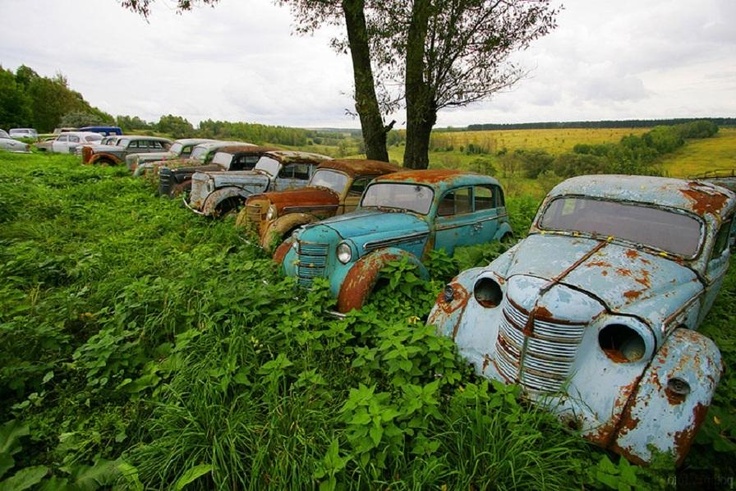
Abandoned Cars Reclaimed by Nature: Rust, Growth, and Quiet Ruin
When neglected vehicles are left outdoors long enough, rust, moss, and trees rewrite them into strange still lifes—sad, photogenic, and slowly returning to the ground.