
Skin-Canvas Portraits by Pinpin Co.
China-born, Japan-based artist Pinpin Co draws intricate temporary portraits on skin with a fine gel pen—ephemeral ink, long sessions, and faces treated as living architecture.
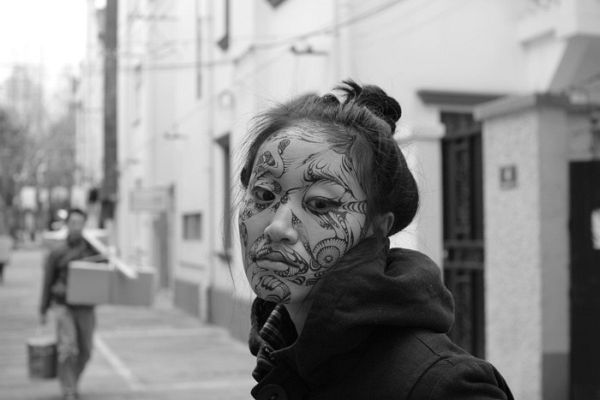
Pinpin Co turns a face into temporary architecture. China-born and raised in Japan, the Tokyo-based artist draws directly on skin with a fine gel ink pen—often a 0.38 mm line—until eyelids, cheeks, and forehead hold patterns as dense as maps. The portraits look fierce and delicate at once. They ask for a steady hand and a patient subject, because the work only pauses when the model must blink, breathe, or simply endure the long quiet of being drawn upon.
These are not tattoos and not conventional makeup. The ink is meant to be washed away. What remains afterward is a photograph, a memory of contact, and—for both artist and sitter—the strange intimacy of hours spent almost forehead to forehead.
From architecture school to living surfaces
Before the skin drawings circulated widely, Pinpin Co studied architecture—earning a BFA from Waseda University and later an MFA from Tokyo University of the Arts. That training shows in the work’s sense of structure. Lines behave like scaffolding and circulation routes across the topography of a face. Contours are not only decorative; they negotiate bone, soft tissue, and the small asymmetries that make a person recognizable even under heavy pattern.
Moving from city plans to human surfaces sounds like a leap until you notice what both problems share: boundaries, density, and the ethics of intervening in a place where someone already lives. A face is occupied territory. Drawing on it requires consent, stamina, and a willingness to let the “building” eventually be demolished by soap and water.
By the early 2010s her ink-on-skin practice had appeared in exhibitions and residencies around Tokyo and Yokohama, including presentations that framed the drawings beside performance and broader questions about adornment. The work sits beside conversations about makeup as much as beside body art: what does it mean to “dress” a face until the dressing becomes uncanny?
The session as temporary studio
A single portrait can take roughly five hours. That duration changes the social contract. Small talk thins out. The sitter settles into stillness; the artist settles into listening with the hand. Pinpin Co has described the process as often therapeutic, with a relationship that can feel adjacent to care—closer to doctor and patient than to stylist and client. The drawings sometimes seem to chase scars, tensions, or private weather the sitter carries, translating them into vein-like networks, masks, or ornamental overgrowths.
Because the ink is temporary, risk and trust rearrange themselves. There is no lifelong mark to negotiate, yet there is still vulnerability: a stranger’s pen traveling across eyelids and lips, documenting a version of you that will exist fully for only a short window. Photographs freeze that window. Without them, the piece would vanish into the sink.
Ephemerality is not a gimmick here; it is the medium’s honesty. Skin sheds, sweat shifts lines, and washing ends the sculpture. The art accepts disappearance as part of its form, the way sand drawing accepts tide.
Looking at the portraits
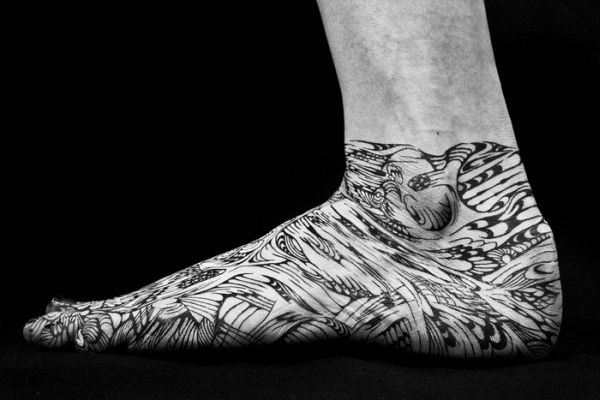
In the images gathered on this page, pattern nearly overrules portraiture—until you find the mouth, the nostrils, the soft edge of an ear. That oscillation is the charge. You are looking at ornament and at a person, and the brain keeps switching which layer is “on top.” Some passages resemble lace; others resemble capillary maps or cracked glaze. The line weight stays disciplined, which keeps the density from collapsing into noise.
Closed or softened eyes are common in documentation, both as practical necessity and as mood. With the gaze withdrawn, the face becomes more canvas and less social mirror. The sitter is present as surface and breath rather than as performer for the camera. When eyes do open, the interruption is almost narrative: the artwork briefly becomes a person again.
Color, when it appears, is usually subordinate to black ink’s graphic authority. The drama is draftsmanship under constraint—no flat wall, no redo without wiping hours away. Every decision is made on a warm, slightly moving ground.
Intimacy, family, and the ethics of touch
Pinpin Co has spoken about how different it feels to draw on a stranger’s skin versus a family member’s. In one widely discussed stretch of work, she spent time reconnecting with her father, traveling to visit him and eventually drawing on his face—an act that braided portraiture with repair. Coming into contact with familial skin, she noted, is not the same sensory or emotional event as working with someone met for a session.
That distinction matters for viewers too. It is easy to consume these images as internet surrealism. It is harder, and better, to remember the hours of touch behind them: the negotiation of comfort, the trust required to let someone ink the territory around your eyes, the quiet labor of holding still. The grotesquerie some viewers sense—the vein-like networks, the almost medical intensity—is inseparable from care. Beauty here is not polish; it is attention taken to an extreme.
Why the work still unsettles and holds
Body painting often aims for spectacle or camouflage. Pinpin Co’s drawings aim for encounter. They make makeup’s everyday strangeness visible by pushing adornment until it looks excessive, tender, and slightly alarming. They also refuse permanence at a moment when tattoo culture and filtered faces both promise lasting revision. Her answer is opposite: revise intensely, then release.
For artists, the series is a lesson in site-specific drawing. The “site” breathes. It has pores and micro-movements. Composition must respect landmarks you cannot erase—brow ridge, philtrum, the outer canthus—while still inventing a world across them. For everyone else, the portraits are a reminder that a face is already a biography written in soft topography. Adding ink does not invent that biography; it briefly underlines it.
Viewers sometimes ask whether the work is fashion, performance, or fine art. The useful answer is that it borrows tools from each without obeying any single industry’s schedule. There is no product launch, no permanent collection piece you can hang without photography, and no runway under the chin. There is only duration, trust, line, and the knowledge that water will finish what the pen began.
Spend time with the two images here before rushing to the next tab. Follow a single line from temple to cheek and notice where it yields to bone. Imagine the room during those hours: the small sounds of a pen, the pauses, the decision to stop. When the ink finally washes off, the photograph keeps the map. The person keeps the memory of being carefully, temporarily rewritten—and then returned to themselves.

Comments
Continue reading
Still-Life Photography by Margareth Perfoncio
São Paulo photographer Margareth Perfoncio’s still lifes of food and flowers—Old Master light, dark wood, and tables that feel inevitable.

Meaningful Love Quotes for Inspiration (and Ink)
Meaningful love quotes that still feel true — short lines for tattoos, gifts, and everyday reminders, with placement and wording tips.
Christina Hess’s Animals From History: Costumed Pets as Playful Portraits
Illustrator Christina Hess reimagines historical icons as ornate animal portraits—Elvis Petme and friends—mixing puns, costume detail, and soft history lessons.