
Reflections: Bezalel’s Short About Play, Mirrors, and Growing Up
Bosmat Agayoff and Alon Ziv’s 2013 Jerusalem graduation film follows Barnie—until other adults erase the childish reflection he still knows how to play with.
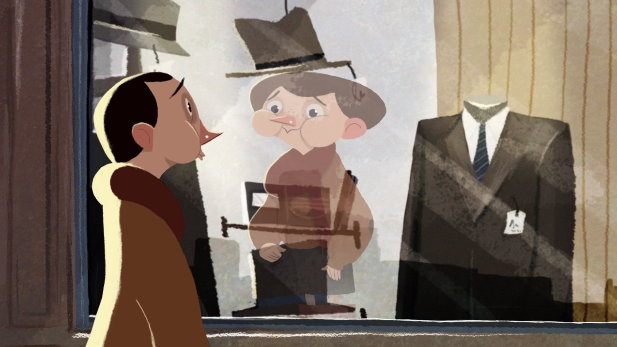
George Bernard Shaw’s line about play—“We don’t stop playing because we grow old; we grow old because we stop playing”—could caption half the internet’s nostalgia posts. Bosmat Agayoff and Alon Ziv’s 2013 graduation film Reflections, from Bezalel Academy of Arts and Design in Jerusalem, treats the idea as drama instead of plaque text. Their five-minute, dialogue-free short follows Barnie, a grown man who still knows how to play with his childish reflection in an urban landscape—until other adults intervene and press him into becoming one of them.
UK Jewish Film’s program note puts the theme bluntly: growing up is hard; the time has come for a boy to become a man, reluctantly. The film’s own synopsis is more specific about method. The mirror is not decoration. It is a second character—Barnie’s younger self as playmate—until social pressure edits that relationship out of him.
Barnie, the city, and the other self
Adult-child double casting is a familiar animation device, from magical transformations to imaginary friends. Reflections keeps the device intimate. Barnie is already grown; the “child” appears as reflection, a version of him that still knows games. The urban landscape supplies stages—glass, puddles, polished surfaces, the everyday mirrors of a city that rarely invites adults to linger. Play happens in public, which is exactly why it becomes vulnerable. Private play can hide. Public play can be corrected.
That correction is the plot turn. Other adults do not merely disapprove; they change him. The wording in the filmmakers’ synopsis matters: they turn him into one of them. Conformity is not a lecture delivered to Barnie. It is an action performed on him. Animation can show social pressure as bodily revision—posture, clothing rhythm, the loss of elastic movement—without a single line of dialogue. When the fun ends, it ends as a visible conversion.
The short’s emotional temperature sits between whimsy and dread. Early passages invite delight: a man collaborating with his reflection is inherently comic and tender. Later passages ask what remains when the collaborator is gone. That arc is why the Shaw quote sticks to the film without needing to appear as on-screen text. Stopping play is framed as something a culture can enforce.
Bezalel craft: TVPaint, Photoshop, After Effects
Agayoff and Ziv have been explicit about tools: TVPaint 9.5, Photoshop, and After Effects CS6. That stack places Reflections in a hand-drawn / digital-composite tradition rather than in a heavy 3D pipeline. TVPaint favors frame-by-frame performance; Photoshop supports design and texture work; After Effects handles assembly, effects, and the kind of urban compositing a reflection premise invites.
Tool lists are boring until they match theme. A story about layered selves benefits from a pipeline that can layer drawings, blur boundaries between figure and mirror, and keep linework alive in motion. The film does not need photoreal streets. It needs streets that feel like a social machine—spaces where adults move with synchronized purpose and a playful body becomes conspicuous.
Music by Ady Cohen carries emotional continuity across the silent performances. In dialogue-free shorts, score often becomes the narrator. Cohen’s contribution helps mark the shift from play to pressure without turning the piece into a music video that overwhelms the drawings. Festival and online write-ups repeatedly treat the short as a complete student statement: clear premise, finished craft, shareable theme.
Why mirror stories hit hard in five minutes
Mirrors are efficient metaphors because audiences already know the rules. A reflection should match. When it plays, the match becomes a relationship. When adults force alignment with the crowd instead of the mirror, the relationship breaks. You can explain that in an essay. Animation can make you feel the break as a change in motion language.
There is also a specifically urban angle. Cities multiply reflective surfaces and multiply witnesses. Barnie’s play is never only internal; it risks being seen. That is closer to real adulthood than a forest fairy tale about losing innocence. The threat is not a monster. The threat is neighbors who have already surrendered their own reflections and now police yours.
Comparisons cropped up when the film circulated—some viewers reached for Disney’s Paperman because both are stylish, mostly silent, city-set shorts with strong graphic appeal. The comparison is atmospheric more than structural. Paperman is a reunion romance powered by paper airplanes. Reflections is a conformity fable powered by a disappearing playmate. One is about finding someone. The other is about losing a self.
Graduation film as argument
Bezalel’s animation graduates often enter a global student-film ecosystem where a five-minute piece must prove taste, not only software hours. Reflections chooses a theme every viewer has opinions about—growing up—and then narrows it to a single mechanism: play with reflection versus adult remaking. That narrowing is professional. Broad themes without mechanisms become posters. Mechanisms without themes become demos. The short wants both.
Festival mentions attached to the film’s travels have included audience recognition and fine-work honors on the student circuit (among them notes circulating around ISFVF Beijing audience award recognition and Shinjuku Creators Festa fine work acknowledgment, plus ASIFA Israel honorable mention in contemporaneous coverage). Awards are secondary evidence. Primary evidence is the film’s clarity: you can recount it accurately after one viewing, then notice craft on the second.
For students making their own shorts, the useful lesson is tonal bravery. It is easy to make a cute mirror gag. It is harder to let the cute premise become unsettling when the crowd arrives. Agayoff and Ziv accept that turn. Reluctance—UK Jewish Film’s key word—keeps Barnie sympathetic. He is not foolish for playing. He is human for resisting the end of play.
How to watch without spoiling the feeling
First viewing: track Barnie’s body. When is he loose? When does he tighten? Second viewing: track the reflection as scene partner. How do they share timing? When does the city start offering surfaces that feel less like playgrounds and more like tests? Third viewing, if you teach or study: watch the adults as a design system. Are they individuals or a chorus? How quickly does “one of them” become a readable visual state?
Also notice what the film withholds. It does not need a workplace subplot, a romantic rescue, or a spoken manifesto about creativity. The reflection is enough. The crowd is enough. The reluctant transformation is enough. In a media environment that often sells perpetual youth as branding, Reflections is quieter and sterner. It suggests that play is not a product demographic. It is a practice that other people can interrupt.
When the short ends, the Shaw line returns with a sharper edge. Growing old, in this telling, is not only a calendar event. It can be a social procedure. Barnie’s city has plenty of reflective surfaces. The question the Bezalel film leaves behind is whether anyone is still allowed to meet themselves there—and answer with a game instead of a nod.

Comments
Continue reading

Still-Life Photography by Margareth Perfoncio
São Paulo photographer Margareth Perfoncio’s still lifes of food and flowers—Old Master light, dark wood, and tables that feel inevitable.

Meaningful Love Quotes for Inspiration (and Ink)
Meaningful love quotes that still feel true — short lines for tattoos, gifts, and everyday reminders, with placement and wording tips.

Christina Hess’s Animals From History: Costumed Pets as Playful Portraits
Illustrator Christina Hess reimagines historical icons as ornate animal portraits—Elvis Petme and friends—mixing puns, costume detail, and soft history lessons.