
Forward, March!: ESMA’s London Guards Meet a Hairy Interloper
ESMA’s 2013 graduation short drops a jovial monster into a ceremonial London parade—wordless comedy about order, disruption, and festival-ready student craft.
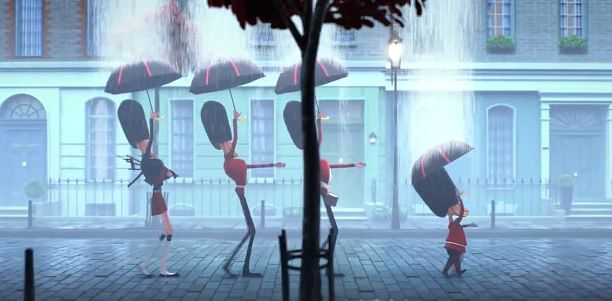
Ceremonial marching is comedy waiting to happen. The uniforms are identical, the steps are synchronized, and the music insists that nothing unexpected will ever occur. Forward, March!—the 2013 graduation short from France’s ESMA (École Supérieure des Métiers Artistiques)—takes that promise of order and drops a hairy, cheerful disruptor into the middle of it. The result is a brief, dialogue-free cartoon about what happens when perfect discipline meets uninvited joy.
Directed by Pierrick Barbin, Rimelle Khayat, Loïc Le Goff, Guillaume Lenoël, and Garrick Rawlingson as their Promotion 2013 film in ESMA’s 3D Animation & FX program, the short runs roughly four and a half minutes. The setup is clean enough to pitch in one sentence: in London, a troop of Guards parades to music until a jovial, furry monster joins the party. That economy is the point. Student films often overstuff. This one trusts a single collision—military spectacle versus soft chaos—and rides it.
London as a comedy stage
Choosing London’s ceremonial Guards is not accidental set dressing. The city’s pageantry already reads as animation before any CG artist touches it: tall hats, bright coats, rigid posture, tourist cameras, the sense that the performance must continue even if a pigeon lands on someone’s bearskin. By placing the short inside that visual language, the team inherits an audience’s prior knowledge. Viewers already understand that breaking formation is a social emergency. The cartoon only has to introduce one wrong note—something hairy, friendly, and completely uninterested in protocol—and the rest of the joke builds itself.
The short stays wordless, which keeps the humor physical and international. Faces, timing, and the stubbornness of a march do the storytelling. You do not need a narrator explaining why order matters; you see bodies fighting to keep the pattern while one body refuses to recognize that a pattern exists. In short-form comedy, that clarity is gold. Every second spent on exposition would dilute the gag’s velocity.
Graduation films as calling cards
ESMA’s end-of-studies projects are designed to show that a team can finish a watchable film, not merely a reel of lighting tests. Forward, March! demonstrates several production muscles at once: character design that reads in silhouette, group animation (harder than a lone hero), environments that feel like a public city rather than a greybox, and a musical spine that sells ceremony before it sells slapstick. Festival programmers noticed. The film was selected for Clermont-Ferrand’s young-audience category and took the jury’s first prize there. Other honors reported by ESMA and festival circuits include recognition at Chennai’s international short festival, a special mention for children’s short work at Animayo, and a best animation prize at Pune—plus selections such as Anima Brussels.
Awards do not make a short funny. They do indicate that the film travels: children can follow it, adults can enjoy the craft, and programmers can schedule it without worrying that cultural references will collapse outside France. A London parade and a fluffy interloper are almost universal props.
Why group comedy is harder than it looks
Many student shorts center one expressive character because that is manageable. Marching Guards multiply the difficulty. Timing must stay locked across a unit; if one performer drifts, the joke about uniformity dies. The monster’s entrance only lands if the group feels like a machine first. That means the team had to animate boredom, pride, panic, and recovery as a shared organism. When the machine wobbles, viewers feel the social horror of being the person who ruins the photo—and the relief of watching someone else do it.
Music is the other half of the machine. Sources credit a film score involving José Vicente, Fred Varot, and David Merales. In a no-dialogue short, the score is not wallpaper; it is the voice of the institution. Brass and cadence say “this is official.” When the monster arrives, the arrangement has somewhere to go: either it fights to stay solemn while the picture goes silly, or it leans into the infection of play. Either choice works if the cut between order and disorder remains readable.
What the short is really about
On the surface, Forward, March! is a cute interruption. Underneath, it is a comedy about institutions that mistake repetition for meaning. A parade looks powerful because nobody breaks. Introduce one creature who treats the street as a playground, and the power suddenly looks fragile—funny-fragile, not tragic. The Guards are not villains. They are professionals trapped inside a ritual that cannot admit improvisation. The monster is not a villain either. It is simply immune to shame. That mismatch is classic cartoon ethics: the world of rules versus the body that does not know the rules exist.
The film also belongs to a long ESMA tradition of polished 3D student work that aims for festival clarity rather than private experiment. You can see the school’s priorities in what is finished: readable designs, clean staging, a joke that survives mute playback. Making of materials shared around the project—character design, set design, look development, colorscript—underline that the comedy was planned as a visual system, not discovered in the render farm at the last minute.
How to watch it
First viewing: chase the disruption. Laugh when formation fails. Second viewing: watch the Guards as a single character with many limbs. Notice how the camera treats the street like a theater aisle, how the monster’s softness contrasts with hard hats and hard lines, and how little the short needs beyond “march continues / march cannot continue.” If you animate, steal the constraint: one location type, one social rule, one incompatible personality. If you produce student work, steal the finishing standard: festival-ready runtime, no dialogue dependency, and a premise a stranger can retell after one screening.
Parades end, but the fantasy of perfect coordination never does. Forward, March! lasts only a few minutes, yet it keeps returning to that fantasy and gently knocking the tall hats crooked. The Guards want the music to mean control. The monster wants the music to mean a party. For four and a half minutes, London is big enough for both—and small enough that neither can pretend the other is not there.

Comments
Continue reading

Still-Life Photography by Margareth Perfoncio
São Paulo photographer Margareth Perfoncio’s still lifes of food and flowers—Old Master light, dark wood, and tables that feel inevitable.
Meaningful Love Quotes for Inspiration (and Ink)
Meaningful love quotes that still feel true — short lines for tattoos, gifts, and everyday reminders, with placement and wording tips.
Christina Hess’s Animals From History: Costumed Pets as Playful Portraits
Illustrator Christina Hess reimagines historical icons as ornate animal portraits—Elvis Petme and friends—mixing puns, costume detail, and soft history lessons.