
Fallin’ Floyd: Anikey’s Dialogue-Free Depression Jazz Short
Albert ’t Hooft and Paco Vink’s Dutch short turns heartbreak into a growing demon on a trumpet player’s back—color, jazz score, and comedy without dialogue.
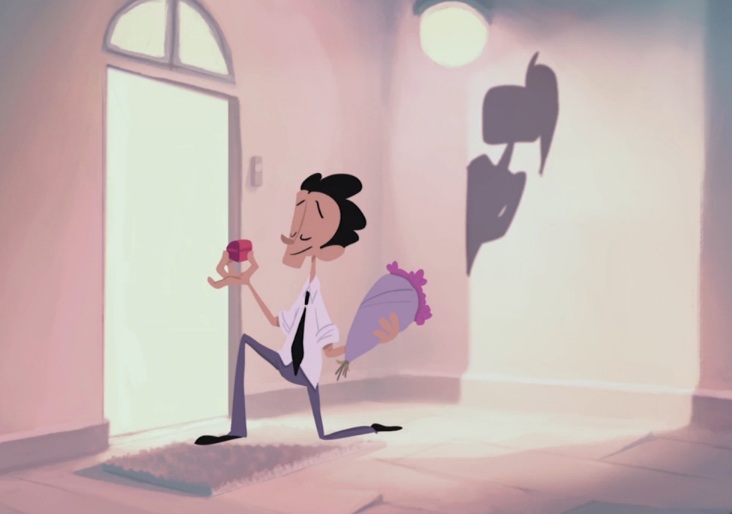
Floyd buys an engagement ring. His girlfriend leaves anyway. Then a little black demon climbs into his life and starts rearranging the furniture of his mind. That is the entire ignition system of Fallin’ Floyd, the dialogue-free Dutch short from Anikey Studios and Il Luster Productions—a jazzy, colorful, bruising comedy-drama about depression that never needs a monologue to explain itself.
A turbo drama without speeches
Directed by Albert ’t Hooft and Paco Vink, Fallin’ Floyd (2013) runs in the neighborhood of seven to ten minutes depending on the listing, and it uses almost none of that time for talk. Floyd is a cheerful trumpet player until heartbreak knocks him sideways. His psychological spiral manifests as an ink-dark creature that rides him, goads him, and grows when he sinks. Alcohol appears. Color drains and mutates. The world keeps moving while Floyd falls from scene to scene like a man who has lost the right to stand still.
Il Luster’s own synopsis calls it a humouristic turbo drama: funny, fast, and serious about pain. That balance is the film’s signature. Depression stories in animation can tip into either pure gloom or quirky mascot nonsense. ’t Hooft and Vink aim for a third lane—laugh so you can keep looking, then keep looking so the laugh means something.
Where the idea came from
In a Directors Notes interview, the pair describe the concept as a fusion of older sketches. Around 2005, Albert had rough ideas about a man harassed by a demon on his back. Paco had a separate image involving a depressed bear searching for a heart while tumbling through scenes. When they wrote in earnest around 2009, they braided those images together with lived experience of failed relationships and the ugly feelings that follow. The result is not autobiography as diary. It is autobiography as fuel: enough personal truth to keep the comedy from becoming cruel, enough invention to keep the metaphor theatrical.
Fallin’ Floyd was their third short after Paul and the Dragon (a commissioned piece connected to children with cancer) and the darkly comic Little Quentin. The directors have said they try to change something essential with each film. Here the experiment is emotional: a positive message about not surrendering to depression, delivered through gags that hurt.
The demon as flexible anatomy
Character design does philosophical work. The demon needed to scale with emotion—small enough to nag, large enough to dominate, distorted when control is gone. Animal traits creep into the creature’s body language; horns-and-tail clichés were tried and rejected. At one point a tiny suitcase gag amused the team and then got cut for sense. Simplicity won. The creature stays readable in silhouette, which matters in a film that sells feeling through poses rather than lines of dialogue.
Floyd himself is built for contrast. He begins as a performer whose public joy is visible: trumpet, color, motion. Heartbreak does not merely sadden him; it re-orchestrates him. The film’s falling structure—shot connections that make him seem to tumble from situation to situation—turns mental freefall into cinematic continuity. Compositing that illusion was, by the directors’ account, one of the production’s headaches. When it works, viewers feel the drop in their stomach before they name the theme.
Color as mood board, not decoration
’t Hooft and Vink built a colorboard for the short. As Floyd sinks, his healthy pink shifts toward blue and dark purple; backgrounds follow. The changes are meant to be noticeable without becoming a distraction seminar. In practice, that means color operates like score: you may not annotate every modulation, but your nervous system tracks it. Dialogue-free films need these nonverbal rails. Otherwise emotion becomes guesswork.
Background art and environment design support the same idea. The world is stylized, graphic, and elastic enough for comedy, yet grounded enough that Floyd’s pain does not float away into abstraction. Digital painting in Photoshop, 2D animation in Toon Boom Animate Pro, and compositing in Digital Fusion (with late help from Kaspar Guyaux) formed a pipeline typical of ambitious European indie 2D—handmade character work married to flexible digital glue.
Music first, then the rest of the sound
Because Floyd plays trumpet, the soundtrack is not a late polish pass. The team needed music early enough to animate performance scenes accurately. After their previous composer was unavailable, producer Chris Mouw connected them with Martin Fondse. Fondse wrote the score and recorded in Osnabrück, Germany, with renowned Dutch trumpet player Eric Vloeimans among the musicians. The directors have described hearing Fondse at the piano on arrival and realizing the film had found its emotional spine.
Foley and mix by Jeroen Nadorp at Bob Kommer Studios then solved a dialogue-free puzzle: when should an instrument comment, and when should a sound effect land? The demon’s voice was especially stubborn. A weird musical instrument proved too distracting. The solution was animal sound collage—monkeys, rattlesnakes, guinea pigs—layered into something that feels alive without speaking English. In a film about intrusive thoughts, that choice is poetic: the demon chatters in a language beneath language.
Production that stretched like the demon
Anikey’s team worked in fragments around feature development and commercial jobs. Across stages, roughly four to five artists were active at a time, with key animation contributions from Paco Vink and Jelle Brunt and internship support from artists including Ruben Zaalberg and David Muchtar. Ben Vinkenburg and Robin Niekerk helped push environments and 3D elements. Counted end to end, the directors estimated around fourteen months from storyboard to final render—longer than planned, as animation schedules often are.
That duration shows in the confidence of the cuts, not in bloat. The short stays lean. What the months bought was integration: color, music, falling transitions, and demon performance tuned to one tone. Indie shorts frequently fail by collecting handsome shots that do not share a nervous system. Fallin’ Floyd shares one.
What to take from Floyd’s fall
- Externalize an inner state with a character who can grow and shrink.
- Use color shifts as emotional subtitles.
- Let music carry speech when speech would flatten the feeling.
- Keep comedy attached to suffering so the hope at the end is earned.
- Design transitions that embody the theme—here, falling—rather than only decorating it.
Floyd’s trumpet still matters after the demon arrives. Music is not a nostalgic prop; it is one of the ways a person remembers he exists. Watch the short once for the gags. Watch it again for the way the frame drops him, catches him, and asks whether he will let the creature on his back choose the next note.

Comments
Continue reading

Still-Life Photography by Margareth Perfoncio
São Paulo photographer Margareth Perfoncio’s still lifes of food and flowers—Old Master light, dark wood, and tables that feel inevitable.
Meaningful Love Quotes for Inspiration (and Ink)
Meaningful love quotes that still feel true — short lines for tattoos, gifts, and everyday reminders, with placement and wording tips.
Christina Hess’s Animals From History: Costumed Pets as Playful Portraits
Illustrator Christina Hess reimagines historical icons as ornate animal portraits—Elvis Petme and friends—mixing puns, costume detail, and soft history lessons.