
Scarlett Johansson for Vogue Russia, October 2012
Victor Demarchelier’s October 2012 Vogue Russia cover story: Scarlett Johansson in Dolce & Gabbana Alta Moda—period couture editorial, not breaking news.
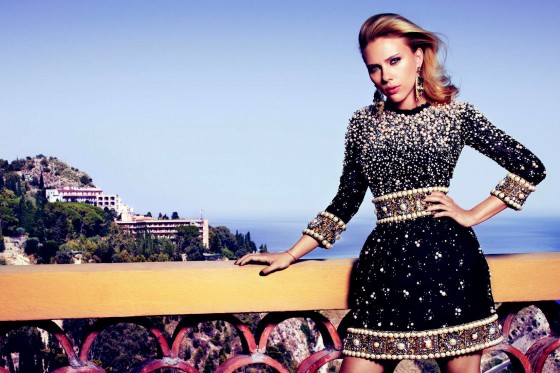
In autumn 2012, Vogue Russia put Scarlett Johansson on its October cover for a fashion story built around Dolce & Gabbana Alta Moda—the Italian house’s haute couture idiom—photographed by Victor Demarchelier. Where some celebrity covers sell approachable gloss, this one sold density: embroidery, jewels, satin, and a star framed as capable of carrying couture weight without looking costumed. The Russian edition’s October slot has long been a prestige position; casting Johansson in Alta Moda signaled international glamour aimed at readers who expect Vogue covers to feel expensive on contact.
The frames kept on this page come from that October 2012 package. They remain useful as period fashion documents: not breaking news, not a career summary, but a specific Condé Nast Russia editorial moment when Hollywood casting met Italian couture language under Demarchelier’s camera.
October 2012: Vogue Russia’s couture bet
International Vogue editions use October for collection-season authority—clothes that photograph as investment fantasy rather than weekend tips. Vogue Russia’s choice of Johansson in Dolce & Gabbana Alta Moda pushed that fantasy toward Sicilian-Italian maximalism: black and jewel tones, crystal and pearl weight, lingerie-adjacent satin against heavily worked outer layers. Period fashion coverage described the cover look as opulent and body-conscious, with embellished jackets and matching statement earrings doing as much narrative work as the actress’s fame.
Alta Moda, as Dolce & Gabbana’s couture offering, is designed to read as singular rather than seasonal basics. Putting those clothes on a Hollywood face for a Russian Vogue cover translated private-client drama into newsstand shorthand. Readers did not need a seat at an Alta Moda presentation. They needed a cover that said: this edition can still deliver rarity.
Credits circulated with the story in fashion press named Victor Demarchelier as photographer, Ekaterina Mukhina as stylist, Ken O’Rourke on hair, and Adrien Pinault on makeup. That crew list is the industrial signature of a major Vogue sitting—local fashion leadership paired with an internationally recognized camera and glam team so the images can travel beyond the print run into global blog circulation.
Victor Demarchelier’s frame
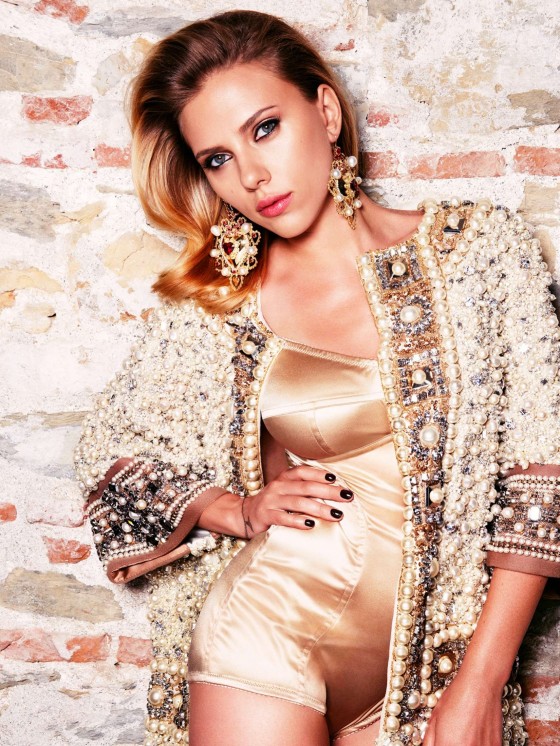
Victor Demarchelier’s fashion photographs often favor clean authority: subjects centered, clothes allowed to show their construction, light that flatters without dissolving texture into haze. On Johansson, that approach meets a performer who already understood how to hold stillness for a still camera. The October 2012 images do not ask her to mime a film role. They ask her to wear couture as if it were a natural extension of star scale.
Compare the visual thesis, carefully, with other Johansson magazine moments from the same broad era. A U.S. Marie Claire studio package tends toward women’s-magazine versatility and interview intimacy. A Vanity Fair France launch cover leans on portrait encounter and geographic premise. This Vogue Russia story leans on garment spectacle—how much embroidery a frame can hold before it collapses, how satin and crystal photograph under editorial lighting, how a face remains readable inside ornament.
Demarchelier’s inheritance of a famous photographic surname is biography; the work on the page is craft. The successful frames balance ornament and identity so neither erases the other. That balance is why Alta Moda editorials either sing or sink. Too little presence and the clothes look like product shots; too much theatrical mugging and the couture becomes costume-party. Johansson’s October 2012 set stays on the usable side of that line.
Alta Moda as cover language
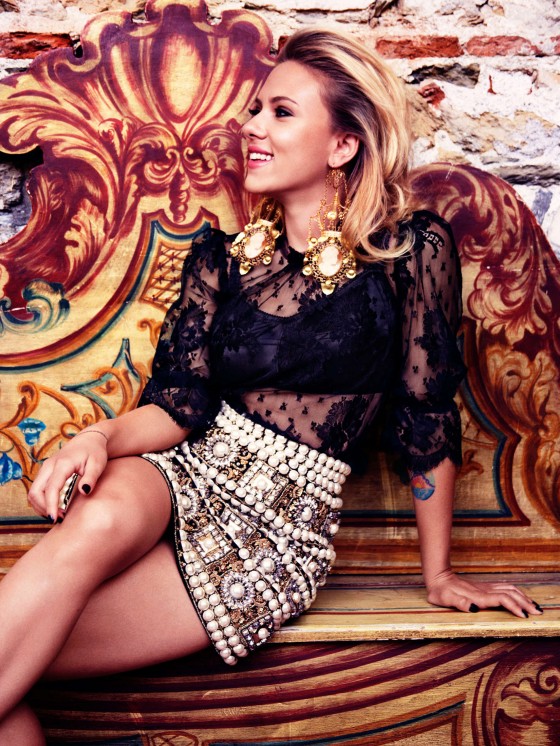
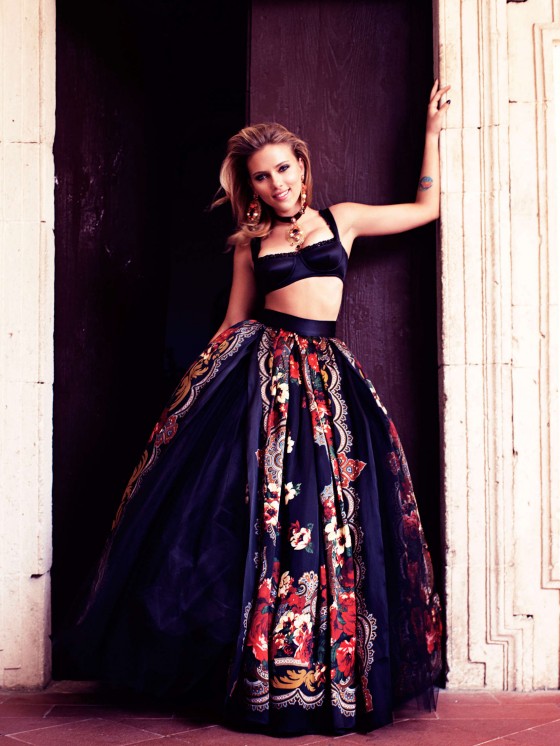
Dolce & Gabbana’s couture vocabulary—religious and romantic references, black lace, gold, crystals, strong shoulders, lingerie codes elevated into evening armor—gave Vogue Russia a ready-made visual mythology. Johansson’s casting plugged Hollywood blondeness into that mythology without requiring the clothes to become ironic. The editorial reads as celebration of excess executed with magazine discipline: hair finished, makeup precise, jewelry scaled to the garments rather than competing randomly.
For Russian Vogue’s audience in 2012, international actress covers also functioned as soft power for the title itself—proof of access. Securing Johansson in full Alta Moda was a statement that Moscow’s Vogue could book the same grade of subject and wardrobe that global fashion media respected. The photographs had to justify that claim on sight. Judging by how widely the cover and interior frames were mirrored on fashion sites that September, they did.
Texture is the story’s real protagonist after Johansson’s face. Embellished outer layers catch light in discrete points; satin underneath returns broader reflections; earrings and necklines echo the jacket’s jewel logic so the frame does not splinter into unrelated sparkle. That kind of internal rhyme is how couture editorials avoid looking like costume closets emptied onto a backdrop. Mukhina’s styling, as credited in period posts, keeps the house codes consistent across changes instead of chasing unrelated trends for variety’s sake.
It is worth leaving the personal gossip economy out of the center. Contemporary blog asides about exes and tabloid rivalries aged faster than the clothes. What remains durable is the fashion argument: couture texture, controlled pose, and a national Vogue edition using Italian haute craft to define an October mood. Date the page as October 2012 Vogue Russia and the images stay sharp; stretch them into a vague “Scarlett forever” scrapbook and they lose the assignment that made them specific.
How the images moved—and how to read them now
As with most early-2010s Vogue covers, preview posts in September 2012 split the package into portable stills. A single embellished jacket on the cover could travel without the full credit block. Interior portraits extended the thesis across multiple outfits while keeping the same opulent register. The local gallery here preserves that sequence enough to show variation inside one house language rather than a random celebrity scrapbook.
Looking back from a distance, the set is dated in the useful way: beauty finish, retouching norms, and couture maximalism all mark the year. It is also still instructive. Students of fashion media can see how a non-U.S. Vogue edition leveraged Hollywood casting plus Italian couture to claim luxury authority. Fans can see Johansson as a cover instrument capable of more than one magazine dialect—studio American gloss, Paris launch portraiture, and, here, jeweled Alta Moda density.
Even a short local gallery is enough to show range inside one brief: cover recognition, standing portrait scale, and closer frames that let embroidery read as craft rather than as noise. That is the lasting utility of keeping the media paths intact. The pictures were commissioned to persuade a newsstand; years later they persuade as historical fashion evidence—what Vogue Russia thought “October luxury” looked like when it cast Scarlett Johansson in Dolce & Gabbana Alta Moda under Victor Demarchelier’s light.
Those photographs keep their original assignment visible. Johansson wears the couture as if the embroidery belonged on a newsstand as much as in a private atelier—and for one Russian October, that was exactly the point the magazine needed to make.

Comments
Continue reading
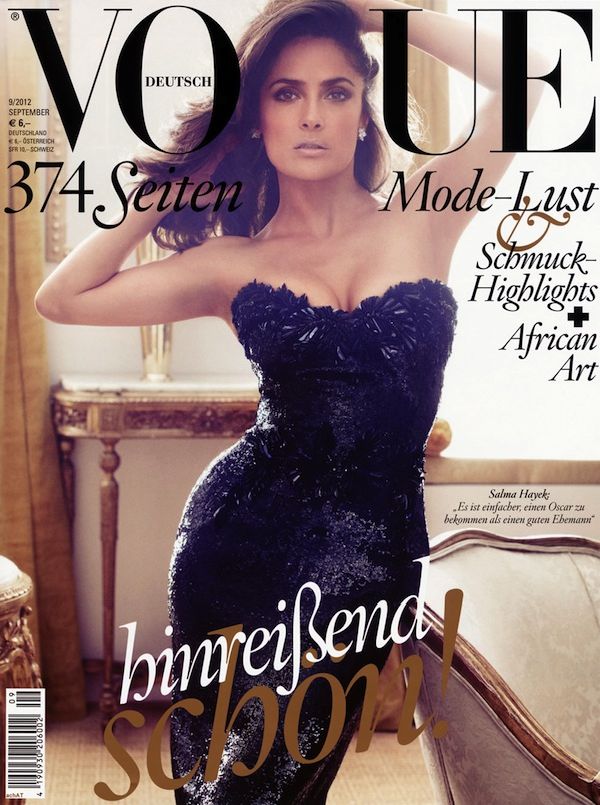
Salma Hayek by Alexi Lubomirski for Vogue Germany, September 2012
Period look at Salma Hayek’s September 2012 Vogue Germany cover story—photographed by Alexi Lubomirski in an after-hours fashion editorial.
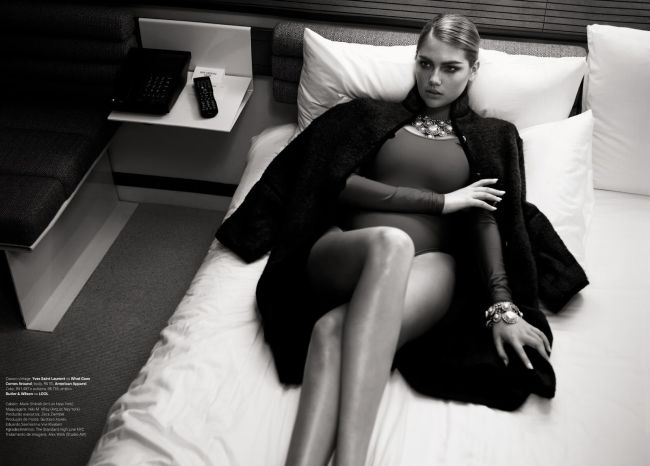
Kate Upton on Vogue Brasil July 2013: E o Novo Sexy
Henrique Gendre and Luis Fiod put Kate Upton on Vogue Brasil’s July 2013 cover in Miu Miu—a Brazilian newsstand thesis on “the new sexy.”
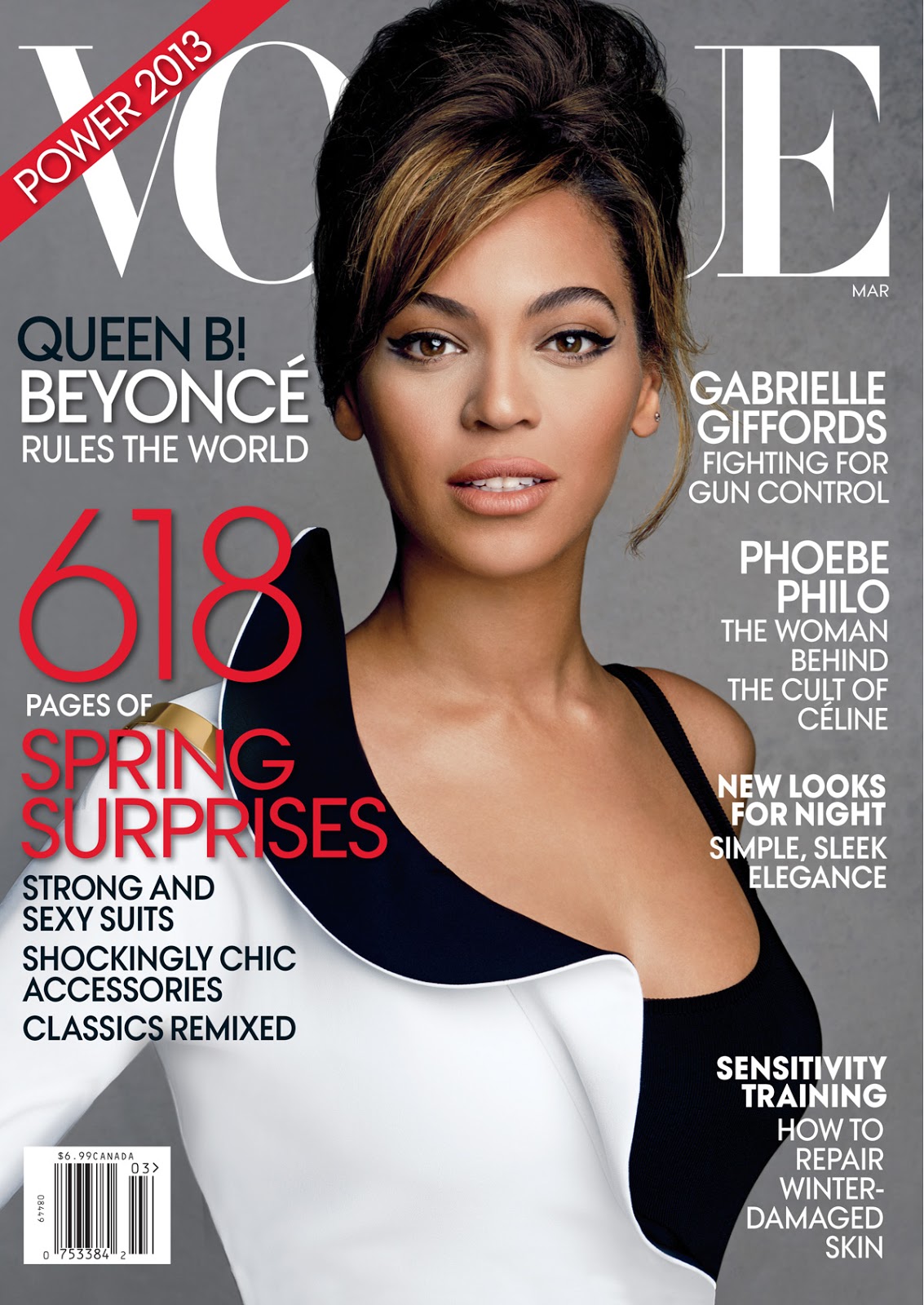
Beyoncé for Vogue US, March 2013 Power Issue
Beyoncé on the March 2013 Vogue US Power Issue—Patrick Demarchelier’s period editorial of fashion, control, and cover-star glamour.