
LEGO 10243 Parisian Restaurant: The Modular Bistro Set
Jamie Berard unveiled LEGO set 10243 Parisian Restaurant at BrickCon 2013—a 2,469-piece modular with restaurant, apartment, artist studio, and five minifigures.
Among adult LEGO builders, modular buildings occupy a special shelf: street-scale facades that connect stud-to-stud into a private city block. In October 2013, at BrickCon in Seattle, LEGO designer Jamie Berard unveiled the next chapter in that series—set 10243 Parisian Restaurant, scheduled for a January 2014 release. The announcement photos did what modular reveals always do: they made collectors zoom in on olive-green bricks, tiny croissants, window rhythms, and the promise of another evening of storytelling on a 32-stud footprint.
This is not a restaurant furnished with bricks inside a Paris dining room. It is a brick restaurant that aspires to feel Parisian—bistro bustle downstairs, lived-in rooms above, and enough food elements to stage a proposal scene between minifigures. Coverage from The Brothers Brick framed the drop as Exclusive / Creator Expert territory for builders sixteen and up: 2,469 pieces, five minifigures, and a price point (about US $159.99 at announcement) that signaled serious hobby more than children’s playset. Fan wikis and BrickLink inventories later preserved the same skeleton of facts for people who missed BrickCon entirely.
Three floors, three kinds of life
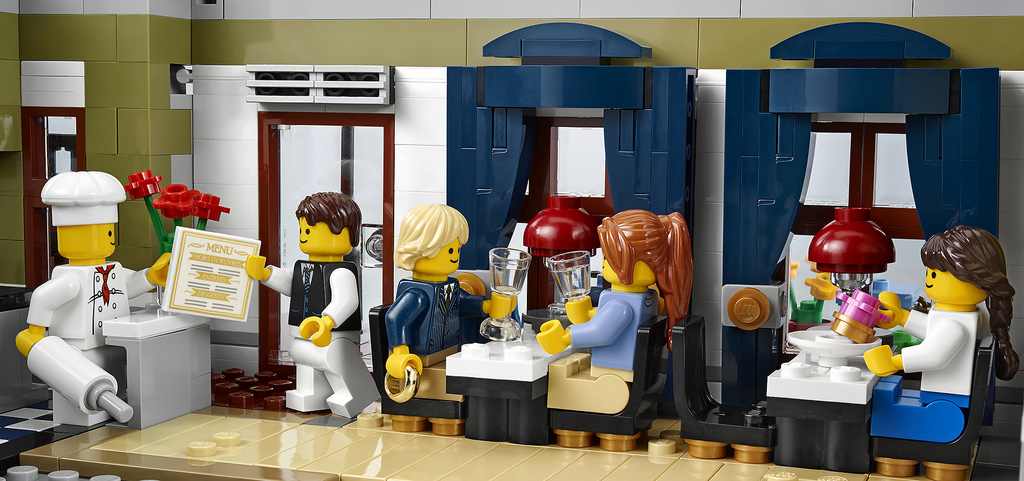
The building stacks functions the way a real Paris corner often does. Ground level holds the restaurant itself: tables, a waiter in motion, a chef working a blue-and-white tiled kitchen stocked with tableware. Official copy from the reveal leaned into comedy—scooter zipping past outside, nervous young man preparing to propose with a ring, kitchen chaos behind the swing door. LEGO modulars sell narrative as much as architecture; 10243 arrived with a ready-made vignette you could rebuild every time you dusted the shelf.
Above the dining room sits a cozy apartment with a pull-down bed, kitchenette, and fireplace—the kind of compact living that makes collectors invent backstories for minifigure tenants. Who sleeps there after the restaurant closes? Do they complain about noise from the terrace? The set never answers; it only supplies furniture that invites the questions. The top floor is an artist’s studio: cast-iron heater, easel, paintbrush, palette, and two artworks attributed to the aspiring resident. Stairs lead to a roof terrace with hanging lanterns and flowers for alfresco dining. Facade details push the Paris cue further: croissant and clam elements, feather flourishes, and accents in olive green, dark blue, and dark red that felt fresh in late-2013 parts palettes.
Food accessories are not afterthoughts. Inventory talk around the set listed croissants (including hard-to-find white ones), pie, cupcakes, grapes, hot dogs, turkey, cheese wedges, a milk carton, and colored bottles. For modular fans, those tiny edible shapes are currency. They photograph well, they populate tables, and they turn a display shelf into a scene instead of a silent facade. A restaurant without food elements is just a fancy box with windows; 10243 understood that and packed a pantry.
Where it sits in the modular line
By 2013 the modular series already had a loyal following who lined up Cafe Corner descendants along baseplates like a personal boulevard. Parisian Restaurant joined that conversation as a restaurant-forward corner with residential and creative space above—less a single-purpose shop, more a mixed-use slice of city. Builders compared cornice heights, sidewalk depths, and color blocking to earlier modules, asking the usual questions: Will the roof line match the neighbor? Do the sidewalks align without awkward gaps? How many rare parts land in the spare bag for future custom work?
Jamie Berard’s BrickCon presentation mattered culturally inside the hobby. Designer appearances turn a product drop into a shared event; attendees see the model in person, argue about techniques on the spot, and seed the first wave of online speculation before official shop pages go live. That social choreography—convention floor, camera phones, overnight blog posts—is how 10243 entered collector memory as much as through the later instruction booklet. The Brothers Brick write-up, Brickipedia entries, and fan unboxings formed a paper trail that still helps people identify the set from a single olive-green facade photo.
Minifigure roster details also traveled with the news: chef, waiter, girl, and a romantic couple, plus outdoor extras such as a scooter, dumpster, and trash can that make the rear alley feel as intentional as the street face. Modular collectors care about backs and sides because shelf cities are walked in the mind from every angle. A beautiful front with a hollow rear breaks immersion; Parisian Restaurant tried to keep the fiction intact around the corner.
What builders actually do with it
Some keep 10243 sealed as investment plastic. More open it, build once following the numbered bags, and park it permanently on a shelf city beside a town hall, a detective office, or a grand emporium. A third group rebuilds interiors, swaps colorways, or frankensteins the restaurant into a custom block with neighboring modules. The set rewards that range because its floors already suggest different hobbies: cooking play, domestic vignette, painter’s attic. You can photograph the terrace under a desk lamp and get something that reads as travel-postcard humor without leaving the apartment.
Advanced builders often study the facade’s parts usage—how SNOT (studs not on top) techniques create signage depth, how tile work sells café elegance, how the olive green breaks up darker masonry without turning the model into a toy rainbow. Those lessons migrate into MOCs (my own creations) that never use the set’s official name but still carry its mixed-use DNA. In that sense the Parisian Restaurant became both a finished product and a teaching object.
For collectors who arrived late, after retirement from retail, the set became a BrickLink hunt like other modular classics—complete boxes, missing food elements, or minifigure-only lots. That aftermarket life is part of why early unveil articles still matter: they freeze the moment when the restaurant was rumor-adjacent news rather than nostalgia inventory with fluctuating secondary-market prices.
A practical look checklist
- Facade: croissant and shell detailing, balcony depth, olive-green accents against darker masonry, street-level window rhythm.
- Kitchen: blue-and-white tile floor, counter clutter, chef clearances, tableware that reads at arm’s length.
- Apartment: pull-down bed mechanism, fireplace as focal point, kitchenette scaled for one or two minifigures.
- Studio: easel scene, heater, artworks that imply a character with unfinished canvases upstairs.
- Terrace: lanterns, flowers, sightlines down to the street vignette and scooter pass-by.
- Sidewalk and alley life: proposal staging, trash infrastructure at the rear, connection points for the next modular neighbor.
If you build for display, leave one table mid-service. Empty restaurants look like closed museums; a half-eaten pie and two facing chairs sell the fiction that the waiter just stepped into the kitchen. Keep the artist’s easel mid-painting rather than perfectly tidy. Modular cities feel alive when something is unfinished on purpose. That single habit—protecting a little mess inside a precise build—does more for atmosphere than any rare tile you can add later from the parts bin.

Comments
Continue reading

Legofied Best Picture Posters by Old Red Jalopy
Neil Robinson (Old Red Jalopy) reimagines 2014 Oscar Best Picture nominee posters as LEGO one-sheets—minifigure stars, brick sets, and poster craft intact.

Still-Life Photography by Margareth Perfoncio
São Paulo photographer Margareth Perfoncio’s still lifes of food and flowers—Old Master light, dark wood, and tables that feel inevitable.

Meaningful Love Quotes for Inspiration (and Ink)
Meaningful love quotes that still feel true — short lines for tattoos, gifts, and everyday reminders, with placement and wording tips.