
Models and Their Mothers: Howard Schatz’s Adult Double Portraits
Howard Schatz’s long-running studio series pairs working models with their mothers—adult faces, heredity, aging, and relationship under the same light.
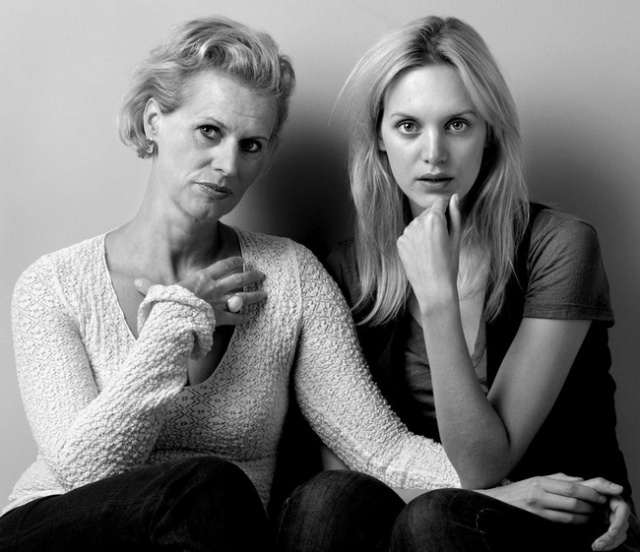
Fashion photography is full of solitary beauty: one face, one body, one mood controlled by stylists. Howard Schatz’s long-running series Models and Their Mothers does the opposite. In a New York studio, working with his wife and collaborator Beverly Ornstein, he photographs adult models beside the women who raised them—two generations sharing the frame, neither one treated as a prop for the other.
The project grew out of ordinary studio talk. Models arrived from everywhere for castings and commercial jobs; many were still in their teens or twenties, living far from home. When Schatz asked how they had landed in the city, mothers kept appearing in the answers—apartment hunting, paperwork, emotional ballast. He began inviting those visiting mothers into the portrait session. Over more than a decade he photographed hundreds of pairs, aiming not for a fashion lookbook but for a study of heredity, aging, and the uneasy intimacy that shows up when professional posing is asked to stop.
Adult daughters, not childhood nostalgia
These are not “before they were famous” snapshots. The daughters are working adults—faces already trained by the industry—standing next to mothers whose faces carry the same architecture softened by decades. The drama is lateral, not nostalgic. You are invited to compare cheekbones, jawlines, posture, and the quieter facts of how two people occupy space together now, not how one of them looked at age seven.
Schatz has said he asks the models to stop being “sexy fashion models” and simply be daughters. That instruction is harder than it sounds. Smiling on cue, angling a shoulder, holding the camera’s gaze—these are muscle memory. Dropping them leaves room for something less marketable: hesitation, protectiveness, rivalry, or the easy lean of people who still touch without thinking.
Some pairs hug and cannot keep their hands off each other. Others sit close but careful, as if an inch of air is a treaty. A few barely touch. The photographs treat all of those outcomes as information. Affection is not mandatory for the picture to succeed; honesty is.
What the double portrait reveals
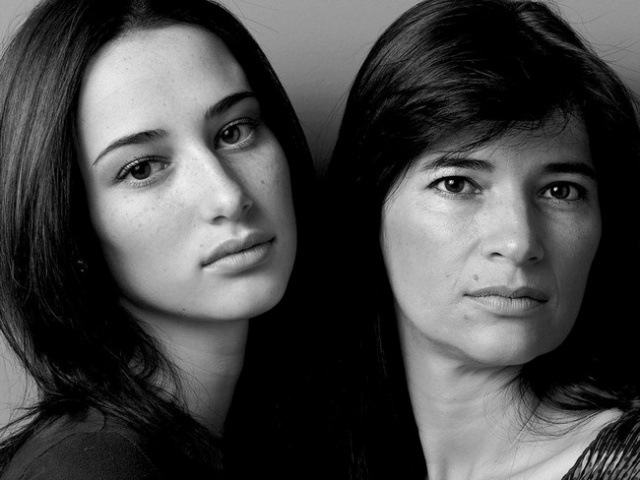
Viewers often respond first to resemblance—the uncanny sense of one face previewing another. Schatz has framed that reaction more sharply: for some people, especially men, the discomfort comes from seeing a glamorous young woman and, beside her, what looks like that same woman twenty to forty years later. Time becomes visible as a second body. Beauty is not erased; it is rewritten in skin, hair, and stance.
Relationship is the other subject. A mother who dresses like her daughter’s peer, a daughter who still seeks approval, a pair that presents as sisters—these dynamics show up in clothing choices, eye lines, and who leans toward whom. The studio is neutral; the choreography is not. When Schatz directs physical closeness, he is not staging a greeting-card moment so much as testing how the pair’s real grammar of touch survives under lights.
Aging is treated without cruelty. The mother’s face is not a punchline or a warning label. It is evidence that glamour photography’s usual erase-the-years habit is optional. Placing the two women as equals—same light, same frame, same dignity—makes the series feel closer to anthropological portraiture than to beauty advertising, even when both subjects are striking.
New York as the meeting ground
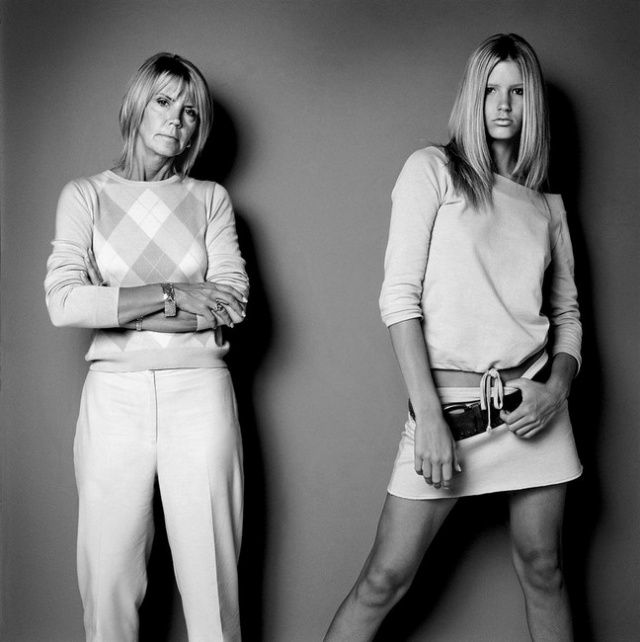
The city is the quiet third character. Models live there for work; mothers visit to check that life is safe, to cook, to sit in small apartments that still smell like ambition. Those visits create a narrow window when both generations are available for a session. The photographs freeze a temporary reunion that fashion culture rarely documents: the parent who helped launch a career standing beside the career itself.
Because the daughters come from many countries, the series also becomes a map of migration into fashion capitals. Faces and features travel; family ties stretch across oceans and still rearrange themselves for a few hours under studio softboxes. You can feel jet lag and jet-fueled pride in the same frame.
Schatz’s wider practice—athletes, underwater studies, commercial campaigns—often celebrates extreme physical control. Here the control is emotional. The craft is in lighting two people fairly, refusing to flatten the older face, and waiting past the first “good” professional expression until something private arrives.
How to look at these pictures
Start with hands. Are they linked, hovering, or occupied with clothing? Hands often tell the truth before faces do. Then check vertical alignment: who is taller in the crop, who claims more of the center, who turns toward the other. Fashion images usually center the paid talent; these portraits sometimes let the mother claim equal or greater visual weight, which is part of their charge.
Next, compare texture. Makeup on the daughter, softer or absent makeup on the mother, jewelry that matches or clashes—these details sketch class, culture, and how each woman wants to be seen that day. Finally, notice what is missing: no runway, no product, no celebrity caption required. The pair is enough.
If you know the industry only through campaigns and red carpets, the series can feel almost documentary. If you have parented or been parented through a public career, it can feel familiar in a way fashion magazines rarely allow. Either way, the photographs ask a simple question with complicated answers: what survives of family when one member’s face becomes a public product?
Why the series still matters
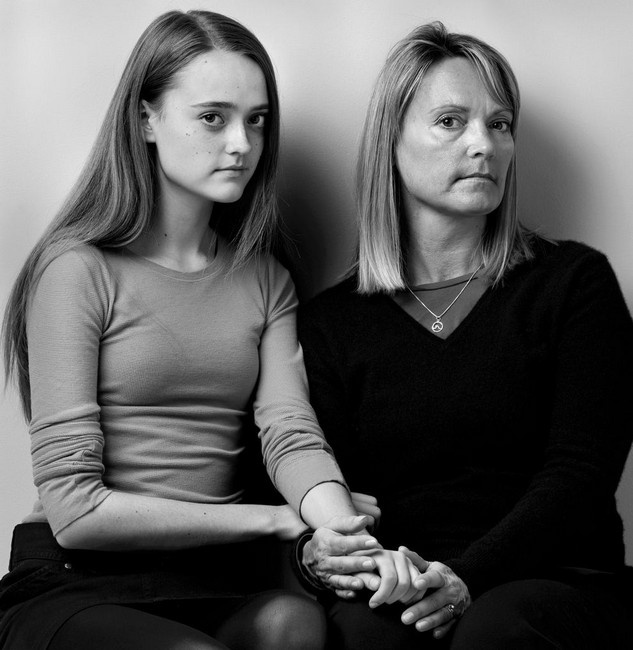
Beauty culture loves the myth of the self-made face. Schatz’s mothers undo that myth without speech. Genes, habits, and care are written across two timelines at once. The work also quietly argues that older women belong in serious portraiture—not only as supporting characters in their daughters’ origin stories, but as subjects whose presence completes the meaning of the younger face.
For photographers, the lesson is compositional and ethical: light both people as if both matter; do not use the mother as proof of the daughter’s genes alone; leave space for awkwardness. For viewers, the lesson is slower. Spend time with one pair until the novelty of resemblance fades. What remains is relationship under pressure—the pressure of a camera, of time, of a career that pulls a child into public life while a parent waits just outside the shot.
Look again at the last frame above. Whatever the exact names of the women, the structure is the same across the series: two adults, one shared history, a studio that refuses to hide age. That is the gallery’s real subject—not childhood recovered, but adulthood shared.

Comments
Continue reading

Stunning Photos by Aaron Groen
South Dakota photographer Aaron Groen’s Dark Places series finds drama in prairie weather, open roads, and light that refuses to flatter.

Dramatic Photo Art by Sukron Ma’mun (Ipoenk Graphic)
Cirebon, Indonesia photographer Sukron Ma’mun uses theatrical natural light to frame village life, play, and place in lyrical photo art.

Bird’s-Eye Views: Florian Beaudenon’s Instant Life
Paris photographer Florian Beaudenon’s Instant Life series captures people in their rooms from above—intimate, collaborative overhead portraits of everyday joy.