
Exploded Flowers by Fong Qi Wei: Blooms Disassembled into Radial Maps
Singapore photographer Fong Qi Wei carefully takes flowers apart and arranges every petal and disc on white—revealing how gerberas, roses, sunflowers and more are built.
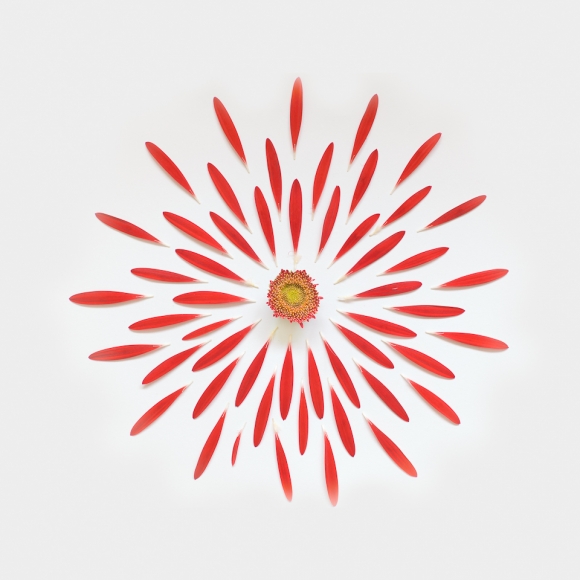
Singapore photographer Fong Qi Wei treats a flower the way an engineer treats a machine: take it apart, lay out every piece, and study how the whole was built. His series Exploded Flowers does not romanticize a vase arrangement. It freezes a bloom at the moment of careful disassembly—petals, disc, stamens, and other parts arranged on white paper so radial symmetry becomes visible as geometry, not metaphor.
The pictures look simple at a glance: one flower, one white field, one centered composition. Stay with them and the craft reveals itself. Each petal keeps its own curve and color. Spacing is deliberate. The “explosion” is not chaos; it is an inventory. Fong has said he hesitates to call the process dissection, because the aim is not a scientific treatise. It is appreciation—of how much surface a rose hides inside a tight bud, of how a sunflower’s disc behaves differently from a hydrangea’s cluster, of how photography can hold a state that lasts only hours before wilt and drying rewrite the specimen.
Disassembly as design, not destruction
Part of the series’ charge comes from a quiet influence: Todd McLellan’s Disassembly photographs of tools and gadgets taken apart and sorted. Fong borrows that clarifying impulse and applies it to living structure. A flower evolved for reproduction; its beauty is also engineering. When you see only the intact bloom, you experience a finished object. When you see the exploded layout, you experience the parts list—the radial logic that made the intact bloom possible.
That shift matters for how we look at botanical photography more broadly. Many flower pictures chase atmosphere: soft focus, dew, dramatic side light. Exploded Flowers chooses a flatter, almost catalog light. Shadows are soft. The background stays neutral. Nothing competes with color and silhouette. The result feels closer to a specimen plate than to a greeting card, yet it never becomes cold. The red of a gerbera or the layered pinks of a rose still carry sensual force; they simply share the frame with evidence of how those colors were packaged.
Fong has also noted a practical truth that any florist knows: flowers change overnight. Gerbera petals can dry after a single night of waiting. Photography, here, is not only an aesthetic choice. It is a race against dehydration. The neat rings you see are temporary architectures—arrangements that exist long enough to be recorded, then disappear as the materials stiffen or curl.
Reading the blooms in the gallery
Gerbera. The opening image is almost a diagram of the whole project. The disc sits dead center; ray florets radiate in concentric rings of increasing length. Against white, the red reads as graphic design as much as botany. You can count the expansion: small inner petals, longer outer ones, each pointing outward as if centrifugal force had been paused mid-spin.
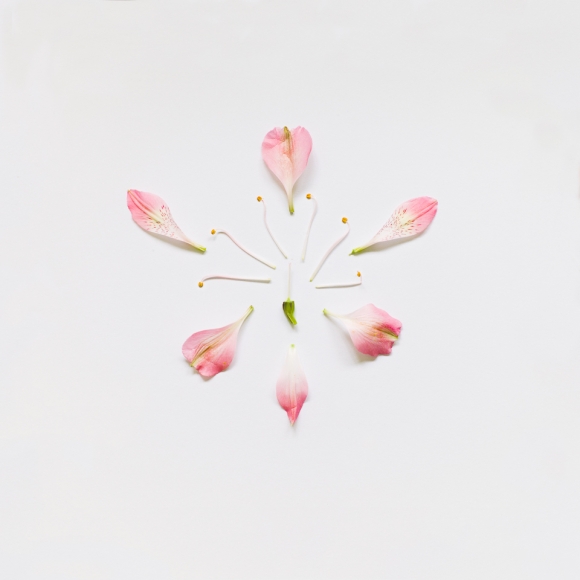
Peruvian lily. Where the gerbera is a flat starburst, the Peruvian lily (Alstroemeria) brings more complex petal shapes and speckled markings. Disassembled, those markings stop being a soft mottling and become distinct stamps on separate surfaces. The layout teaches you that “pattern” on a flower is often a collection of individual painted planes, not a single painted globe.
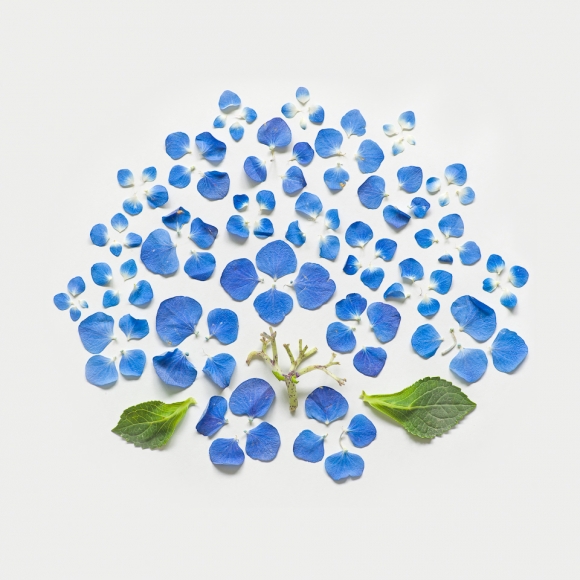
Hydrangea. A hydrangea head is already a crowd. Exploded, that crowd becomes legible: many small florets, each with its own modest architecture, suddenly granted personal space. The image can feel denser than a rose even when the original head looked softer and more informal. Volume in the intact bloom was a social illusion; the exploded plate shows how many citizens that society contained.
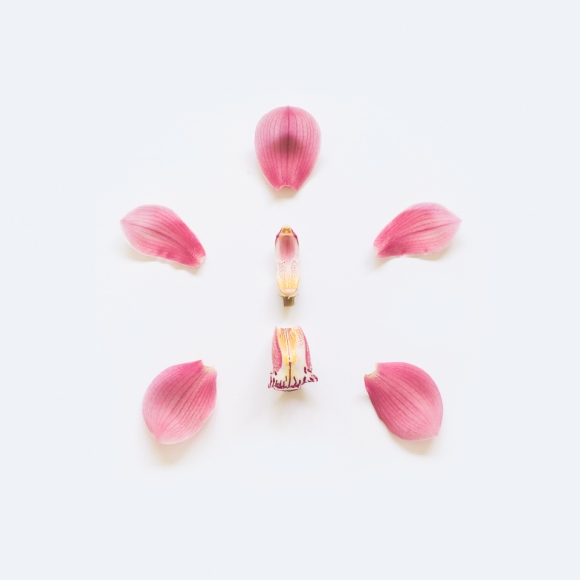
Orchid. Orchids refuse the easy radial story of a daisy. Their bilateral drama—labellum, column, asymmetric wings—survives disassembly as a different kind of map. Instead of a perfect wheel, you get a puzzle of specialized parts. Looking at the orchid plate after the gerbera is useful: it reminds you that “explosion” is a method, not a single geometric outcome.
Rose. Fong has pointed out that a rose’s relative surface area, once exploded, can feel larger than that of a sunflower, even though the intact sunflower is the bigger presence in a garden. The rose plate makes that claim visceral. Layer after layer of petals turns into a wide field of overlapping curves. What looked compact on the stem reveals itself as extravagant packaging—many surfaces folded into a tight spiral for display and protection.
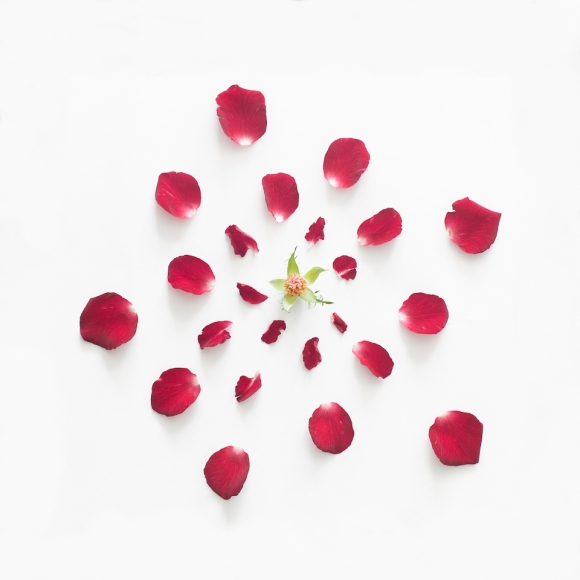
Pom-pom. Chrysanthemum-style pom-poms are explosions even before they are exploded. On the plate, the dense ball becomes a storm of short, repetitive units. Rhythm replaces drama. If the rose is about layered luxury, the pom-pom is about multiplicity—how many near-identical parts it takes to build a soft sphere.
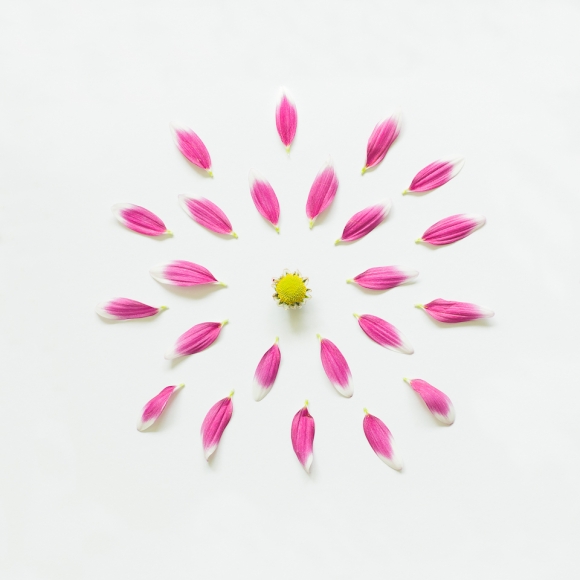
Sulfur cosmos. Cosmos petals are simpler, more graphic, often fewer in number. Exploded, they can look almost like a child’s sun drawing—clear rays, open center, generous white space. After denser flowers, the cosmos plate is a palate cleanser: proof that the series works with restraint as well as abundance.
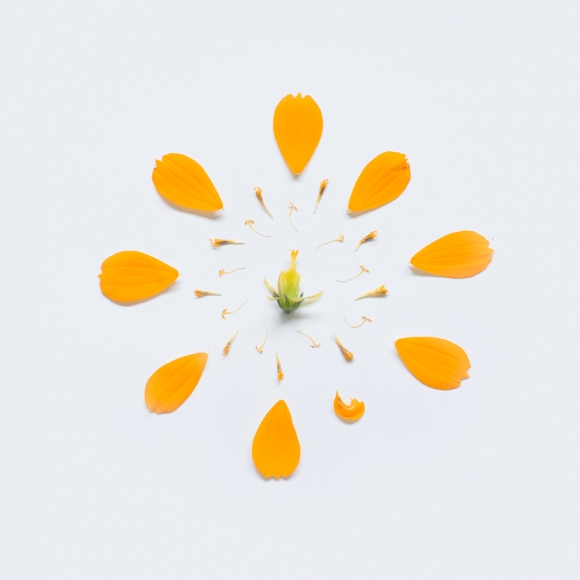
Sunflower. The sunflower is the series’ scale test. Intact, it dominates by diameter and by the authority of its disc. Exploded, the disc remains a powerful central object, but the surrounding petal field may feel less “expanded” than a rose’s. That counterintuitive comparison is one of Fong’s quiet jokes about perception: our eyes judge flowers by silhouette and cultural weight, not by unfolded area.
Why the white field matters
White is not empty here. It is a laboratory and a stage. It equalizes species so a street-market bloom and a florist’s prize specimen speak the same visual language. It also makes color absolute. Reds do not negotiate with a wooden table; yellows do not compete with foliage. The isolation can feel severe, even clinical, until you notice how tender the edges of petals remain under that scrutiny.
Compositionally, the centered radial layout invites a particular way of looking: start at the core, walk outward ring by ring, then jump between species to compare packing strategies. Viewers who like “before and after” puzzles will invent the missing intact flower in their heads. Viewers who like abstraction can ignore names entirely and treat the plates as mandalas made of perishable matter.
Context around the early 2010s
When design and photography sites circulated Exploded Flowers widely around 2011–2013, the series arrived into a culture already hungry for object taxonomies—things sorted by color, tools laid out like icons, food deconstructed for blogs. Fong’s version stood out because the objects were still alive, briefly, and because the layouts respected botanical individuality instead of forcing every specimen into the same template. Recognition followed, including strong placement in the International Photography Awards in 2012, but the pictures do not depend on award footnotes. They depend on the pleasure of seeing structure.
Fong Qi Wei’s broader practice—time-compressed cityscapes, botanical portraits, careful formal experiments—helps explain the patience on display. These are not casual phone macros. They are studio decisions: choose the bloom, open it without mangling narrative, arrange for clarity, photograph before the materials fail. The finished print is calm; the working process is a negotiation with wilting.
A short looking checklist
- Identify the center: disc, column, or cluster?
- Count rings or groups of parts before reading color.
- Ask what the intact flower looked like—tight spiral, open face, compound head?
- Compare surface area to your memory of the garden silhouette.
- Notice what the white space is doing: breathing room, or a frame that makes the flower feel larger than life?
Try that sequence on the gerbera first, then on the rose. If the rose suddenly feels “bigger” than the sunflower in your mind, the series has done its job. You have stopped seeing flowers only as finished symbols and started seeing them as assemblies—temporary, intricate, and, for one carefully lit hour, completely legible.

Comments
Continue reading
Liz Rusby and the Romantic Beauty of Nature
California photographer Liz Rusby’s soft-focus flowers and spring blossoms—intimate botanical romance without postcard syrup.

Dramatic Photo Art by Sukron Ma’mun (Ipoenk Graphic)
Cirebon, Indonesia photographer Sukron Ma’mun uses theatrical natural light to frame village life, play, and place in lyrical photo art.

Bird’s-Eye Views: Florian Beaudenon’s Instant Life
Paris photographer Florian Beaudenon’s Instant Life series captures people in their rooms from above—intimate, collaborative overhead portraits of everyday joy.