
Delicious Miniature Foods by Fairchildart
Hyper-realistic 1:12 polymer-clay dollhouse food by Fairchildart—charcuterie, seafood, burgers, breakfasts, sushi rings, and pecan pies small enough for a fingertip.
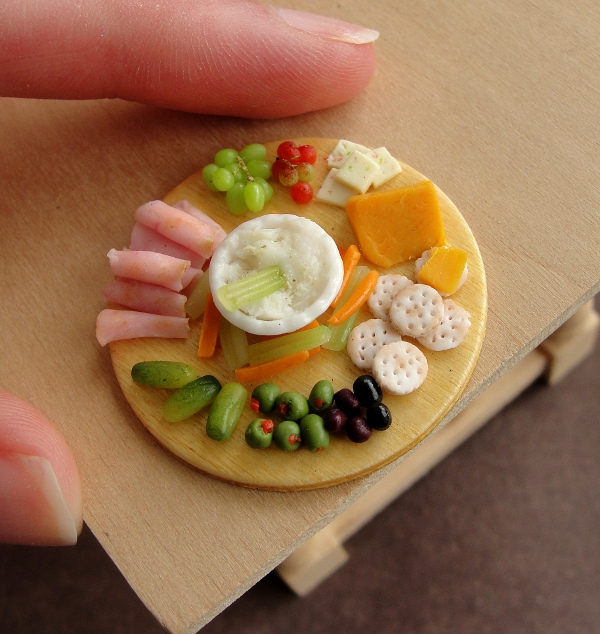
Dollhouse food only works when it fails the first glance. You lean in expecting plastic; you stay because the grape looks translucent, the cheese has a rind, and the burger bun has a toast line. The miniatures collected here come from Fairchildart—Kim’s polymer-clay practice at classic 1:12 dollhouse scale—where everyday meals are sculpted so carefully that a fingertip in the frame does most of the explaining.
She started in 2008 with polymer-clay tutorials and real-food reference photos, then settled into a specialty: edible-looking things that are entirely inedible. FIMO and Sculpey, translucent liquid clay, chalk pastels for blushing fruit and toasting pastry, clear varnish for glaze—those are the tools. Plates and boards are often store-bought dollhouse pieces; the food is handmade. The result is a table of snacks and dinners small enough to balance on a fingernail.
An appetizer platter is a stress test for a miniaturist. Rolled deli meat, cheddar wedges, herb-flecked white cheese, grape clusters, cornichons, stuffed olives, crackers with docking holes, and a white bowl of dip with carrot and celery sticks all have to read correctly at once. Soft grapes need translucency; crackers need matte dryness; meat needs thinness without looking like pink clay ribbons. A finger at the edge of the board reminds you the whole spread is roughly coin-sized.
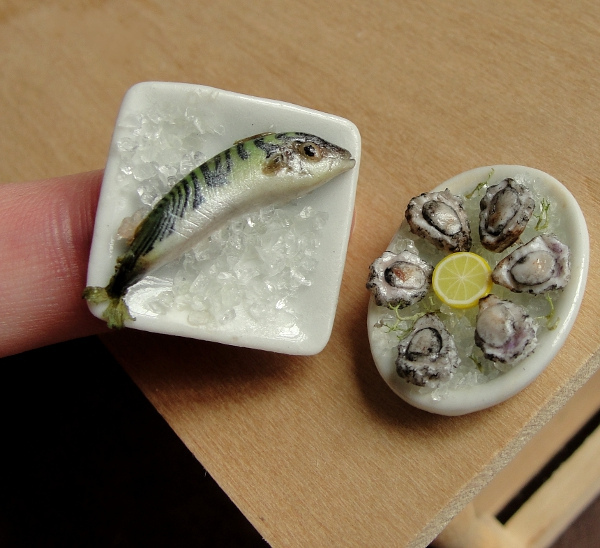
Seafood is harder because viewers know the real textures. A striped fish on crushed “ice,” and a ring of oysters around a lemon slice with dill-like sprigs, depend on color shifts and shell roughness more than on size alone. The ice reads as crystalline rather than sugary; the oyster meat stays pale and wet-looking without becoming glossy blob. Two plates side by side turn the scene into a tasting menu for ants.
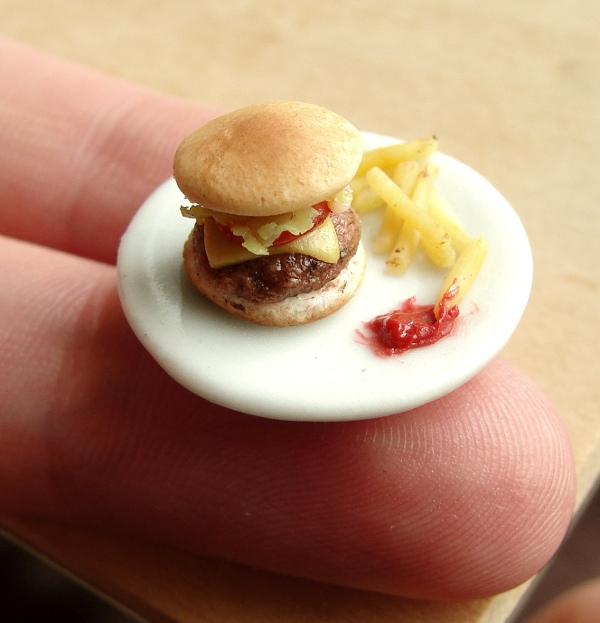
Fast food miniatures succeed when layers stay legible. Toasted bun, patty, cheese, tomato, onion—each strip has to survive being stacked at a scale where a fingerprint ridge is taller than the burger. Fries vary in length and browning so they do not look extruded from one mold. A ketchup smear gives the plate a lived-in diner energy that perfect symmetry would kill.
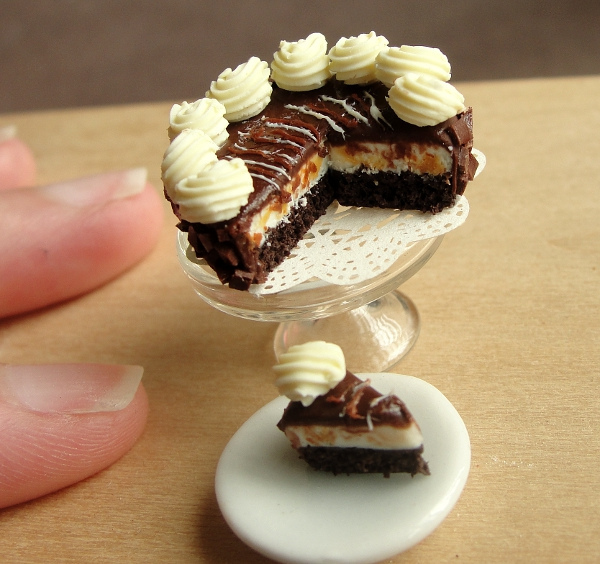
Cake is Fairchildart territory at its most theatrical: a doily, a stemmed glass stand, piped swirls, drizzle work, and a removed slice so the interior layers show. Chocolate crumb, pale filling, dark glaze—the cross-section is half the illusion. Without the cut, you might doubt the height. With it, the dessert becomes architecture.
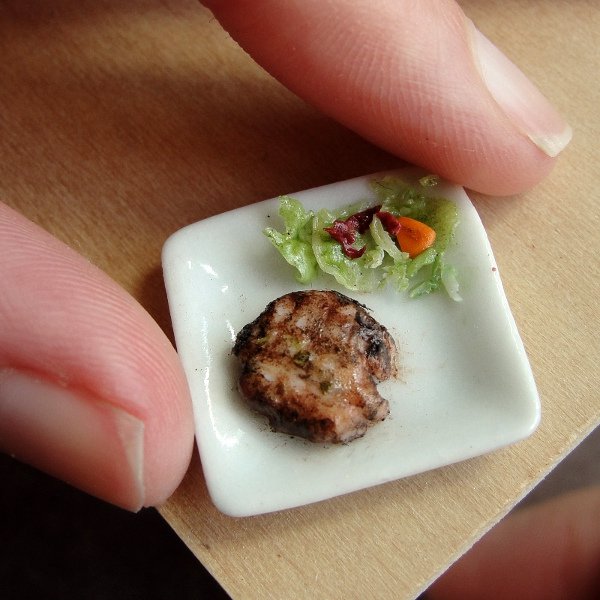
A grilled chop beside a shred of salad looks simple until you notice char marks and the crinkled lettuce bits. Savory browns are unforgiving; one wrong shade and “steak” becomes “fudge.” Pastels help toast edges and blush vegetables without painting opaque coats that kill depth.
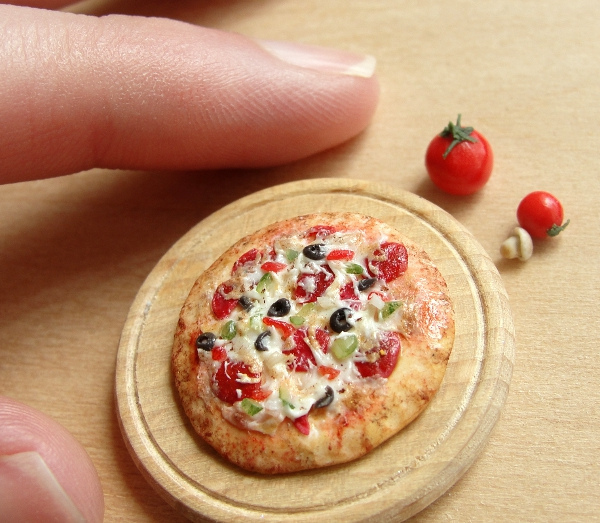
Pizza at this scale is a circle of decisions: crust browning, cheese melt sheen, pepperoni discs, olive rings, green pepper flecks. Nearby whole tomatoes and a mushroom slice act as scale keys and as proof that the sculptor can do produce as well as baked dough. The wooden serving board keeps the scene in dollhouse language rather than jewelry display.
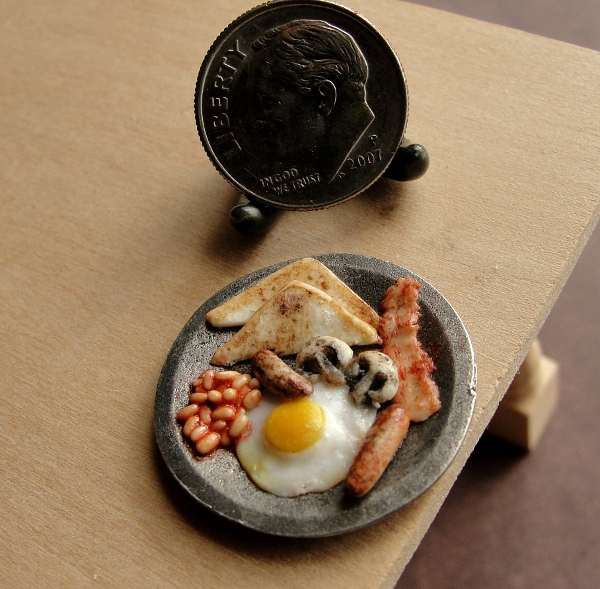
A full English breakfast on a dark plate—egg, toast triangles, beans, mushrooms, bacon, sausage—needs every item to stay distinct. The sunny-side yolk is the showpiece: glossy, centered, believable. A Roosevelt dime standing behind the plate turns admiration into measurement. Many miniaturists use coins for the same reason; Fairchildart’s breakfast earns the comparison.
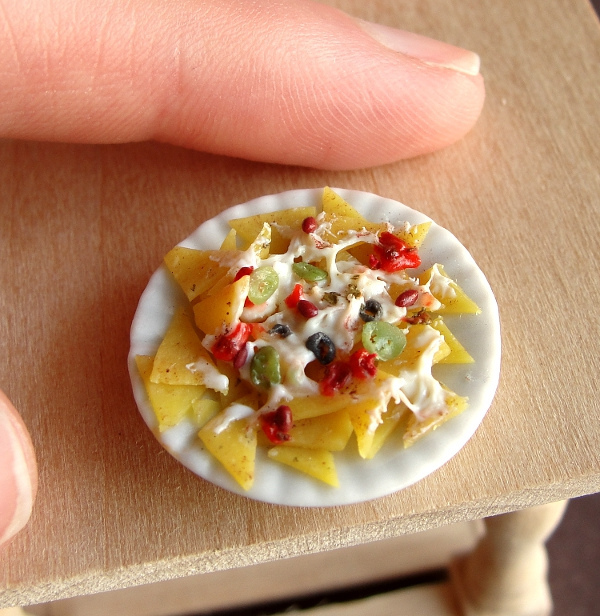
Nachos look chaotic at full size and must look carefully chaotic when tiny. Triangular chips, white cheese or crema, jalapeño rings, olive slices, and red bits only work if the pile has air and variety. A scalloped plate softens the composition so the snack feels festive rather than like rubble.
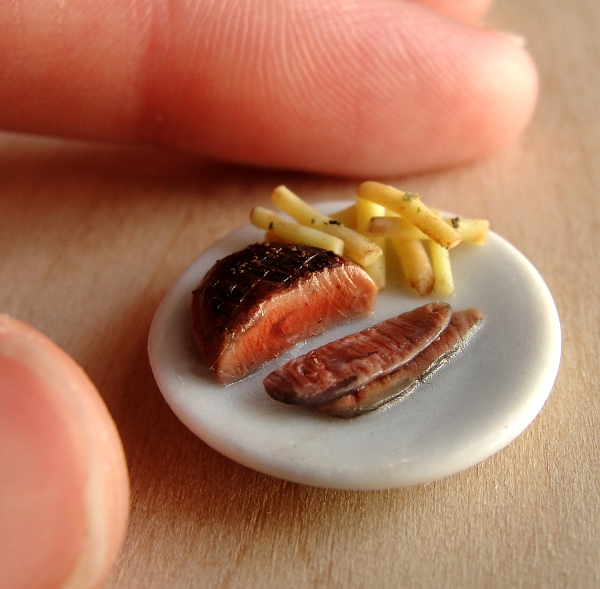
Cutting into a miniature steak is a flex. Medium-rare pink inside a seared crust, with two slices laid aside and fries for company, tells you the sculptor thought about interiors, not only silhouettes. That pink has to stay clay-solid while reading as juice. Fingers framing the plate keep the joke honest.
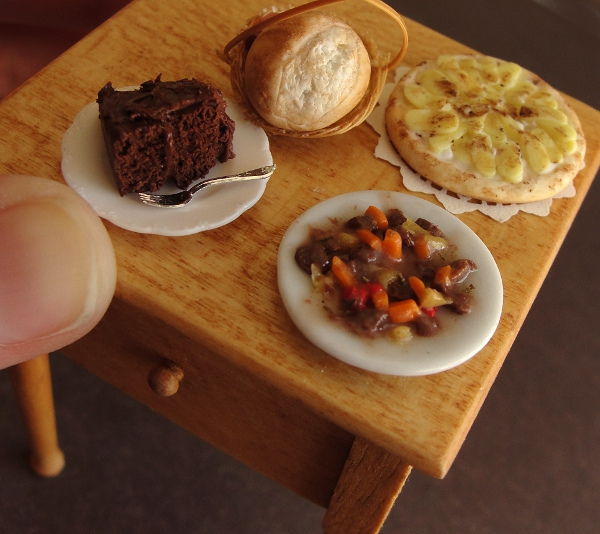
A miniature table with a drawer knob turns individual pieces into a room. Chocolate cake with a silver fork, a flour-dusted roll in a basket, a fruit tart on a doily, and a stew with carrot bits suggest a whole evening rather than a single prop. Context is half of dollhouse realism: food without furniture can look like a sample; food on a table looks like a life at reduced scale.
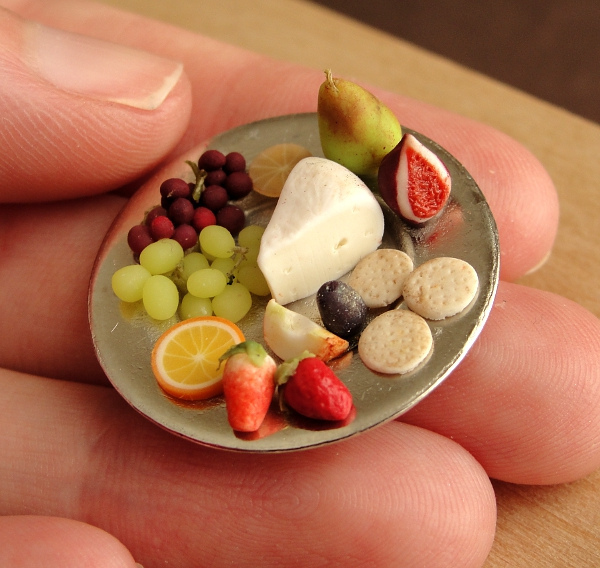
Cheese-and-fruit boards reward translucency and rind work. Brie with air holes, purple and green grape clusters, a halved fig with seed texture, a russeted pear, citrus slices, strawberries, crackers, an olive—the platter is a catalog of techniques. Held between fingers, it becomes wearable almost by accident: jewelry-adjacent craft without leaving the food genre.
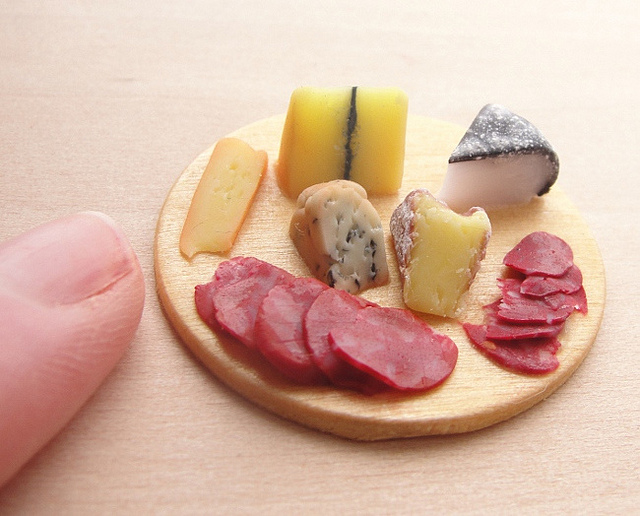
A second cheese board leans harder into rinds and veins: a lined Morbier-style block, blue cheese, orange cheddar, dusted white rind, salami folds that look thin enough to tear. Meat translucency is one of the hardest polymer-clay tricks; overlapping slices sell the illusion better than a single thick coin of “salami.”
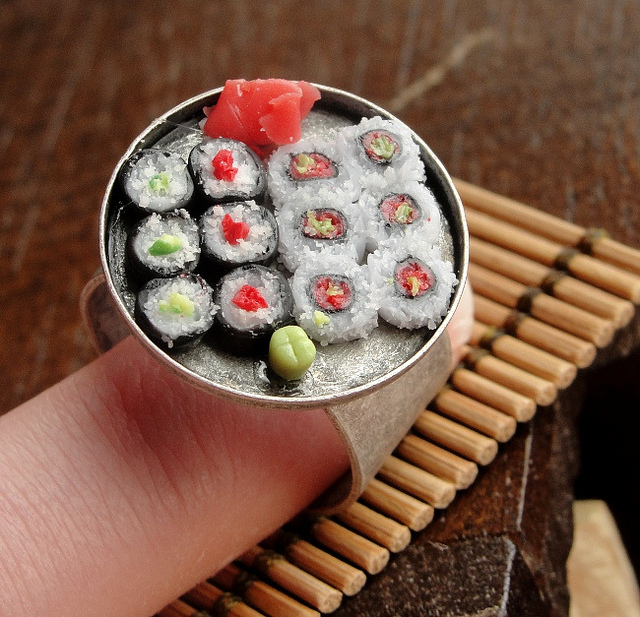
Sometimes the miniature leaves the dollhouse and becomes jewelry. A silver tray ring loaded with nori-wrapped rolls, rice-outside uramaki, pickled ginger, and wasabi sits on a bamboo mat while worn on a finger. The rice grain texture is the tell: if rice looks like white paint, the sushi fails. Here the granules hold.
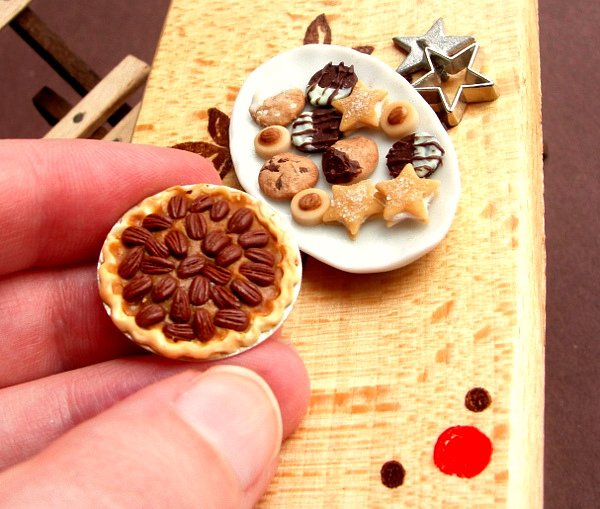
Baking miniatures close the set: a fluted pecan pie with concentric nut halves, plus a plate of star cookies, chocolate-dipped rounds, thumbprints, and a chip cookie beside star cutters. Pastry crusts and sugar textures are where chalk pastels earn their keep—toasting without opaque brown paint.
Why these miniatures still stop the scroll
Fairchildart’s work belongs to a wider miniatures community that trades tips on clay brands, varnish, and reference photography, then ships finished food across the world for dollhouses and collectors. The appeal is not nostalgia alone. It is the double take: hunger first, then the laugh when you remember nothing on the plate can be eaten. If you collect dollhouse kitchens, study how she stages scale—coin, finger, or miniature furniture—because scale is what turns skill into wonder. If you sculpt, notice how often she lets a cut edge, a halved fig, or a sliced steak prove the interior. Surfaces persuade; cross-sections convince.

Comments
Continue reading

Funny Animal Signs That Warn People (While Animals Ignore Them)
From a seagull on a no-birds disc to classic zoo and park ironies—why animal warning signs get funny, and what the rules are still for.
How to Find Local Amenities on Vacation: Mechanics, Haircuts & More
Locate trustworthy local services and everyday spots while traveling or settling in—using publications, reviews, map apps, neighbor tips, and low-pressure exploration.

Kristen Stewart for V Magazine, Spring Preview 2013
V81’s Wild at Heart cover story—Kristen Stewart shot by Inez & Vinoodh, styled by Joe McKenna, in pale minimal spring glamour.