
David Johnson’s Firework Fruits: Ottawa Long Exposures That Bloom
At Ottawa’s International Fireworks Show, photographer David Johnson refocused mid-exposure—turning bursts into volumetric shapes that look like fruit, flowers, and deep-sea creatures.
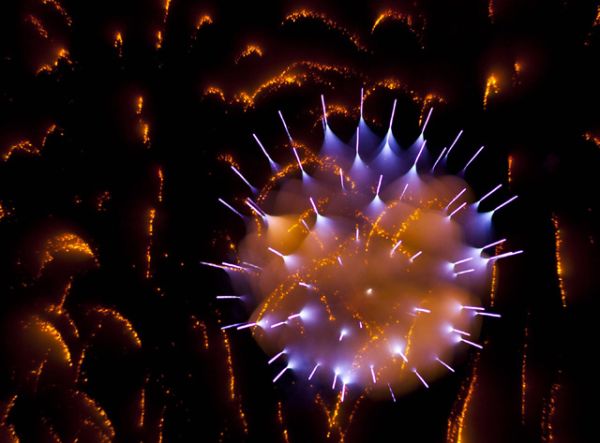
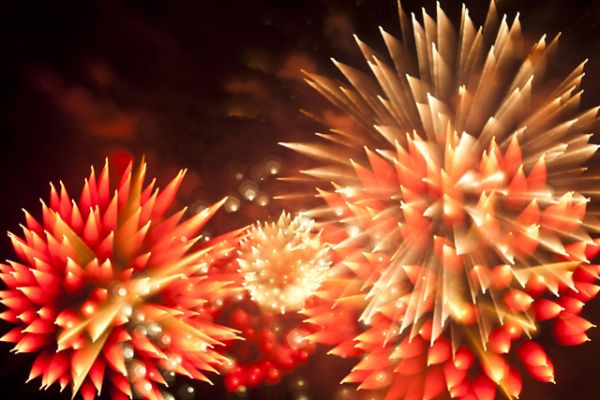
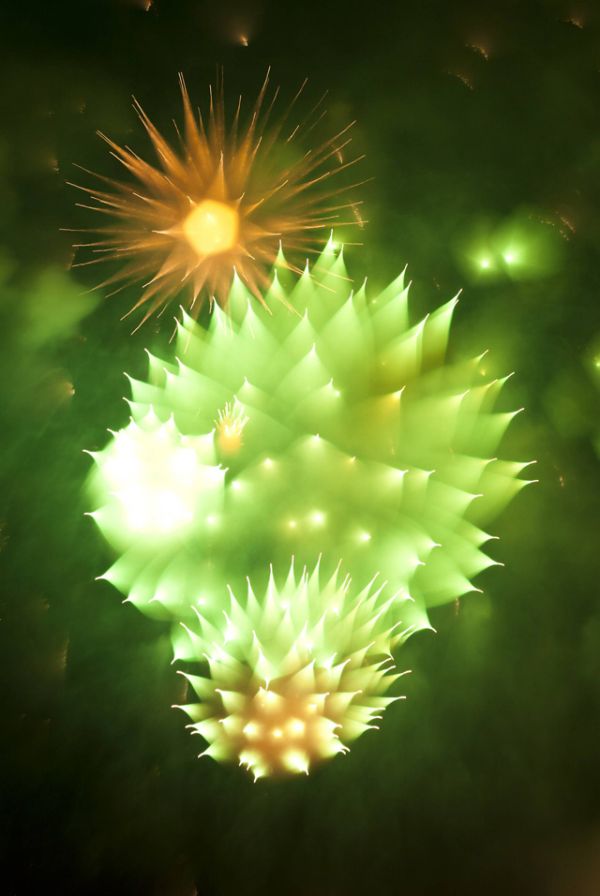
Most firework photographs look like the night itself: bright arcs, chrysanthemum bursts, and long-exposure ribbons scratched across a dark sky. Ottawa photographer David Johnson’s 2012 series does something stranger. In his frames, explosions thicken into rounded volumes—forms that read less like skywriting and more like fruit, flower heads, or deep-sea creatures hanging in black water. The trick is not a filter pack. It is a timing decision made with the focus ring while the shutter is still open.
Johnson made the pictures at Ottawa’s International Fireworks Show, experimenting during a Spanish performance when the usual long-exposure formula started to feel too familiar. Instead of locking focus and letting light paint clean trails, he began each exposure with the lens deliberately soft, then snapped focus toward sharpness as a shell burst. Over one or two seconds, out-of-focus color collapses into points. The “stems” and lobes that result are optical accidents with a consistent grammar—and they look deliciously wrong in the best way.
How the refocus technique works
Johnson later described the method in plain terms: each shot ran about a second, sometimes two; he started out of focus and, when he heard the explosion, quickly refocused so the soft blobs tightened into fine tips. That sequence is everything. While the shutter gathers light, changing focus remaps where each spark’s trail lands on the sensor. Soft focus spreads a spark into a disk or smear; racking toward infinity (or toward a chosen plane) draws that smear into a taper. Do it mid-burst and you get volume—cones, petals, pods—rather than the classic spiderwebs of fixed-focus firework photography.
The technique rewards anticipation more than pure luck. You listen for the mortar, watch the climb, and move the ring as the break begins. Too early and you sharpen empty sky. Too late and you only catch the fade. Because exposures are short by bulb standards, there is little room for hesitation. Manual focus control matters; autofocus hunting would ruin the gesture. A sturdy stance or tripod helps, but the expressive part is the hand that turns the ring.
Johnson’s own metaphors lean toward biology: deep-sea lookalikes, stems growing into points, bizarre shapes that surprised him even when he knew the method. Viewers reach for fruit and flowers just as often. Both readings make sense. Fireworks already borrow botanical names—peonies, willows, dahlias. His pictures push that metaphor until the sky feels harvested.

Why they read as fruit
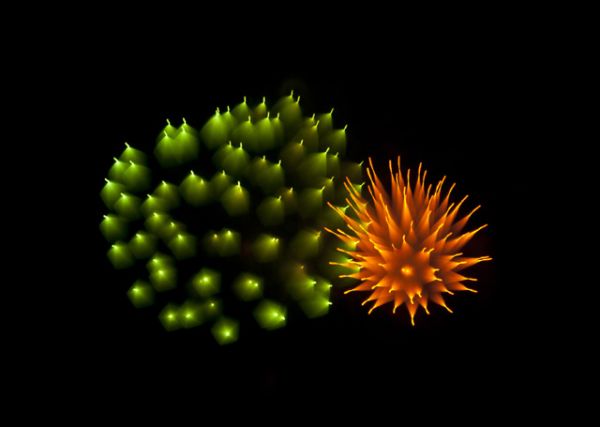
Fixed-focus firework photos emphasize trajectory. You see where sparks went. Johnson’s images emphasize mass. Soft light at the start of the exposure builds a swollen body; the later sharp focus adds tips, seeds, or whiskers. Color blocks sit against black like produce on velvet. A magenta lobe with a pointed tip can look like a dragonfruit slice. A gold burst with tapering filaments can look like a rambutan or a sea urchin made of sparks. The brain, hungry for categories, supplies the grocery aisle.
That misrecognition is part of the pleasure. You know you are looking at a public fireworks show in Ottawa. You also cannot stop seeing orchard and aquarium. The photographs sit in the sweet spot where process is understandable and effect remains slightly unbelievable—the same zone that made the set travel quickly through photography blogs in August 2012.
Ottawa, August, and a show within a show
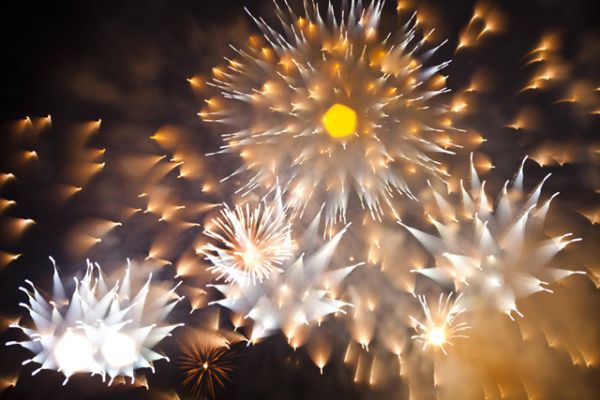
Context helps. Ottawa’s international competition format means multiple national teams present choreographed displays. Johnson’s experiment during the Spanish segment was not a studio setup with controlled charges. It was street-level (or park-level) photography under real show conditions: wind, timing gaps, overlapping bursts, and the social pressure of a crowd looking up. Choosing to “tinker” in that environment is a photographer’s habit—curiosity interrupting documentation.
Johnson’s broader practice includes wedding, event, and lifestyle work. That background may explain the instinct to treat a fireworks night as a chance for a fresh formal problem rather than a checklist of classic skyline-plus-burst compositions. Event photographers live by contingency. When contingency becomes method, you get series like this: a night’s worth of variations on one risky idea.
What the pictures teach about looking
Beyond novelty, the series is a lesson in how little of a photograph’s character is settled by subject alone. Fireworks are among the most photographed subjects on Earth. Everyone knows the cliché. Changing one variable—when focus happens—rewrites the genre without abandoning the subject. That is a useful reminder for anyone stuck shooting familiar events: invent a constraint, then obey it long enough to get a set, not a single lucky frame.
It is also a reminder that “abstract” photography often still depends on recognizable light sources. These images are abstract in silhouette and strangely concrete in origin. You can almost hear the boom that triggered each refocus. The black background is not conceptual emptiness; it is summer night above a river city, temporarily hosting a competition of pyrotechnicians.
If you try a version yourself
You do not need Johnson’s exact results to borrow the principle. A practical checklist for a first attempt:
- Use manual focus and a lens you can rack quickly without hunting for a switch.
- Start with exposures around one to two seconds; adjust for how bright the shells are.
- Begin soft, then move toward sharp as the burst opens—not before the climb, not after the fade.
- Expect a high failure rate. Keep shooting through awkward frames until the gesture becomes muscle memory.
- Review for volume, not for “clean” trails. If it looks like every other firework photo, the refocus may have been too subtle or too late.
- Watch your highlights. Bright cores can blow out while edges stay interesting; expose for the glow you want to keep.
Safety and courtesy still apply. Do not block sightlines, and do not treat a public show as a private laboratory that inconveniences everyone else. The best experiments remain invisible to the crowd and obvious only later, on the camera’s screen.
Why the set still sticks
Years later, firework tutorials still cite refocus and defocus methods, including notes Johnson himself shared about starting soft so sparks bloom before they tighten. The internet loved the pictures because they offered instant metaphor—fruit! sea creatures!—and because the explanation was simple enough to retell without killing the magic. That combination is rare. Many process-heavy photographs collapse once you know the trick. These keep their strangeness after the trick is public.
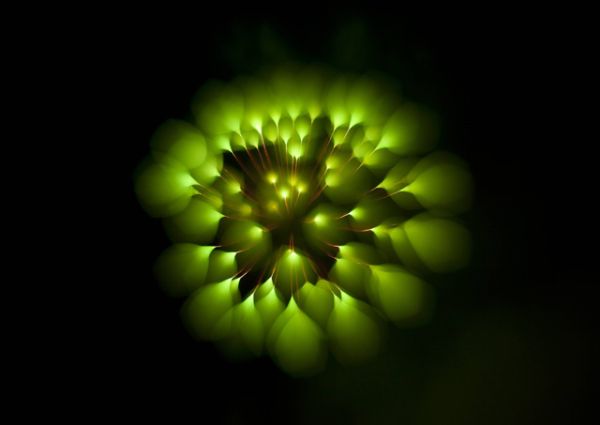
Look again at the tall frame in the set, the one that feels almost botanical from crown to stem. Then look at a rounder burst that sits like a single piece of glowing produce. Same night, same city, same photographer, different turns of a ring. The International Fireworks Show gave Johnson color and timing. His hand gave the color a body. Between those two gifts, ordinary celebration photography briefly became a still-life genre written in sparks—harvested from the Ottawa sky one second at a time.

Comments
Continue reading

Dramatic Photo Art by Sukron Ma’mun (Ipoenk Graphic)
Cirebon, Indonesia photographer Sukron Ma’mun uses theatrical natural light to frame village life, play, and place in lyrical photo art.

Bird’s-Eye Views: Florian Beaudenon’s Instant Life
Paris photographer Florian Beaudenon’s Instant Life series captures people in their rooms from above—intimate, collaborative overhead portraits of everyday joy.
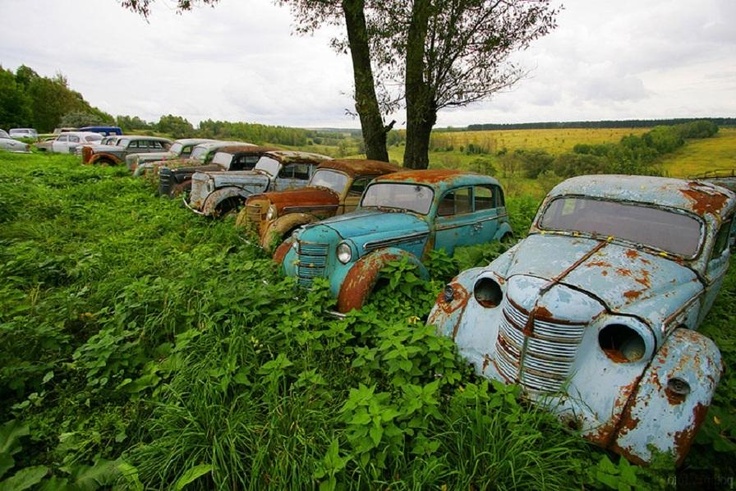
Abandoned Cars Reclaimed by Nature: Rust, Growth, and Quiet Ruin
When neglected vehicles are left outdoors long enough, rust, moss, and trees rewrite them into strange still lifes—sad, photogenic, and slowly returning to the ground.