
Olek’s Crocheted Locomotive in Łódź, Poland
In July 2013, artist Olek wrapped a four-car locomotive in technicolor crochet—a homecoming yarn-bomb she nicknamed Deadly Romance.
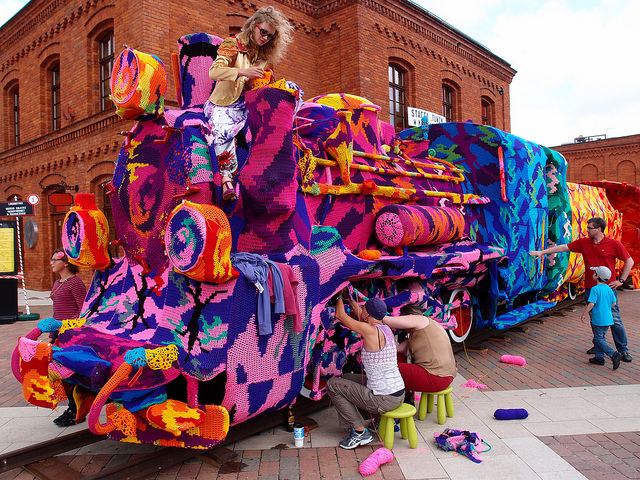
In July 2013, a four-car locomotive in Łódź, Poland, stopped looking like industrial scrap and started looking like a knitted fever dream. Polish-born, New York–based artist Olek (Agata Oleksiak) covered the train in her signature technicolor camouflage crochet—row after row of yarn stretched across steel until the machine read as soft, loud, and slightly impossible. She later nicknamed the piece “Deadly Romance,” a title that fits an object she said she loved and that nearly exhausted her.
A homecoming in yarn
Olek’s work has long treated crochet as both armor and announcement. She has wrapped apartments, bodies, playground equipment, and public monuments in dense handmade fabric, turning a craft associated with quiet domestic skill into a public-scale interruption. Returning to Poland for a locomotive-sized piece carried extra charge. The artist grew up in industrial Silesia and has spoken about leaving that close-minded industrial world for a practice that brings color, energy, and surprise into living space. Covering a train in Łódź—another city shaped by factories and rails—put that biography back on track, literally.
The timing was brutal. Olek has described flying from London’s Animal Ball (still in costume from the night before) to Poland on July 10 to meet a crew of four assistants. Installation ran around the clock, including rain. Contemporary reports place the debut around July 13, with the work remaining on public view through August 19, 2013. Two days of hanging and fitting crocheted skins over a multi-car train is not a metaphor for dedication; it is the schedule.
What the crochet is doing
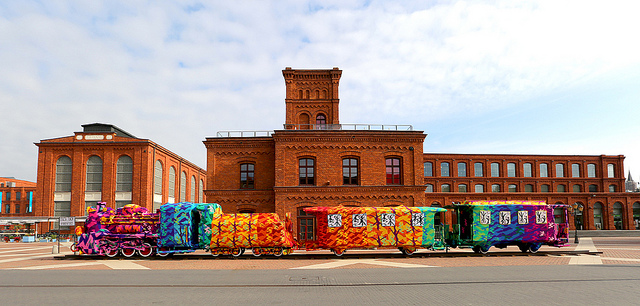
Yarn bombing often aims for charm: a cozy tree trunk, a cheerful bike rack. Olek’s locomotive uses some of that surprise while aiming higher. Camouflage patterns usually hide military machines; her rainbow camo does the opposite, making the train impossible to ignore. The soft surface also argues with the train’s purpose. Rails and freight imply speed, weight, and utility. Crochet implies patience, touch, and time measured in loops. Put together, they create a temporary monument to labor—both industrial and handmade.
Scale matters. A beanie can be finished during a film. A locomotive cannot. Assistants become collaborators by necessity, and the finished object depends on logistics as much as aesthetics: how panels join, how wind and weather behave, how the public approaches something that still looks like a train and suddenly feels like a plush sculpture. Photographs from the installation show the work’s density—almost no bare metal left to remind you of the original machine’s severity.
Olek’s own language for the work
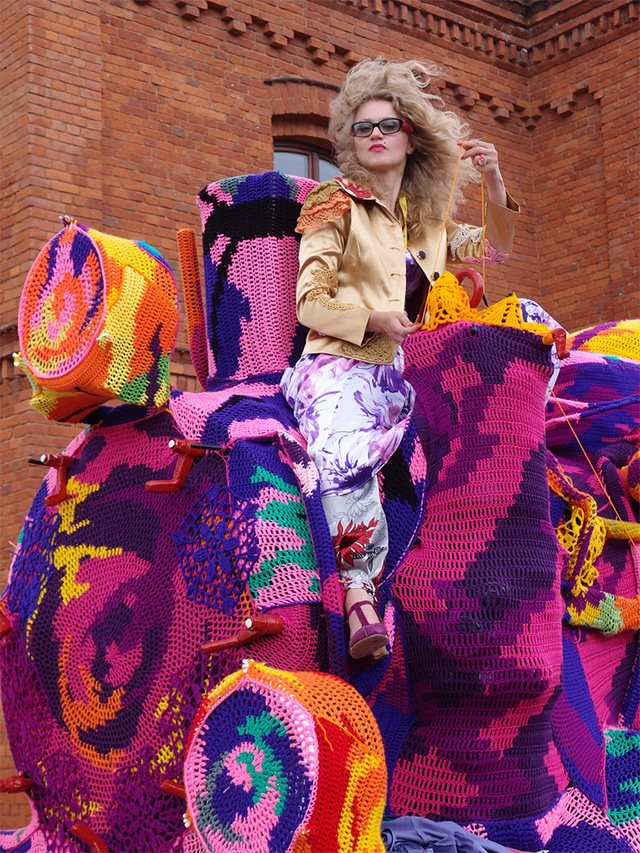
Olek has explained her practice in loops and hours: madness becoming crochet; life and art refusing to separate; movies watched while working feeding the work, and the work choosing the next film. She crochets what enters her space—messages, medical reports, found objects—and she remains aware of unraveling, the ephemeral side of fiber that never lets her forget how limited an art object’s life can be. “What do I intend to reveal?” she asks in one statement. “You have to pull the end of the yarn and unravel the story behind the crochet.”
That self-description fits the Łódź train unusually well. The story is not only “artist covers big object.” It is a Polish artist returning home with a New York street-art vocabulary; a crew working through weather; a nickname that admits love and damage in the same breath. After the install she joked about needing a plane—or the moon—as the next canvas, which is both bravado and a real question about how public crochet scales once a locomotive has already been done.
Why a train, and why then
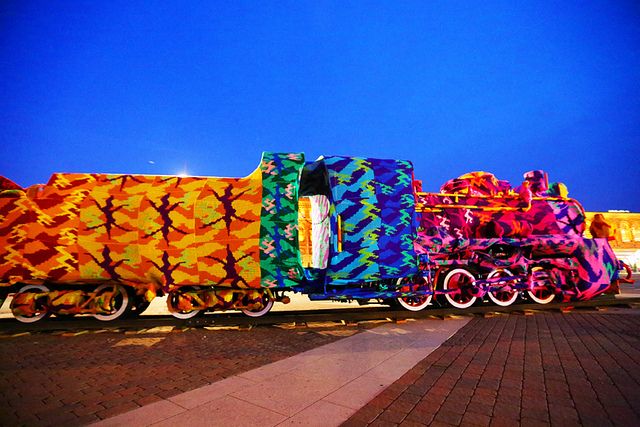
2013 was a prolific stretch for Olek: international travel, gallery shows, and outdoor projects stacked tightly. The locomotive arrives in that year as a climax of size rather than a one-off stunt. Earlier yarn interventions had already proven she could claim sidewalks and parks; the train claimed a symbol of national and industrial identity. In Poland, locomotives are not neutral props. They carry histories of movement, labor, war, and modernization. Wrapping one in handmade color does not erase those histories—it dresses them so passersby have to look again.
Public fiber work is also fragile. Weather, vandalism, and municipal timelines all shorten a piece’s life. Olek has dealt with vandalism of her work in Poland before; the locomotive’s scheduled summer display window already assumed the piece would not be permanent. Ephemerality is not a bug in her thinking—it is part of the medium’s honesty. Crochet can be cut, burned, soaked, or carefully stored. Either way, it reminds viewers that even hard machines can wear a temporary skin.
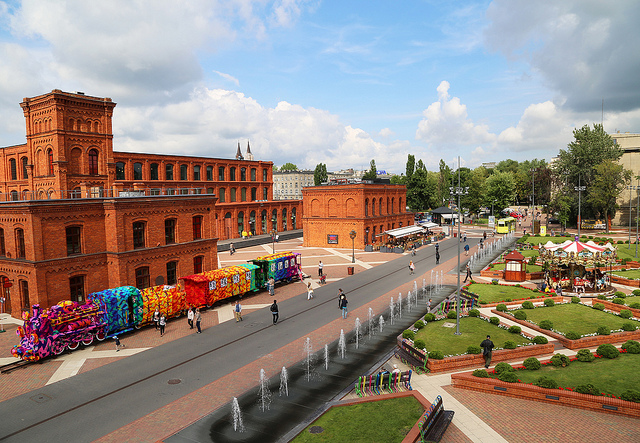
How to look at the photographs
Start with silhouette. From a distance the train still reads as train: length, wheels, linked cars. Then notice where the pattern breaks the metal’s logic—windows softened, edges blurred by stitches, color fields that refuse industrial gray. Look for human scale: assistants, visitors, or the artist’s body against the cars. Those figures prove the absurd amount of handwork involved. Finally, notice weather and light. Rain during install and summer sun during display are part of the piece’s biography, not just background conditions.
If you make fiber art yourself, the Łódź locomotive is less a tutorial than a permission slip for ambition. Techniques stay familiar—hook, yarn, joins—while the substrate becomes architecture. Planning panels, managing a crew, negotiating a site, and accepting a short public life are as much the craft as the stitch pattern.
Place in a larger practice
Olek’s statements often mention studying the science of culture and approaching investigation with a miner’s work ethic—digging deeper rather than polishing a single cute gesture. Living in New York’s many neighborhoods, she has said she wants her actions to answer economic and social reality, not only decorate it. The Polish locomotive sits at an interesting intersection of those aims: spectacular enough for international art blogs, local enough to function as a homecoming, handmade enough to keep the politics of labor visible in every loop.
Years later, the images still do what the best yarn interventions do. They make a familiar machine strange. They celebrate skill without pretending the work was effortless. And they leave a clear imprint of a particular summer in Łódź, when a train wore crochet like a second identity and the artist called that relationship a deadly romance—devotion mixed with exhaustion, pride mixed with the urge to look away and then look back.
Stand with the last photograph a moment longer than you need to. Ask what object in your own city would look transformed—not merely covered—if someone spent two sleepless days wrapping it in color by hand.

Comments
Continue reading
Olek’s Crochet on San Francisco’s Doggie Diner Heads
In 2013, artist Olek wrapped John Law’s iconic Doggie Diner heads in crochet—yarn, civic mascots, and a roaming San Francisco installation.

Still-Life Photography by Margareth Perfoncio
São Paulo photographer Margareth Perfoncio’s still lifes of food and flowers—Old Master light, dark wood, and tables that feel inevitable.
Meaningful Love Quotes for Inspiration (and Ink)
Meaningful love quotes that still feel true — short lines for tattoos, gifts, and everyday reminders, with placement and wording tips.