
Celebrity Hedcuts by Noli Novak: Likeness in Dots and Lines
Wall Street Journal illustrator Noli Novak’s celebrity hedcuts turn famous faces into stipple-and-hatch portraits built for recognition.
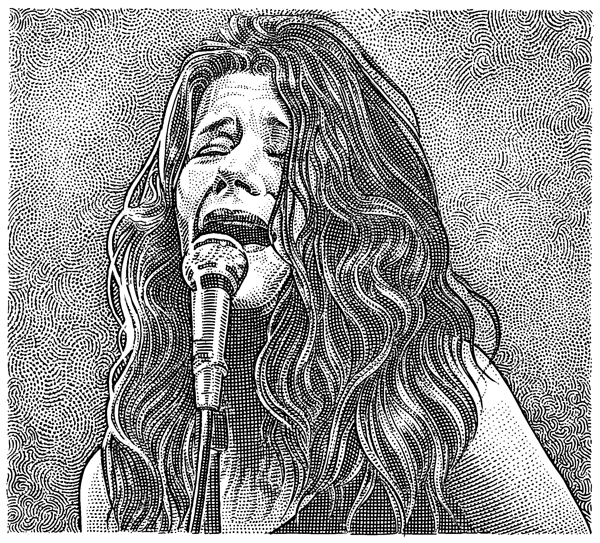
Noli Novak draws faces the way a newspaper once needed them drawn: with patience, ink, and a resemblance strong enough to survive cheap paper and fast scanning. As a long-time illustrator associated with The Wall Street Journal, she works in the paper’s famous hedcut style—portraits built from stipple dots and fine hatching that echo old woodcuts, certificate engravings, and the engraved look of currency. For private and editorial clients, she has also turned that same discipline toward celebrity likenesses, where the test is simple and unforgiving: does the person still look like themselves when every shade has been translated into marks?
This page gathers a run of those celebrity hedcuts and the idea behind them. The drawings are not painterly soft-focus tributes. They are graphic translations. Hair becomes pattern. A smile becomes a decision about which lines to keep. Eyes have to carry recognition without the luxury of photographic blur.
What a hedcut is
In newsroom slang, “hed” is headline. A hedcut is the small portrait that often sat with a story—literally a “headline cut.” At the Journal, staff artists developed a house style that readers still recognize instantly: black-and-white faces made of countless tiny dots and short strokes, designed to print cleanly and to feel continuous with the paper’s typographic seriousness.
Technically, the method leans on stippling (density of dots to suggest value) and hatching (clusters of lines to build shadow and contour). Cross-hatching deepens form; open areas become light. There is rarely a continuous outline that “colors in.” The face emerges from accumulation. That is why hedcuts reward close looking: from a distance they read as a portrait; up close they dissolve into craft.
The style also carries a cultural temperature. It suggests authority, permanence, and a slight remove from glossy celebrity photography. When that language is applied to musicians, actors, scientists, and politicians, the effect can feel like a wry promotion—fame rendered in the visual dialect of finance and reportage.
Novak’s approach to likeness
Novak has described capturing resemblance as the central problem, and celebrity work makes that problem public. Viewers already know the face. They arrive with a mental average of angles, expressions, and iconic features. A hedcut cannot hide behind atmosphere or color grade. If the spacing of the eyes is wrong, or if a signature smile collapses into a generic grin, the drawing fails in a way everyone can name.
Working from reference photographs is standard for this kind of illustration. The artist chooses a source that already holds useful information—clear lighting, a readable three-quarter turn, hair that explains the silhouette—then rebuilds the face mark by mark. The photograph is evidence; the hedcut is interpretation. Choosing what to emphasize is half the job: a musician’s wild hair, an economist’s glasses, a broadcaster’s familiar half-smile.
Since joining the Journal as a graphic illustrator in the late 1980s, Novak has produced a vast body of hedcut work for the paper and for outside commissions. Over time she has also helped the technique travel from pure newsprint constraints into cleaner digital reproduction, without abandoning the handmade look that makes the brand’s portraits feel physical.
Celebrities in ink
The set associated with this gallery ranges widely: musicians such as Janis Joplin, Sting, and Questlove; actors including Michael Douglas, Benicio del Toro, John Leguizamo, Daryl Hannah, and Christopher Guest; public figures from Neil deGrasse Tyson and Alan Greenspan to Barack Obama, Hillary Clinton, and Hamid Karzai; media personalities such as Cynthia McFadden, Arianna Huffington, Christiane Amanpour, Lesley Stahl, Kelly Ripa, Conan O’Brien, and Bill Maher; fashion and culture figures including Cindy Crawford, Karl Lagerfeld, Cynthia Rowley, and Salvatore Ferragamo; plus names like Steve Jobs, Larry Page, Michael Bloomberg, Rupert Murdoch, Bear Grylls, John Waters, Mindy Kaling, Penn and Teller, and others.
That mix is part of the interest. Hedcuts are often imagined as sober portraits of CEOs and policymakers. Celebrity commissions pull the same technique into entertainment without abandoning its graphic rules. Joplin’s intensity has to survive as pattern. Obama’s widely reproduced features have to remain specific. A comedian’s expression has to stay funny after being turned into dots.
Grouped sheets in the series—pairs and grids—also show how hedcuts behave as a system. When several faces share the same mark language, differences in hair, bone structure, and expression become easier to compare. The medium equalizes glamour lighting; what remains is likeness and character.
Why the style still feels modern
In an era of infinite photographic resolution, a labor-intensive black-and-white drawing can look strangely contemporary. It refuses the default of the phone camera. It announces that a human hand spent time deciding where shadow lives. For brands and publications, that labor reads as care. For viewers tired of interchangeable retouched portraits, it offers a different kind of clarity.
Hedcuts also age well in layout. They sit beside typography without competing the way a full-color photo might. They reduce a famous face to information dense enough for a column and elegant enough for a wall. That dual usefulness—editorial tool and collectible likeness—explains why artists like Novak keep receiving requests long after the first newspaper applications.
There is a training dimension too. Because the style is house-specific and exacting, experienced practitioners become stewards of a visual dialect. Teaching and refining the method means protecting consistency: how dark a cheek can go before it muddies in print, how much detail hair can hold before it turns into noise, how to keep a smile from becoming a cartoon.
How to look at these portraits
Start with recognition. Who is it at first glance? Then move closer in your mind’s eye and ask which features carry the likeness—eyebrow shape, the set of the mouth, the hairline, a habitual tilt of the head. Notice how much information is withheld. Hedcuts often omit the soft gradients photography loves; they replace them with rhythm.
Compare two faces from different fields. A scientist and a pop star, drawn in the same grammar, can reveal how much of “celebrity” is costume and how much is structural. The ink does not care about red-carpet hierarchies. It cares about planes of the face.
If you draw, try a small experiment: take a clear headshot and translate only the darkest darks into clusters of dots, leaving large areas of paper white. You will feel immediately why hedcuts demand patience. Density mistakes are hard to undo. Resemblance is earned slowly.
Where the work lives
Novak’s celebrity hedcuts have circulated as portfolio pieces and commissions alongside her staff work for the Journal. Readers who know the paper’s daily portraits already understand the visual contract; seeing familiar public figures treated with the same severity is half the pleasure. The other half is craft pride—counting, almost, the labor inside a cheekbone.
For anyone collecting or commissioning portrait illustration, the hedcut asks a useful question up front: do you want a likeness that flatters like a photograph, or a likeness that declares itself as drawing? Novak’s celebrity pieces argue for the second path without losing the subject. That balance—newspaper discipline meeting famous faces—is what these portraits are for.
Look again at Joplin’s hedcut if you return to only one image. The hair alone is a study in controlled chaos: enough wildness to feel like Joplin, enough pattern to remain printable. That is the hedcut’s quiet boast. It can hold a storm of personality inside a vocabulary of dots.

Comments
Continue reading

Still-Life Photography by Margareth Perfoncio
São Paulo photographer Margareth Perfoncio’s still lifes of food and flowers—Old Master light, dark wood, and tables that feel inevitable.
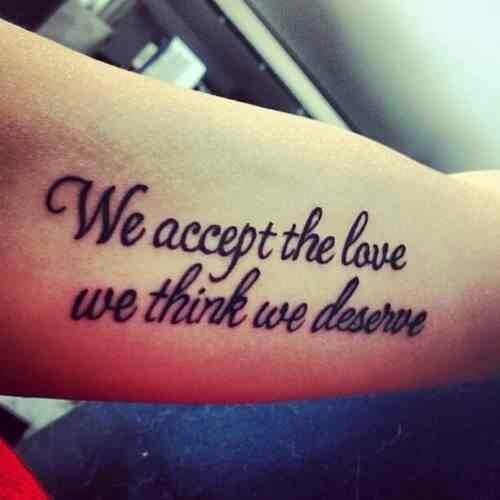
Meaningful Love Quotes for Inspiration (and Ink)
Meaningful love quotes that still feel true — short lines for tattoos, gifts, and everyday reminders, with placement and wording tips.
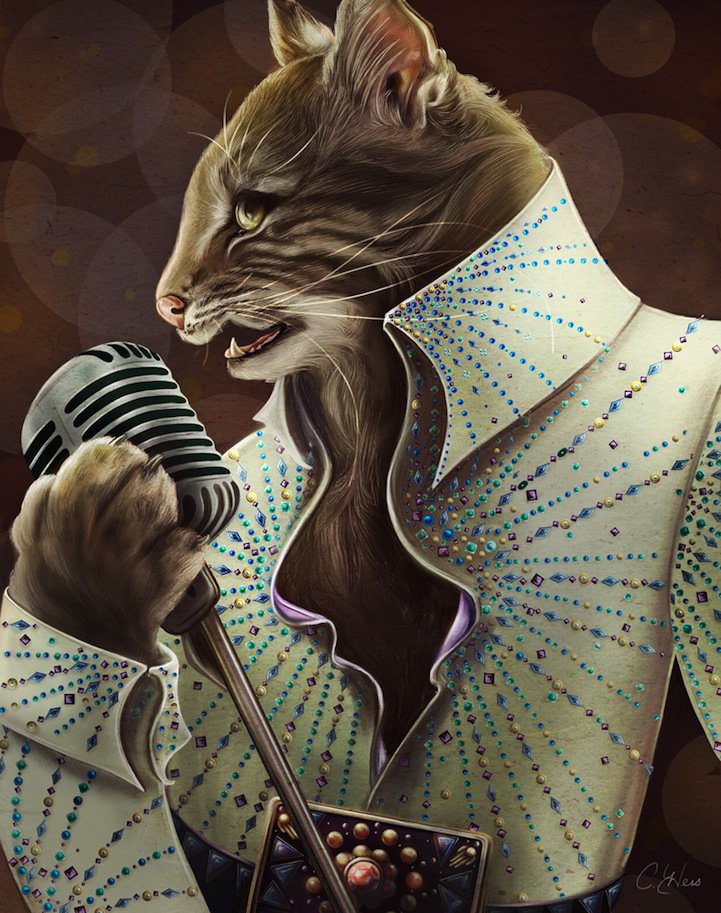
Christina Hess’s Animals From History: Costumed Pets as Playful Portraits
Illustrator Christina Hess reimagines historical icons as ornate animal portraits—Elvis Petme and friends—mixing puns, costume detail, and soft history lessons.