
Brilliant Decorative Pillow Ideas for Sofas, Daybeds, and Reading Corners
How to mix color, pattern, texture, and size in decorative pillows—plus styling formulas, care tips, and lessons from a maximalist white-sofa arrangement.
Late afternoon, a pile of books, a breeze at the window, and a soft, plump pillow—sometimes that is the whole mood of a room. Decorative pillows do the quiet work of turning a sofa, daybed, or reading chair from furniture into a place you want to land. They bring color without painting walls, pattern without committing to new upholstery, and comfort without rearranging the floor plan.
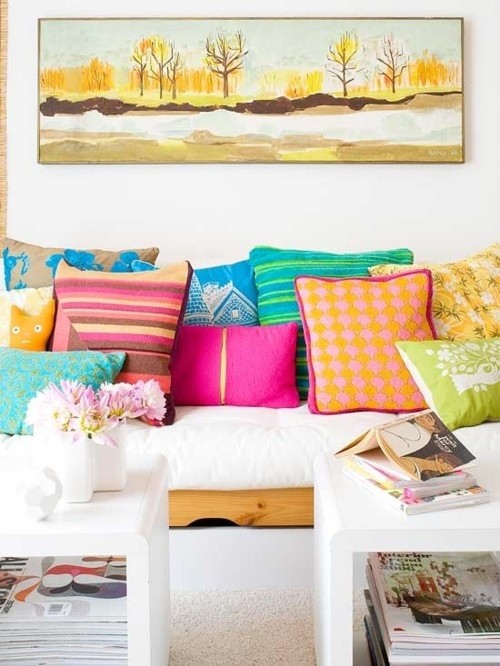
The arrangement below shows how far a white base can go when pillows are allowed to be loud: stripes, geometrics, graphic sketches, solids, and even a playful cat-shaped cushion stacked until the seat looks generous rather than sparse. The lesson is not “buy twenty pillows.” It is that variety, scaled thoughtfully, can sit on a calm frame without tipping into chaos.
Notice what makes this mix work. The furniture and wall stay pale, so pinks, turquoises, yellows, greens, and oranges can compete safely. Patterns differ in scale: wide stripes, small geometrics, illustrative motifs, and quiet solids take turns leading. A few odd shapes break the grid of squares. Artwork above and simple side tables keep the pillows from becoming the only story in the room.
Start with the frame, not the fabric
Before shopping for covers, decide what the pillows must do. On a deep sofa, they should invite lounging and fill empty corners. On a slim modern couch, fewer pieces with cleaner silhouettes look sharper. On a bed, shams and throw pillows layer in rows. On a window seat or daybed like the one pictured, a generous pile is the point—this is seating meant to be nested into.
Measure width and depth. A love seat usually wants three pillows; a standard three-seater often wants five; a long sectional can take more if you leave clear landing spots for sitting. Catalogs love matched pairs at each end. Real rooms often look better with odd counts and slight asymmetry, as if the pillows were gathered over time.
A practical mixing formula
Designers lean on simple recipes so pattern mixing does not stall. One reliable approach is solid + texture + pattern. Another is large-scale print + small-scale print + solid or textured quiet piece. Keep the palette to three or four related colors pulled from something already in the room—a painting, rug, throw, or book spine—so new pillows feel connected rather than random.
Size layering matters as much as print. Place larger squares (about 22–24 inches) toward the back or corners, mid-size squares (about 20 inches) in front, and a lumbar rectangle in the center or as a front accent. Inserts should usually run about two inches larger than the cover for a plump look; underfilled pillows make even expensive fabric look tired.
Texture is the secret when you want calm color. Linen against velvet, chunky knit against smooth cotton, a bit of embroidery against a flat weave—these contrasts photograph and feel richer than five different loud prints fighting for attention.
Color strategies for different rooms
On white or cream upholstery, saturated pillows are an easy win. Hot pink, turquoise, mustard, and forest green can coexist if you repeat each color at least twice so nothing feels like a one-off accident. On gray sofas, try dusty blue, mustard, and cream, or stay monochrome with heavy texture. On beige or camel, olive, rust, and natural linen tones warm the seat without shouting.
If the rest of the room is already patterned—busy wallpaper, a loud rug—let pillows go quieter: tonal florals, textured solids, thin stripes. If the room is minimal, pillows can carry more graphic risk: architectural sketches, bold geometrics, a single novelty shape for humor.
Seasonal rotation is kinder to your budget than full redesigns. Keep a core of neutrals year-round; swap two or three covers for warmer weaves in autumn and lighter cottons or brighter accents in spring. Store off-season covers clean and dry, zipped or buttoned so dust stays out.
Pattern mixing without the headache
Choose one lead pattern—the loudest or largest motif. Support it with a quieter pattern at roughly half the visual scale, sharing at least one color. Fill the rest with solids and textures. Three patterns is usually the ceiling before a sofa starts to look restless.
Stripes are peacemakers: they bridge florals and geometrics because the eye reads them as structure. Illustrative pillows (a house sketch, a tree graphic) act like small artworks; give them breathing room beside quieter neighbors. Novelty shapes—animals, oversized buttons, sculptural forms—work best as singles. Two novelty pillows often cancel each other’s charm.
Comfort and care, not only looks
Decorative does not have to mean untouchable. If people actually lean on the sofa, choose durable weaves for the front-most pillows and save delicate silks or heavy embellishment for pieces that stay more visual. Removable covers with zippers make washing realistic. Down and feather inserts feel luxurious but need occasional fluffing; synthetic inserts hold shape with less maintenance and suit allergy-sensitive homes.
Watch the edges. Piping, flanges, and knife edges change the silhouette. Piped pillows look tailored; flange edges soften a formal sofa; knife edges keep a modern line. Mix edge styles deliberately rather than accidentally collecting whatever was on sale.
Styling the pile
For a balanced sofa, try two large solids in the corners, two patterned mid-sizes inward, and one lumbar in front. For a plush look closer to the photo, stack more pieces but still vary size so the eye can travel. Karate-chop styling—a soft center dent—is optional; some prefer a rounder loft. Either way, fluff after guests leave; collapsed pillows make a room look neglected overnight.
Coordinate with nearby surfaces. A stack of books, a vase of flowers, and a simple table—as in the image—ground a colorful pillow story so it feels lived-in rather than staged for a catalog alone. Let one pillow color echo something on the table or in the artwork for a quiet thread.
When you edit, remove before you add. If the seat no longer invites sitting, you have too many pillows, no matter how beautiful each one is. Keep a clear spot wide enough for a person, then rebuild the arrangement around that human-sized gap. The best decorative pillow ideas still leave room for the afternoon, the books, and the breeze.

Comments
Continue reading

Garden Decoration Beyond Beds: Lace, Mosaiculture, and Upcycled Yard Art
From dressed topiary and floral cyclists to license-plate dragonflies and lace between trees—garden decorations that give a yard a voice.
Kitchen Design Ideas: Layout, Storage, Light, and Finishes That Work
Practical kitchen design ideas—work zones, cabinetry, lighting, and durable finishes—so inspiration translates into rooms that cook and gather well.
25 Cool Room Partition Ideas That Actually Divide Space
From frosted sliders and pallet screens to book towers and branch walls—twenty-five ways to carve rooms without building solid walls.