
Black and White Photography by Guy Cohen
Jerusalem photographer Guy Cohen’s high-contrast black-and-white work—shadows, light, and surreal street atmospheres from his early-2010s portfolio.
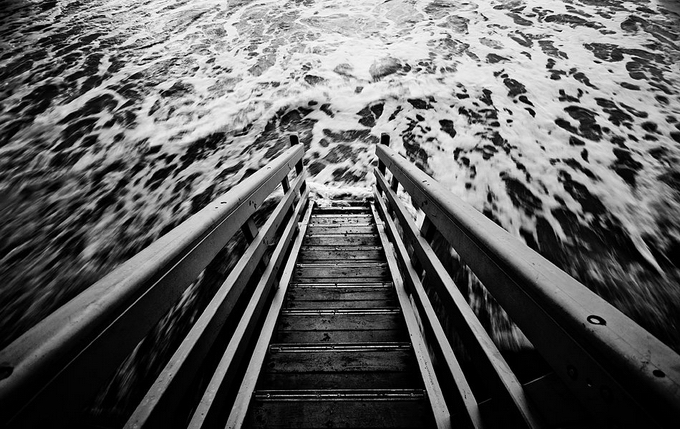
Guy Cohen came to wider online attention in the early 2010s as a young Jerusalem-based photographer with a gift for brooding monochrome. At the time he was often introduced as a photography student in his mid-twenties and as an editor connected with the online photography magazine Composition. He traveled around Israel and farther afield, chasing scenes where light, shadow, and perspective do more narrative work than bright color ever could.
What made his pictures stick was not only technical contrast. Cohen built atmospheres—sometimes surreal, sometimes quiet—where ordinary streets and figures felt slightly rewritten. Black and white, for him, was a way to put light back at the center of attention.
A young photographer’s monochrome world
In interviews from that period, Cohen described photographing for years—since his mid-teens—and wanting viewers to notice a “magical” layer of everyday life: things always present but rarely examined. He spoke of wanting people to feel something specific when they looked at a frame, to wonder rather than simply recognize.
Jerusalem and other Israeli locations gave him strong raw material: hard sun, pale stone, deep doorways, and the graphic clarity of shadows at certain hours. Travel widened the palette of architectures and skies, but the through-line stayed consistent—high-contrast black and white, careful framing, and a preference for mood over snapshot cheer.
His work circulated on platforms such as 500px and in photography blogs that favored striking single images. In that ecosystem, a coherent personal language mattered. Cohen’s language was shadow-first.
Shadows with a living soul
One of Cohen’s best-known approaches was to treat shadows as primary subjects. Instead of only photographing passersby as solid bodies, he often emphasized the dark shapes they cast—sometimes flipping or otherwise transforming the relationship between figure and ground so the shadow world felt upright and inhabited. He described giving shadows a living soul: flattening identifying details of face and clothing into black form, then using black and white to blur the border between the “real” standing world and the world on the pavement.
The effect can feel upside-down even when you understand the trick. Viewers hesitate: which way is up? Which shape is person, which is projection? That hesitation is the photograph working. Surrealism here is not random distortion; it is a disciplined play with orientation and silhouette.
Strong sunlight helps. Midday or late-day directional light stretches shadows into readable characters. Soft gray weather, by contrast, can dissolve the very material Cohen needs. His best shadow pictures are weather-dependent in the most practical sense.
Light, contrast, and digital craft
Cohen’s published comments on process stress that converting to black and white is not a one-click afterthought. He has described building images with many layers—on the order of numerous adjustment stages—so that contrast, local brightness, and mood land exactly where he wants them. The shoot provides the raw geometry; the edit completes the emotional key.
That matters for anyone hoping to learn from the look. Punchy presets can imitate drama for a minute, but Cohen’s frames feel considered: midtones are not always lifted for “nice” skin; deep blacks are allowed to stay deep; edges between light and dark are shaped. Color, he suggested, often steals attention from light itself. Remove hue, and luminance steps forward.
Perspective joins the toolkit. Low angles, unusual cropings, and the deliberate confusion of scale make staircases, walls, and plazas behave like stage sets. Even without inverted shadows, a steep viewpoint or a hard diagonal can push a documentary street into something closer to dream logic.
What the pictures feel like
Browsing Cohen’s black-and-white work from that era, several moods recur:
- Solitude in public: single figures or sparse groups held inside large tonal fields.
- Architectural gravity: stone, concrete, and sky reduced to interlocking planes.
- Quiet menace without gore: darkness as atmosphere, not horror-movie props.
- Playful disorientation: especially in the shadow series, where the ground becomes a second city.
None of this requires exotic locations exclusively. The point of his stated ambition—showing a magical world inside ordinary seeing—is that the transformation happens in attention and craft. A familiar square can become strange when silhouette and contrast take over.
Lessons for photographers drawn to his style
You do not need to copy Cohen’s exact upside-down shadow project to learn from it. Try these practice moves:
- Hunt shadows before faces. Spend an hour photographing only cast shapes on ground and wall. Review which silhouettes read as characters.
- Shoot when the sun is directional. Soft light is beautiful for other genres; hard light is fuel for this one.
- Convert with intention. In your editor, adjust color channels before desaturating so skies, stone, and skin separate into distinct grays.
- Protect a true black and a clean highlight. Muddy gray-everything flattens the mood Cohen relies on.
- Leave room for mystery. If every detail is equally visible, the frame may feel informative but not haunting.
- Sequence your edits. Build contrast in stages rather than slamming a single slider; local adjustments often matter more than global ones.
Ethically, street-based shadow work still involves real people. Be mindful of context, especially when transformations make bodies anonymous—anonymity can protect, but it can also feel extractive if the situation is sensitive. Cohen’s public projects presented stylized, atmospheric scenes; your own practice should include judgment about when a stranger’s worst day is not raw material.
Where he fit in the early-2010s photo web
Around 2013–2014, sites that featured emerging photographers repeatedly returned to Cohen’s monochrome Israel work and shadow experiments. The appeal was clear in a feed culture: the images stopped the scroll with graphic clarity, then rewarded a second look with conceptual twist. Being a student and magazine editor at the same time also placed him inside a community of makers who cared about craft talk, not only virality.
Seen from today, those features are a time capsule of how online photography audiences discovered talent—portfolio platforms, blog roundups, shared portfolios—before short video dominated attention. The pictures themselves remain instructive because their strengths are old-fashioned: light, form, and a point of view.
Stand again with the photograph above. Ask what the darkest shape is doing, where the brightest edge falls, and whether the frame would survive if every color in the original scene returned. If the answer is that the structure still holds, you are looking at the kind of black-and-white thinking Guy Cohen practiced in public: not nostalgia for film by default, but a belief that grayscale can still invent a world under our feet.

Comments
Continue reading
Black and White Photography of Beauty and Solitude
Monochrome frames that treat solitude as presence—not pity—through light, space, and the quiet beauty of being alone.
Black and White Boudoir Photoshoot Ideas: Light, Consent, and Tasteful Framing
Respectful monochrome boudoir ideas—consent and comfort, wardrobe and fabric, posing without stiffness, privacy-minded crops, and a practical session checklist.
Black and White Street Photos by Vivian Maier
The nanny-photographer who documented Chicago and New York in private for decades—and whose rediscovered street archive reshaped how we see mid-century American life.