
Ribbonesia: Baku Maeda’s Folded Ribbon Animals
Baku Maeda and Ribbonesia turn grosgrain and satin ribbon into a menagerie—studio sculptures and wearable pins, from seals with circus balls to lapel bears.
Ribbon is usually an accessory to something else—a gift, a collar, a cake box. Ribbonesia treats it as the whole subject. The project, begun around 2010 by Japanese artist and illustrator Baku Maeda with creative direction from Toru Yoshikawa, folds, twists, and loops ribbon into animals that look almost inevitable once you see them: dogs, birds, seals, cats, bears, and hybrid creatures whose species you invent while looking. The material stays recognizably ribbon—ribbed grosgrain, swallowtail cuts, shiny satin—yet the forms read as a menagerie.
What follows walks through a gallery of those early Ribbonesia animals as studio objects and as wearable pins. The craft lesson is consistent across frames: limit the palette, trust loops to do the drawing, and let soft light prove that fabric can hold volume.
A menagerie in one glance
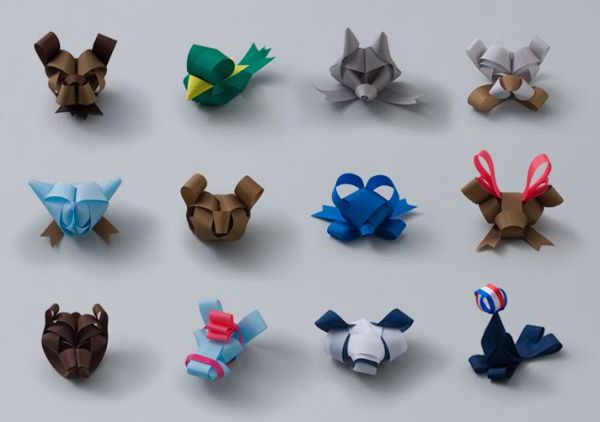
The opener is a three-by-four grid on pale gray: twelve small heads and one full-body seal, each built from one or two ribbon colors. Brown floppy-eared dogs sit beside a green bird with a yellow beak; gray fox-like faces share the row with cooler blue and white constructions. A deer-like form wears pink loops as antlers. A light-blue horse carries a tiny pink bow. At the bottom right, a navy seal balances a striped red-white-blue ball—the only figure given a whole body and a prop.
Seen together, the set argues for system thinking. Ears are loops. Snouts are folded tips. Bases flare into classic V-cut ribbon tails. Once you learn the grammar, you can scan the grid the way you scan a type specimen sheet: same alphabet, different words. That is half of Ribbonesia’s charm. The other half is joy. These are not solemn taxidermy stand-ins. They are playful, slightly cartoon, and stubbornly handmade.
Blue horse with a pink bridle
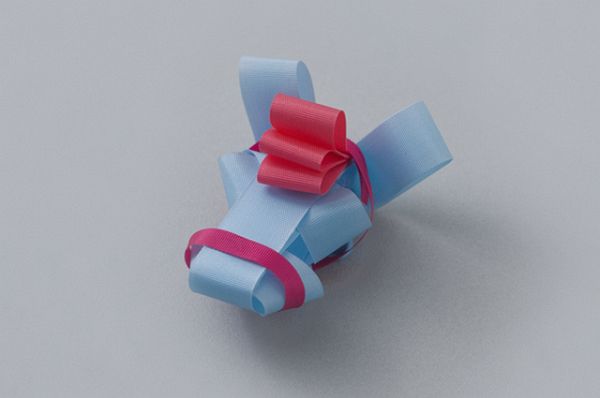
Close up, a light-blue grosgrain horse becomes architecture. Wide loops build the skull and ears; a rectangular fold becomes the muzzle; three stacked pink loops sit between the ears like a toy mane. A thin magenta strip wraps the snout as a bridle. The ribbed texture of the ribbon does more work than painted detail ever could. Soft light from the upper left throws a gentle shadow to the right, proving the piece occupies air, not only the picture plane.
Color pairing here is deliberate. Cool blue keeps the form calm; hot pink supplies personality without embroidery or glued eyes. Ribbonesia often refuses facial features in the realistic sense. Recognition comes from silhouette and proportion. You know it is a horse because the ears and muzzle argue horse, not because someone drew nostrils.
Navy seal and circus ball
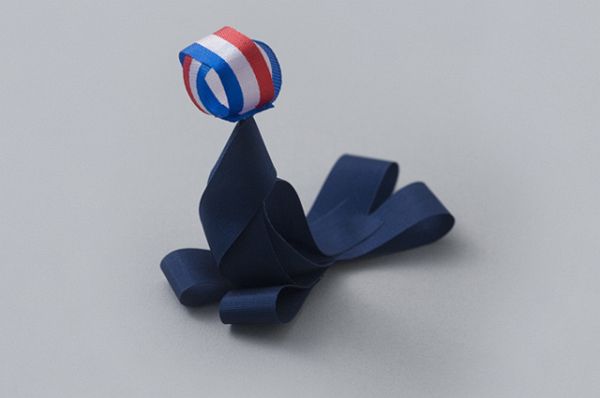
The seal is the gallery’s acrobat. Dark navy ribbon curves from rear flipper loops up through a tapering neck to a pointed nose, where a hollow sphere of red, white, and blue striped ribbon rests in balance. Front flippers are small loops; the pose is circus without becoming kitsch, because the material stays honest. You can still see every fold that made the body.
Narrative props are rare in this set, which makes the ball land harder. It turns a static craft object into a moment—an animal mid-trick. That narrative spark is useful for photographs meant to travel: the image explains itself in a second, then rewards a longer look at how the sphere was wound.
Magenta cat, all one color
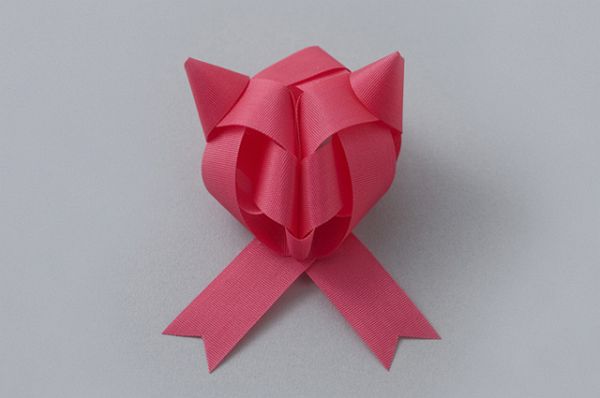
A single warm magenta ribbon becomes a cat: pointed ear triangles, overlapping loops for cheeks and muzzle, and two swallowtail ends flaring down as a base. Monochrome forces the folding to carry everything. There is no second color to mark eyes or nose. Depth comes from nested curves and the shadows trapped between layers.
Cats suit this method because their ear silhouette is so graphic. Even without whiskers, two sharp peaks read feline. The V-cuts at the ribbon ends keep the piece tied to gift-wrapping culture—the same finishing cut people make on presents—while the head itself has left the gift table for sculpture.
Gray fox geometry
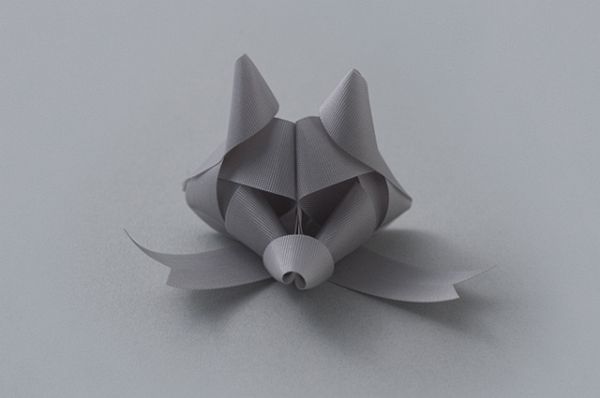
Gray grosgrain builds a fox or wolf: upright pointed ears, deep geometric folds for the eye sockets, a tightly curled tip for the nose, and wing-like side flaps with notched ends. The monochrome palette turns the animal almost architectural. Soft top-left light carves the planes so the face feels faceted rather than soft-toy plush.
This is where Ribbonesia’s claim that ribbon work can behave like painting becomes plausible. Value shifts—highlight on a rib, shadow in a fold—stand in for brushwork. The viewer’s eye travels the same way it travels across a small still life: edge, recess, edge again.
Green bird, yellow beak
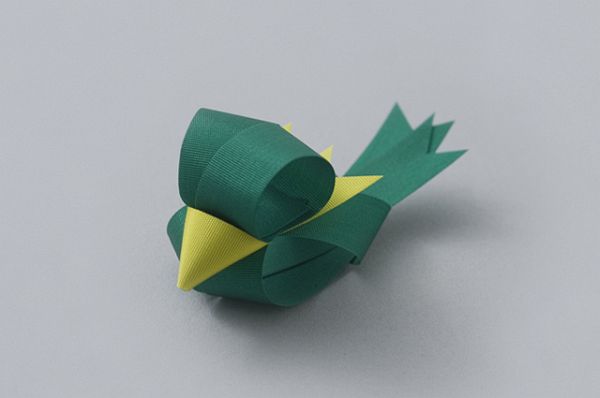
Forest-green ribbon forms a compact bird aimed toward the lower left. A green loop crowns the head; a sharp yellow fold becomes the beak; small yellow points peek backward like crest feathers; the rear ribbon is notched into a V that reads as tail. Two colors are enough to separate face from accent. The body stays simple so the beak can punch.
Birds test a ribbon sculptor’s sense of direction. Unlike a frontal mammal head, a bird often needs a clear forward axis. Maeda’s solution is economy: point the beak, notch the tail, and let the viewer complete the flight path.
Brown body, pink antlers
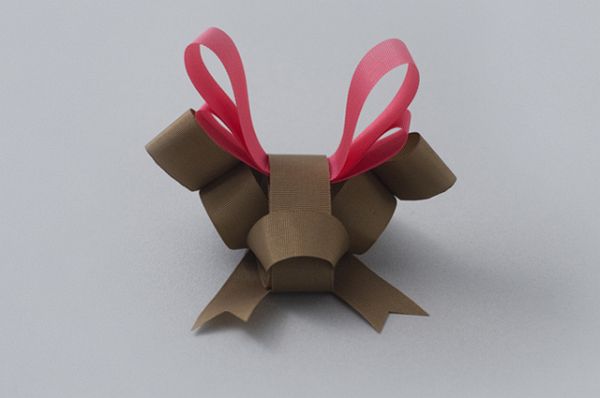
Olive-brown loops make a compact torso; two tall neon-pink vertical loops rise like ears or antlers; brown swallowtail flaps sit as a base. The color contrast is almost comic—quiet earth tones interrupted by candy pink. That interruption is the personality. Without the pink, the piece might read as a generic mammal lump. With it, you start arguing deer versus rabbit versus fantasy pet, which is part of the fun.
Width of ribbon matters here. These pieces look to sit in a half-inch to three-quarter-inch range, stiff enough to hold open loops yet soft enough to curve. Grosgrain’s ribs help the loops keep circular memory instead of collapsing into ovals.
Dark brown bear head
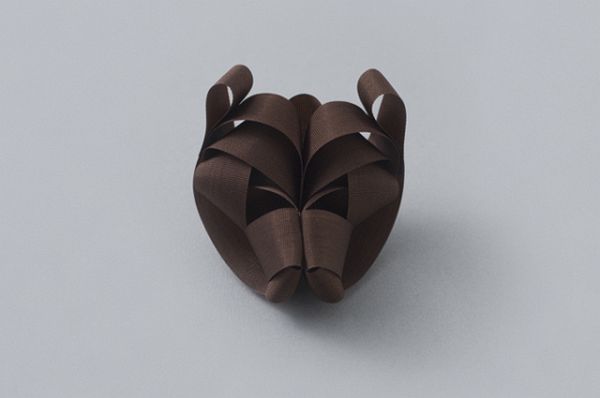
A single dark brown ribbon builds a symmetrical bear-like face: open ear loops at the top corners, layered curves for brow and cheeks, pointed folds meeting at a muzzle. Shadows pool inside the construction until the head feels hollow and solid at once—like a mask made of gift wrap that somehow learned anatomy.
Symmetry is a quiet flex. Handmade loops want to drift; keeping left and right mirrored without looking machine-cut is harder than a casual scroll suggests. The photograph’s centered framing and clean gray field treat the piece as a design object, not a craft-fair leftover.
Royal blue loops
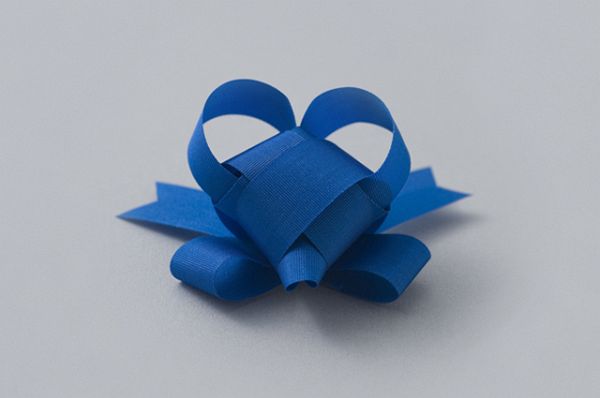
Vibrant royal blue becomes a low, dense creature—piglet to some eyes, crab to others—with a small forward snout loop, two large upper loops, side “feet,” and long V-notched tails stretching left and right. Ambiguity is allowed. Ribbonesia’s animals invite naming games; the point is recognizability of life, not zoological ID tags.
The extended tails are important compositionally. They turn a compact knot into a horizontal emblem, almost logo-like. That graphic clarity helps explain why these works photographed so well for blogs and design roundups: they read at thumbnail size.
Worn on a teal cardigan
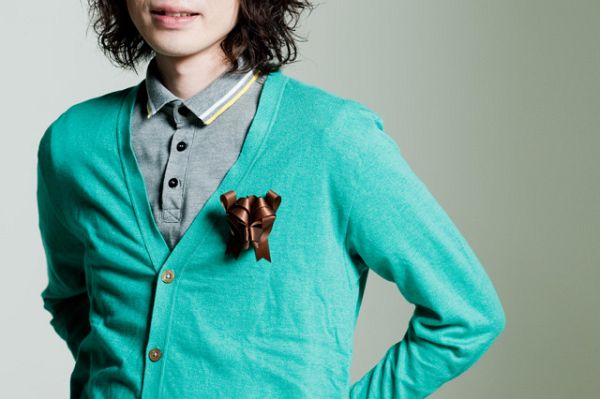
Studio sculpture is only half the story. Here a glossy brown satin bear head is pinned to a mint-teal cardigan over a gray polo. Rounded ear loops, a folded snout, and two fishtail ends hanging like paws turn the animal into a brooch. Soft smile, hands behind the back, neutral backdrop: the photograph styles ribbon art as everyday fashion, not gallery-only preciousness.
Satin changes the mood from matte grosgrain. Light skims the surface; the animal looks slightly dressier, closer to corsage culture. Maeda’s practice has always lived near that border—craft object, product possibility, and wearable joke at once.
Pink pin on black
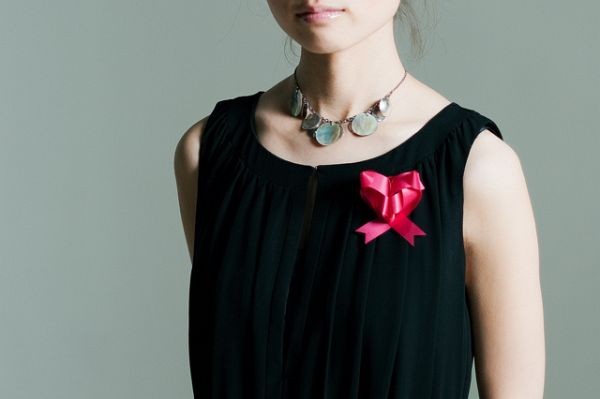
Magenta satin against a sleeveless black dress and a coin-pendant necklace: ears, rounded snout, crossed V-cut tails. The animal pops like a single bright thought on a dark field. Cropped at chin and shoulders, the frame refuses to make the wearer the star; the ribbon keeps the center.
Fashion context matters for understanding Ribbonesia’s early appeal. These pieces could live on a desk as toys and on a lapel as conversation starters. That double life widened the audience beyond pure craft blogs into lifestyle and style coverage.
Pink and brown on a plaid lapel
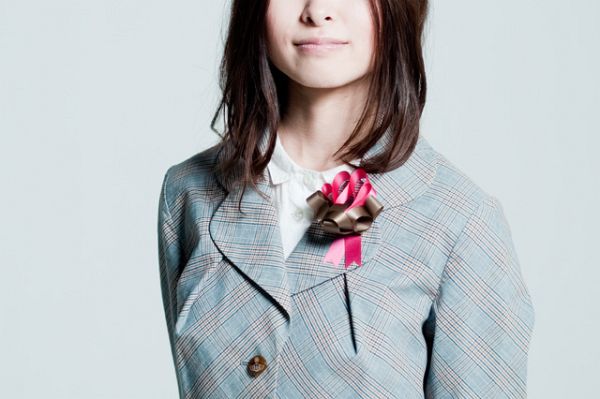
The closer places a two-tone pink-and-brown ribbon creature on a light plaid blazer over a white shirt. A tall pink loop rises like a neck or crest; clustered loops build the body; pink V-tails hang below. Against cool gray-blue check, the warm ribbons read as intentional accessory design—closer to a boutique pin than a kids’ craft hour.
Seen after the gray studio set, the wearables complete the argument. Ribbon animals are not only photographs of clever folds. They are objects that want contact with clothing, light, and human scale. The blazer shot proves the work survives the move from seamless paper to real fabric grain.
Why the folds still hold attention
Ribbonesia’s early animals succeed because constraints are visible and loved. One material family. A short list of moves—loop, twist, notch, stack. Colors chosen like a poster, not like a fur reference chart. Photography that refuses clutter. Baku Maeda’s hand supplies the variation; Toru Yoshikawa’s conceptual framing helps the project feel like a world rather than a pile of one-offs. The name itself—Ribbonesia—promises a place. The gallery delivers a passport stamp: you have visited a country where gift ribbon grew fauna.
If you make with ribbon yourself, steal the discipline more than any single pattern. Decide the animal’s silhouette in two or three loops before adding decoration. Leave facial features implied. Photograph on plain grounds so texture can speak. And when a navy seal seems ready to balance a striped ball, let it—because play is not the opposite of craft here. Play is how the folds remember they used to celebrate something, and decided to become the celebration instead.

Comments
Continue reading
Funny Animal Signs That Warn People (While Animals Ignore Them)
From a seagull on a no-birds disc to classic zoo and park ironies—why animal warning signs get funny, and what the rules are still for.
How to Find Local Amenities on Vacation: Mechanics, Haircuts & More
Locate trustworthy local services and everyday spots while traveling or settling in—using publications, reviews, map apps, neighbor tips, and low-pressure exploration.
Kristen Stewart for V Magazine, Spring Preview 2013
V81’s Wild at Heart cover story—Kristen Stewart shot by Inez & Vinoodh, styled by Joe McKenna, in pale minimal spring glamour.