
Paper-Cut Collages Inside Toilet-Paper Rolls by Anastassia Elias
Anastassia Elias stages miniature paper scenes inside cardboard tubes—circus, streets, sports, and wildlife—then photographs them as glowing peep-show worlds.
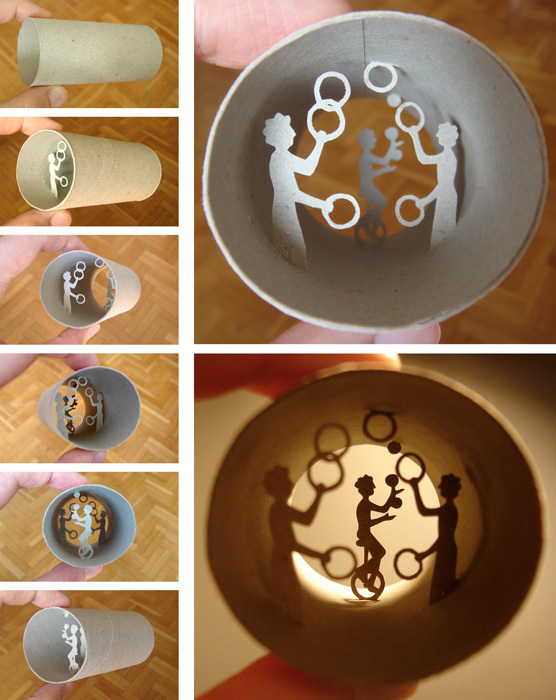
A toilet-paper tube is usually the last object anyone treats as architecture. French artist Anastassia Elias turns that discarded cylinder into a peep-show theater: tiny paper figures staged inside the roll, then photographed front-lit and backlit until ordinary cardboard becomes a tunnel of story. The series often called her rouleaux work is collage by another name—cut shapes, layered depths, and a circular frame that forces you to look in rather than glance past.
What travels in these images is not only craft. It is the double take. Six small views of a hand holding a plain tube remind you how humble the vessel is. Two larger end-on shots—one even light, one glowing silhouette—prove how much cinema a few centimeters of pulp can hold.
The circus opens the set. A unicyclist holds the center while jugglers flank the ring, rings and balls frozen mid-arc. Under flat light you see cardboard texture and the delicate tabs that keep figures upright. Backlit, the same scene becomes ink-black action against a bright circle—performance reduced to outline, which is exactly how memory stores a show.
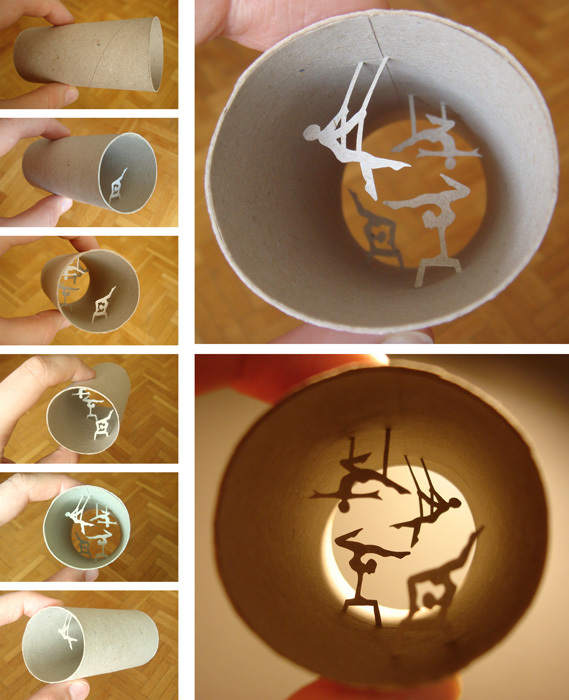
Acrobatics follow: trapeze, handstand, bridge pose, bodies stacked through the tube’s depth as if the cylinder were a gymnasium aisle. Spacing does the editing. A figure nearer the lens reads larger; one farther back shrinks into supporting cast. Elias’s method—matching paper color to the roll so the cuts feel native—keeps the illusion that the scene grew from the cardboard rather than being glued on as decoration.
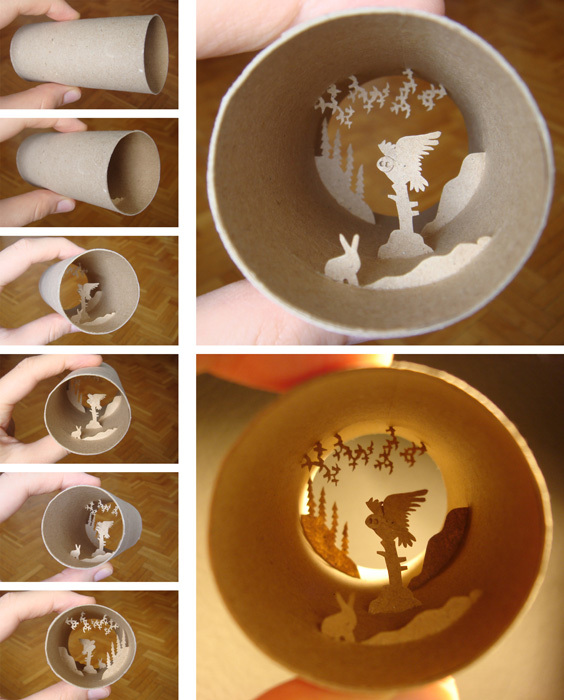
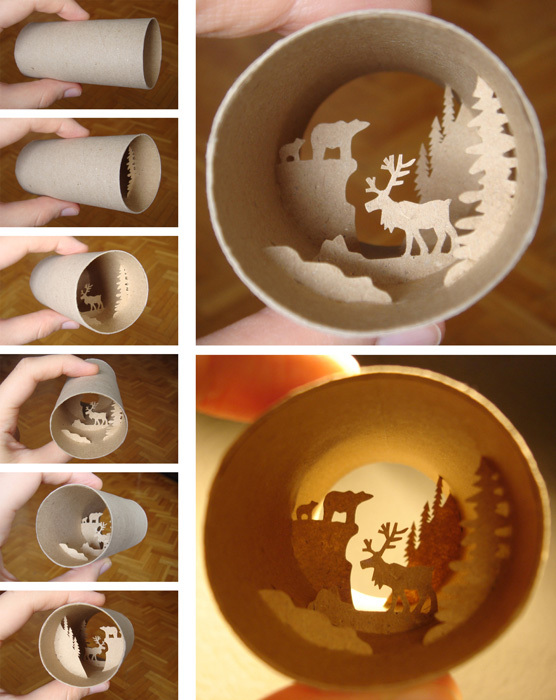
Wildlife scenes widen the mood. An owl lands on a jagged stump while a rabbit watches and a flock stitches the upper half of the tunnel. Nearby, an antlered deer shares a northern ledge with bears and pointed pines. Nature fits the format oddly well: trees and animals are already silhouette-friendly, and the tube’s curve becomes a forest edge or a cave mouth depending on where you stand.
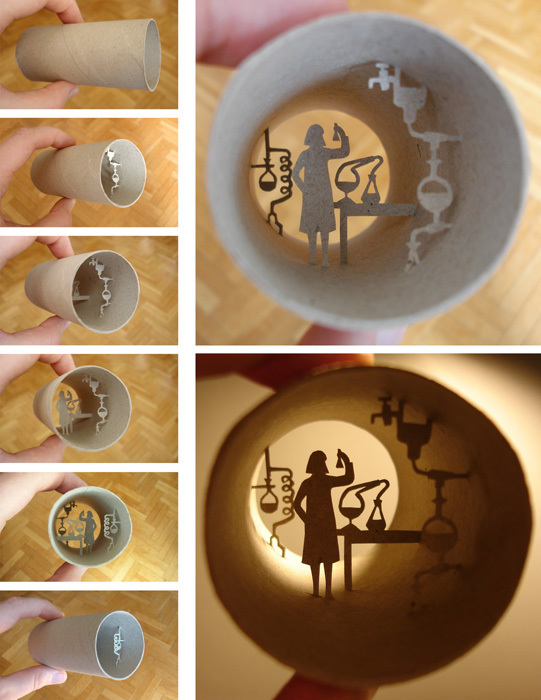
Then the everyday returns, scaled to tweezers. A laboratory fills the roll with flasks, coils, and a figure lifting glassware as if checking a reaction. Distillation gear climbs the walls; a tap silhouette finishes the joke that science can live inside packaging that once held bathroom paper. The humor is gentle. The craft is not casual. Hours hide inside each piece—Elias has described cutting matching paper, placing shapes with tweezers, and accepting that one roll may take a long afternoon.
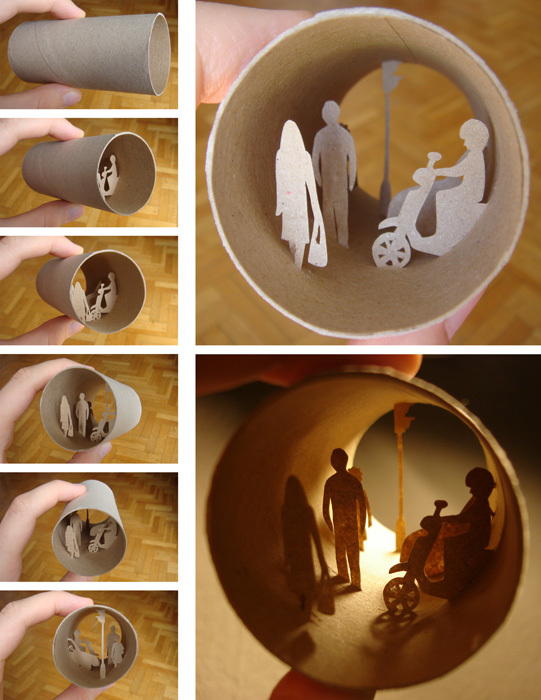
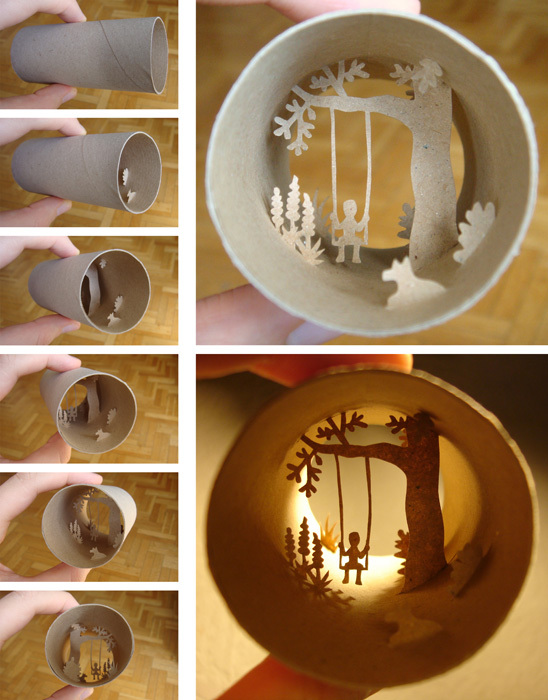
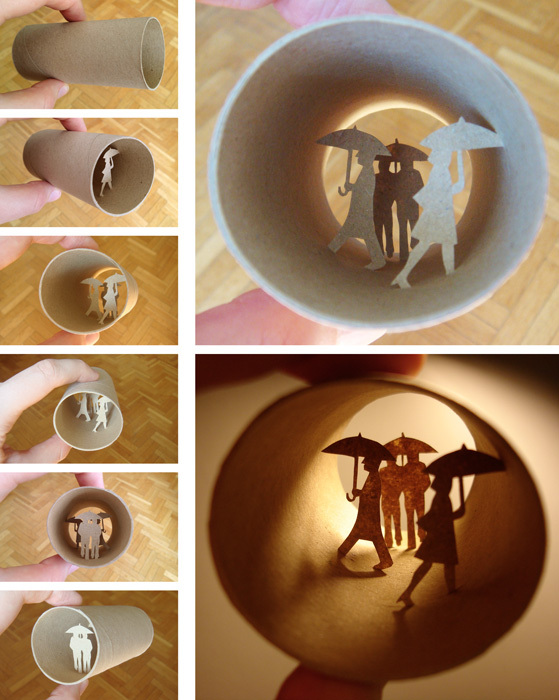
Street life and quiet play sit side by side. A woman with a bag, a standing figure, a scooter, a lamppost—urban errands compressed into a circle. A child on a swing hangs from a branch while a small dog waits beneath the tree and grass stalks rise on the opposite wall. Umbrella walkers stride through rain as if the tube were a covered passage ending in light. Domestic and civic scenes matter here because they refuse the idea that miniature art must be fantasy. Elias often stages the recognizable: shopping, weather, a park afternoon.
Labor, sport, and spectacle
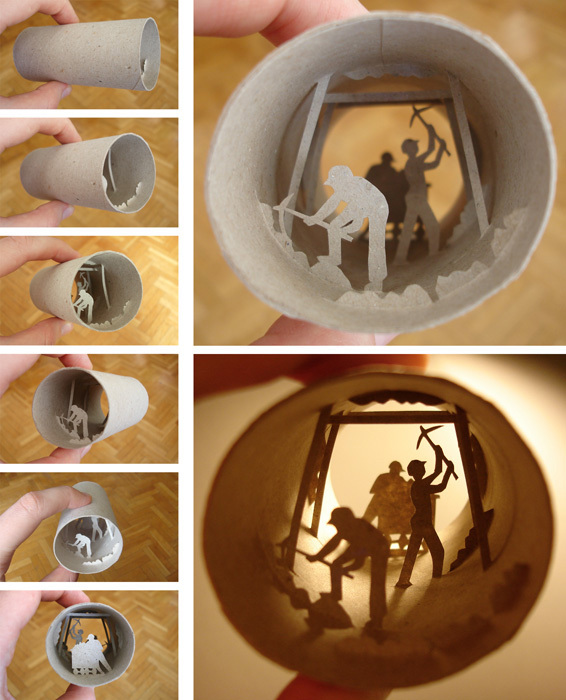
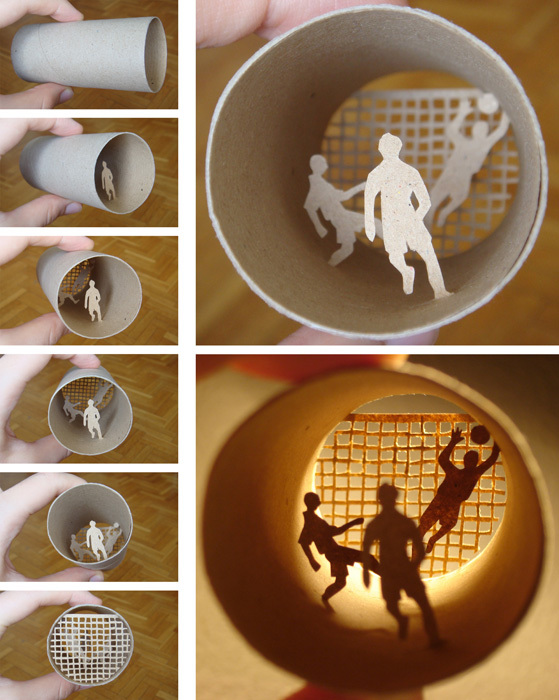
Work and play share the same diameter. Miners swing pickaxes beneath timber braces, one figure farther back near a cart, the shaft beams turning the tube into a tunnel within a tunnel. A soccer pitch ends in a cut grid for the goal net; a keeper dives, a striker drives, a third player runs toward the lens. Action poses survive reduction because sport already speaks in outline—raised arm, stretched dive, mid-kick.
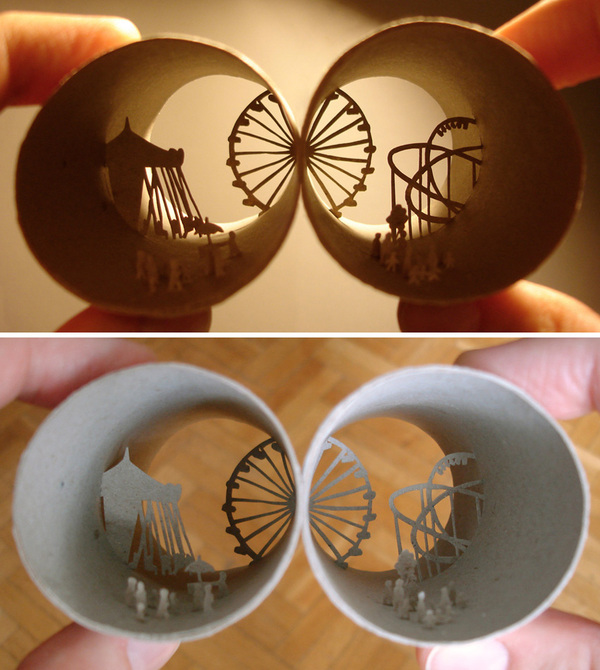
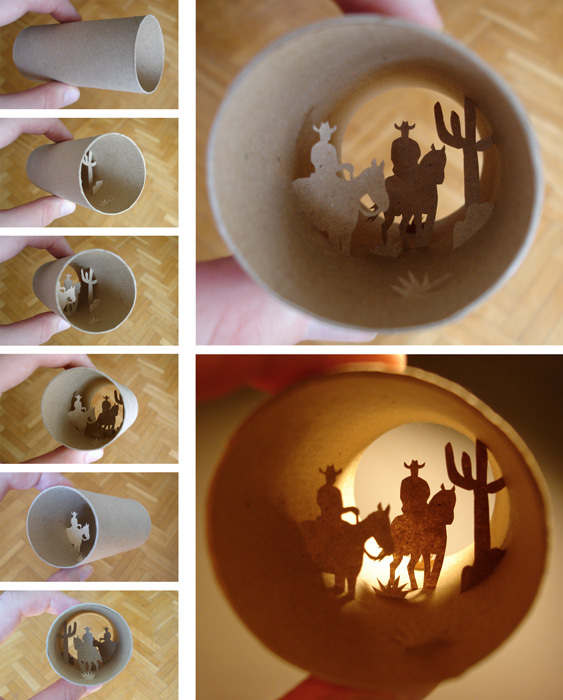
Sometimes one tube is not enough. Held like binoculars, a pair of rolls joins a carousel to a Ferris wheel to a looping coaster, spectators dotted along the lower curve. The amusement-park panorama is collage in the literal sense: adjoining cylinders become neighboring attractions. Elsewhere a Western scene rides through—cowboys, horses, a tall cactus, desert grass—sunset-ready the moment backlight hits the far rim.
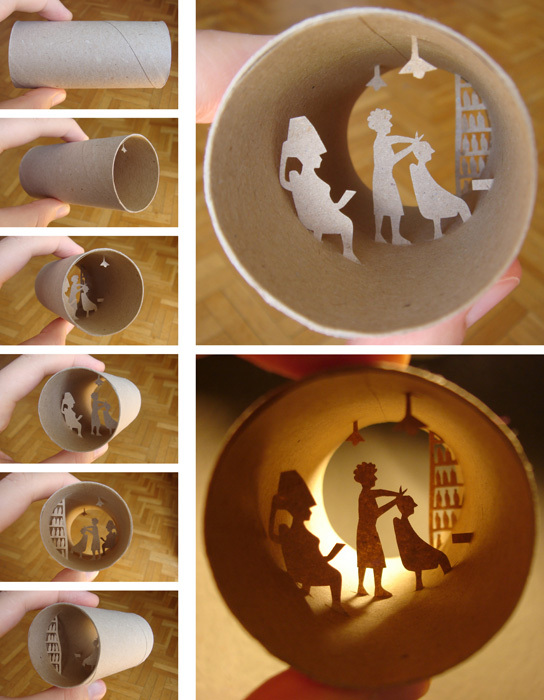
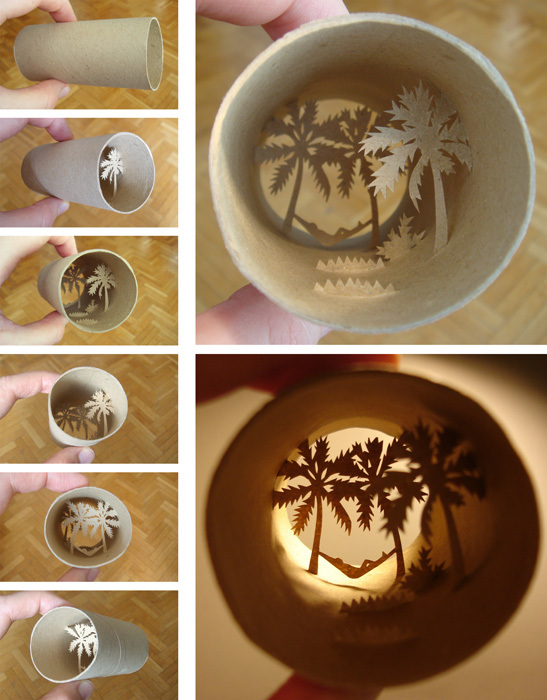
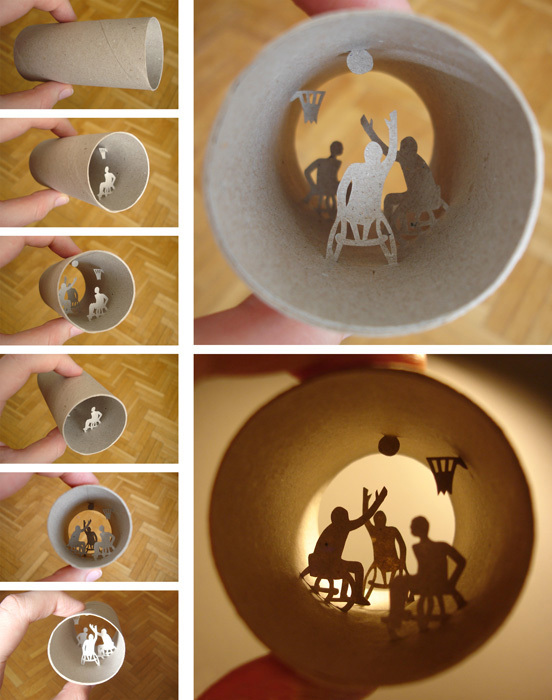
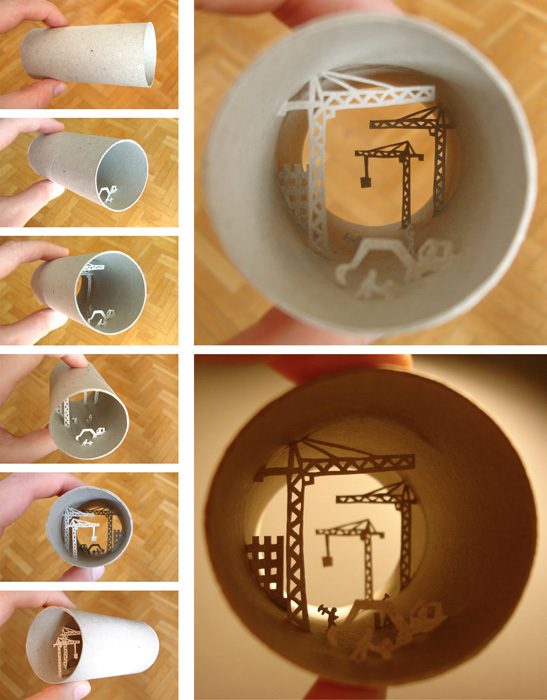
Interior trades and leisure fill more frames. A barbershop stages scissors at a customer’s head while another client sits under a beehive dryer with a magazine; bottles line a shelf and pendant lamps hang from the cardboard “ceiling.” Palm trees and a hammock offer escape, serrated grass or waves grounding the tropical floor. Wheelchair basketball players raise arms toward a tiny hoop and suspended ball. A construction site stacks cranes at different depths while workers mark the floor with tools and posture. Each subject tests the same rule: if the silhouette reads, the story lands.
Why the tube works
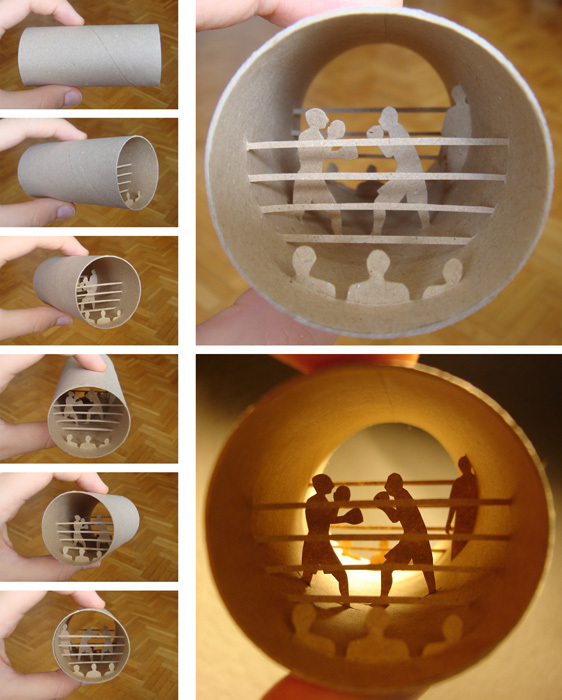
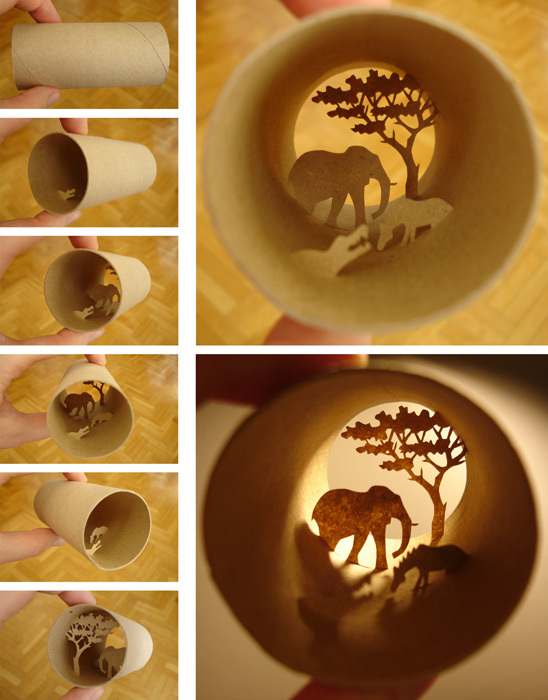
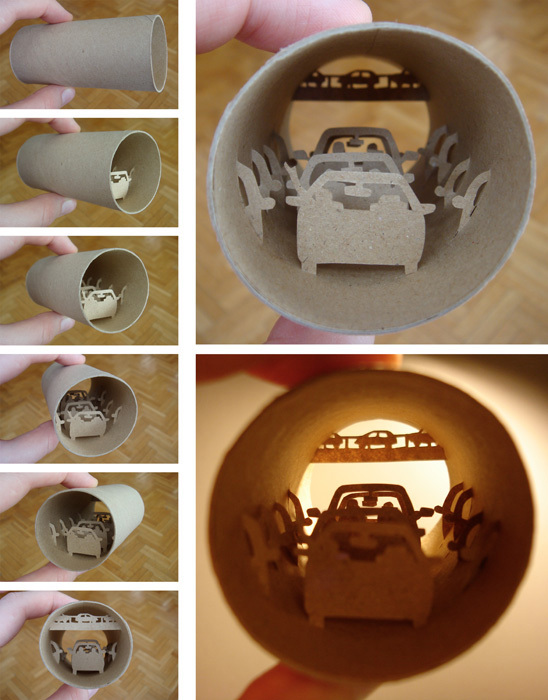
Boxing ropes stretch across a duel of gloves while spectator heads line the near curve; a savanna gathers elephant, branching tree, and smaller beasts; a traffic tunnel queues cars beneath an overpass while pedestrians crowd the walls. These last scenes underline Elias’s range—from ring drama to wildlife calm to the anonymous density of city flow. The cardboard never pretends to be marble. Its brown honesty is part of the charm.
Technically, the cylinder is a forced-perspective machine. Depth is limited, so every millimeter of spacing counts. Light from the far end turns craft into graphic design; light from the near end reveals seams, tabs, and the physical comedy of tiny upright figures. Photographing both states is not vanity. It teaches the viewer how the illusion is built, the way a magician sometimes shows the sleeve.
Hands in the side panels are more than scale markers. They insist the work is portable, domestic, almost accidental—something you could miss if you only glanced at the exterior. The parquet floor behind many shots keeps the photos in a real room rather than a white infinity cove. That groundedness matters. Wonder lands harder when the backdrop is ordinary wood.
Collage usually means fragments gathered from elsewhere. Here the fragments are cut to match, or cut from the vessel itself, then recomposed as life inside waste. That recycling ethic is visual before it is moral: you see thrift as elegance. Later projects would push the same format toward civic themes; this earlier gallery stays closer to play, labor, weather, and wonder—enough for a scroll that keeps stopping.
Viewers who linger notice how often Elias chooses mid-action: balls in air, picks mid-swing, keepers airborne, horses mid-stride. Stillness is never the point. The tube freezes motion the way a shutter does, which is why the photographs feel cinematic even when the subjects are hammocks and hair dryers. Genre hops—circus to lab to mine to salon—also keep attention awake. A single theme would fatigue; this survey behaves like a pocket anthology.
Hold one of these photographs in mind and the next empty roll on a bathroom shelf looks temporarily suspicious, as if it might contain a derby, a mine, or rain. Anastassia Elias does not ask you to romanticize trash. She asks you to notice how little material a world needs when outline, depth, and light agree. The tube stays trash-adjacent. The scene inside does not. That gap—between what the object was and what the peep-hole shows—is where these paper-cut collages keep their charge.

Comments
Continue reading
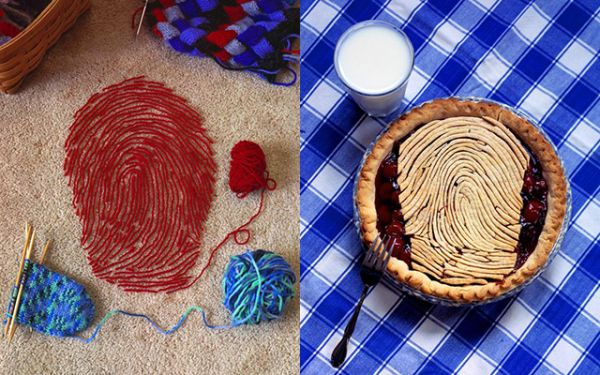
Fingerprint Art by Kevin Van Aelst: Autobiography in Ridges
Connecticut photographer Kevin Van Aelst rebuilds each of his ten fingerprints from mustard, wool, snacks, and other memory-laden materials—turning biometrics into still-life self-portraiture.
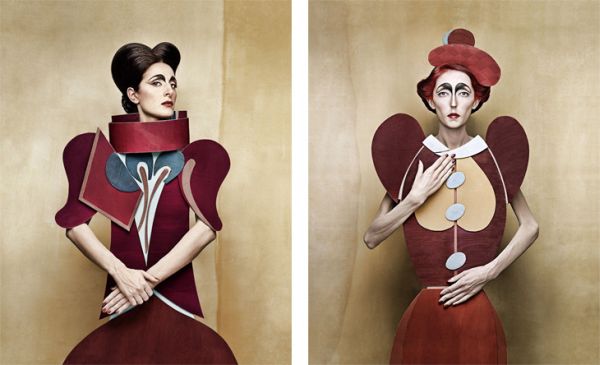
Cardboard Ladies (Dame di Cartone) by Christian Tagliavini
Christian Tagliavini’s Dame di Cartone portraits dress women in handmade cardboard couture—baroque, fifties, and cubist echoes built as craft photography.
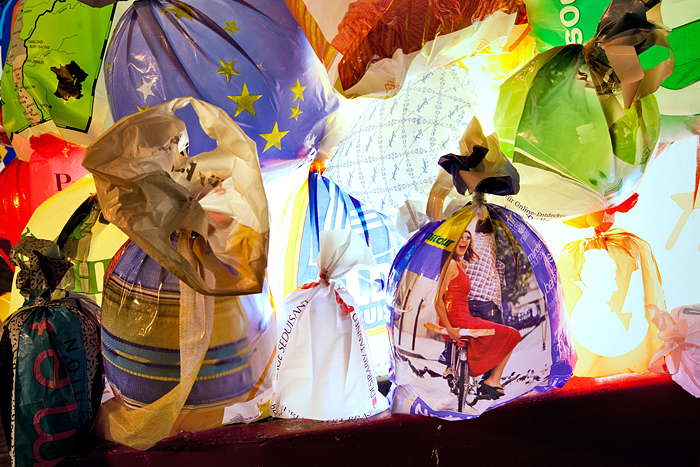
Luzinterruptus: Plastic Garbage Bags Lighting Installation in Winterthur
Luzinterruptus’s 2012 Winterthur installation Plastic Garbage Guarding the Museum—5,000+ illuminated bags left outdoors for four months.