
Luzinterruptus: Plastic Garbage Bags Lighting Installation in Winterthur
Luzinterruptus’s 2012 Winterthur installation Plastic Garbage Guarding the Museum—5,000+ illuminated bags left outdoors for four months.
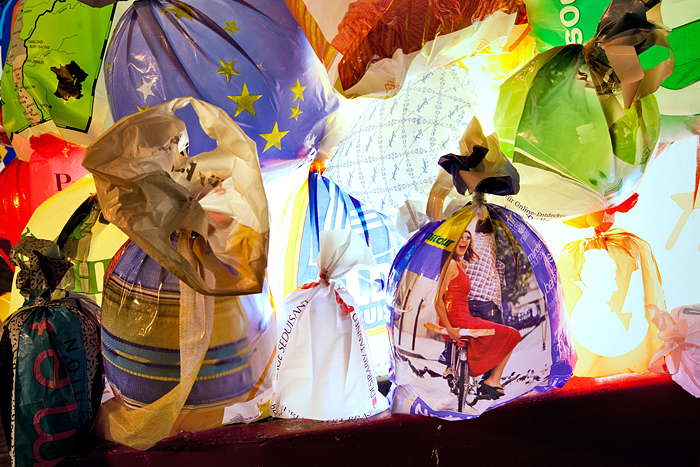
In June 2012, the Madrid-based anonymous art collective Luzinterruptus filled two large containers with illuminated plastic shopping bags and set them beside the main entrance of the Gewerbemuseum in Winterthur, Switzerland. The piece, titled Plastic Garbage Guarding the Museum (Basura plástica custodiando museo), was commissioned within Oh, Plastiksack!, a monographic exhibition on plastic bags curated by Ida-Marie Corell and Susanna Kumschick.
In the first photographs the installation looks festive: a mountain of branded colors, inflated forms, and internal light spilling through thin polyethylene. That beauty is temporary on purpose. Luzinterruptus left the work outdoors for four months so weather, deflation, and dirt could rewrite the image—from spectacle to something closer to real trash. The lighting installation is therefore not only an object but a slow public demonstration.
Street work, not gallery glass
Luzinterruptus prefers the street. The collective’s projects typically use light as a temporary public medium—interventions people can encounter without buying a ticket, then watch disappear. In Winterthur that preference mattered because the subject was an everyday object already moving through the city: the disposable shopping bag. Keeping the critique outdoors refused the comfort of treating plastic waste as an abstract gallery theme.
Rather than fabricating a polished sculpture from new materials, the artists wanted bags that already belonged to local consumption habits. Museum staff helped by exchanging donated bags for exhibition tickets. The swap collected more than 5,000 bags and pulled visitors into the museum of applied arts at the same time. Participation became part of the artwork’s supply chain, not an optional side activity.
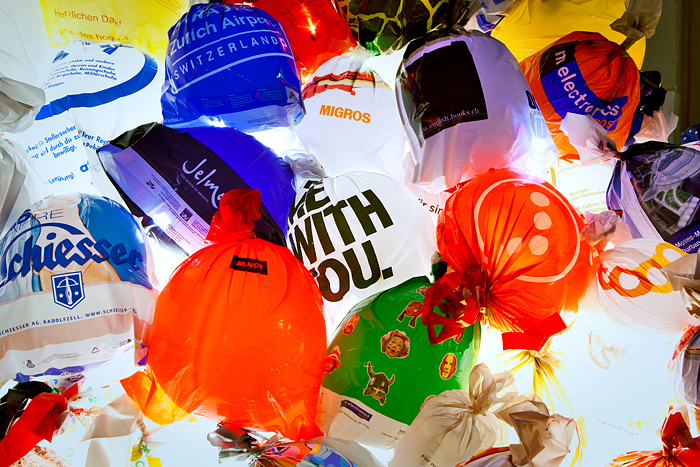
From that donated pile, Luzinterruptus selected the most colorful and luxurious examples—the bags designed to advertise brands and feel like small status objects at the checkout counter. Those chosen bags were filled with air, packed into two large dumpster-like containers flanking the museum door, and lit from within. Set-up took three days. The collective reported no damages. Permanence was planned as four months.
What the light does—and what time undoes
Internal illumination turns packaging into lanterns. Logos soften. Colors bloom. The containers first read like a celebration of design abundance—exactly the seduction plastic bags are engineered to produce. Retail bags invite purchase and carry a brand’s positive image. Luzinterruptus uses light to amplify that seduction until it becomes almost absurd: garbage that glamorizes itself.
Then time does the critical work. After the first days, when every bag sat inflated and neatly arranged, the display began to sag. Weeks later it was less pleasing to the eye. By the end of the four-month run, the artists expected something “truly decrepit.” Far from treating that decay as a failure, they treated it as the installation’s narrative arc. Viewers could watch, in public, how a shiny consumer object becomes stubborn waste that is hard to remove from the environment.
That arc is why the piece remains clearer than a static anti-plastic slogan. It does not only claim that bags are harmful after use. It stages the before-and-after in the same physical objects, under the same street conditions, beside the same door. Physics and weather finish the sentence the artists started with electricity and air.
Opening night as a second act
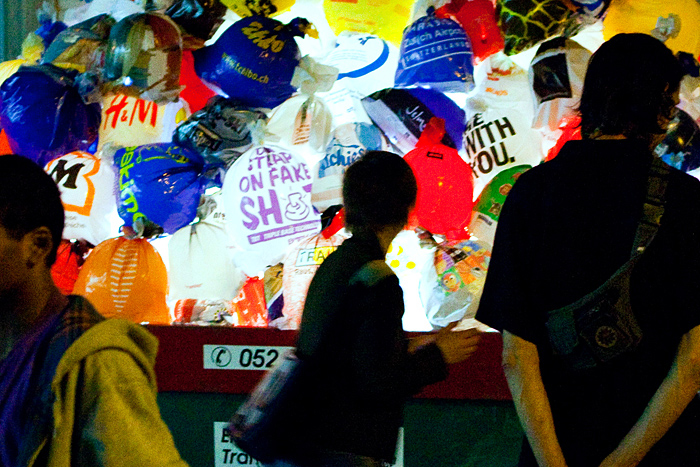
The containers at the door were the long-duration piece. On inauguration day, Luzinterruptus also staged shorter light interventions around the museum. Illuminated bags filled a small plaza, creating a gathering space where people could sit and hunt for familiar store logos among the glowing pile. Visitors received floating illuminated trash bags to carry through the city—small plastic “moons” drifting above Winterthur’s streets.
Those ephemeral actions matter because they move the critique from the museum threshold into ordinary circulation. A bag that floated as a party object for one evening still names the same problem as the dumpsters: an item designed for minutes of convenience and years of environmental persistence. Humor and beauty pull people close; material history does the rest.
Most contemporary photographs of the early luminous state are by Gustavo Sanabria. Later images sent by the museum tracked the fading attractiveness as air escaped and surfaces dulled. Documentation itself became part of the work’s public life—proof that the decline was not accidental but designed into the timeline.
Context inside Oh, Plastiksack!
Oh, Plastiksack! treated the plastic bag as a design object with a full life cycle—from seductive product packaging to hazardous discard. Curators Corell and Kumschick framed a monographic look at an item so common it often escapes aesthetic scrutiny. Luzinterruptus’s outdoor piece guarded that conversation literally and figuratively. Anyone approaching the Gewerbemuseum had to pass glowing refuse before entering a museum of applied arts.
The placement is a civic joke with teeth. Cities usually hide trash behind buildings. Here the trash “guards” the entrance like ceremonial sculpture. Luxury logos stuffed into dumpsters and lit like treasure acknowledge how consumption aesthetics can survive even after the object’s useful life ends—until weather finally wins. Anonymous collective authorship fits the same ethic: individual celebrity stays secondary so the public encounter stays primary.
Why the installation still reads
Environmental art often lectures. This lighting installation prefers demonstration. You do not need a long wall text to understand that plastic bags look better as brand messengers than as waste. Beauty arrives first; decline arrives on a schedule set by air loss, sun, rain, and neglect. That clarity helped the work travel through design and culture press in 2012, and it is why the still photographs continue to communicate without needing the original Winterthur sidewalk underfoot.
Look again at the early frames: the colors still advertise. That is the uncomfortable charm of the work. The bags were never only trash in the first nights. They were trash rehearsing as spectacle—exactly the double life Luzinterruptus wanted the city to notice on its way into the museum.
For readers arriving through this page’s title, the credits stay simple and worth repeating: Luzinterruptus as authors; the Gewerbemuseum Winterthur as host; Oh, Plastiksack! as exhibition frame; more than five thousand donated bags as raw material; four months outdoors as the clock that completed Plastic Garbage Guarding the Museum.

Comments
Continue reading
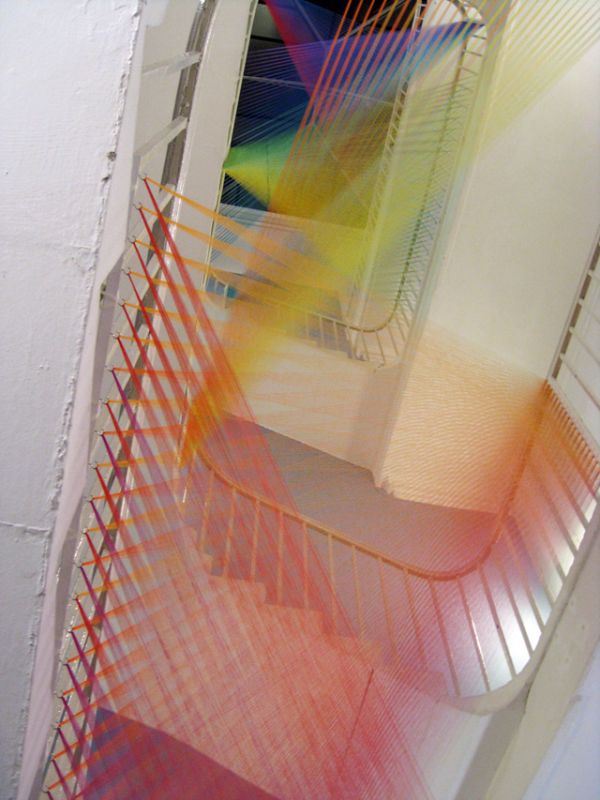
Gabriel Dawe’s Rainbows of Thread: The Plexus Installations
How Gabriel Dawe turns miles of colourful embroidery thread into room-scale spectra—craft, tension, and the illusion of light.

Fingerprint Art by Kevin Van Aelst: Autobiography in Ridges
Connecticut photographer Kevin Van Aelst rebuilds each of his ten fingerprints from mustard, wool, snacks, and other memory-laden materials—turning biometrics into still-life self-portraiture.

Cardboard Ladies (Dame di Cartone) by Christian Tagliavini
Christian Tagliavini’s Dame di Cartone portraits dress women in handmade cardboard couture—baroque, fifties, and cubist echoes built as craft photography.