
Paper-Cut Action Silhouettes by David Reeves
David Reeves cuts film- and game-inspired action into miniature paper silhouettes, then lights and photographs them like freeze-frame cinema.
Paper is flat until someone decides it should behave like a freeze-frame. Photographer and designer David Reeves cuts action out of that flatness—miniature silhouettes staged as movie beats and game moments, then lit and photographed until they feel like stills from a film you almost remember. The work sits between craft table and cinema: scissors for casting, a desk lamp for direction, a camera for the final cut.
What made these pieces travel so widely in the early 2010s was not novelty for its own sake. It was recognition. Viewers who grew up on Alien corridors, Batman rooftops, Limbo’s gray horizons, or the tense hush of stealth games could read a black outline in half a second and supply the soundtrack themselves. Reeves’s silhouettes do not explain. They trigger. That is their engine.
Shadow theater with a shutter
Call the series freeze-frame shadow puppet theater and you are close. Each figure is cut from paper, often in layered planes, then arranged in shallow space so a lens can invent depth. Soft backgrounds—clouds, mountains, murky water, a blur of corridor—sit behind sharper foreground cuts. Depth of field does what stage flats once did: it tells you where to look and how far danger might be.
The silhouettes favor readable gesture over lace detail. A raised weapon, a running stride, a creature’s claw, a cape’s jagged edge—shapes that survive reduction. Too much interior line and the piece becomes illustration; too little and the reference dissolves. Reeves works the middle register where pop-culture iconography already lives: the poses we have seen a thousand times on posters and pause screens.
Photography is not documentation after the fact. It is part of the sculpture. Angle, exposure, and focus decide whether a seven-inch cutout feels monumental or merely cute. Close shooting with a short focal length can exaggerate scale; a longer lens can compress layers into a graphic frieze. Light from the side throws thin shadows that prove the paper occupies air. Without those cues, black shapes on a backdrop risk looking like stickers. With them, the scene breathes like a miniature set.
Film and game as shared mythology
Reeves’s references lean toward action, horror, and atmospheric play. Ridley Scott’s Alien universe offers xenomorph silhouettes and industrial gloom that paper handles surprisingly well—sharp ridges, coiled bodies, the suggestion of wet metal without needing chrome. Batman pieces borrow comic-book architecture: ledges, windows, the angular language of vigilantism after dark. Games such as Limbo, Left 4 Dead, Half-Life, Thief, and later tributes to titles like The Last of Us extend the same logic. Interactive media already teaches audiences to read silhouettes under pressure. A paper version flatters that literacy.
Tribute work walks a thin line. Copy a frame too literally and you make a souvenir. Abstract too far and the homage evaporates. Reeves’s strongest images feel like memory rather than merch: the emotional weather of a scene, not a licensed still. Viewers complete the cast list in their heads. That participatory recognition is why galleries of these photographs spread so easily across design blogs and gaming sites—each scroll was a quiz people enjoyed failing and passing at once.
There is also childhood in the method. Comic books, cowboy movies, ninjas, zombie hunters—the artist has spoken of that appetite, and of wanting filmmaking even when life pointed elsewhere. Paper cuts became a portable cinema. You do not need a crew to stage a rooftop chase if scissors and patience will do. The desk becomes a lot; the lamp becomes golden hour or alien night; the finished photograph becomes the release print.
How a cut becomes motion
Action is hard to imply in a static medium. Reeves solves it with posture and spacing. Figures lean into strides. Weapons sit mid-swing. Monsters occupy the frame as if mid-lunge. Negative space between characters acts like editing: a gap can mean chase, standoff, or the second before contact. Layering helps—foreground debris or railing cuts, midground actors, background atmosphere—so the eye travels the way a tracking shot would.
Minimalism does heavy lifting. Stark black forms against luminous or softly graded grounds strip away costume color and leave rhythm. You notice silhouette the way a cinematographer notices blocking. A cape’s triangle, a gun’s straight line, a creature’s many limbs: graphic decisions that read at thumbnail size, which is exactly how most people first encountered the work online.
Craft details matter even when the final image hides them. Narrow ankles and weapon barrels are fragile; humidity and blade dullness punish haste. Reeves’s setups, when shown in making-of frames, often look improvised at the edges—clamps, scraps, the honest mess just outside the crop. That honesty is useful. It reminds you the drama is constructed inches from ordinary life, which makes the cinematic result feel more earned, not less.
Lighting as story
Many pieces lean into dusk, backlight, or high-contrast “magic hour” moods. Sunset silhouettes are a classic photographic shortcut, and here they double as genre weather: endings, arrivals, last stands. Horror scenes may prefer colder or flatter light that keeps unease without romance. Game-inspired frames sometimes chase the game’s own palette—desaturated Limbo gray, industrial Half-Life haze—translated into paper and blur.
Focus is selective by design. A sharp hero cut against a soft world mimics how games and films guide attention. It also forgives the limits of hand-cut edges. At a certain softness, paper fiber disappears into myth. The photograph sells the illusion that these figures could move if you blinked wrong.
Scale tricks complete the spell. A figure a few inches tall, shot from a low angle against a distant-looking backdrop, borrows the visual grammar of epic cinema. Viewers know, intellectually, that they are looking at craft. Emotionally they still flinch at the creature or root for the runner. That split response—knowing and believing—is the pleasure of miniature sets in any medium.
Why silhouettes suit pulp and pixels
Silhouette art is older than film. Profile portraits, shadow plays, and folk cuttings all traded on outline. Reeves plugs that tradition into contemporary pulp: blockbusters, comics, shooters, stealth games. The fit is natural because those forms already live by icon. Batman’s ears, a xenomorph’s dome, a zombie’s shambling posture—brands of shape. Paper simply returns them to pure contour.
There is a quiet joke in the materials. Office-adjacent paper performing Hollywood violence is almost comic; the same paper staging loneliness from an indie game can feel unexpectedly tender. Reeves allows both tones. Some frames are bloody little dioramas; others are quiet corridors of dread. The medium stays constant so the mood can travel.
For makers, the series is a lesson in constraints. One color (often black), limited thickness, a camera’s rectangle: those rules force clarity of pose and hierarchy of layers. For viewers, the lesson is about memory. We do not store movies as full frames so much as key silhouettes and lighting climates. Reeves builds images that match how recall actually works.
Looking without the gallery wall
Online, these photographs arrived as cascades—grid after grid of night chases, monsters, and game nods. Without a physical exhibition, pacing mattered. A strong sequence alternates intensity: a crowded combat beat, then a solitary figure on a ridge; a joke homage, then something colder. Even a single standout piece can teach the whole method if you stay with it long enough to notice the blur plane, the cut edge, the invented distance.
Credit stays with David Reeves: the cutting hand, the staging eye, the photographer who finishes the fiction. Earlier blog posts often pointed readers toward a Tumblr archive; the work itself does not need a funnel. It needs attention to outline, light, and the half-second of recognition that makes a stranger’s desk look like a studio backlot.
Paper will always be cheaper than a film set. That is not a deficiency. It is the point. When Reeves cuts an action silhouette and photographs it as if the frame mattered, he proves that cinema is partly a way of seeing—angles, timing, negative space—more than a budget line. The next time a movie still or a game loading screen lodges in your mind as a black shape against glow, you will know the family resemblance. Somewhere between scissors and shutter, that shape already learned how to run.

Comments
Continue reading
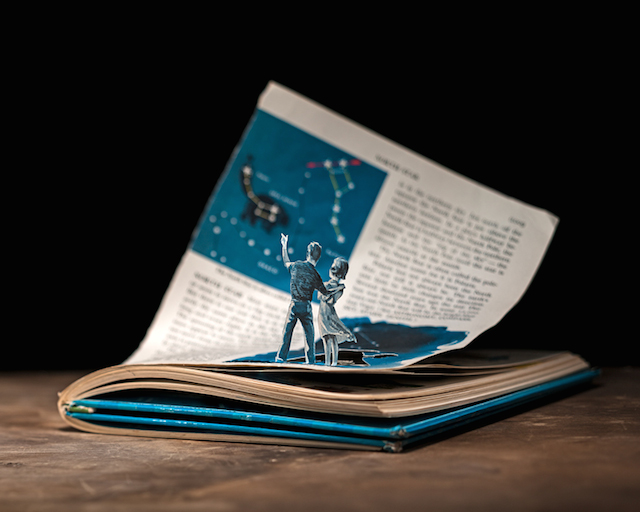
Thomas Allen’s Book-Cut Illustrations
Michigan illustrator Thomas Allen cuts pulp paperback figures into 3D tableaux, photographs them in shallow focus, and gathers the practice in his Aperture book Uncovered.
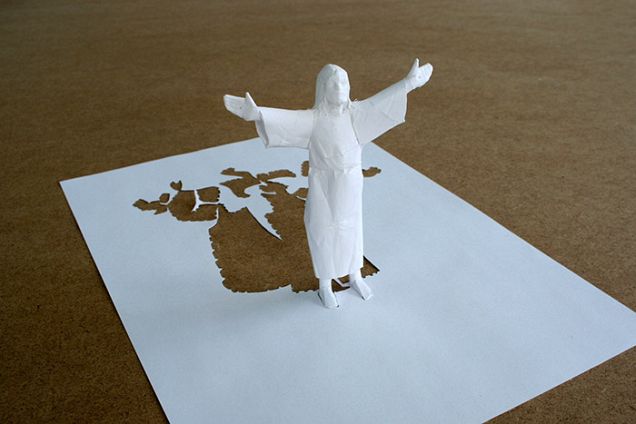
Peter Callesen’s A4 Paper-Cut Sculptures: One Sheet, Figure and Void
Danish artist Peter Callesen cuts and folds a single A4 sheet so a standing figure rises while its exact silhouette remains as an empty window in the page.
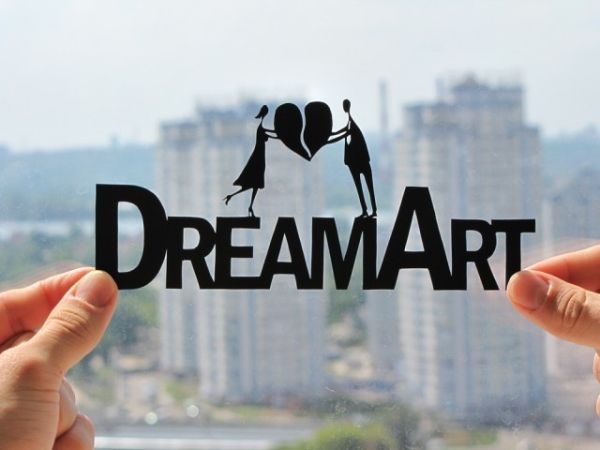
Original Handmade Papercuts by Dmytro and Iuliia
DreamPapercut’s Ukrainian duo cut interconnected silhouettes from a single sheet—nature, love motifs, and typography held together by patient knife work.